Are the Beliefs of Martyrs Who Risk Their Lives Born of Awakening or Brainwashing?
June 8, 2026 – Day 7 of Bhutan Schedule (Inspection of Bardo and Shingkhar Gewogs in Zhemgang Dzongkhag)
Hello. Today, Sunim is inspecting five project sites in Bardo Gewog and Shingkhar Gewog in Zhemgang Dzongkhag.
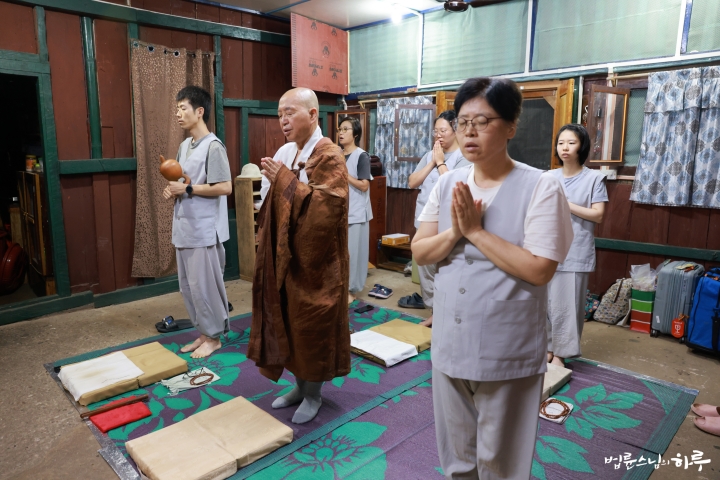
Sunim began the day at 4:30 a.m. with the Bhutanese volunteers at the Panthang JTS Center, offering morning prayers together.
After breakfast, Sunim departed the Panthang JTS Center at 7 a.m. and headed for Bardo Gewog. At 8:30 a.m., he arrived at Digala Chiwog in Bardo Gewog, the first site of the day. Three projects were underway at Digala Chiwog: road repair, new housing construction, and walkway construction.
From the car, Sunim observed the renovated road. In the past, the road leading into Digala Chiwog was uphill and overgrown with stones and weeds, making it hard to tell whether it was a mountain trail or an actual road—and quite dangerous. Today, however, the area around the road had been cleanly cleared, and a wide cement surface had been laid for vehicles, making the journey far more convenient and safe.
After surveying the repaired section of the road, Sunim moved on to the new housing construction site.
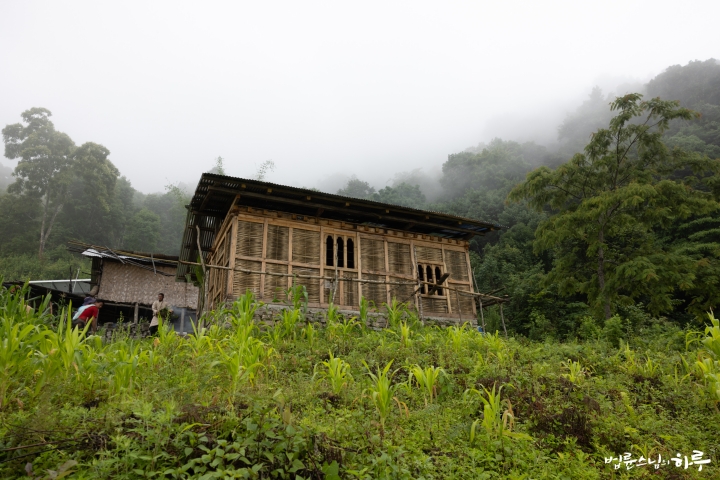
The house was still under active construction. Noticing that work on the bathroom and kitchen had not yet begun, Sunim showed the on-site technician some photos and said:
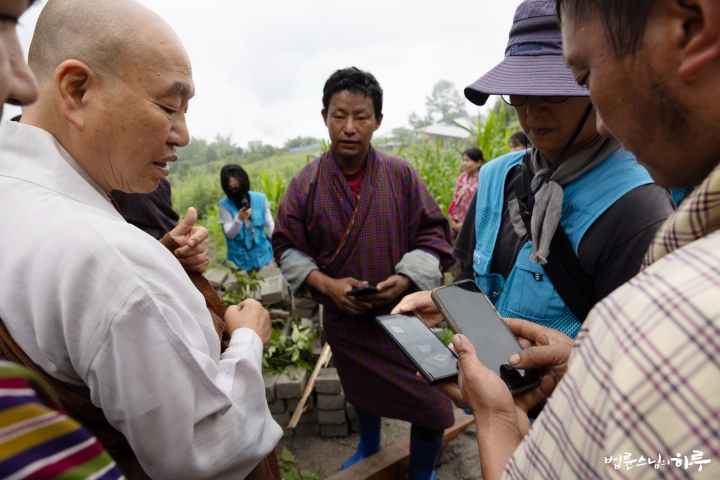
Sunim then asked the homeowner of the new house:
"Are you happy that your house is being built like this?""Yes, I am very happy. Thank you, Sunim! (laughs)"
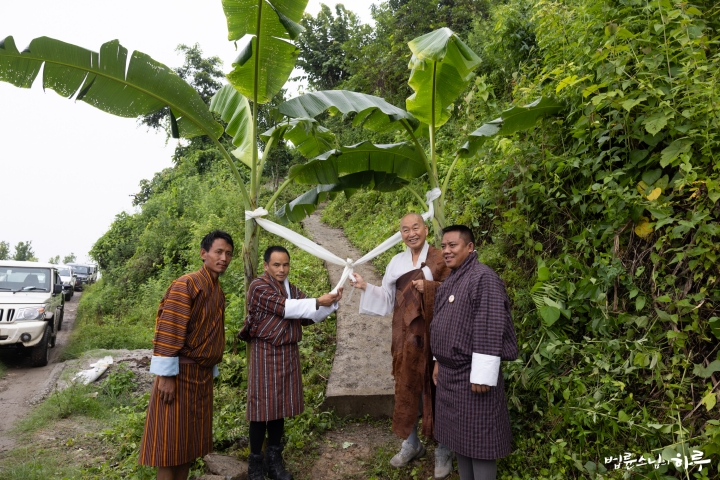
Sunim gave prayer beads to the homeowner and the carpenter, and then moved on to the walkway built by the residents of Digala village.
This is a 90-meter walkway used by villagers to travel from the residential area to the temple. Because the temple is located on steep ground, walking along the dirt path posed a risk of slipping on the steeper sections, and even the ends of the steps were sloped, making it particularly inconvenient for the elderly and children.
The villagers had pooled their efforts to lay stones and then cover them with cement, creating a clean, safe walkway with no risk of slipping.
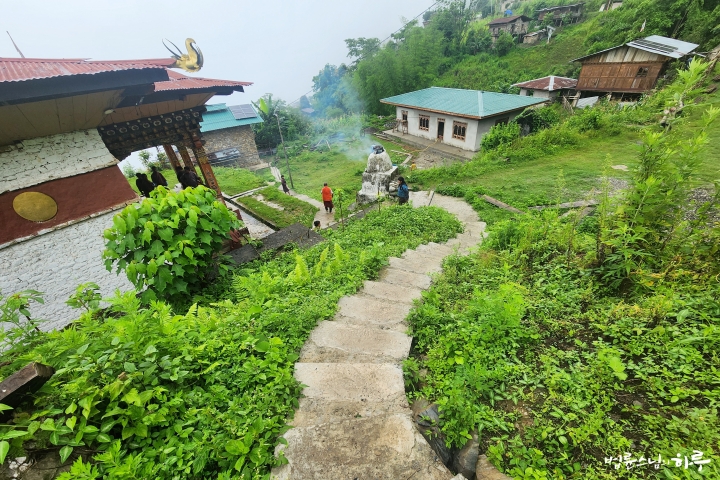
As small facilities in Digala village were being improved one by one through the hands of the residents, the entire village was gradually becoming a better place to live.
At 9:30 a.m., Sunim and his group arrived at the second site, Rangdelbi Chiwog.
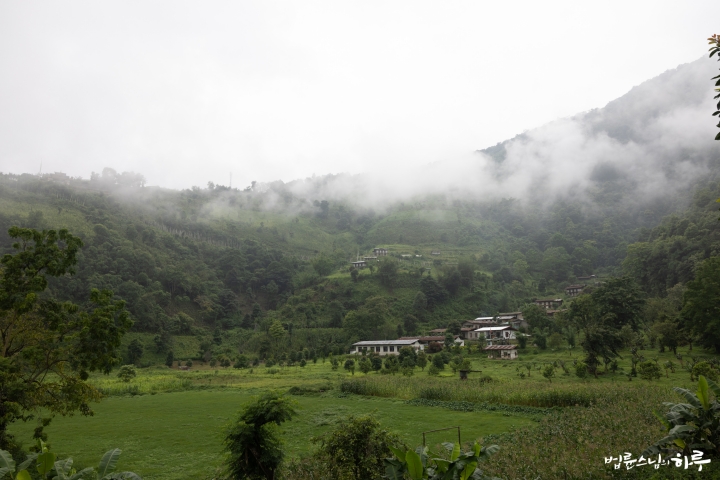
Rangdelbi Chiwog is the place where, two years ago when the pilot project began, Sunim found a small house in the village and lived there with a few Korean volunteers, personally working on the first sample house. Memories of that time naturally came to mind, making the return to Rangdelbi Chiwog feel especially warm and meaningful.
The residents of Rangdelbi Chiwog constructed a 50-meter concrete walkway and built an 82-meter drainage ditch alongside it. The path that had once become a muddy mix of dirt and wastewater with every step now had a dedicated drainage system, allowing residents to walk cleanly and making the entire village environment much more pleasant.
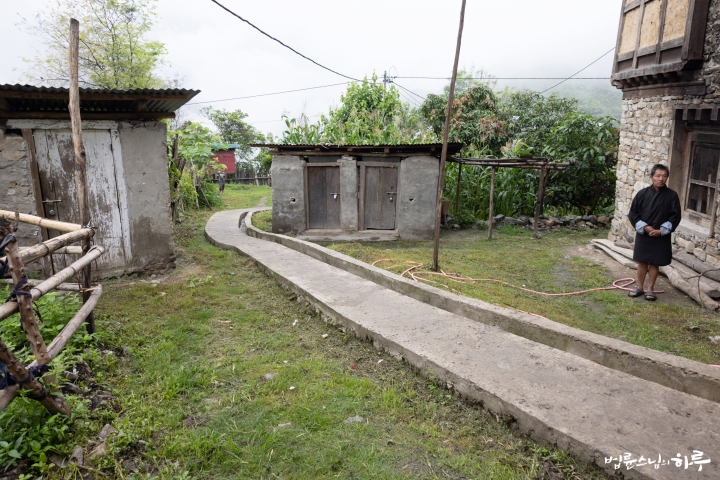
Encouraged by this achievement, the villagers of Rangdelbi asked Sunim for advice on building a walkway inside the health clinic compound next year. However, upon inspecting the area himself, Sunim saw that the inside of the health clinic was flat and covered with grass, with no real need to replace it with concrete. Instead, he proposed that the villagers extend the newly built walkway further and lengthen the drainage ditch as well.
After completing the inauguration ceremony for the Rangdelbi Chiwog walkway, Sunim and the Bhutanese volunteers moved on at 11 a.m. to the third site, Khomsar Chiwog.
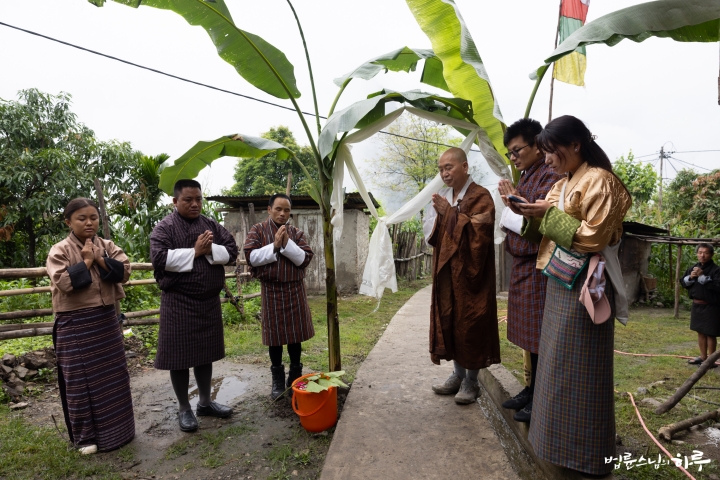
Thanks to active road improvement projects carried out by the government over the past few years, the route to Khomsar Chiwog had become much more convenient than before, allowing for a quick journey.
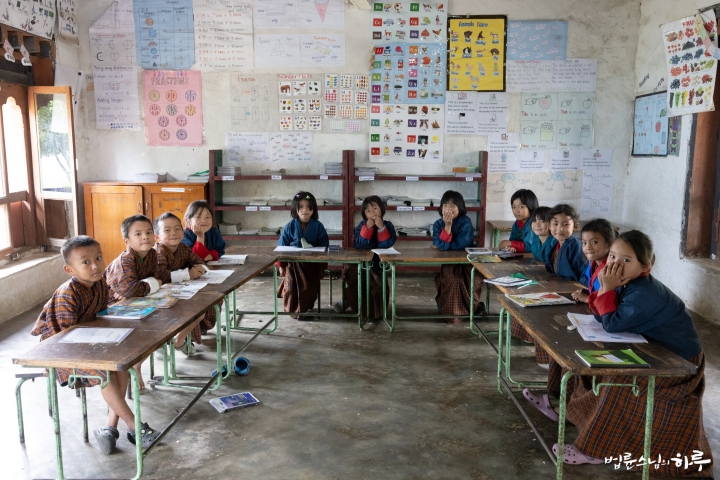
At Khomsar Chiwog, there were two projects underway: renovation of the primary school and the construction of an agricultural waterway. When they arrived at Khomsar Primary School, the principal had carefully prepared tea and momo (Bhutanese dumplings) to welcome Sunim, who had traveled such a long way.
Sunim shared the refreshments and conversed with the teachers.
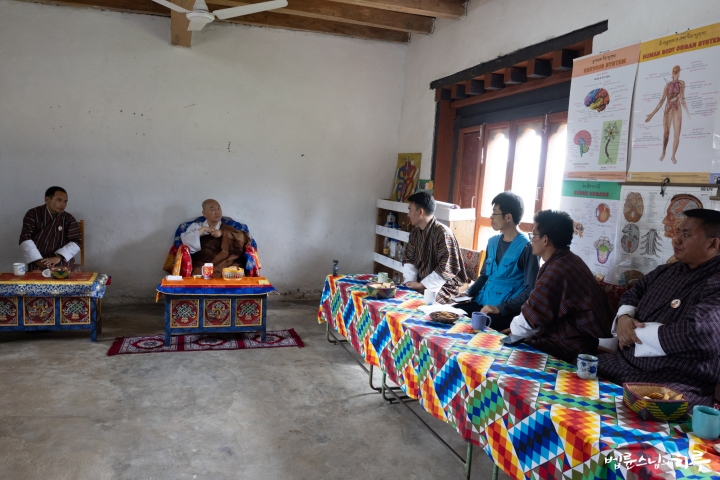
Khomsar Primary School is a fairly large school with 141 students. However, the number of toilets seemed insufficient for the school's size, so Sunim arranged for JTS project funds to build four new boys' toilets and renovate six girls' toilets. In addition, since the ceiling of the administrative office where the teachers work had cracks, repair and repainting work was also being carried out. The principal told Sunim that about 20 teachers and staff had personally participated in this JTS project.
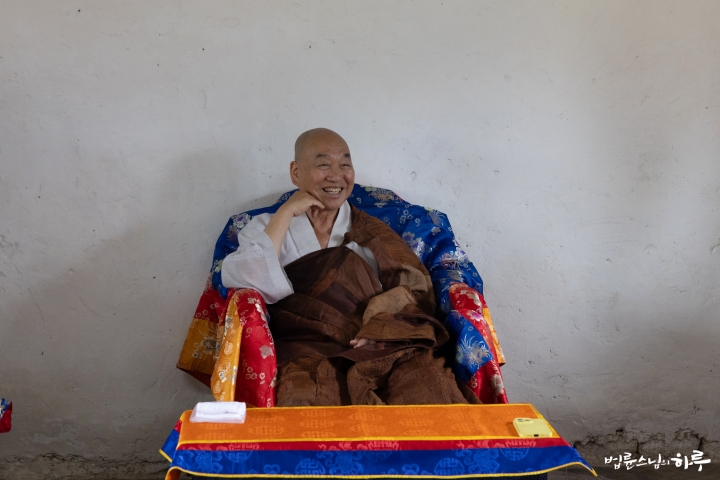
After tea, Sunim stood up to check on the progress of the construction work. Overall, the work was going well, but there were a few areas in the girls' toilets that needed improvement.
The wastewater drain outlet was located right in front of the girls' toilet door, which was likely to cause inconvenience during future use. In addition, the floor at the toilet entrance was not level, raising concerns that dirty water could pool there when it rained or when cleaning was done.
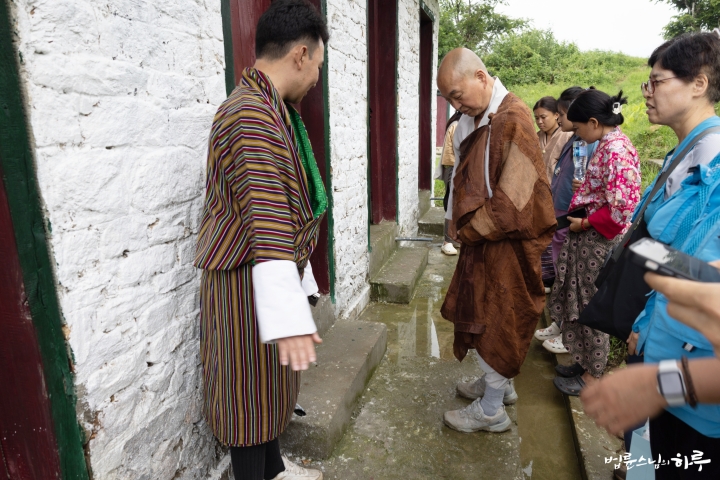
Sunim requested that the direction of the wastewater drain be redirected toward the inside of the door, and that the toilet floor be properly leveled so that, once completed, it could be used without inconvenience.
Before leaving Khomsar Primary School, Sunim shared a few words of advice with the principal and the Mangmi (deputy chief) of the gewog.
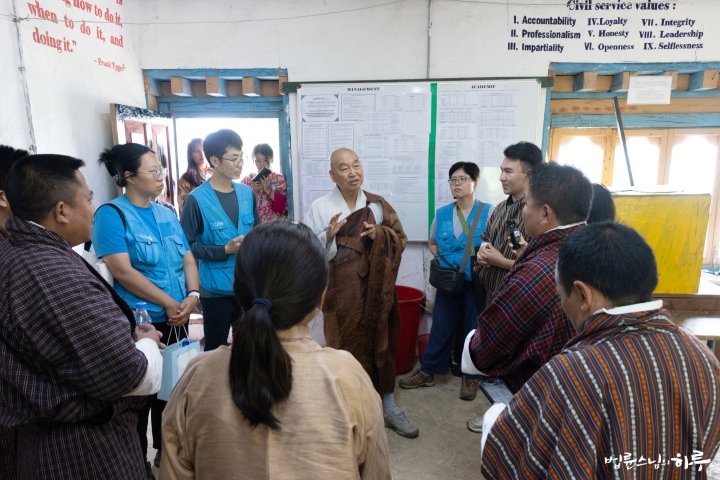
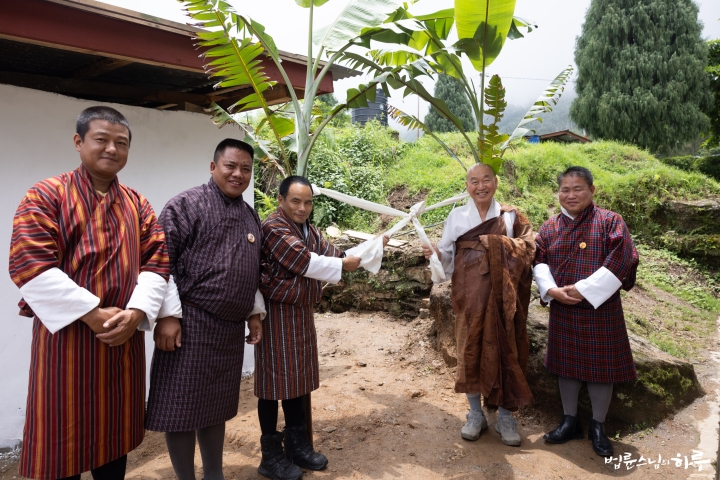
Around noon, Sunim moved to a location near the Bardo Gewog office for lunch. Over the meal, he discussed with Norbu, the Planning Officer of Zhemgang Dzongkhag, ways to reduce the poverty rate in Zhemgang.
"You mentioned that the current poverty rate in Zhemgang is 40 percent. So if we can resolve the problem of people without homes alone, the poverty rate in Zhemgang will drop significantly. To do that, we need to address the issue of homelessness across all of Zhemgang Dzongkhag. Currently, the JTS village improvement project is set up to support only the bottom 20 percent income group, but this criterion needs to be adjusted a bit. Even if someone falls slightly outside the poverty line, they should still be eligible for the project if they actually don't have a home. Unless there's some special circumstance—such as not having land—why don't we try to ensure that, through this project, there is not a single person in Zhemgang Dzongkhag without a home?"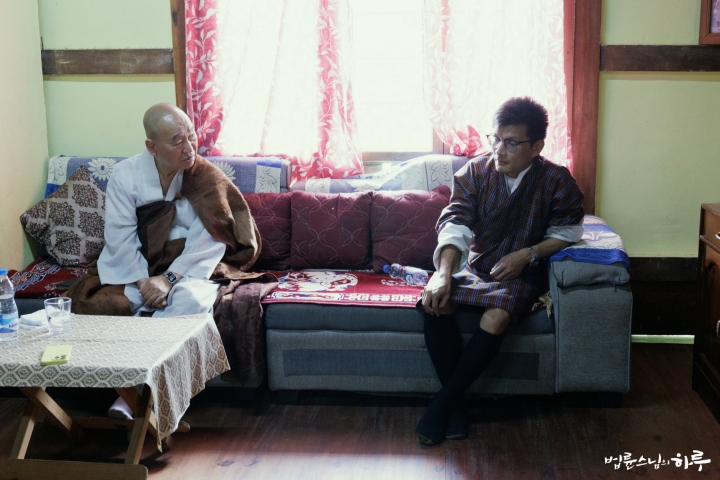
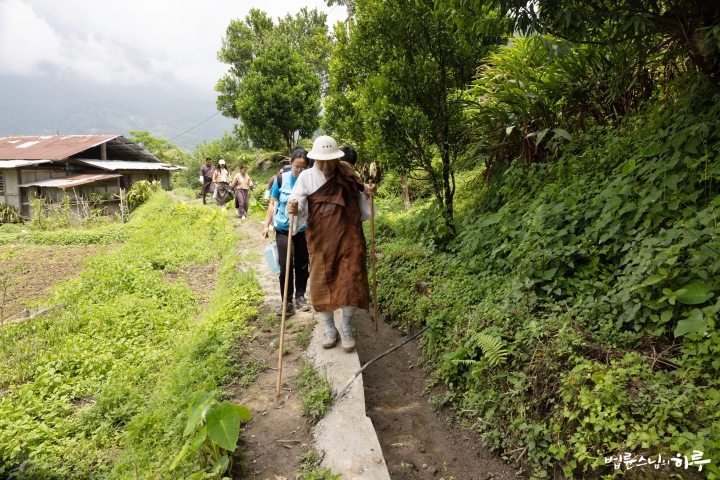
After finishing lunch, Sunim took a mountain path to inspect the irrigation channel that had been constructed in Komshar Chiwog. Along the way, Sunim spoke to the Bhutanese volunteers.
"For the remaining schedule, whether we're inspecting irrigation channels or roads, please plan the route to go from top to bottom. Going downhill is manageable, but climbing up steep slopes is exhausting (laughs)."Sunim needed two legs and two walking sticks—like a four-wheel drive vehicle—to climb the uphill path. Even then, on particularly steep sections, a practitioner had to push Sunim from behind to help him up.
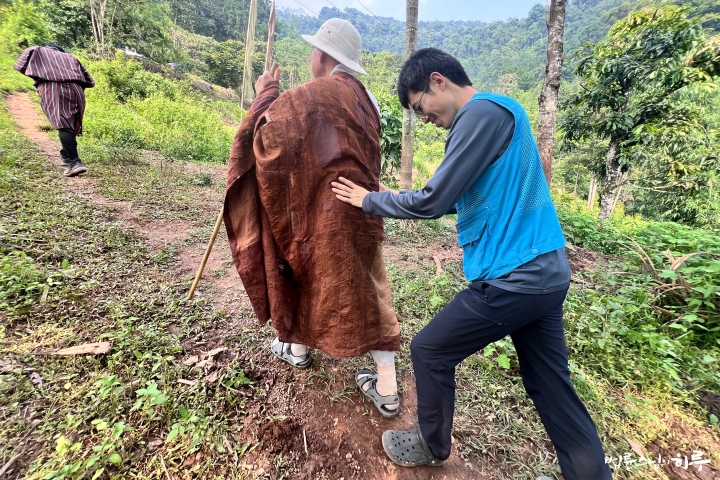
Sunim's witty joke made the accompanying volunteers laugh together, forgetting their fatigue.
The residents of Komshar Chiwog had been using a one-kilometer irrigation channel that was repaired last year through the JTS Village Improvement Project. However, water overflowed in sections where construction had not been carried out, causing damage to houses and farmland located below the channel. As a result, the residents of Komshar Chiwog came together once again to undertake additional repair work on the irrigation channel. Sunim had a brief conversation with the Tshogpa of Komshar Chiwog.
"Have you been using the irrigation channel well since the repairs last year?""Yes, we've been using it well."
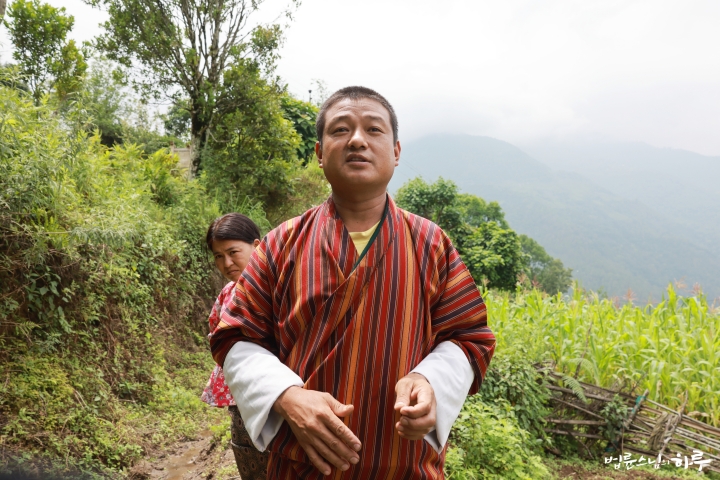
"Yes, I understand. We've been cleaning it once before the rice planting season."
"Even before rice planting, you need to clean it during the rainy season. If leaves pile up inside the channel, water can overflow during the rainy season. When problems arise while managing the channel and need urgent attention, please contact JTS right away to receive cement for the repairs."Sunim and the Bhutanese volunteers left Komshar Chiwog and headed to the fourth site, Bardo Chiwog.
At Bardo Chiwog, two housing improvement projects and a fence installation were in progress.
At the fence installation site, the wire mesh materials had not yet been delivered, so there was nothing in particular to inspect. After confirming from a distance that the fence location had been marked with wooden posts, the group moved on to the site where the housing improvement project was underway.
First, Sunim went to inspect the construction site of a new toilet that had been requested by an elderly woman living alone. The toilet construction was about 80 percent complete, with only the plumbing and septic tank work remaining. However, the bigger problem was that the entire house where the elderly woman lived needed repairs.
"The ceiling is so low that it would be uncomfortable to live in this condition. The ceiling needs to be raised, but this isn't a simple repair. One method is to dig down and lay a concrete floor to raise the ceiling height, but that would likely cause moisture problems in the room."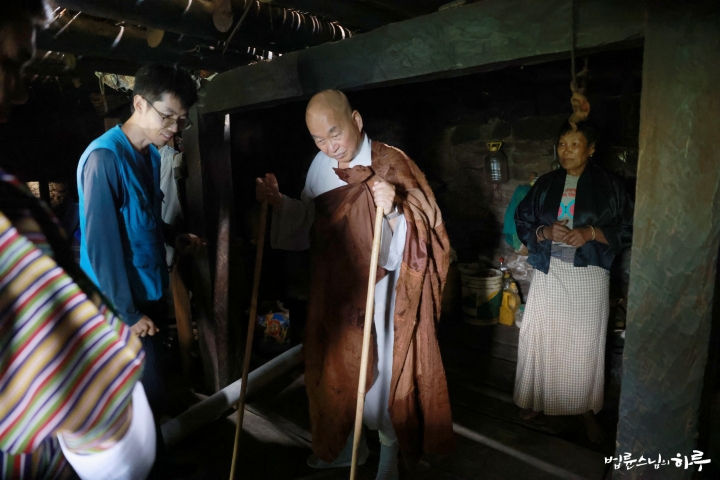
Sunim did not overlook even the small inconveniences he observed in the lives of residents participating in the JTS housing improvement project. Sunim carefully explained to the elderly homeowner that if she wanted comprehensive house repairs, she could apply to JTS and receive support including roofing materials, before heading to the next house.
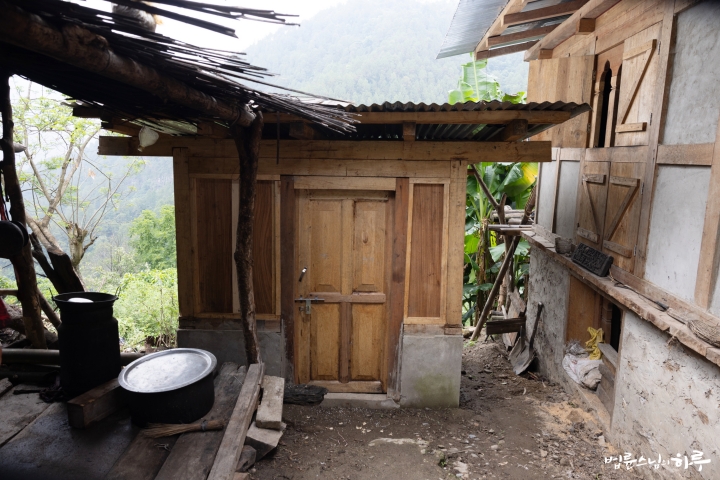
This house had also just had a new toilet built, but it was a place where comprehensive repairs had already been completed last year as a pilot project. Sunim was well aware of this household's situation, and today was his third visit. A family had been caring for an uncle who was hard of hearing, and that uncle had now grown old and become an elderly grandfather.
"This house wasn't originally on the support list, but thanks to the merit of caring for an uncle with disabilities for so long, they've received this blessing. (laughs) Thank you for taking such good care of the elder. I've already visited this house three times. (laughs)"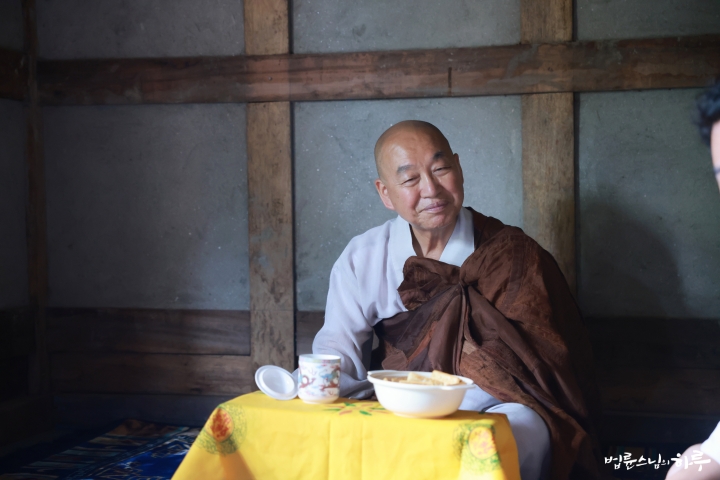
"Thank you for your support, Sunim!"
The homeowner offered cheese, butter, and rice to Sunim as offerings.
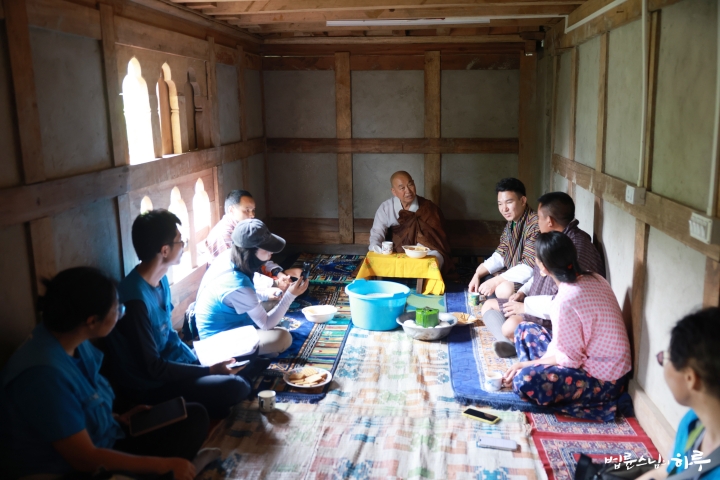
Sunim departed from Bardo Gewog and headed to the fifth site and the final inspection location of the day, Shingkhar Gewog.
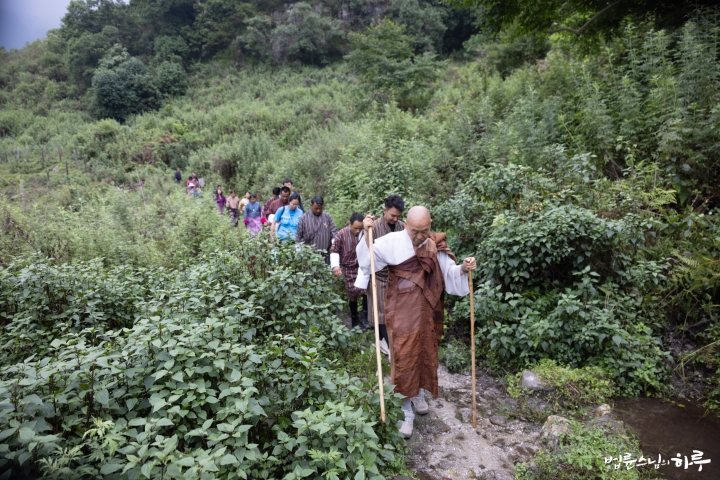
At 4 p.m., Sunim arrived at Shingkhar Chiwog in Shingkhar Gewog. Sunim and the Bhutanese volunteers toured the fence the villagers had installed. Across a vast area totaling 19 acres, a 5.2-kilometer fence stretched as far as the eye could see. Since the wire mesh was strung in seven layers, the total length of the wire alone exceeded 36 kilometers. Sunim asked the villagers,
"What kinds of animals usually come into this area?""Wild boars, deer, and monkeys come in."
"Wild boars dig under fences, so did you install the wire mesh tightly at the bottom to keep them out?""Yes."
"Let's observe for about a year to see which animals come in through which sections, and then reinforce accordingly. Were you satisfied with the fence installation?""Yes, everyone is delighted. Buying and installing wire mesh is very expensive, so it's not easy for individuals to do on their own. Thank you, Sunim!"
Since it was impossible to tour the entire area, Sunim recited prayers from where he stood and concluded the completion ceremony.
"I pray that, with the protection of the Dharma-protecting deities (護法善神), this village will be free from damage caused by animals."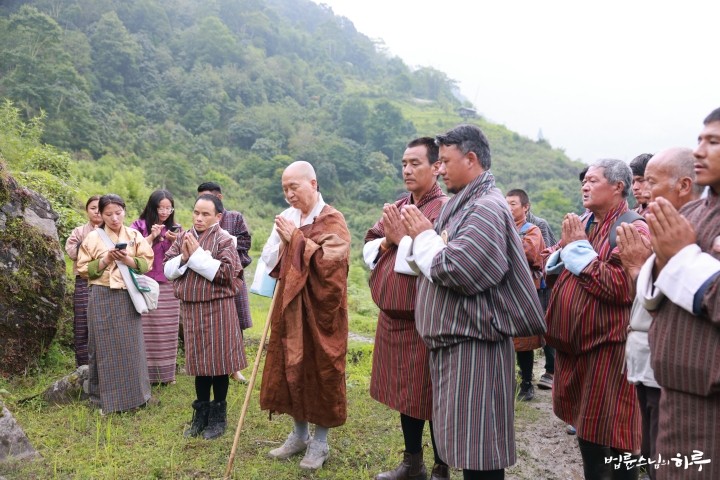
Sunim took a moment to talk with the residents of Shingkhar Chiwog about the JTS project, checking whether there was anything else the villagers needed and explaining what areas could be supported through the project.
"You've worked hard on the fence installation. Did you do it yourselves, or did you hire workers?""We formed a group and did it ourselves."
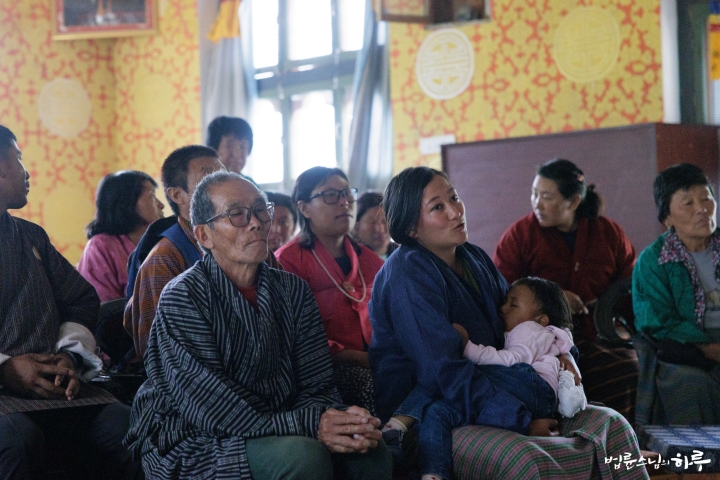
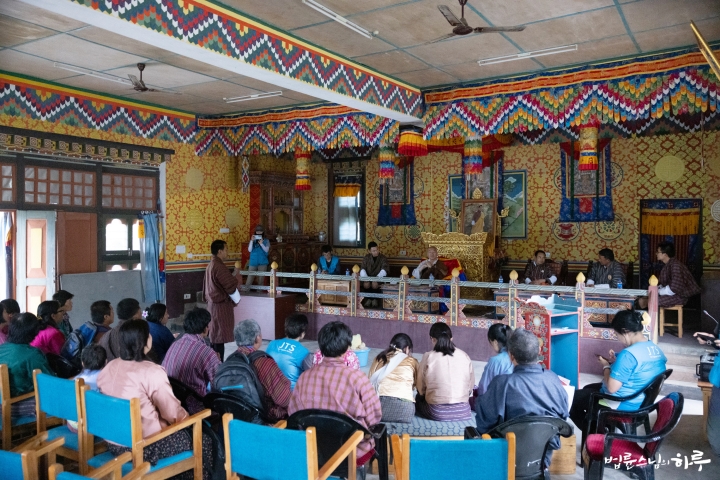
Sunim completed all of today's scheduled activities and returned to his lodging around 5:30 PM. After having tea and conversing with the Bhutanese volunteers at the lodging, he skipped dinner and took an early rest, concluding the day's work.
Tomorrow, Sunim plans to travel to Nangkor Gewog in Zhemgang District to inspect the project sites.
Since there was no Dharma talk today, this post concludes with a conversation from the Dharma Q&A held at Kyungpook National University last April.
Were the Martyrs' Life-Risking Convictions Born of Self-Awareness or Indoctrination?
"There's a saying, 'To understand a person, look at the environment in which they were raised.' By observing their family background, friendships, and social environment, you can understand a person to a certain extent. Since human beings are historical and social beings, in most cases they are greatly influenced by the environment surrounding them. There's a counterargument to this, which is that some people grow up entirely differently even in the same environment. This is because each person has different innate characteristics. In Buddhism, these individual characteristics are called 'cause (因),' and the conditions of the era and society are called 'condition (緣).' If we compare individual characteristics to a soybean seed, the seed must be planted in a field to sprout. If you suspend it in the air without planting it in the field, it will never sprout no matter how much time passes. In this way, a result emerges only when cause (因) and condition (緣) come together. If those two martyrs had been born into royal families or wealthy households rather than during the Japanese colonial period or in harsh labor conditions, they likely would not have lived such lives. In this way, a person's life can be seen as the result of both the influence of the times and their individual characteristics working together. Just because people are born in the same era doesn't mean they all live the same lives. This is because each person has unique characteristics. Conversely, even people with the same characteristics will inevitably live different lives depending on the era in which they are born. This is because no individual can escape the influence of their times. So the answer to your question is that it can be seen as the result of a person's characteristics and the conditions given to them interlocking and working together. Just as a seed must meet the field to sprout and bear fruit, we can say that both personal awareness and the circumstances of the times influenced them together.""Throughout history, there have been people like the martyr Jeon Tae-il and Yu Gwan-sun who risked their lives for their convictions. Was this driven by their personal awareness, or was it the result of indoctrination by their era or a particular group? If it was due to indoctrination, I wonder whether their sacrifice still holds value."
"Thank you. May I ask just one more question? Then how should we view these two martyrs' cases? Was it because they had characteristics that made them easily indoctrinated, or did they voluntarily develop such convictions through reflection on their times? Or was it both?"
"As you mentioned, both cases exist. For example, in some Muslim schools in the Middle East, children who grow up under strong religious influence from a young age sometimes become warriors as adults. Those convictions were formed under such conditions, and from our perspective, it may look like a form of indoctrination. We can see similar cases today in North Korea or some religious groups. Looking at it this way, one might even question whether the Buddha's renunciation was also the result of some kind of indoctrination. However, the Buddha was someone who awakened on his own and lived with an unwavering center. Similarly, among independence activists who endured self-sacrifice, there may have been those who acted out of indoctrination and those who acted out of self-awareness. So we can say that both cases exist.""Is there a way to know this for oneself?"
"While it may be difficult to know about other people, you can know about yourself to a certain extent. If you think, 'I will fight so that I can go to a good place after I die,' that is likely the influence of indoctrination. However, if you feel, 'I'm not trying to go to heaven, nor am I trying to become a Buddha. It is right to walk this path even at the risk of death,' that has a different quality. In that case, you may not even consider it a sacrifice. Without seeking any reward or blessing, it may simply feel natural to live that way. This case would be closer to the perspective of self-awareness. Although it may seem complicated, if you look within yourself, even just a little, you can tell which it is.""Yes, thank you."
"