How Does a Judging Mind Differ From an Understanding Mind?
Jun 2, 2025 – Arrival in Bhutan, Day 1 of Bhutan Visit
Today, Sunim’s schedule involves transiting through Bangkok to enter Bhutan and then traveling to Trongsa, where the ‘JTS Sustainable Development Project’ is currently underway.

What Is the JTS Sustainable Development Project?
In 2024, Sunim proposed a ‘Sustainable Development Project’ to the Bhutanese government. The aim is to realize in Bhutan a model of living happily with less consumption, instead of pursuing indiscriminate material development in this era of climate crisis. The goal is to improve the actual living conditions of residents in underdeveloped regions while preserving the values of GNH (Gross National Happiness), which Bhutan upholds as its national ideology. The development covers seven areas: improving housing conditions, establishing a foundation for self-sufficient production, supporting education and healthcare, repairing basic infrastructure, and preserving traditional culture and the natural environment. The project is carried out through a cooperative arrangement in which JTS provides materials, the Bhutanese government provides technical personnel, and local residents provide labor. Through a field survey in early 2024, the two most vulnerable regions, Zhemgang and Trongsa, were selected as project sites. In April of that year, the first pilot project MOU (Memorandum of Understanding) was signed and pilot projects began, supporting 27 housing improvements, repairs to 7 schools, the installation of drinking water facilities, roads, and irrigation channels, and 106 hearing aids. Based on these achievements, the main project MOU was signed on June 23, 2025, launching a full-scale project that will invest 5 million dollars over five years. Sunim’s current visit to Bhutan comes at the one-year mark since the main project began.
Sunim’s Day Begins in Bhutan
Sunim arrived at Bangkok Airport at 1 a.m. on June 2. Hwang Soyeon (황소연) and her husband Kunzang, Jungto practitioners active in Bangkok, came to greet Sunim at the airport.
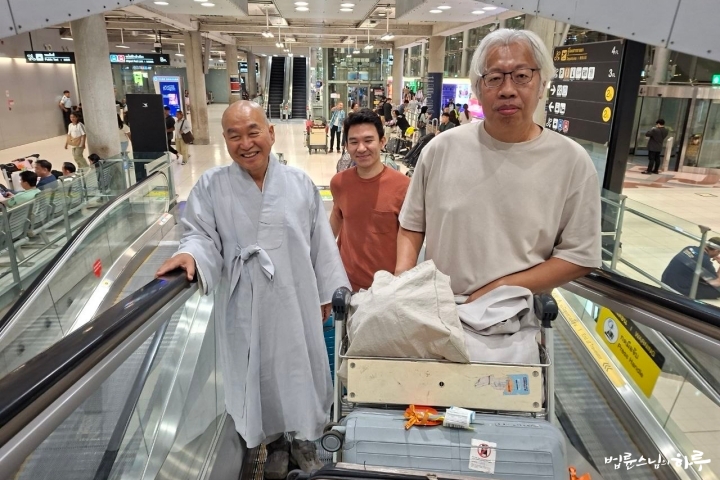
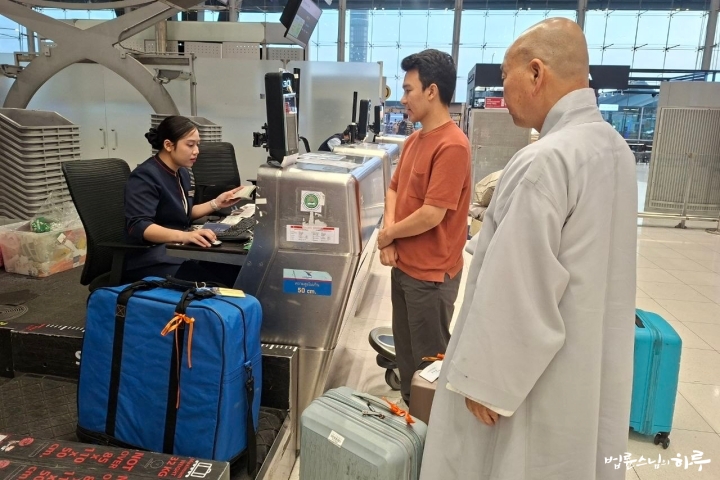
Sunim also met Rinchen, who will be serving as interpreter throughout this Bhutan trip, at Bangkok Airport. Together, they moved to Hwang Soyeon’s home for a brief rest. After proofreading a manuscript and completing his morning prayer, Sunim returned to Bangkok Airport. He went through check-in procedures to board the flight to Bhutan, scheduled to depart at 7:30 a.m.
At 11 a.m. local time, the plane arrived at Paro Airport about 30 minutes earlier than scheduled. At the airport, Sunim met Dr. Tashi Zangmo, Executive Director of the BNF (Bhutan Nuns Foundation).

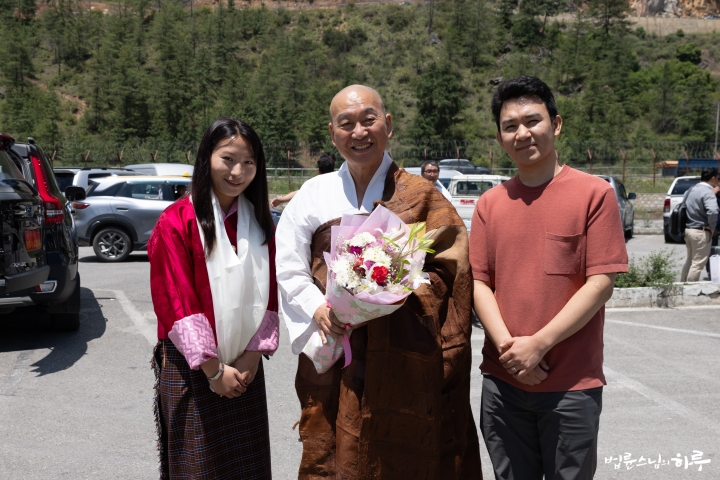
After collecting the luggage and exiting the arrival hall, Tshewang, the project coordinator from the Bhutanese Cabinet, was there to warmly welcome Sunim. Tshewang presented Sunim with a welcoming bouquet of flowers.
Contrary to expectations that Bhutan would be rainy and chilly, the sun was shining brightly and it was quite hot. After organizing the luggage and loading it into the car, the group departed for today’s destination, Trongsa, at 11:30 a.m.
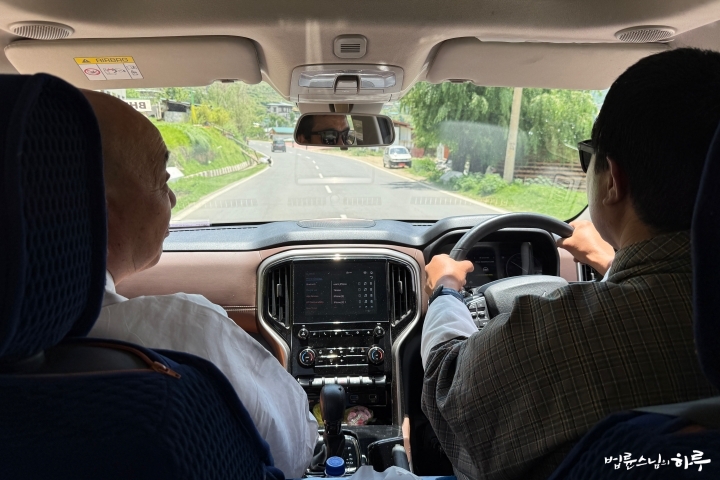
As they began the journey, Sunim greeted the driver who would be driving for him throughout this trip. The driver, Nachu, said he has worked as a driver for the Bhutanese Cabinet for 16 years.
“The roads are rough. Will you be okay?”“Yes, I’ll be fine. I once accompanied the Prime Minister to Zhemgang.”
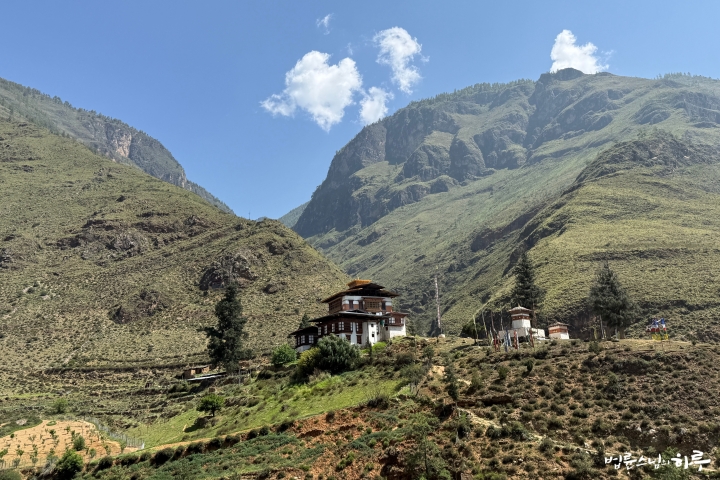
Due to Bhutan’s mountainous terrain, there are many narrow, winding roads, so travel time is quite long relative to the distance. In particular, the road to Zhemgang is rough, and most roads leading into villages are unpaved and bumpy, requiring the driver to be especially careful for safe driving.
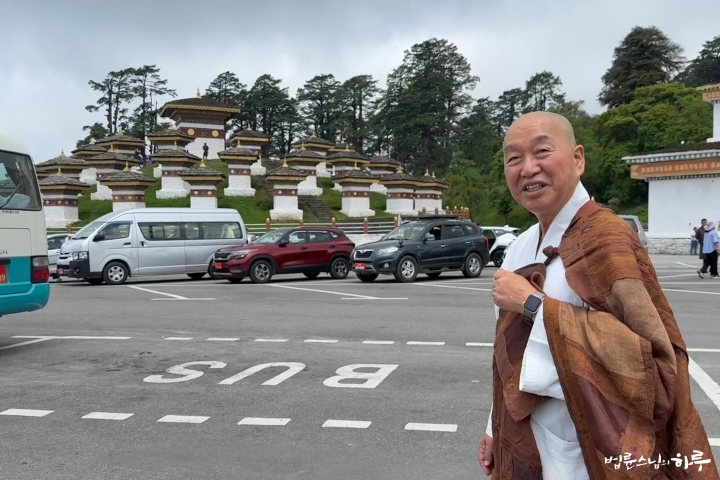
At 1 p.m., they stopped briefly at Dochula. At 3,000 meters of altitude, the wind at Dochula was cool. There were many Indians around. In northern India, May and June are the hottest months, with many days exceeding 40 degrees Celsius, so this is the season when people travel to cooler regions to escape the heat. June is the start of the monsoon season in India. Humidity levels are usually very high, which can make the weather feel significantly hotter than the actual temperature. Indian tourists who had come to Bhutan to escape the heat could easily be seen everywhere.
They got back into the car and continued on their way. Last year, heavy rains caused many landslides and severely damaged the roads, but the roads had recently been repaved, so they were in excellent condition.
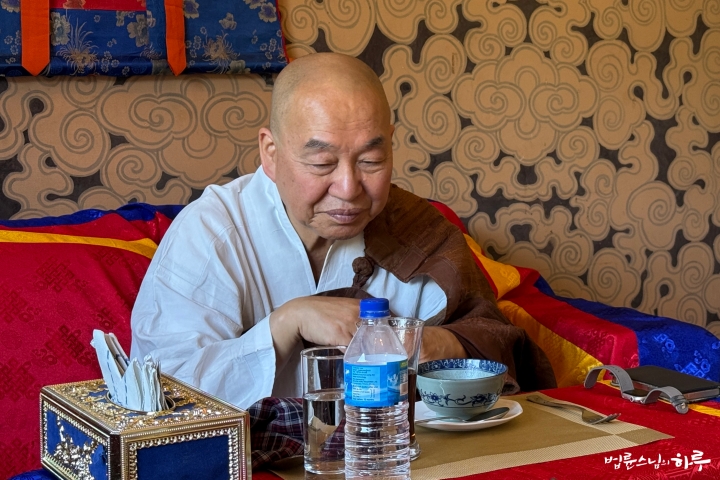
At 1:40 p.m., they arrived at a restaurant in Lobesa for lunch. Sunim had the lunch prepared by the Chief Secretary of the Bhutanese Cabinet and rested for a while, chatting with the group. At 2:40 p.m., they got back into the car and continued on to Trongsa.
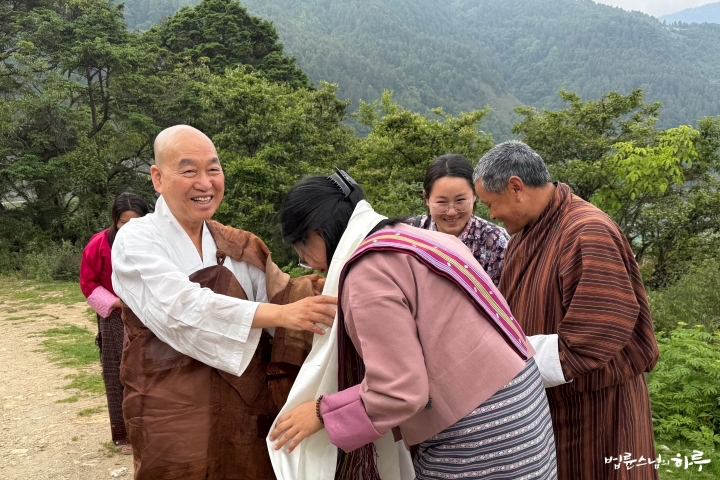
At 4:30 p.m., they arrived at Chendebji Chiwog in Tangsibji Gewog, Trongsa. JTS Korean volunteers and Tangsibji Gewog officials warmly welcomed Sunim.
Chendebji village had repeatedly requested the installation of a pedestrian walkway, but since the slope was not steep, it did not meet JTS’s support criteria. This area was officially designated as a Heritage Village in 2003, where restrictions on changing the exterior of houses are in place to preserve traditional Bhutanese architecture and promote cultural tourism. Therefore, there were concerns about installing a cement walkway, and Sunim’s inspection was needed. That is why this site was visited first.
The village path had already been laid with stones so that people could walk on it. However, the village’s request was to pave the walkway with cement. After walking along the stone walkway and looking around the village, Sunim said:
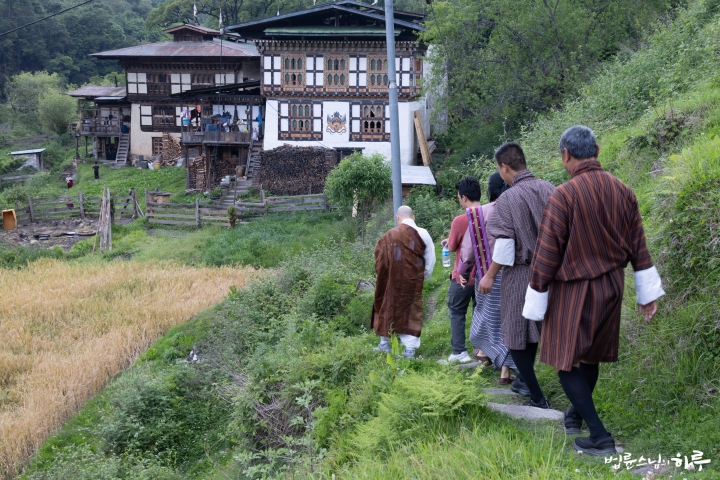
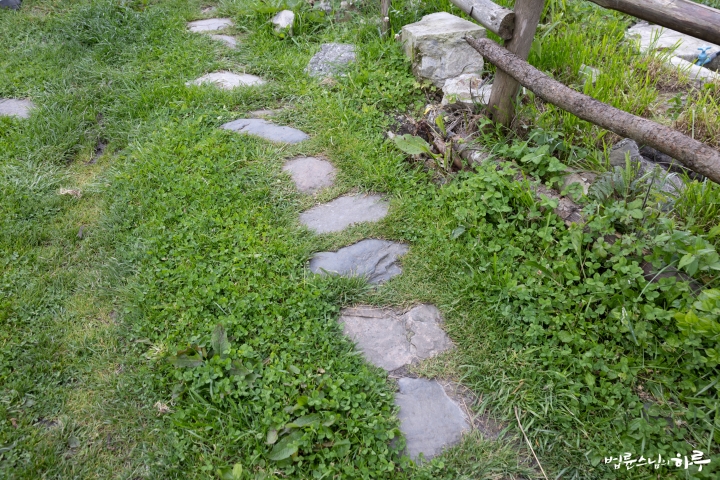
Sunim drew pictures to make it easy for the Tshogpa (head of the Chiwog, equivalent to a village head in Korea) and the people to understand.
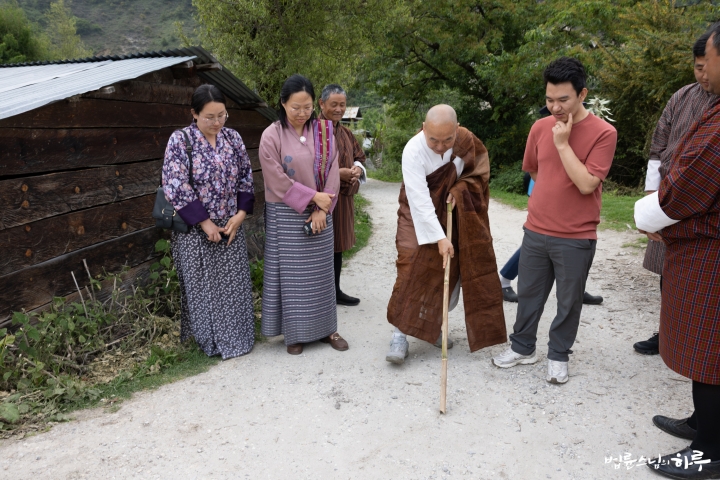
After looking around and talking with the group, it became clear that the project was not so much something the villagers wanted, but rather one desired by the Governor and the village head who wanted to develop the area as a cultural heritage village. The villagers said they were not enthusiastic about the project because the cement walkway would not connect to their own homes. Sunim asked the Tshogpa:
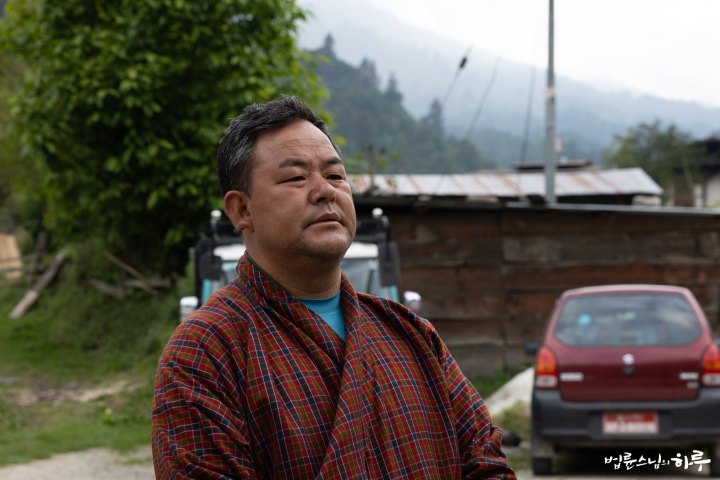
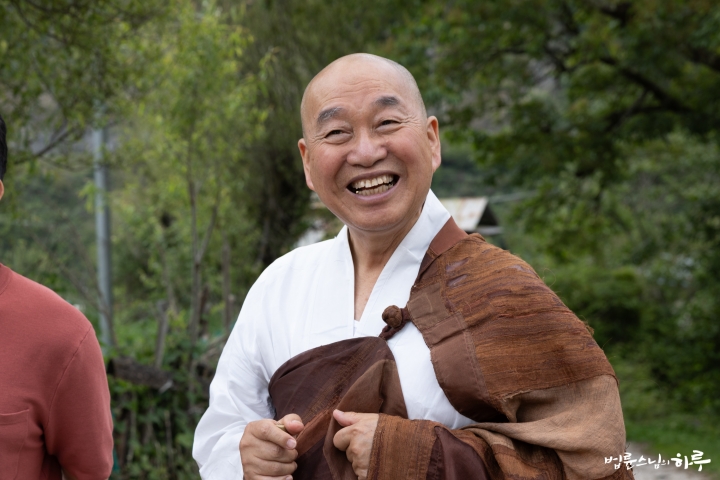
“They think it’s necessary. They even put their stamps on the agreement to work on it. We held 4 or 5 meetings. The Gup (head of the Gewog, equivalent to a township head in Korea) came and persuaded them that it would be good to do it.”
“If they don’t want it themselves, why are you trying to proceed with the project? (Laughs) Since the villagers think the main walkway isn’t really necessary for them, it won’t be easy to get them to participate. If everyone builds the 250-meter main walkway together, and then individuals want to build walkways from the main walkway to their own houses, we will support them with materials. That way, the villagers will be able to participate more actively.”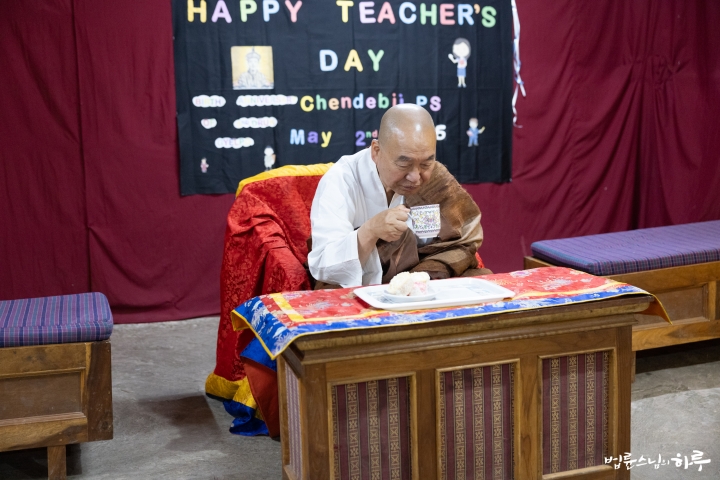
After the site visit, Chendebji Elementary School prepared tea, and the group caught their breath while drinking tea. After tea, they began moving again toward Trongsa.
At 6:20 p.m., they arrived at the Trongsa Residential Administrative Center. The Governor of Trongsa and his group were waiting for Sunim. They welcomed Sunim with a bouquet of flowers. After the welcome ceremony, they had tea at the Residential Administrative Center and conversed with the Governor.
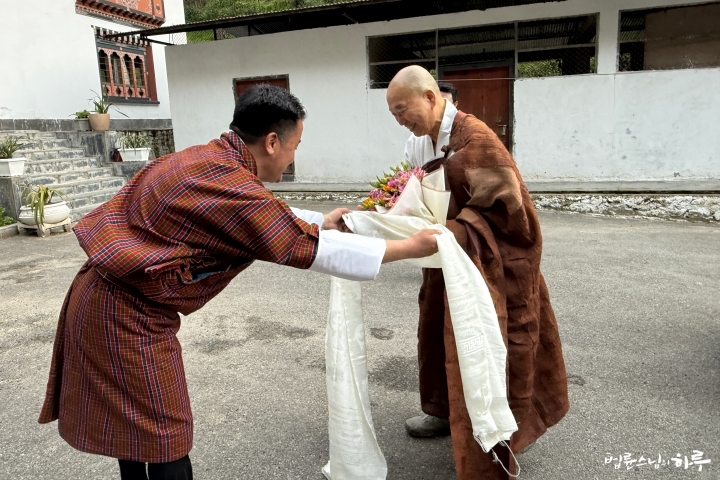
In addition to the Governor, the Deputy Governor, the newly appointed judge, and the chief of police also joined them. Over tea, Sunim discussed the progress of the project with the Trongsa Governor. The Governor said:
“Sunim, I heard your schedule this time is extremely tight.”
“Yes. I’ve heard there are 108 places to visit. Since the residents have worked sincerely on the projects, I need to look around and encourage them.”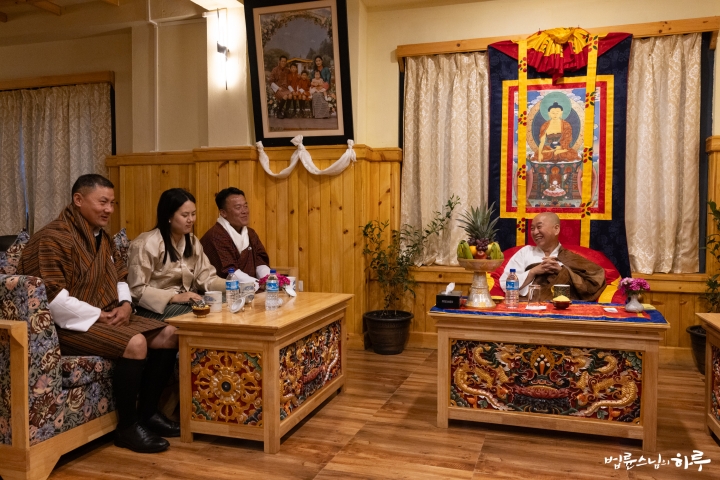
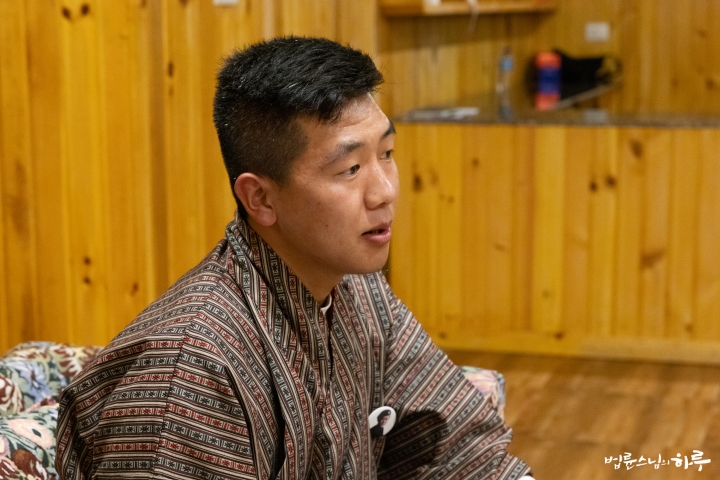
Sunim asked the planning officer:
“Are the residents finding the project difficult? Or are they enjoying it?”“At first, when Sunim said you would support them, people were enthusiastic, but when they actually had to use their own bodies to do the work, they found it difficult. However, now I think they understand well that doing it this way benefits them. But our concern is that Sunim has come from so far away, and we worry whether what we’ve done is good enough.”
Besides this, they discussed various pending issues, including the road project in Nabji of Korphu Gewog and Korphu Chiwog.
The Governor said:
“Since JTS provides materials for the Sustainable Development Project and government officials also participate in this project, quite a few residents thought that everything would be provided for them, just as the government usually does. When we told them that for the main project, residents themselves have to participate through their own labor, some canceled the project. However, I think the government’s support method will inevitably have to follow the JTS approach in the future. The fence installation project currently being carried out by the government is also only providing materials. I think this model will become more widely adopted.”
Sunim continued:
“Public works are done by the government, but making irrigation channels, putting up fences, and building houses are personal matters, so people have to do them themselves. Providing materials and having people participate and build things themselves is what fosters self-reliance. The project must be carried out according to these standards. As in Nabji, bringing water from a distant place is something the government does, but channeling that water into each individual’s rice field is a personal matter, so the villagers themselves must do it. Even if there is a budget, it is necessary to have them contribute and participate themselves. Projects that are accomplished entirely through government support don’t yield economic returns commensurate with the investment.”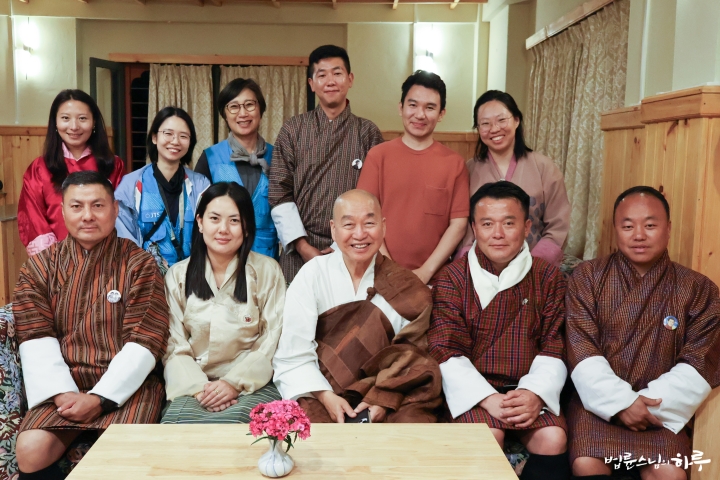
The Trongsa Dzongdag, who visited Korea in late March and early April, had experienced Korean food culture during his trip, and so he prepared dinner with vegetable side dishes that were neither spicy nor oily.

After dinner, Sunim took a tour around the community administration center. The Dzongdag had previously consulted one of the JTS volunteers, who he knew had many ideas about interior design, when remodeling the community administration center. A ping-pong table was set up on the first floor, so Sunim tried playing table tennis as well.
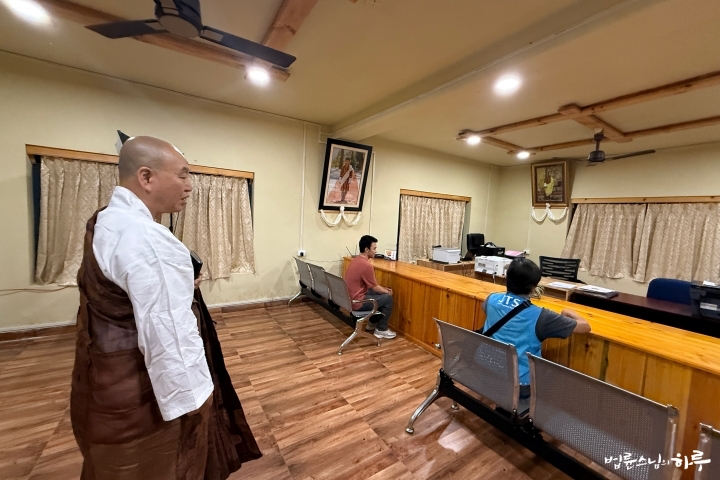
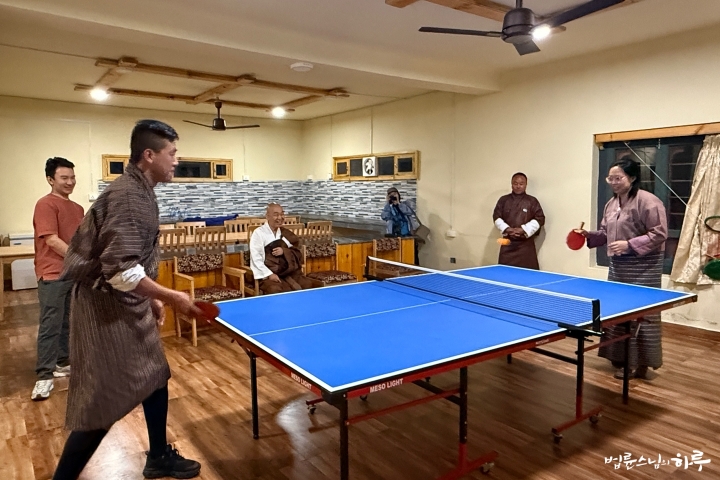
After leaving the community administration center, Sunim moved to the Trongsa JTS Center, where he would stay for the night. This place serves as both lodging and an office for volunteers while projects are underway in Trongsa Dzongkhag. It was Sunim’s first visit to this center. To commemorate his first visit, he was asked to perform a Bhutanese-style blessing by sprinkling water throughout the center, and Sunim performed the blessing with sincerity. After the blessing, the Korean volunteers offered three bows to Sunim.
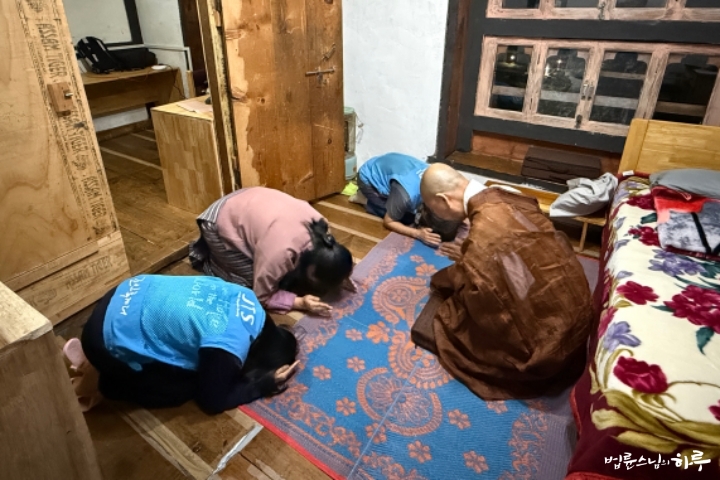
Sunim received a briefing on tomorrow’s schedule, proofread some manuscripts, and concluded his day. Tomorrow, he plans to check on the progress of the Trongsa regional projects and travel to Zhemgang.
Since there was no Dharma talk today, this post concludes with a Dharma Q&A from the “Happy Conversations” lecture held in Busan last April.
How Is a Judging Mind Different from an Understanding Mind?
“I’ve been gaining much wisdom by reflecting on my life through Sunim’s Dharma Q&A. I run a barber shop in Busan. Since I meet various people every day, at some point I started to think, just by looking at someone’s choices or attitudes, ‘That person is going to have a hard time later on.’ And in many cases, as time passed, things turned out as I had predicted. Whenever this happened, instead of thinking ‘They are simply different from me,’ I kept evaluating their choices and attitudes. What’s more confusing is that when those people did end up struggling as I had expected, I also felt uncomfortable. I’m not sure whether this comes from a place of caring for the other person, or from trying to control them based on my own standards. When I can see another person’s life to some extent, is it right to simply accept it as ‘difference’? Or is it natural to judge based on what I see? What kind of practice do I need to let go of these judgments and look at others with ease? How can I distinguish whether this mind that judges other people’s lives is truly for their sake, or whether it comes from a desire to control them based on my own standards?”
“Are you a saint like Jesus or the Buddha?”“No, I’m not.”
“Then why do you say you’re doing it for others? Fundamentally, people only know themselves. That’s what humans are. Even when we say we’re acting for others, it’s ultimately for ourselves, and everyone lives only from their own perspective. If you understand this clearly, there’s nothing left to ask.”“I see.” (Laughter from the audience)
“If I like my wife, that’s my own desire. Liking or disliking my wife is simply my own emotion. If you truly want to treat someone like a saint would, what matters is not having a feeling of liking but having a mind of understanding. When you have an understanding mind, there’s no hatred or resentment, and no anger arises. Instead, the desire to help arises. But the mind of liking is different. If the other person doesn’t return your affection in proportion to how much you like them, you immediately come to hate them and want revenge. There was a young woman who married a man who loved her dearly. He was so devoted that he would give up everything for his wife, so she decided to live with him. Then one day, a male friend she had known since her school days came to visit her. It wasn’t a romantic relationship—just an old acquaintance. But the friend who came along had to leave suddenly to take an urgent call, leaving the two of them alone to talk a little longer. At that very moment, the husband came home. In this situation, does the husband get angry more because he loves his wife, or less because he doesn’t love her?”“He gets angry more because he loves her.”
“That’s right. The husband flew into a rage. As you can see, the mind of liking is that dangerous. I also become cautious when someone says, ‘Sunim, I really like you!’ People who don’t like me have no reason to hate me or be disappointed in me. On the contrary, those who say enthusiastically, ‘I’m your fan, Sunim!’ are more likely to suddenly turn into enemies if I don’t take pictures the way they want. Whether you like someone or dislike someone, there’s no need to ask—those feelings are all self-centered. The compassion that the Buddha or Jesus spoke of is not about liking someone. It’s about understanding. ‘Ah, that person is angry because of this,’ ‘That person is acting that way because of that!’—it’s about cultivating this kind of understanding mind. Even if you can’t fully understand, at the very least you should know how to respect the other person. Respect means acknowledging the other person, who is different from you, just as they are. It means acknowledging, ‘That’s how that person is.’ Respect comes first, and then understanding. When you cultivate an understanding mind that says, ‘That person had no choice but to be that way,’ no feelings of hatred arise. Let’s say there’s a man and a woman who like each other. When there is an understanding mind, you can look at the other person’s circumstances and wait for them. When the other person seems to be struggling, you want to help. But when there’s only the mind of liking, that’s not the case. You want to get married quickly, and when things don’t go your way, you become irritated instead. So how would you describe your case?”“It’s selfish and self-centered.”
“I’m not saying that’s bad. I’m just saying that’s how the human mind naturally is. When someone asks me, ‘Please congratulate us on our marriage,’ I don’t readily say, ‘Congratulations on your marriage.’ Whether this marriage is truly something to celebrate or not can only be known with the passage of time. Because there are many cases where people happily get married now, but soon become enemies and regret it. When we use the word ‘love,’ we may simply call the feeling of liking someone love. But if you look deeply into the word love, in the end you come face to face with your own desire that lies behind it. When we make friends, we value whether the person has loyalty. When looking for a business partner, we value whether they have credibility. But what about a marriage partner? Out of various qualities, do we look at just one important one, or do we examine all ten? Most people examine all ten. Their looks and personality, their family background and education all have to be good. Why do we scrutinize all these conditions? It’s because we want to hold on to one person and benefit from them for the rest of our lives. So it’s no wonder it’s difficult to find a spouse. ‘Love at first sight’ means that the person seems to possess all the various conditions I want at once. That’s why such relationships rarely last long. The reason why so-called ‘weddings of the century’ mostly end in failure is the same. In such relationships, there is no mind that truly understands the other person. In the end, a mind that acknowledges, respects, and understands the other person—that is what is most precious in human relationships. However, failing to do so doesn’t make you a bad person. The reason all kinds of conflicts arise from everything being entangled in human society is that most people don’t first cultivate a mind of understanding the other person. Looking at a customer, you might think, ‘Judging by his manner, things won’t go well for him,’ and when it actually turns out that way, you might think, ‘See, I was right!’ But at that moment, in fact, it’s not just that person who has a problem—you have the same problem. You’re both in the same boat. So instead of stopping at judging the other person, if you look at yourself too and think, ‘You’re just the same,’ reflecting on yourself, there’s no problem at all. If you acknowledge when getting married that ‘I’m doing it out of selfishness, and so is the other person,’ then from the start it isn’t love—both sides are acting out of selfishness. But that’s not a bad thing. Marriage is originally something done out of selfishness. It’s just that conflict arises because people mistake selfishness for love. If you think from the start that you’re marrying because your interests align, there’s no reason to feel offended when the other person calculates their interests, because you’re doing the same thing. But because people meet for mutual benefit and then keep deluding themselves that they met for love, conflicts deepen. There’s a book I wrote called Sunim’s Wedding Officiant Speech . Do you know what title I originally gave it? I gave it the title ‘Love, my foot!’ and submitted it to the publisher. But the publisher said, ‘Oh Sunim, that absolutely won’t do,’ so the title was changed. However, as you’ll see when you read the book, the overall content is unmistakably ‘Love, my foot!’ (Laughter) In the same way, you shouldn’t blame that person for being selfish. If you recognize that both that person and yourself—all of us—have this nature, and cooperate with each other, you can live without major problems.”“I’d like to ask just one more question. I understand exactly what you mean about understanding and respect, but is there a way to actually cultivate that kind of mind?”
“So I’ve been talking nonsense that you couldn’t understand all this time. (Laughter from the audience) Are people in this world the same in appearance, or different?”“They’re different.”
“Are their personalities the same or different?”“They’re different.”
“Are their tastes the same or different?”“They’re different.”
“You can immediately see that everyone is different like this, so why would you ask, ‘What should I do to know that they’re different?’ If you have eyes, you see differently, so you know they’re different; if you have ears, you hear differently, so you naturally come to know they’re different. For example, if you ask the people who listened to today’s Dharma Q&A, ‘How did you feel after listening to Sunim’s Dharma talk?’ will they all say the same thing, or will each person say something different? Some people will say they were moved, but others might think, ‘Sunim only has to avoid getting married himself—why is he criticizing our marriages?’ Even when listening to the same talk, everyone hears it and feels it differently. You shouldn’t criticize others by saying, ‘Why do you say that?’ You just need to accept that ‘that person felt that way’ and ‘that person heard it that way.’ So the question itself—’How do I know that different things are different?’—is a contradiction. If you see things as they are, people are each different. But why don’t you know this fact? It’s because you’re caught up in your own thoughts and live with your eyes closed. Lastly, understanding someone doesn’t mean ‘that person is right.’ It just means ‘from that person’s standpoint, that’s understandable.’ For example, let’s say a husband comes home late and his wife gets angry. At this time, for the husband to understand his wife doesn’t mean ‘I was wrong for coming home late,’ nor does it mean ‘my wife was wrong for getting angry.’ I had reasons for coming home late, and my wife had reasons for getting angry. The wife may have prepared dinner in her own way, trying to be good to her husband. The more effort she put in, the angrier she’ll be. But if the wife hadn’t been waiting for her husband at all, she wouldn’t be angry. If the wife happened to be enjoying a phone call with a friend, the later the husband came home, the better it would be for her. At that time, she wouldn’t be the least bit pleased if her husband came home early. The wife’s anger comes from the fact that she was waiting for her husband. So the husband just needs to accept, ‘My wife is angry,’ and ‘From my wife’s standpoint, it’s understandable that she’d be angry.’ If you can’t do that, it’s because you’re caught up in your own thoughts.”“Yes, I understand well.”