“Can I End My Relationship with My Sister Who Has Depression?”
May 31, 2026 - Farming Work and Guest Schedule, Day 2
Hello. Today, Sunim did farming work and spent time with guests.
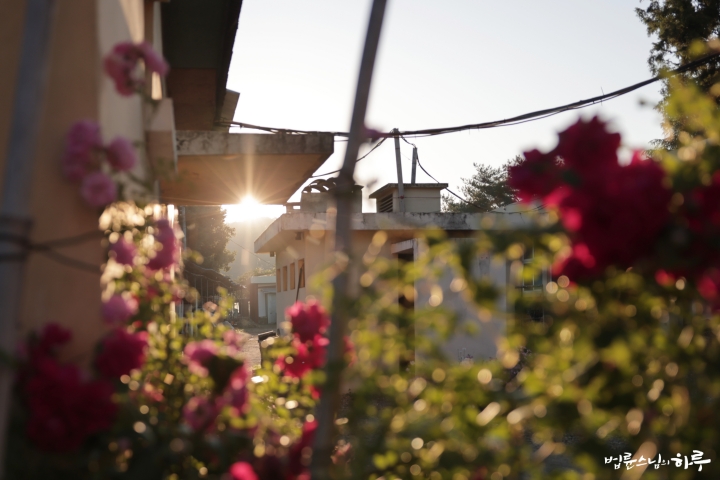
Sunim began his day with early morning practice and meditation. At 6:30 a.m., he put on his work clothes, gathered his tools, and went to a older sister’s farm in Jeonggeori, near Dubuk Jungto Retreat Center. Last month, Sunim had pruned the angelica trees and chestnut trees on his sister’s farm. When he went to the farm today, he saw that the ramie plants growing in the inner area where the angelica trees had been were thriving with a deep green color.
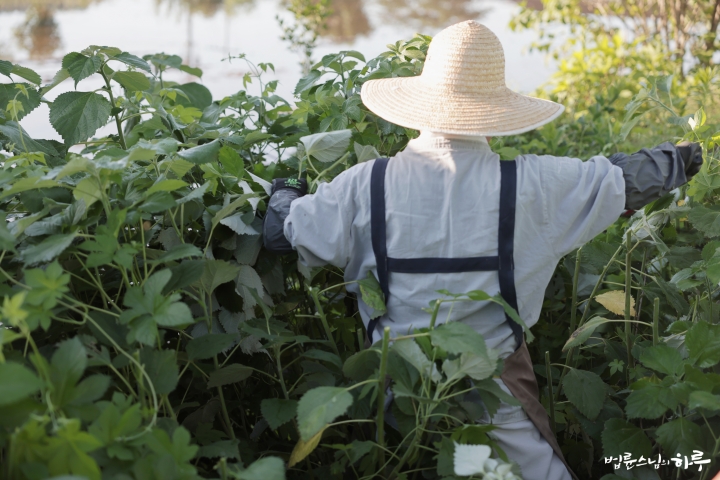
Sunim used a sickle to cut mainly the upper parts of the ramie plants. He left the shorter ramie plants in the front so that his sister, whose back is bent, could still harvest them, and instead focused on cutting the taller ramie leaves and stems further back.
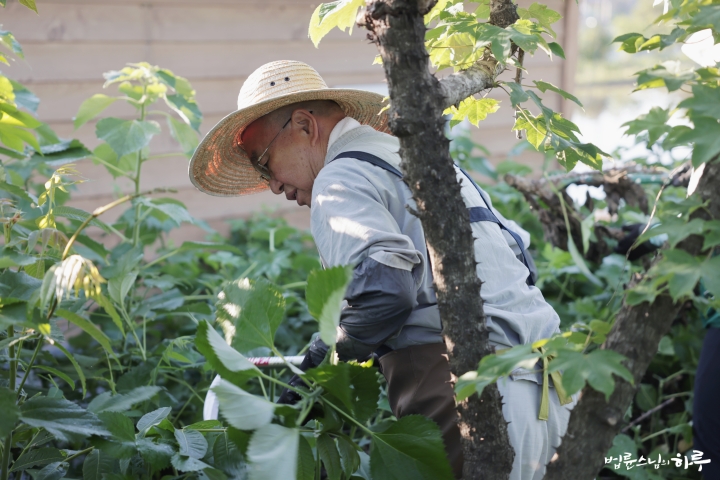
The taller ramie plants in the back were near a pile of angelica branches. The ramie was so dense that the angelica branches were hard to see. Sunim stepped on the pile of angelica branches to cut the ramie. The angelica thorns pierced through his rubber boots and pricked the soles of his feet, causing a stinging sensation.
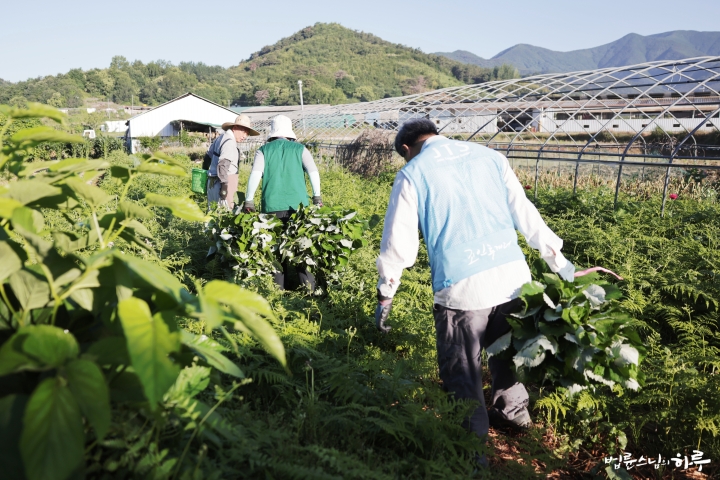
After just a few swings of the sickle, a large pile of ramie quickly accumulated. When tied with rope, it made three bundles.
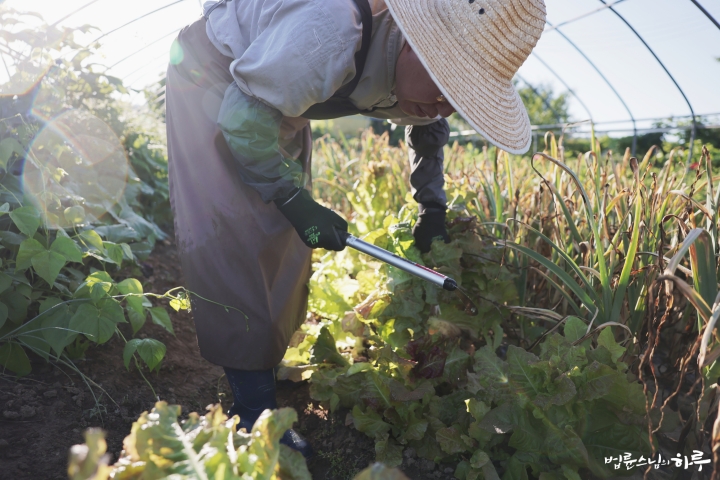
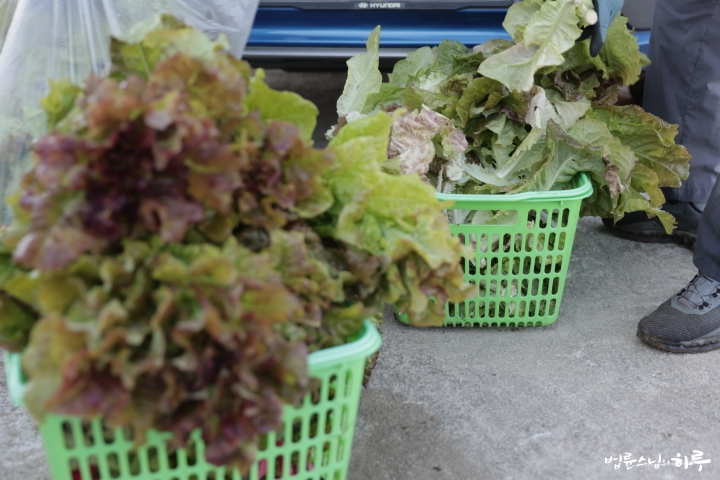
The sister also told him to harvest all the lettuce from the field. Sunim used the sickle to cut the lettuce along with its stems. The lettuce at his sister’s farm was tender with large leaves because the soil was rich in compost. With just a few swings of the sickle, two baskets were soon filled to the brim with lettuce.
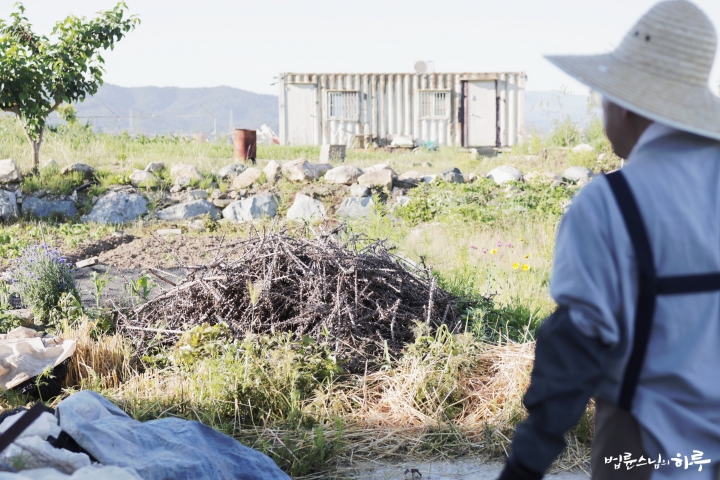
The angelica branches that had been cut last April were piled up on one side. Sunim wanted to clear them away, concerned that it would be difficult and tiring for his sister, whose back is bent, to organize the angelica branches. However, his sister insisted on doing it herself, so he stopped.
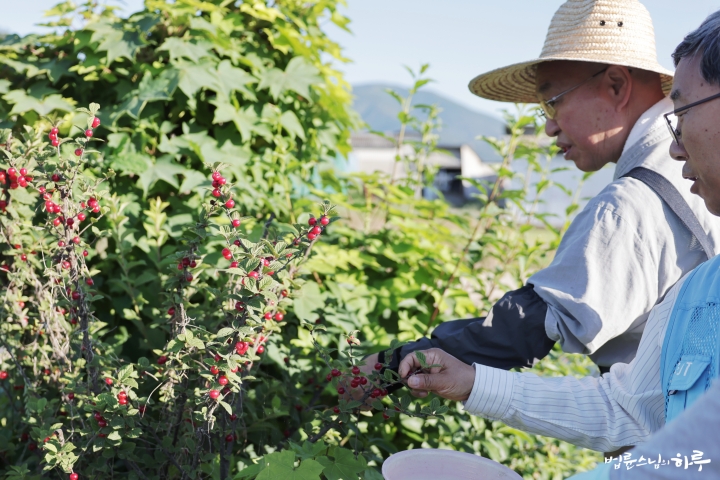
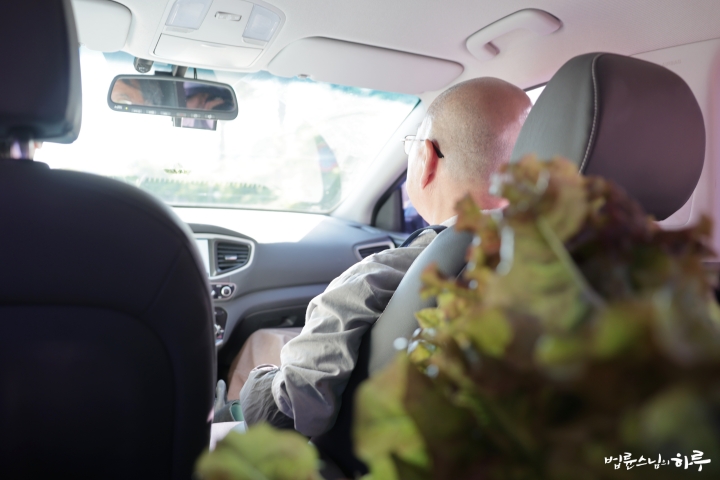
The sister packed up various crops and kimchi for him. After about an hour of farming work, Sunim returned to Dubuk Jungto Retreat Center.
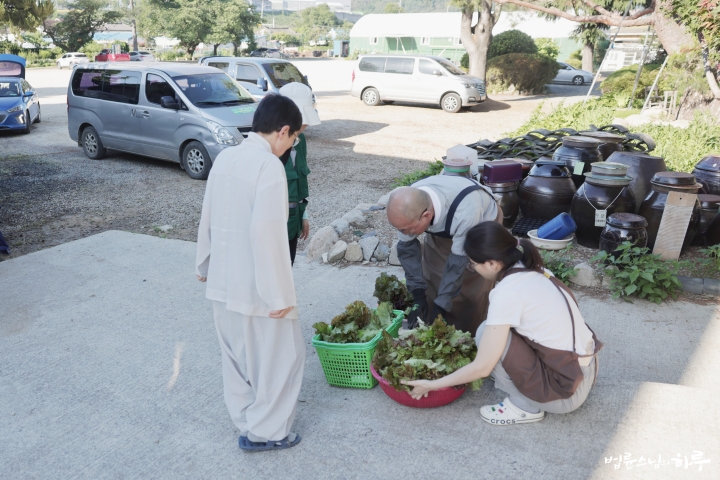
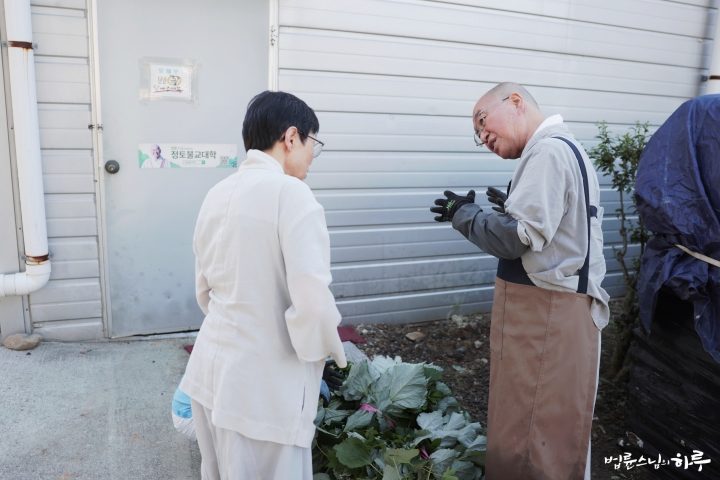
Around 8 a.m., Sunim arrived at Dubuk Jungto Retreat Center and unloaded the lettuce and ramie. He then asked Dharma Teacher Myosu to have the lettuce trimmed and eaten with the trainees during Barugongyang, and to have the ramie prepared and boiled according to Dharma Teacher Hyangjon’s instructions. Once the trainees finished trimming and boiling the ramie, Dharma Teacher Hyangjon would take it to the mill. Preparations were underway to enjoy ramie rice cakes. When Sunim arrived at Dubuk Jungto Retreat Center, the Haengjawon trainees were in the middle of a study session as part of the Unity Retreat, so he could not begin the work immediately. Instead, the lettuce and ramie would be trimmed and prepared at the scheduled work time.
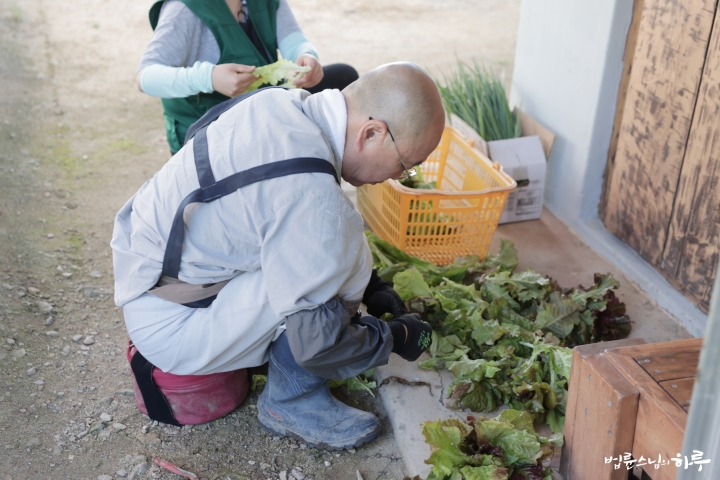
Sunim trimmed and organized the lettuce and other crops he had received from the sister so they could be eaten.
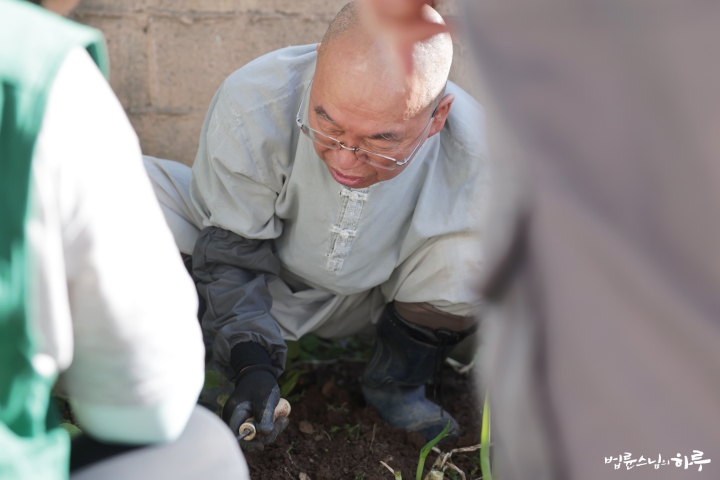
He brought some seedlings from Dubuk Farm and planted them in the garden. While tending to the garden, Harsha and Moo arrived. Sunim quickly finished gardening and went to have breakfast with the guests.
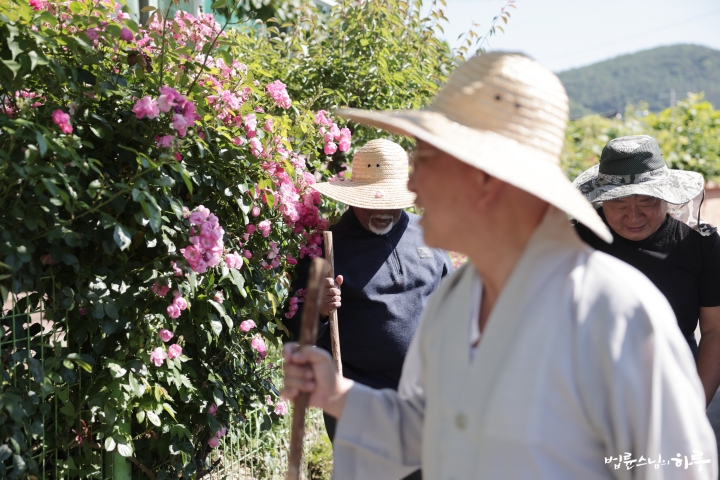
After breakfast, Sunim and the guests decided to take a tour of Dubuk Farm.
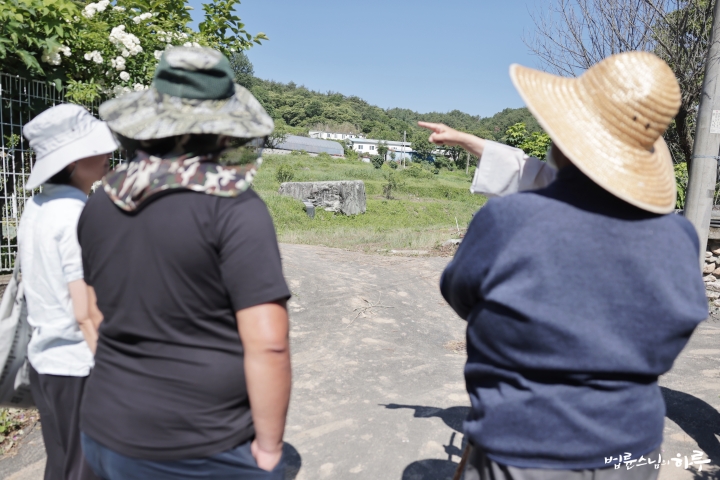
On the way to Dubuk Farm, Sunim explained about the dolmens in the village.
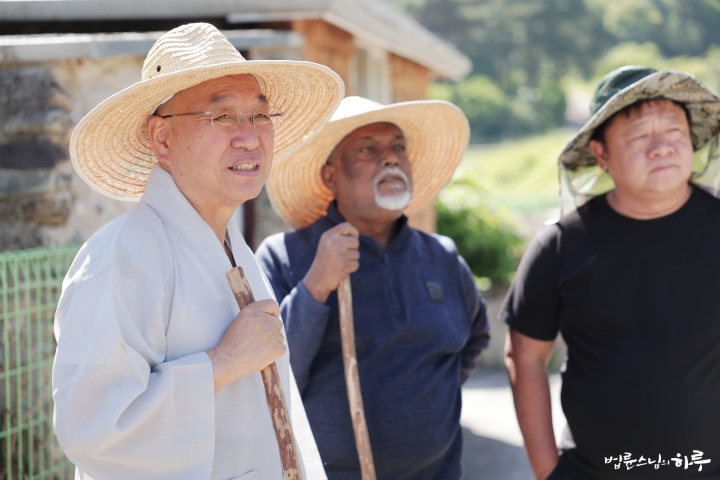
He explained that there used to be five dolmens in the village, but because the villagers did not realize they were dolmens and they were sitting on farmland, they had been cleared away, and now only one remained. He added that the villagers long ago did not realize they were historical relics and treated them as such.
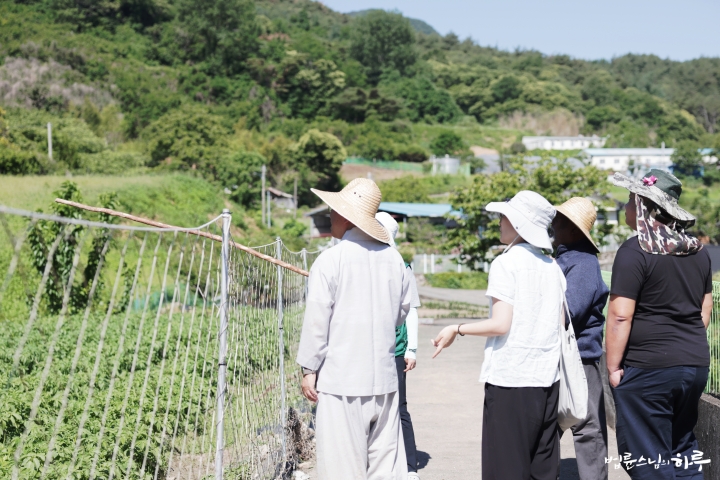
For Harsha and Moo from Sri Lanka, who were visiting Dubuk for the first time, Sunim explained the traditional Korean household items they encountered along the way to Dubuk Farm. As they passed by jangdok (earthenware jars), buttumak (traditional stoves), and gamasot (cauldrons), Sunim explained each one, and Harsha listened with great interest. He even asked what was inside the jangdok. After walking a little further, they came upon a field. Sunim explained what crops were planted there.
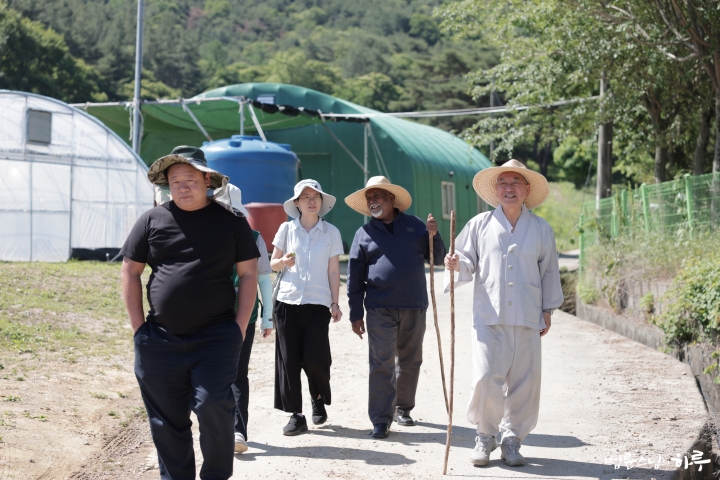
Harsha asked various questions about farming. He was curious about whether the farm was organic, whether chemicals were used, what the yield was like with organic farming, and how many months it took to grow and harvest rice, among other things.
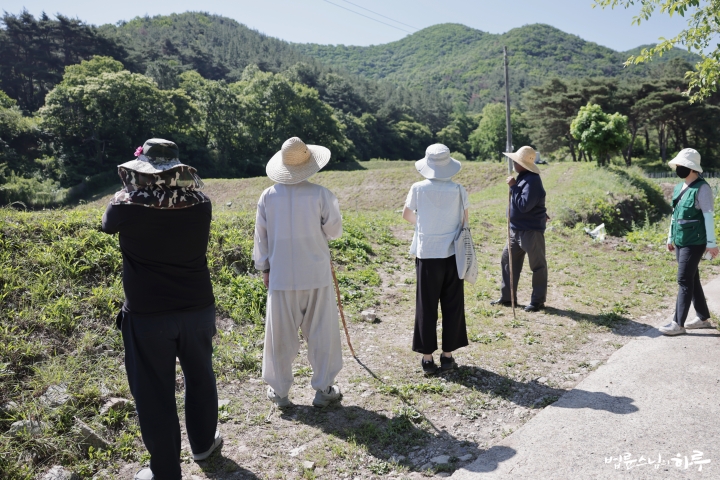
Sunim also mentioned that if organic farming could secure a reasonable yield, it could help solve the issue of increasing rural income in Southeast Asia. The fields tended by Jungto practitioners had open-field potatoes growing, and both the upper and lower rice paddies had completed rice planting.
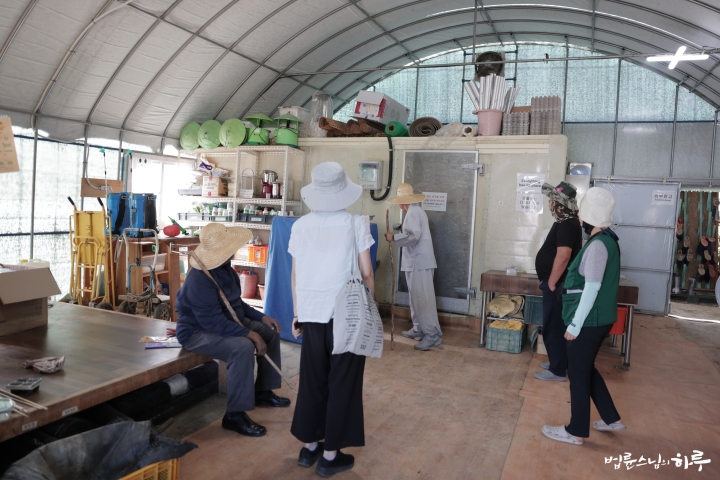
After passing the fields and paddies, they went to the farm shed. They took a look around the dryer, cold storage, and tool storage areas inside the shed. This time, Moo asked various questions.
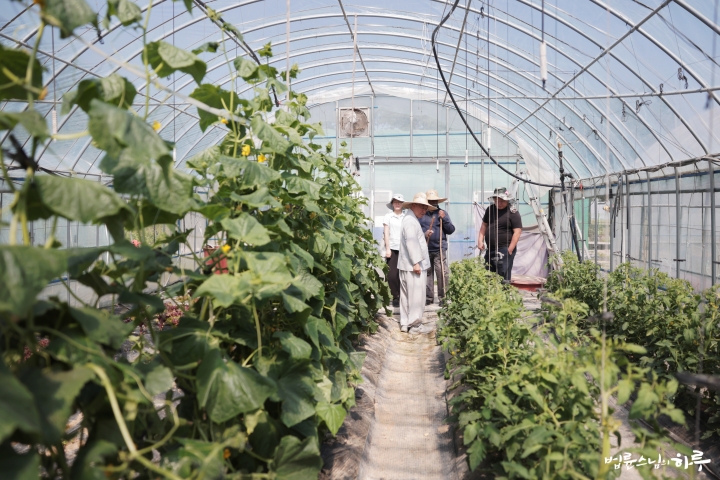
Next, they moved to the greenhouses to see what crops were being grown. In the greenhouse where potatoes had been harvested a few days earlier, the soil had been neatly tilled in preparation for the next crop. Another greenhouse had peppers planted, and yet another had various vegetables growing. The cabbages had grown remarkably large. Harsha was amazed, saying he had never seen such large cabbages even in Canada. To suppress weed growth, weed mats had been laid out neatly throughout the greenhouses. They also discussed whether using plastic weed mats was truly eco-friendly when doing organic farming.
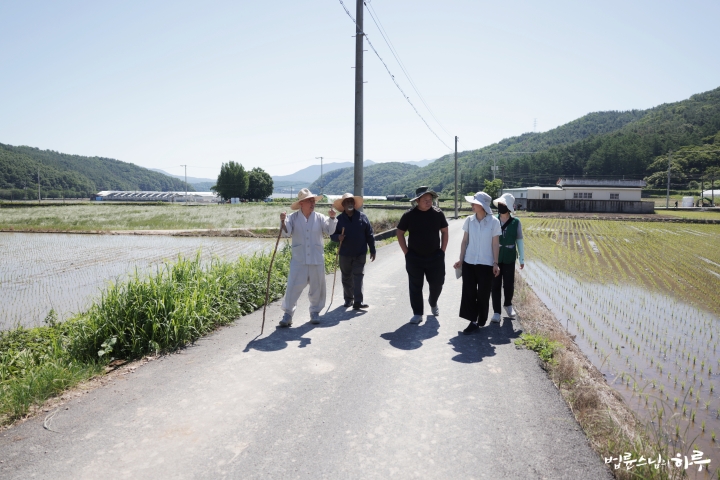
Harsha asked Sunim how the land for Dubuk Farm had been acquired, and Sunim explained that in Korea, one must qualify as a farmer to purchase farmland. Hearing this, Harsha shared how it works in Sri Lanka. Since Harsha had served as Sri Lanka’s ambassador to Canada, he also shared about how it works in Canada.
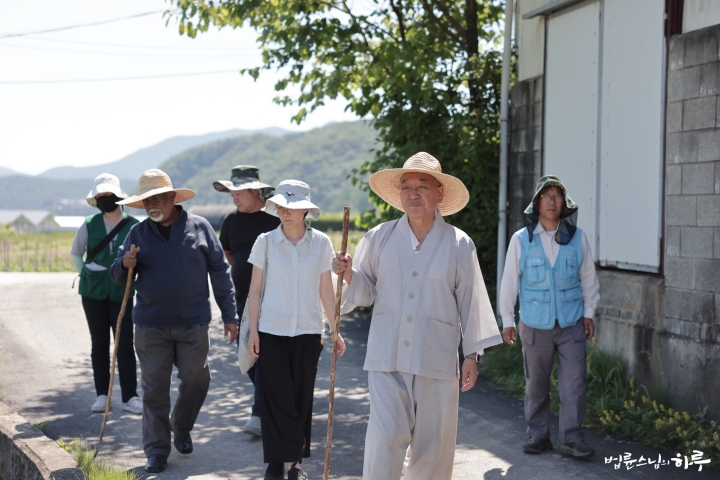
After finishing the tour of Dubuk Farm, Sunim and the guests returned to the lodging. As the sun grew stronger, even a short walk caused them to sweat. After arriving at the lodging and cooling off, the guests had a conversation with Sunim. Harsha and Moo broadly sought Sunim’s advice on how INEB (International Network of Engaged Buddhists) should conduct its activities over the next ten years and how they could continue collaborating with Sunim. Various ideas and opinions were exchanged.
They discussed the idea of building a training center near Bangkok to serve as a place to educate Buddhist activists and young monks from Southeast Asia; the role The Peace Foundation could play in promoting peace and reconciliation not only between North and South Korea but also throughout Asia and the world, for example by forming an inter-religious council and creating programs through which various religious leaders from Southeast Asia, South Asia, and East Asia could collaborate and learn from one another; and the desire to establish a microfinance fund for poverty alleviation in Southeast Asia, similar to the Grameen Bank in Bangladesh, for which they sought Sunim’s advice and asked whether he could introduce them to relevant experts in Korea. The conversation between Sunim and the guests continued after lunch as well.
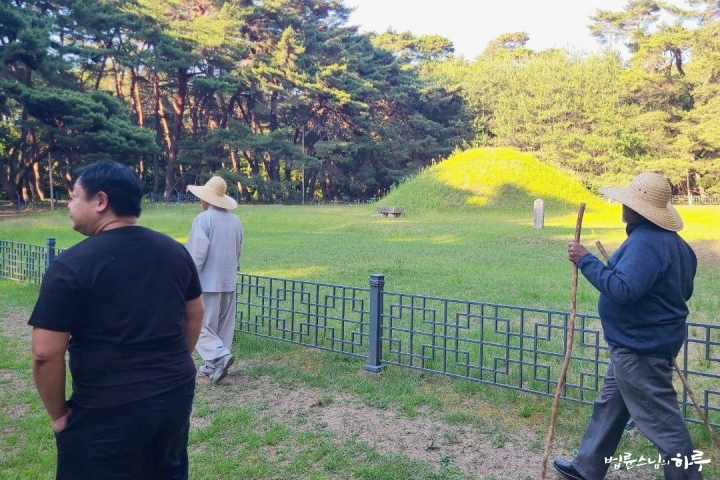
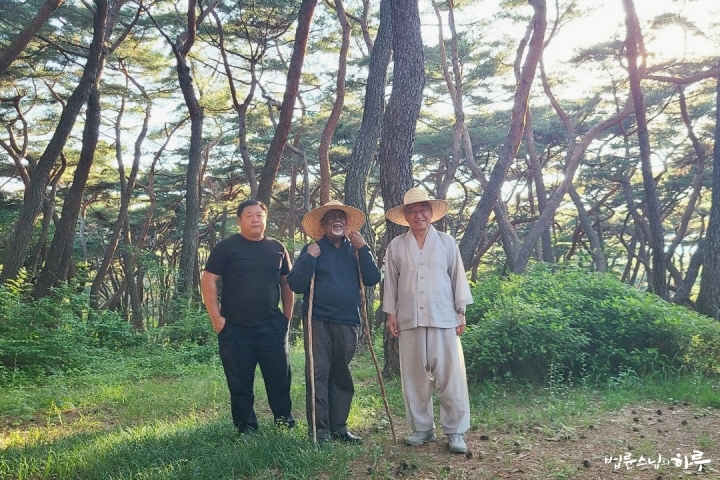
Having sat for a long time, Sunim went out for a walk around the Gyeongju area with the guests.
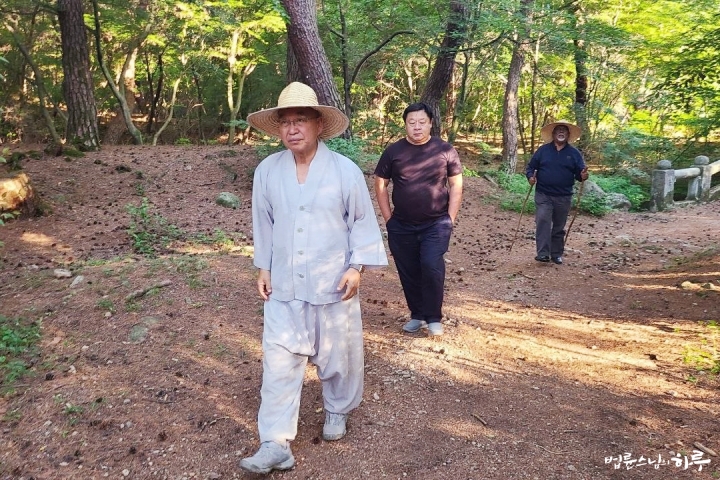
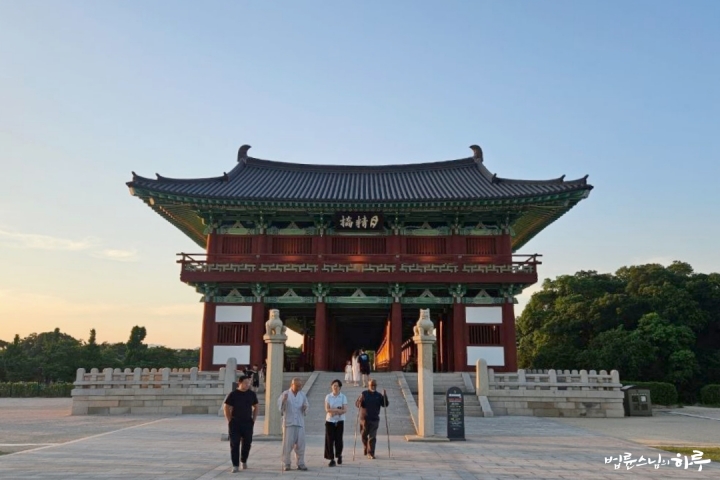
They visited Samneung, the Three-Body Stone Buddha, Woljeonggyo Bridge, and Donggung Palace and Wolji Pond. As it was the last day of May, the tourist areas in downtown Gyeongju were crowded with people.
After the walk, they had dinner, and Sunim and the guests continued their conversation. They talked until late at night and concluded the day’s schedule.
Tomorrow, Sunim will travel to Seoul with the guests, see them off, and then depart from Incheon Airport in the evening for his Bhutan trip.
Since there was no Dharma talk today, this post concludes with a conversation from a recent Dharma Q&A session.
Can I End My Relationship with My Sister Who Has Depression?
“I am five months pregnant and about to become a mother soon. Though I have something joyful ahead of me, I have concerns about my relationship with my older sister, so I would like to ask. As a child, because I was a second daughter, I heard comments expressing disappointment, and I was raised separately by my grandmother in the countryside until I was four years old. Growing up in an environment where people didn’t talk much, I also couldn’t speak well, and later, when I moved to Busan to live with my family, I adjusted belatedly. My relationship with my parents wasn’t good, and we were also financially struggling. In that situation, with the resolve not to burden my mother, I supported my own tuition and living expenses on my own after becoming an adult. Meanwhile, my sister has suffered from depression for a long time, repeatedly saying for over 15 years that she wants to die, and as a result, the family has been dragged along by her situation. I also could not bear that situation and once took extreme actions myself. Currently, my sister has not become financially independent and depends on our mother. Whenever conflicts arise, she repeatedly engages in extreme behavior and is admitted to and discharged from psychiatric hospitals. My mother recently retired, but she still supports my sister and younger brother. Hoping my sister would get better, I have provided financial and emotional support, and I have also supported my mother, but as these efforts came to be taken for granted, feelings of resentment and disappointment have built up. At the same time, I feel the burden that future responsibility for the family will be passed on to me. In this situation, I would like to know whether I can end my relationship with my sister, and how I should approach my family.”
“That’s quite a long story. How old are you now?”“I am 33 years old.”
“At 33, are you an adult or a minor?”“An adult.”
“And you said you’re married, right?”“Yes.”
“Then you can live however you want. There’s no need to go on at length about this. The reason I said ‘long-winded’ is that you’re unnecessarily going on with childish talk. If you’ve gotten married and are having a child, that itself is an independent family. Right now, your family is not your sister or mother, but your husband and child. Your sister and mother are merely former family members. To use an analogy, it’s like if you’ve changed companies, you should focus on the work at the current company, not keep holding onto the work at the previous company you’ve already left. Your current situation has already changed. So regarding the family issues you’re talking about now, you only need to view them as ‘there are such people around me.’ The reason you feel resentful is that you keep holding onto things you don’t have to take on. Helping your sister and mother was something you chose to do, and stopping now is also your choice. So you can’t really call it sacrifice or service. It’s simply that you acted according to your own disposition. Suffering as a result of that is also your own life, and you can also think, ‘Let me stop doing pointless things and live my own life,’ and live happily with your husband, building a family together. There’s no need to stay tied to the family relationships of the past. And your sister is a patient suffering from depression. As you said, if your sister could judge everything herself and manage her life, she wouldn’t really be considered a patient. Your sister is a patient. If your sister were mentally healthy, why would she depend on your mother instead of living independently? You’re not viewing your sister as a patient but thinking of her as if she were a normal person, and getting angry when things don’t go your way. Whether your sister calls you or not, that’s her business. If a call comes, you can answer; if not, that’s that. These days, because of the election season, I get a lot of calls from unknown numbers for polls and such. Does that mean I should confront those people and demand why they called? Making the call is their freedom. Even Korean law doesn’t restrict the act of making a call. Whether to answer or not is also my freedom. Whether I respond is up to me. So you just need to decide whether to answer when a call comes, and whether to talk if you do answer. But picking a fight with ‘Why did you call?’ or ‘Why didn’t you answer?’ is quite a self-centered way of thinking. You say you’ve lived independently and devotedly since childhood, but the more I listen, the more I feel you’re someone with a strong sense of self-centeredness. You seem to have not even a fingernail’s worth of understanding for your mother and sister, and you appear to be simply asserting your own thoughts. Becoming independent at a young age is a good thing. Because your family environment wasn’t good, it turned out to be a good thing that you became independent early. If you want to give money you’ve earned to your sister, give it; if you don’t want to, you don’t have to. But you feel guilty if you don’t give, and when you do give, you want her to listen to you, but she doesn’t, so you feel bad and try to cut off the relationship. Then when you hear that your sister is struggling, your heart aches again and you’ll try to help her. This isn’t being done for your sister’s sake. It’s just your own mind being shaken back and forth. Your sister using your mother’s money is a matter between mother and daughter, and it’s not directly related to you. If your mother saves up money, it might become your share later, so you might feel bad that your sister is spending it first. In that case, you can use it together too if you need to. You should just take care of your own affairs; demanding that your sister become independent will only create conflict among siblings. The relationship between parents and children depends on how each person sets it up. A mother may feel more concerned about a daughter with depression than a healthy one. Parents tend to scold more but also support more. That’s how most parents are. When a child is weaker or in a more difficult situation, parents want to give them even what belongs to their other children to help them. That’s human psychology. No one has any problem. Your mother is being a parent in her own way, and your sister is acting that way as someone with depression. But you’re suffering because it doesn’t go the way you want, and you’re making yourself miserable. Your mother and sister are not your current family but your past family. Once you turn 20, you are an independent being. The previous family relationships were formed at birth, and the relationships after that are ones you choose to form. Seeing it from this perspective can make things much easier. You asked what you should do about your sister, but just leave her be. If your sister doesn’t call, that’s actually a good thing. ‘Thank you for not calling.’ You can think this way. Then there’s no problem at all. Each person lives in their own way. From your perspective, your mother may sometimes seem a bit foolish, but she’ll figure out her own way of living in her own way. Each person is finding their own path, so you only need to respond when they ask for help. If your mother asks, ‘I don’t know how to live,’ the most honest response is to say, ‘I’m not sure either.’ But if you do have an idea, simply saying, ‘How about trying it this way?’ is enough. The same goes for when your child brings home a romantic partner and asks, ‘I’m thinking of marrying this person. What do you think, Mom?’ Rather than pretending to know and making definitive judgments, it’s better to answer, ‘How would I know?’ If they say, ‘You have more experience, so don’t you know a bit?’ you can smile and brush it off with something like, ‘If I had any ability to judge people, would I have ended up with someone like your father?’ Try giving them witty encouragement like, ‘I haven’t been good at making choices either, that’s why I’m living like this, so I’m in no position to advise you. But whatever choice you make, I’ll trust and support you.’ If your mother or sister asks you for something, do it if you can and don’t if you can’t—that’s it. If they ask you to send some money, just say ‘Okay’ and don’t send it. If they ask why you didn’t send it, just say ‘I don’t have any either.’ If you have extra, send it; if not, don’t send it—no further explanation or argument is needed. During election season, even if asked to vote for someone, you don’t have to comply with everyone. Wanting to get elected is their wish, and choosing whom to vote for is my freedom. That’s just how life is. Leave your family’s lives to them, and choose and live your own life.”