“Is It Okay Not to Have a Dream or a Career Path?”
May 30, 2026. Farming Work, Day 1 of INEB Guests' Visit
Hello. Today, Sunim did farming work, attended to his duties, and welcomed guests.
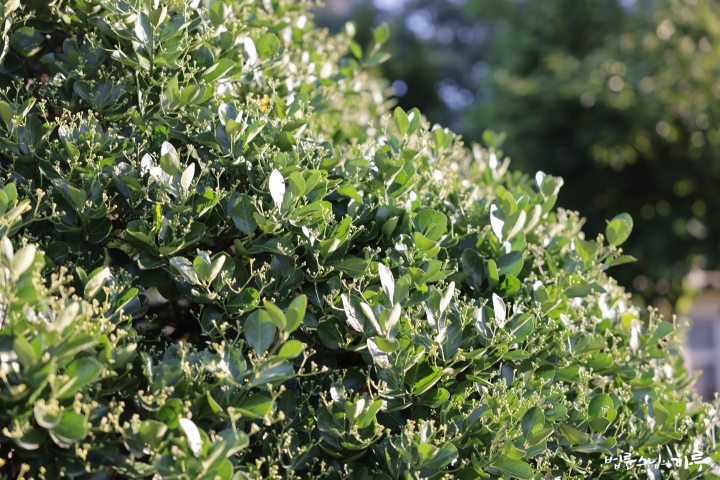
Sunim began his day with morning practice and meditation.
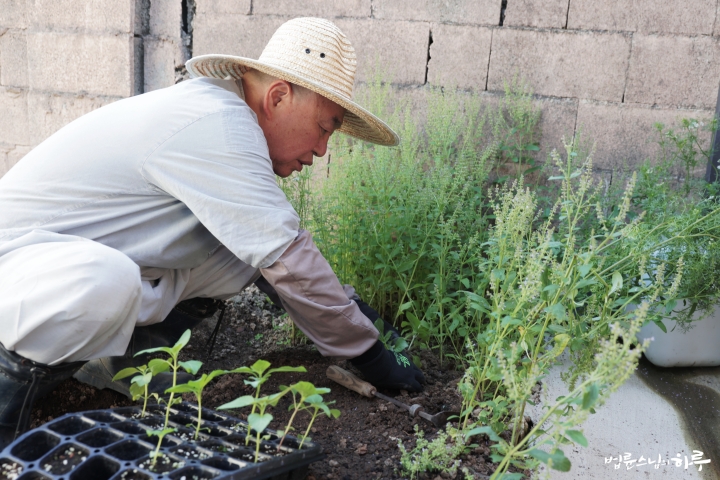
At 6:30 AM, Sunim worked in the vegetable garden as part of the morning chores. He planted perilla seedlings, grown by the farming team, in the empty spaces of the garden, and planted lettuce and other leafy vegetable seedlings in other areas. Since each pot contained several lettuce seedlings, Sunim carefully cut them apart with small scissors. He used scissors instead of pulling them apart by hand to avoid damaging the roots. Considering how quickly they would grow, he planted the divided lettuce seedlings with ample space between them.
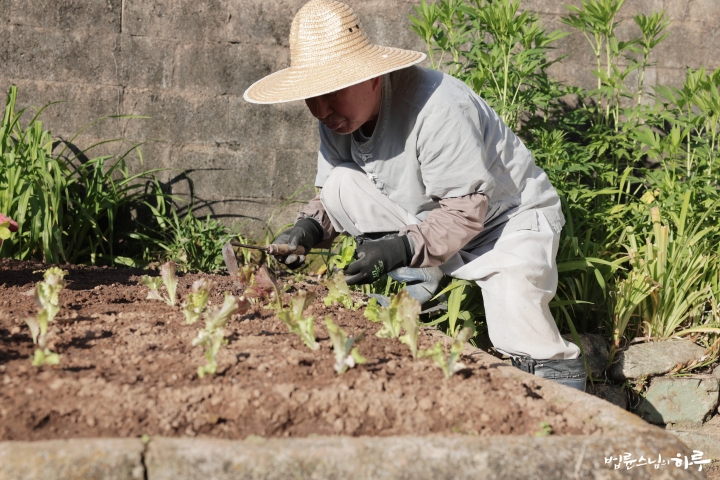
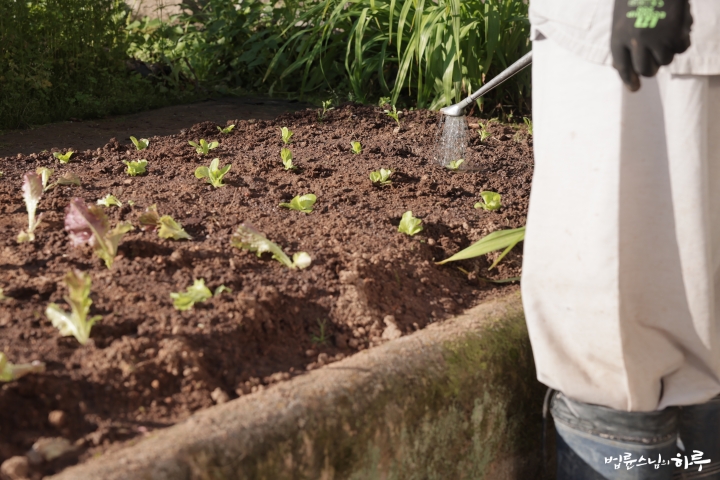
The leafy vegetable seedlings were neatly planted in the garden. Sunim watered them with a watering can.
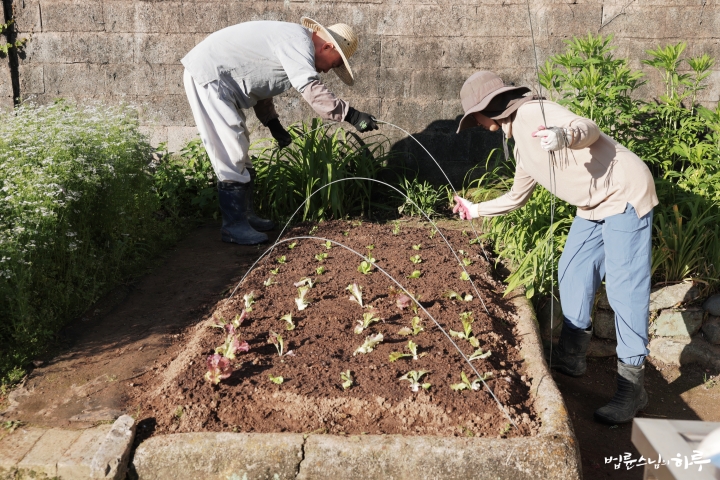
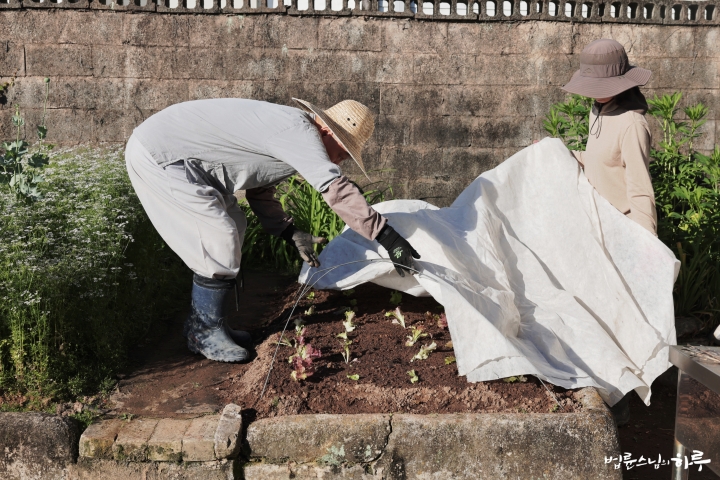
Because the sunlight was strong, Sunim set up arched supports and covered the lettuce seedlings with non-woven fabric. If the fabric were laid directly over them without supports, the seedlings would be crushed. He decided to cover them this way for just one day.
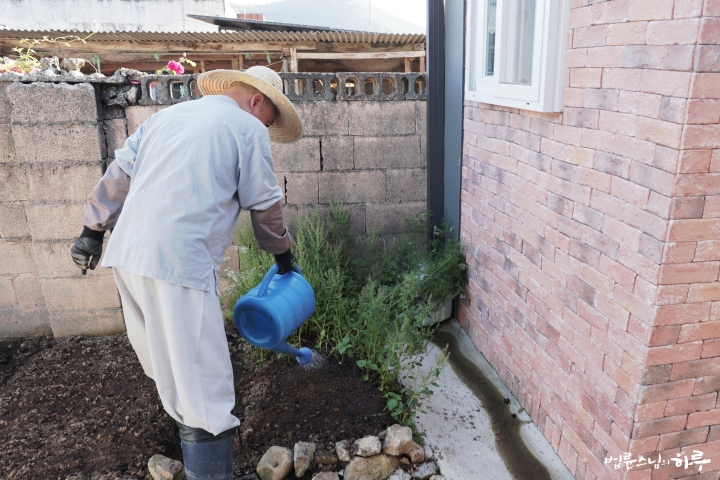
Sunim also watered the perilla seedlings planted in the back garden.
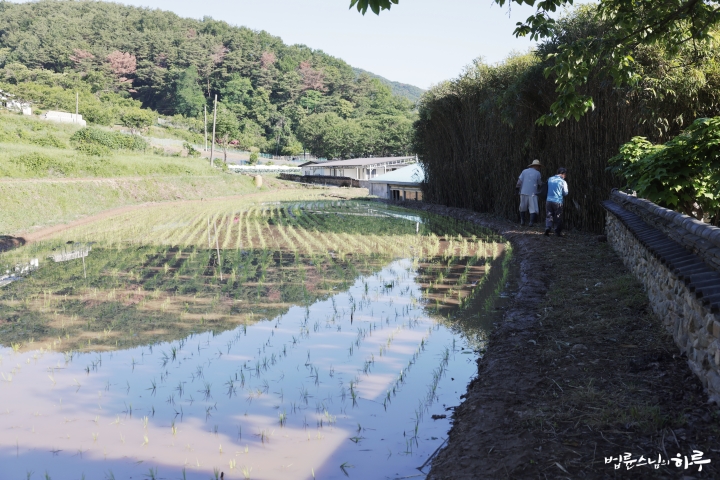
Sunim headed to the rice paddy near the dolmen in the village. Walking along the ridges of the paddy with Dharma Teacher Hyangjon, he examined which parts needed maintenance. Then he came to the paddy ridge where bamboo had been cut. The bamboo along the ridge had been cut, but each time someone walked across the cut area, the bamboo stalks protruded and got underfoot. Since the area was meant to be used as a walking path, more work was needed.
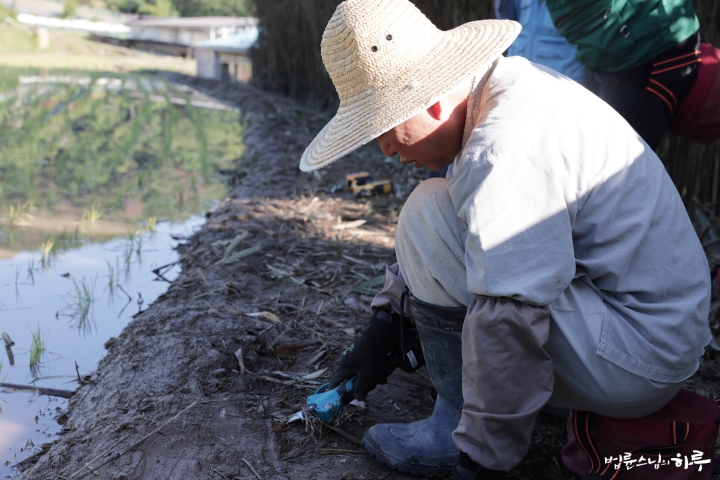
Sunim used automatic pruning shears to cut the bamboo stalks and roots that protruded underfoot. Since the ground was covered with bamboo leaves, he had to scrape them away with a hoe, and once the bamboo stalks were visible, he used the shears to cut them as close to the ground as possible. Since bamboo grew densely in the area, there were many spots to cut. Sunim discussed with Dharma Teacher Hyangjon whether to continue with the pruning shears or use a circular-blade string trimmer to clear the area. Until the circular-blade trimmer arrived, Sunim and Dharma Teacher Hyangjon cut the protruding stalks one by one with the pruning shears.
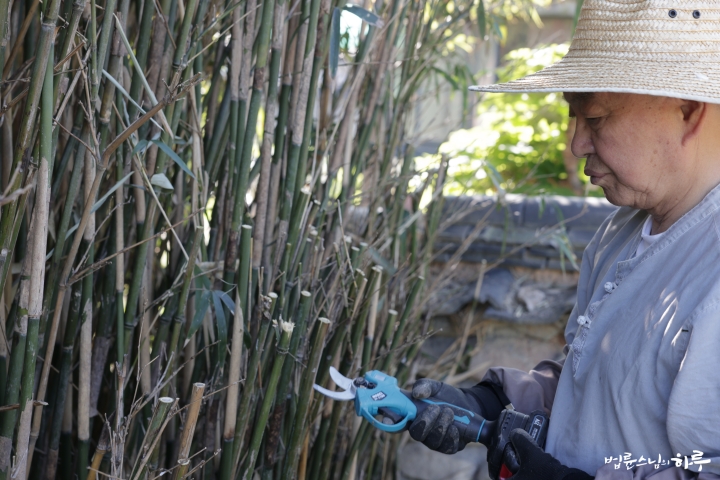
Sunim put down the pruning shears, and when the volunteer who would maintain the bamboo grove arrived, he greeted them and discussed the work.
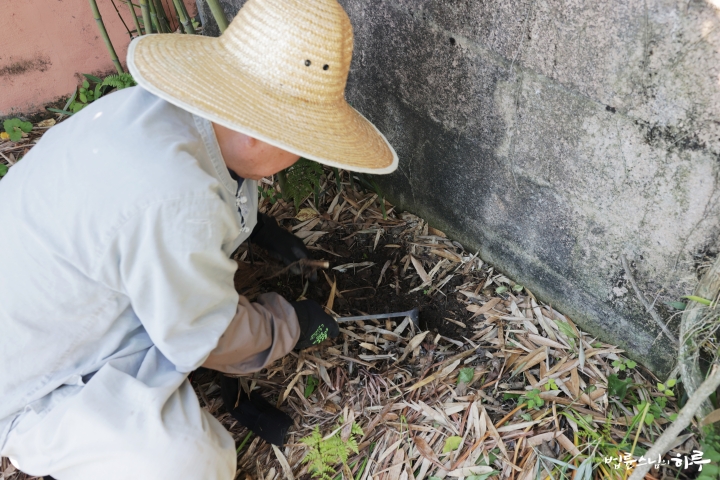
While clearing the bamboo grove, they obtained bamboo roots. Sunim cut them into suitable lengths and planted them near the area where bamboo was already growing by the garden. There were four or five bamboo plants along one wall of the garden, and Sunim explained that they had grown from a clump of bamboo root he had brought down from the mountain and planted. He said that bamboo roots planted this year wouldn’t sprout right away but would emerge next year.
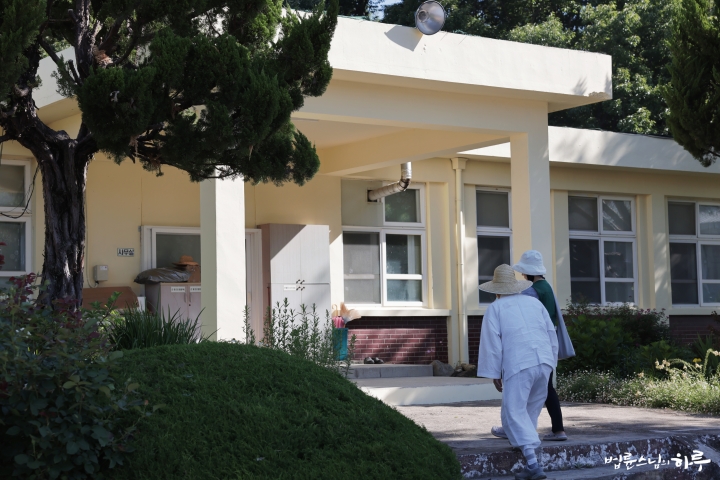
Sunim changed out of his work clothes and headed to the retreat center. Upon arriving, he attended to his duties.
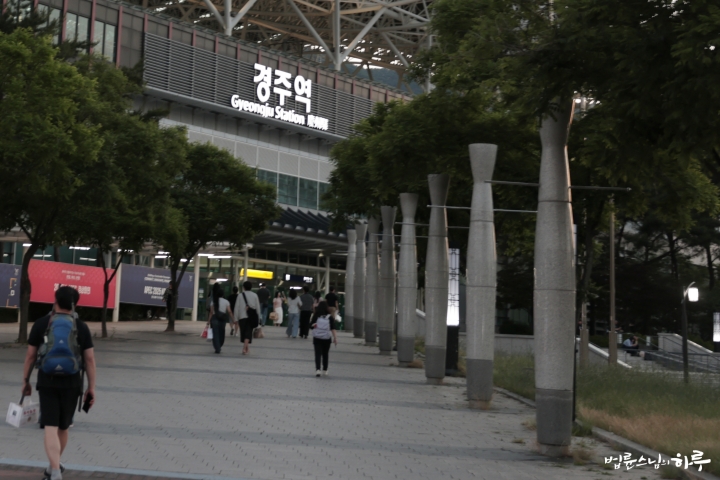
Today, Sunim had a schedule to welcome guests related to INEB (International Network of Engaged Buddhists). Harsha Navaratne, Chair of the INEB Executive Committee, and Somboon Chungprampree (nicknamed Moo), Secretary General, had entered Korea and were scheduled to arrive at Gyeongju Station in the evening by KTX train from Seoul. Sunim went out to meet them at Gyeongju Station.
Sunim had served as Honorary Advisor to INEB before being elevated to the position of Patron in 2020. The Patron is the highest honorary position at INEB, previously held by the Dalai Lama and Venerable Thich Nhat Hanh. After Venerable Thich Nhat Hanh’s passing, the position of Patron became vacant, and at the 2020 INEB board meeting, the board members nominated Sunim and unanimously agreed, making Sunim the Patron of INEB. Each year, Sunim has provided participants in INEB study tours hosted by Jungto Society with opportunities to visit Jungto Society and learn about Korean Buddhism, often personally guiding them.
The reason Harsha and Moo traveled all the way to Korea to meet Sunim was to seek advice on INEB’s current activities and overall future plans, and to gain ideas for new projects through conversation with Sunim.
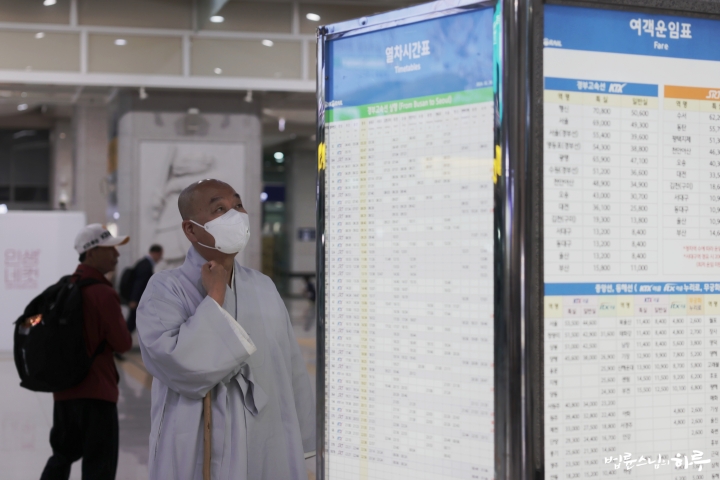
Sunim waited at the Gyeongju Station waiting room for Harsha and Moo, who were scheduled to arrive at around 7:38 PM.
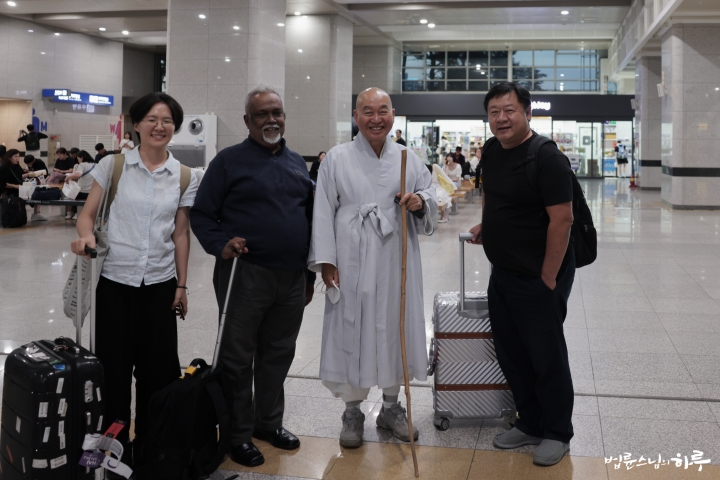
Harsha and Moo arrived without delay. Sunim and the guests got into the vehicle and headed to their lodgings. During the drive, Harsha and Moo asked Sunim how he had been.
“Sunim, are you still busy these days? How is your health?”
Moo greeted Sunim and asked how he was.
“Not particularly well. Recently, my shoulder has been hurting, and when I went to the hospital, they said it was a cervical disc problem. My leg has been hurting too, and when I went to the hospital, they said I have lumbar stenosis. I’ve been going for treatment. How is your health, Harsha?”Sunim asked Harsha about his health, and Harsha answered.
“Not very good, actually. After my kidney transplant, I’ve been taking kidney medication, but I’m having some muscle problems. I have some difficulty walking uphill. The kidney medication suppresses my immune system, so it’s been a bit difficult.”
“I also have difficulty climbing uphill because my coronary arteries are blocked. That’s why I walk with a cane.”“Bhutan is at a high altitude. Is traveling abroad okay for you?”
In response to Harsha’s question, Sunim answered with a smile.
“The doctor tells me not to go. Once I arrive in Bhutan, I have to travel from village to village, so the travel distance by car is long. Being sick is one thing, and going is another. (Laughs)”“Is it okay with the high altitude?”
“At most it’s 2,000 meters. When you cross a pass, it goes up to 3,000 meters. To visit the villages where Bhutanese residents live, I have to drive up winding roads. Many of them are unpaved.”“The airport is also at a high altitude. Is it okay for the plane to land in Bhutan?”
“Once, the plane couldn’t land and had to divert to India. After 5 hours, we tried to land several times before barely managing to touch down. Because of the high altitude, the weather is very unpredictable. (Laughs)”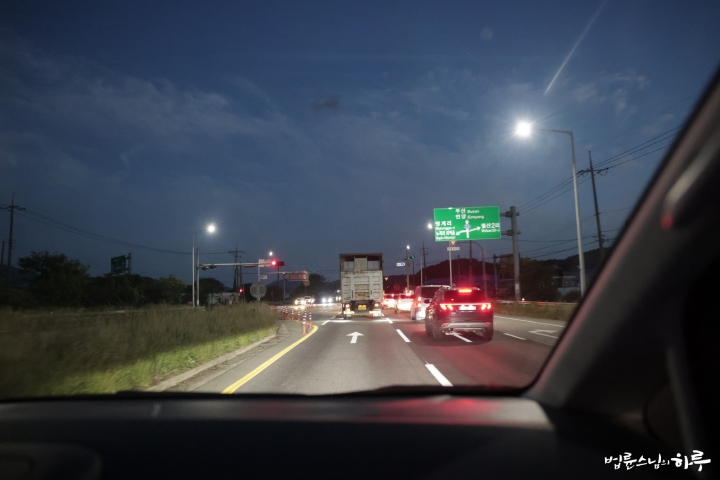
Sunim, Harsha, and Moo continued their conversation until they arrived at the lodgings. As they passed by Dubuk Jungto Retreat Center, Sunim mentioned that this was the elementary school he had attended as a child, and the guests were amazed to learn this new fact.

Darkness fell along the road to the lodgings. A round full moon rose above the mountain. Checking the calendar, tomorrow was the full moon day.
Sunim and the guests had a late dinner and shared recent updates. They talked about the recent Buddha’s Birthday events at Jungto Society, stories of the late Venerable Domun, the recently broadcast entertainment program <Pomnyun Road – Sunim and His Guests>, the upcoming visit to Sri Lanka in June, and stories about Asian immigrants in Sri Lanka and Korea. As the night grew late, they agreed to continue the more detailed discussions tomorrow, and Sunim and the guests wrapped up the day.
Tomorrow, Sunim will do farming work in the morning and spend the day with the guests.
Since there was no Dharma talk today, this post concludes with two short Dharma Q&A conversations about career paths from the talk held at Kyungpook National University this past April.

I Feel Anxious Because I Don’t Have a Dream.
“I just became a second-year middle school student this year. All my friends have dreams of what they want to become in the future, but I don’t have one yet. At school, we are often asked about our career goals, and each time, I don’t know what to write. I feel anxious because I seem to be the only one without a dream. What mindset should I have?”
“I would suffer.”
“If you had a dream of becoming an athlete but couldn’t because you didn’t grow tall enough, would you suffer or not?”“I would suffer.”
“In this sense, having a dream means carrying the seeds of suffering. If you’re still at an age where you don’t know how you’ll grow, it’s okay not to have a dream. As you grow taller, you can find work that suits your height; as you build skills, you can do work that matches your abilities. Then you won’t have anything to suffer about. So is not having a dream a good thing or a bad thing?”“It’s a good thing.” (Laughs)
“Yes, it’s a good thing. You don’t need to envy others who have dreams. In the old days, the question ‘What is your dream?’ didn’t even exist. These days, when parents or teachers ask about career goals, they treat people without dreams as if they’re somehow lacking, but that’s wrong. From now on, when someone asks about your career path, confidently write ‘I don’t know yet.'” (Applause)“Okay.”
“If writing ‘I don’t know’ feels embarrassing, write ‘Anything.’ Meaning, I can become anything. If they still insist that you choose one, just say, ‘I’ll decide after gaining more experience.’ When I was young, I wanted to be a scientist, but now I’m a monk. (Laughs) In life, even when you have a dream, it often doesn’t turn out as planned. It’s okay to have a dream, but you need to accept that things may not go as you wish. Yet most people cling to their dreams and end up disappointed. If you have no dream at all, like you, there’s nothing to be disappointed about. You can live freely and decide later, according to your circumstances and the connections you make. Understood?”“Yes.”
“Even with a job, don’t decide in advance where you must work. Try various things, see what suits you, and decide when you find something that fits. Don’t worry about what others think or feel rushed—live with ease.”“Yes. Thank you.” (Applause)
At the same venue, a university student asked Sunim about their career path.
I’m a Senior in University, and I’m Anxious Because I Still Haven’t Decided on a Career Path.
“I’m a senior in university. My friends are preparing for their futures after graduation, whether by going to graduate school or getting jobs at companies. I’ve been agonizing over this for a year, but I still haven’t made up my mind. There is something I want to do, but it’s completely unrelated to my major, so I’m worried about failing. I’m concerned that my impatience and anxiety have narrowed my perspective too much. What mindset should I have at times like this?”
“Play rock-paper-scissors.” (Laughs)
“With whom?”“With a friend. Or flip a coin.”
“When you come to a three-way intersection and don’t know which way to go, just wait. Sit down right there and wait until someone else passes by.”“Sunim, but I’m too impatient and anxious to wait. I’m worried that if I waste time like this, I’ll end up wandering without finding a job, like the youth NEET (Not in Education, Employment, or Training).”
“It’s also okay to go a long way down the wrong path and come back. You can think of it as exercise. When you don’t know the way, the first thing to do is sit down and wait. Either ask someone, or wait until you have conviction within yourself. That is never a waste. In fact, it’s a way to prevent waste. Going far down a path without knowing, only to turn back when you realize it’s wrong—that could be the real waste. Is it better to buy stocks, lose ten million won, and quit, or to not invest at all?”“Better not to invest.”
“Right. Waiting is not a waste. After resting for about a year, you’ll naturally reach a conclusion about whether to attend graduate school or get a job. But there’s an even more effective way to rest. It’s to actually do physically demanding work. If you try manual labor or cleaning work, your decision will come much faster. Thoughts like ‘Graduate school would be better than this’ or ‘Getting a job would be better than this’ come naturally. If you just sit around, it takes a bit longer to reach that conclusion. It can be summarized in two points. First, stop—wait until your decision becomes clear. Second, if you don’t want to wait, just go somewhere and try it. You’re still young, so it’s okay to go through trial and error. Try something, and if it’s not right, come back. Once you’ve confirmed that one of the three paths isn’t right, you have two paths left, don’t you? Try another path, and if that’s not right either, come back. Is this a waste, or is it a process of finding the right path?”“It’s a process.”
“Yes. The more you confirm what’s not right, the narrower the range of paths you should take becomes. It’s not a waste—it’s a process. So there’s absolutely no need to feel anxious. How old are you now?”“Twenty-three.”
“Resting for a year or spending two years going through trial and error doesn’t necessarily mean you’ll fall behind your friends. Your friends happened to find their path by luck, while you’ll have personally verified several paths and found the one that fits you, so you can have greater conviction. A friend who chose a path without much thought may experience a moment of wavering much later. Is it better to go far and come back, or to come back from nearby?”“From nearby.”
“When you’re young, there’s no problem with going and coming back. It’s a bit difficult at my age though. You might come back only to find it’s time to die. (Laughs) That’s why as you age, you choose the safer option, and when you’re young, you choose to challenge yourself. Don’t get too caught up in or afraid of success and failure—try this and try that. Failure is never really failure. It’s just practice.” (Applause)“Yes, thank you.”