What Should I Do When My Adult Children Won’t Become Independent?
May 29, 2026. Early Voting, Medical Appointments, Paying Respects
Hello. Today is the first day of early voting for the 9th nationwide local elections.
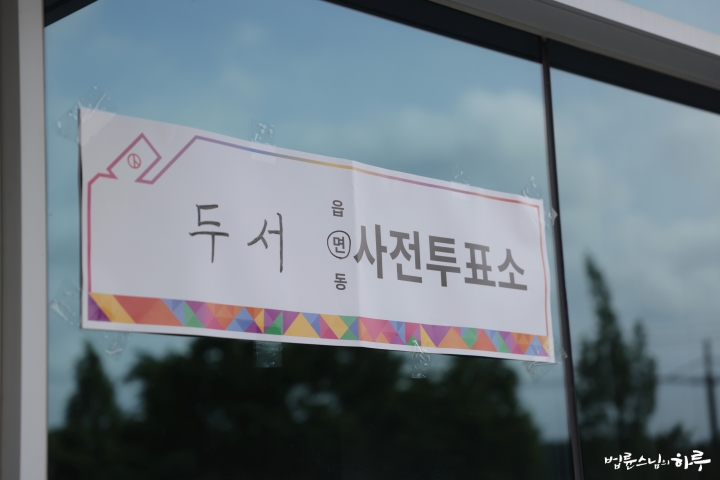
Sunim began his day with early morning practice and meditation. After breakfast and getting ready to go out, he arrived at the Duseo-myeon Administrative Welfare Center at 8 AM. Early voting was held on the third floor of the center. Since it was the first day of early voting and early in the morning, the polling station was quiet.
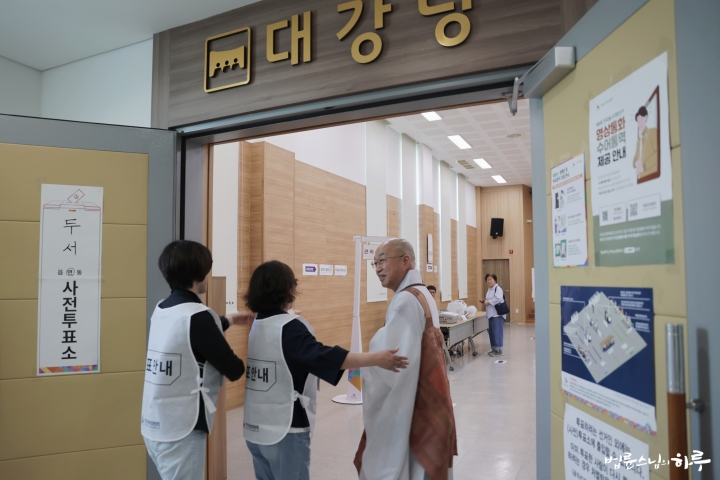
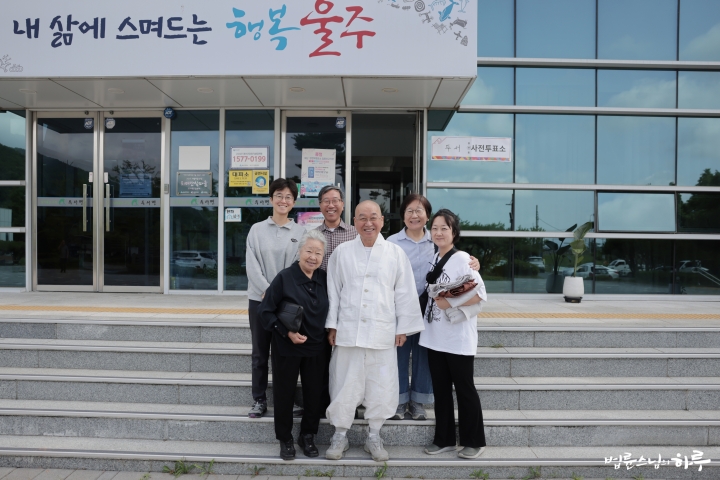
Sunim went to the out-of-district voter line, presented his ID for verification, received his ballot, and entered the voting booth. After marking the ballot, he placed it in a return envelope, sealed it, and dropped it into the ballot box. He completed early voting without any wait.
Sunim then headed to Busan. He visited his older brother who was hospitalized and received Korean medicine treatment. Following that, he also received dental treatment.

Around 1 PM, Sunim arrived at the funeral hall at Haeundae Paik Hospital. He paid his respects to the late husband of Hong Jeong-sun (홍정순), who had served as the secretary of the early Manila Dharma Center, and offered condolences to the bereaved family. Afterward, he traveled to Eonyang to visit a few more people, checking in on their well-being and greeting them. Around 3:40 PM, Sunim returned to the Dubuk Jungto Retreat Center.
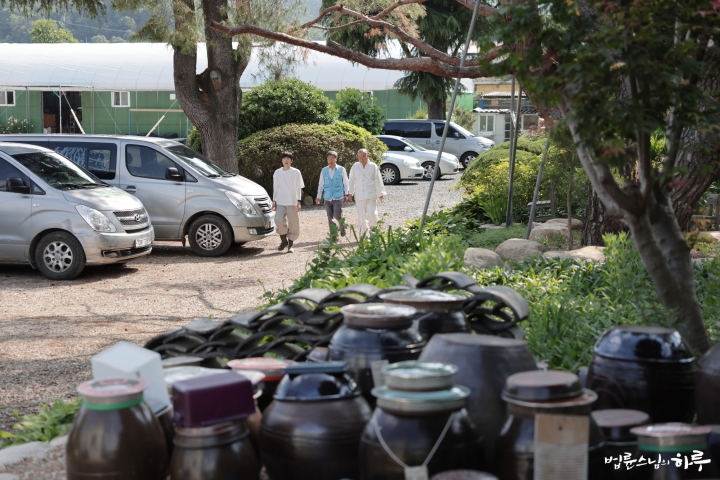
Sunim had a lengthy conversation with the farming team leader of Dubuk Farm. They discussed farming matters and plans for the rice paddy embankment path where communal work had been done the day before.
“Sunim, have you seen the plum tree garden? We’ve prepared it nicely. Why don’t you come take a look?”
After various discussions, the farming team leader showed Sunim the recently completed garden with the plum trees.
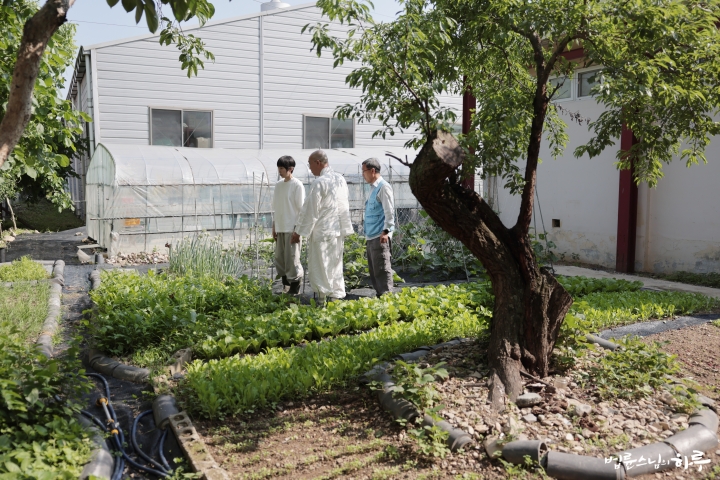
There is an old plum tree at Dubuk Jungto Retreat Center. A garden was created around the plum tree. Raised beds were made, and weed mats were carefully laid down to prevent weeds from growing.
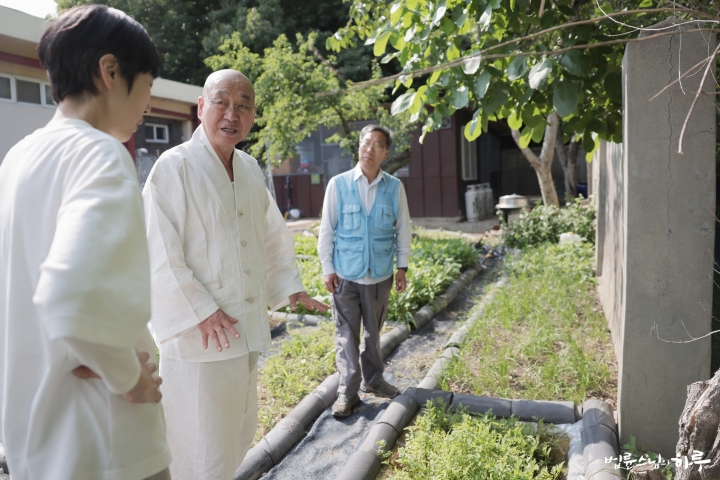
On one side, a small pond was created so that water dropwort could be grown. Sunim looked around the garden next to the kitchen and the plum tree garden. Since the farming team had set up a nice garden next to the kitchen, fresh wrap vegetables were being harvested and eaten at every meal. Although small in size, thanks to the variety of wrap vegetables planted, the community was self-sufficient when it came to wrap vegetables. Sunim suggested to the farming team leader a way to help the water dropwort grow better.
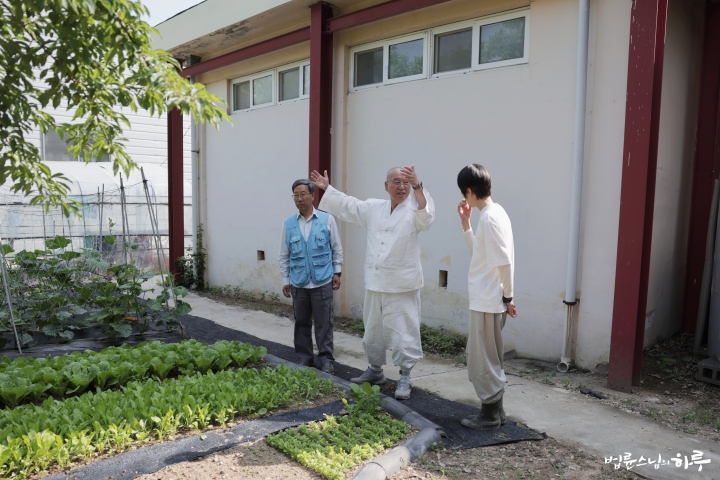
The plum tree was originally a large tree, but last year it underwent major pruning. As a result, the remaining branches bore many plums.
“Wow, after pruning the branches, the plums are growing so large.”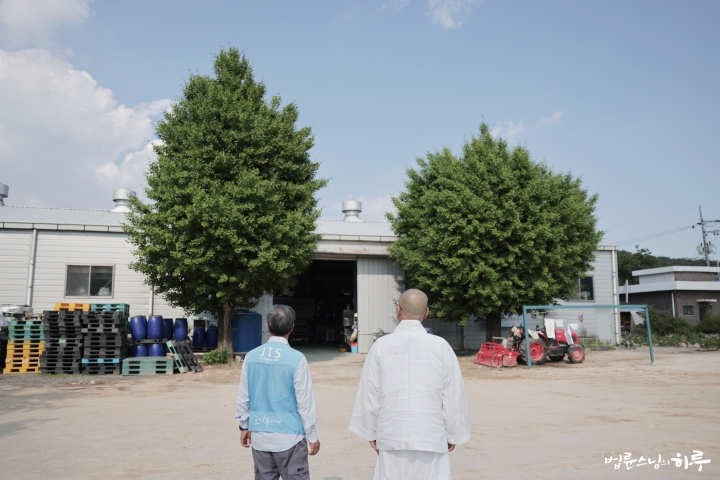
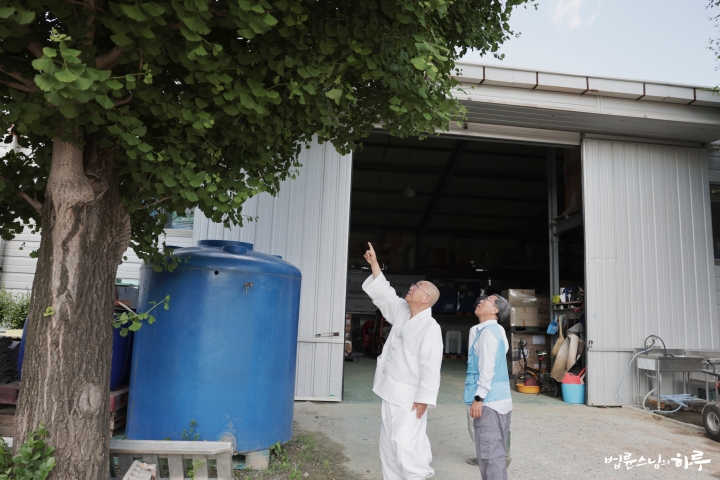
Sunim went out to the field and surveyed the entire retreat center. Looking at the large ginkgo tree near the JTS warehouse, he mentioned that it needed pruning. Since the ginkgo tree was tall, many leaves fell on the warehouse roof, clogging the gutters and causing inconvenience. Sunim walked around with Dharma Teacher Hyangjon, examining how best to prune the trees and discussing the matter. They went through the large trees within Dubuk Jungto Retreat Center one by one.
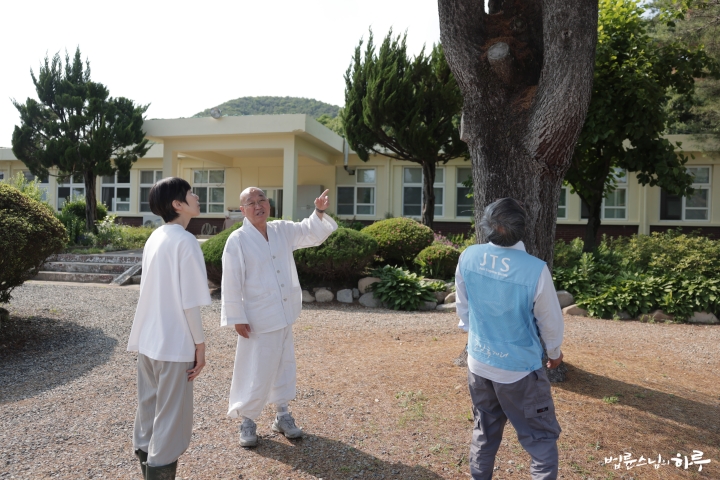
Some trees looked tidy after being pruned, while others, despite being pruned, had quickly grown many branches upward and needed to be pruned again.
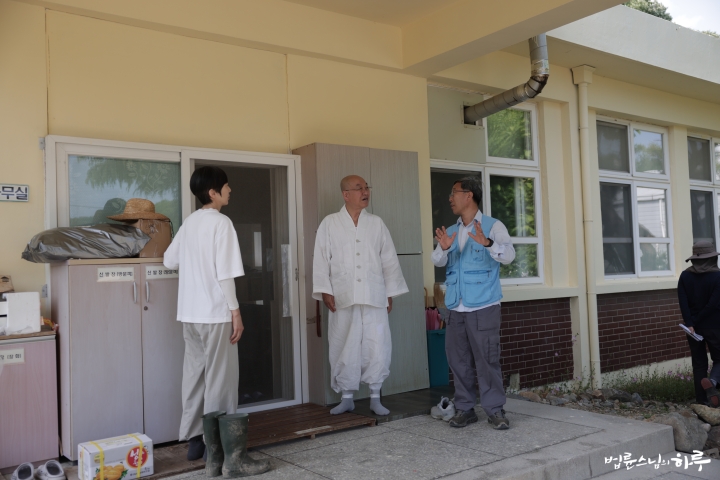
Sunim thoroughly inspected the retreat center, discussed matters needing improvement and items to check with Dharma Teacher Hyangjon and the farming team leader, and then went into the office to attend to work. Since today was a day when he received a lot of acupuncture treatment, the doctor advised him not to work and to rest well. Sunim attended to his work, had dinner, and ended the day with rest.
Since there was no Dharma talk today, this post concludes with a Dharma Q&A from the recent Weekly Dharma Assembly.

What Should I Do When My Adult Children Won’t Become Independent?
“I am raising three children abroad—one in 10th grade, one in 12th grade, and one who is twenty years old. These days, my children seem to live inside their phones and computers. They stare at those two devices all day, and they hate going outside or meeting new people. My oldest child, who is about to turn twenty, has been staying home for a year and a half, saying he’s still not sure about going to college. He says he’ll go to college next year, but he’s just passing time without even finding a decent part-time job. Just five years ago here, it was common for upper-grade high school students to work part-time jobs and live independently with friends. But after COVID-19, prices have risen significantly, and now young people find it difficult even to rent a single room in a share house. With social conditions becoming more difficult and my children spending all their time online, they’re essentially not prepared at all for independence. Perhaps that’s why my children say they want to continue living with me even after becoming adults. I’m worried about whether these children can properly handle rent and living expenses, and whether they’ll end up depending on their mother’s labor even as adults. What should I do to help my children become adults who take responsibility for their own share?”
“Listening to what you’ve said, your situation won’t be easy to resolve. To raise independent children, you need to have them clean their own rooms starting from elementary school. When they become middle and high school students, they should also wash dishes and mow the lawn. Children raised this way gradually develop a sense of independence. But if a mother tells her children to focus only on studying while doing the laundry and cleaning their rooms for them, the children reach the end of adolescence having done almost nothing for themselves. Then when they try to become independent as adults, they simply can’t. Can an animal born in a zoo, raised on food given by humans, survive if you release it into the mountains or forest one day, saying, ‘Now go out and live freely’? If you release it into the mountains, it will come back down before long. There was a time when an Asian black bear was released into the mountains, and when it didn’t come down for a year, people applauded the successful release. But that bear eventually came down to where people live after three years and rummaged through trash cans. The release was a failure. Like that bear, if children haven’t had experience doing things on their own from a young age, it’s difficult for them to become independent as adults. That’s why I’m saying your situation is difficult. Because you’ve raised them this way, you’ve ended up in a situation where you have to continue carrying your adult children. From the children’s perspective, going out and finding a place to live costs money and is difficult. But if they stay at mom’s house, they have their own room and meals are prepared—how nice is that? Of course, it would be good to get married and start a new family, but to live married, you have to find a new home, and if you have children, you have to take responsibility for raising them, which is a big burden. After doing the math, staying with mom is the best option. In Italy, there was a case where a 75-year-old grandmother filed a lawsuit in court asking the court to evict her two sons in their forties who had jobs but continued to live at home without paying a penny. No matter how many times she told them to leave, the sons wouldn’t become independent, so she eventually filed a lawsuit in court to get them out, and it made the news. You also need to find a way now. It would be fortunate if the child left obediently when the mother said to leave, but if they don’t leave, you can’t hit them, and going to court isn’t easy either. In that case, the passive approach you can take is to not get involved at all. This is the easiest. Don’t cook or clean for them. Once they’re over twenty, you only do as much for them as they contribute to the household. If the child mows the lawn or does housework, you cook that much for them. Don’t nag at all—just do exactly as much as the child does. But if you’ve already made food, you can’t tell the child not to eat it. So you’ll end up arguing. So just don’t make food at all. You’ll have to go hungry too. Or you could secretly go out and buy food, or get up while the children are sleeping and cook for yourself. To change a child, the mother must also bear some hardship. Because the mother also contributed in part to the child becoming this way. The child isn’t bad. This is simply the result of raising the child while doing everything for them as if caring for a pet because they were cute. There’s no other way. As the old saying goes, no parent ever wins against their child. There are basically three approaches you can take. First, take care of the children and cook for them until you grow old and die. Second, if that’s too hard, don’t do anything for the children at all. Don’t tell them to leave or to stay either. Third, if it really doesn’t work, file a lawsuit to get them out. Realistically, there are no other options besides these three. Parents raising young children now shouldn’t just feel sorry for their children unconditionally. Starting from kindergarten, children should take care of their own belongings, and when they become elementary school students, they should clean their own rooms. Just because the child doesn’t do it, the mother shouldn’t do it for them. Even if the child cries, don’t scold them—just don’t do it for them. Tell them, ‘Fold your own clothes,’ and leave it to them. You can help them learn to do things on their own by giving them allowance for doing housework. Cleaning, doing laundry, and cooking together with your child are all forms of learning. Studying isn’t only what’s learned at school. All living creatures in nature learn how to live by following their mothers. Yet humans alone leave their mothers and receive education within a school system. You’re a little late. But even starting now, you need to give your children opportunities to do things on their own. Don’t just tell them to be independent—say, ‘Mom is having a hard time. Could you help me a little?’ while not cooking or doing laundry. Don’t scold them. Say, ‘I’m just so tired. I’m sorry,’ and give the children opportunities to try things one by one. Don’t scold the children. They’re past the age for that. You need to take the approach of asking for help rather than commanding. You need to make the children think, ‘Rather than living at home taking care of mom, I’d be better off living on my own.’ If that doesn’t work either, you need to downsize your home. Say you have no choice because you don’t have money, and reduce the size of your home. Tell them that previously each child had their own room, but now two of them have to share a room. In this way, you need to make the children themselves feel, ‘Rather than living here with mom, I’d be better off working and living on my own.’ This is also a parental sacrifice. To help your children become independent, parents must also lower their standard of living and endure inconvenience. You can’t drive a big car while telling your children to walk. You need to reduce your home and your living expenses, and you yourself must live with difficulty. Only then will the children feel that living outside is better than living here, and they’ll be able to become independent. If you can’t do that, then as I mentioned with the first approach, simply taking care of your children until you grow old and die is also one option.”