I Want to Change My Habit of Nagging at Work
May 26, 2026 – Day 2 of the Sangha Dharma Teachers' Retreat
Hello. Today marks the second day of the Sangha Dharma Teachers’ Retreat.
Sunim began his day with early morning practice and meditation. Although the weather forecast predicted rain starting at 4 a.m. and continuing throughout the day, the weather fortunately remained clear. After morning practice, the Dharma Teachers had a light breakfast and headed to the farm shed for communal work harvesting potatoes from the greenhouse.
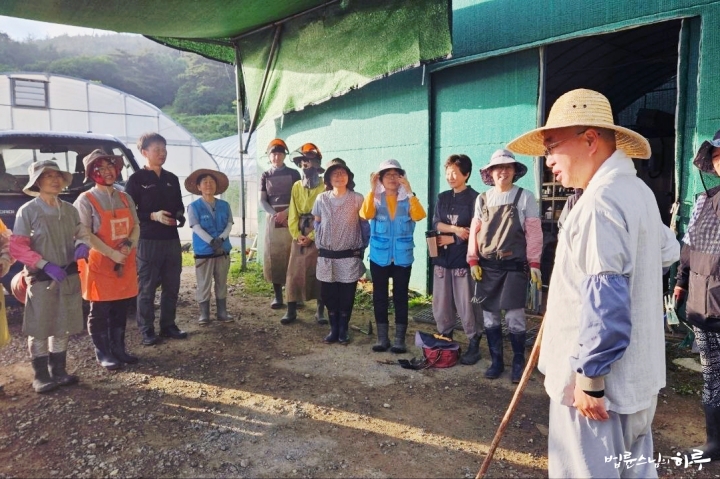
At 6:20 a.m., everyone gathered in front of the farm shed. The Dharma Teachers greeted Sunim with three bows. Today’s task was harvesting and sorting potatoes from the greenhouse. Sunim explained the precautions for digging potatoes and guided everyone to observe the thoughts arising in their minds as they worked, as practitioners should. Before starting, everyone recited together the Words to Remember: “Everything has its proper place,” and then began the work.

Sunim first used a sickle to cut the potato leaves and stems. The cut leaves and stems were moved to the adjacent ridge. The plan was to till them into the soil later to use as fertilizer when plowing the field. As Sunim cut his way through with the sickle, the Dharma Teachers began digging up potatoes starting from the end of the ridge.

Where the green leaves had been cleared, the soil was exposed. The Dharma Teachers sat between the ridges and dug potatoes from the soil. Since the potatoes were intended as gifts, they carefully used hand hoes to avoid damaging them. They had to look carefully because potatoes could remain buried in the soil if they didn’t dig deep enough.
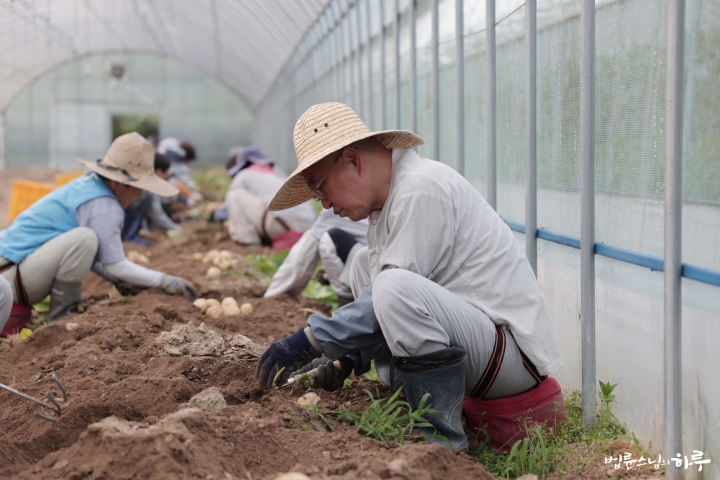
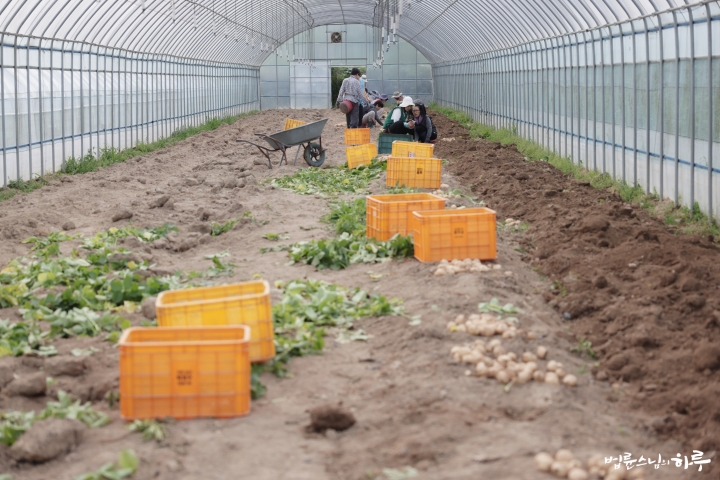
After finishing cutting all the potato leaves and stems, Sunim joined in the potato harvesting. As the hand hoe dug into the soil, white potatoes appeared. Some potatoes were large, while others were small. Despite careful digging, some potatoes got scratched. The damaged potatoes were set aside to be boiled and eaten for dinner.
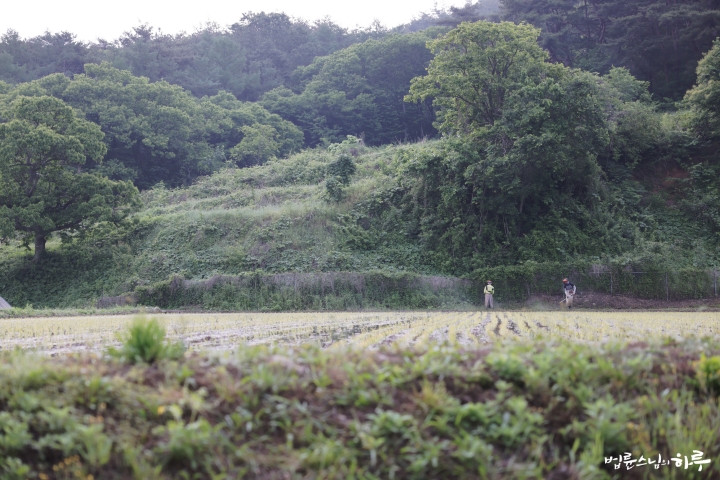
As the potato harvest neared completion, Sunim left the greenhouse and went behind the farm shed. Two trainees from the farming team were trimming with string trimmers on the upper rice paddy and the lower paddy embankment. Sunim took a walk around the rice paddies.
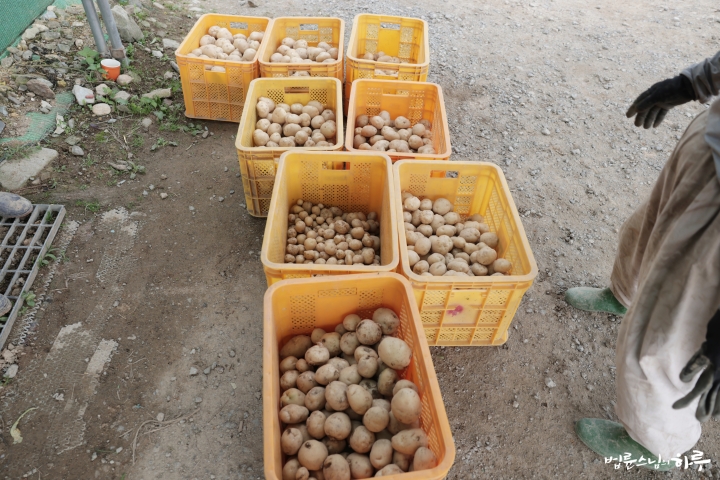
Inside the greenhouse, the potato harvesting was complete, and the potatoes were sorted by size and placed in plastic crates.
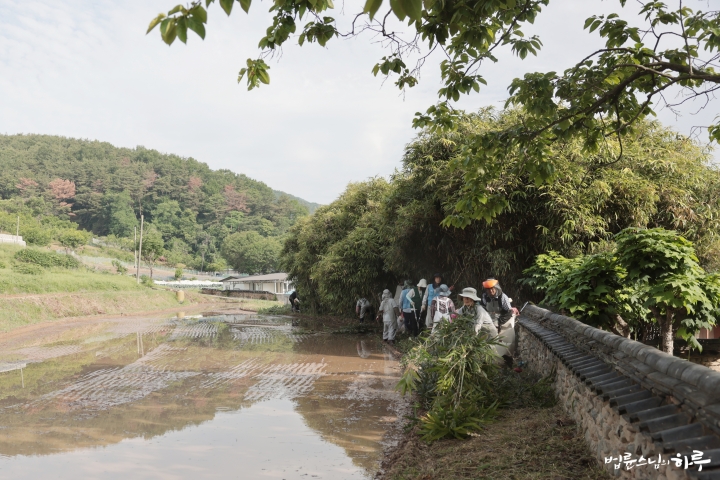
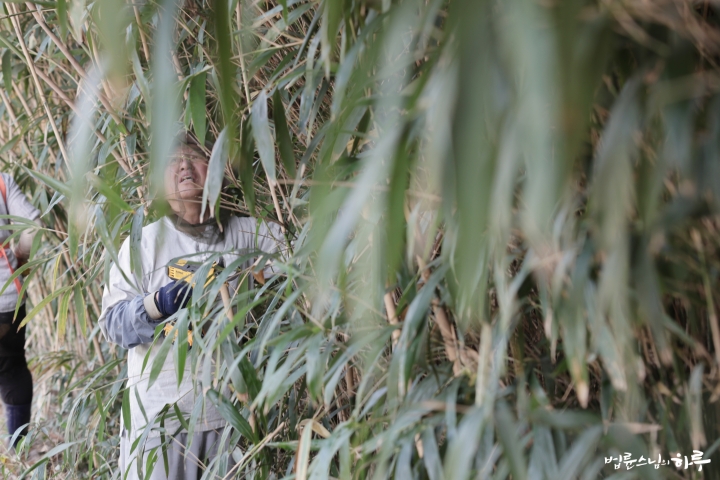
Sunim moved with a few of the Dharma Teachers to begin the next task. The path along the paddy embankment leading to the Dolmen House was overgrown with arrow bamboo, making it impassable. The bamboo had grown so tall that it cast shadows over the rice paddy. The next task was clearing the bamboo so people could walk through.
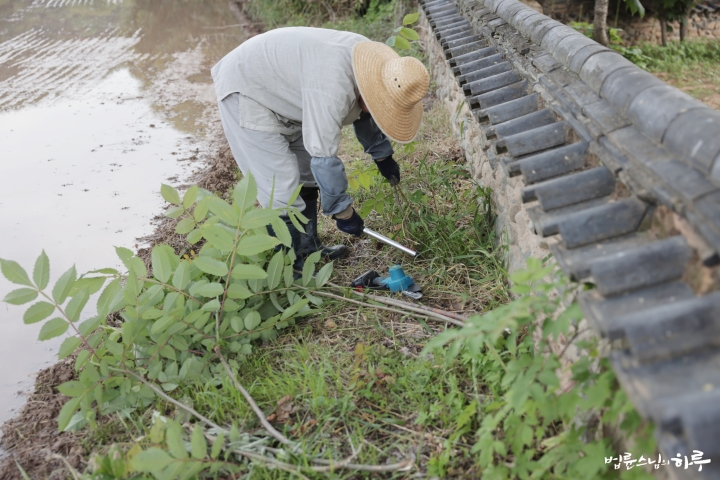
Sunim tried cutting the bamboo with a small electric saw. However, the bamboo wouldn’t cut cleanly, and the saw teeth kept getting caught, making the work difficult. Using a sickle left sharp pointed edges where the bamboo was cut, which was dangerous. Using rechargeable automatic pruning shears cut the bamboo cleanly, but each stalk had to be cut individually, requiring repeated hand strength. The best tool would have been a string trimmer fitted with a circular blade, but the circular blade couldn’t be found, so they couldn’t use it.
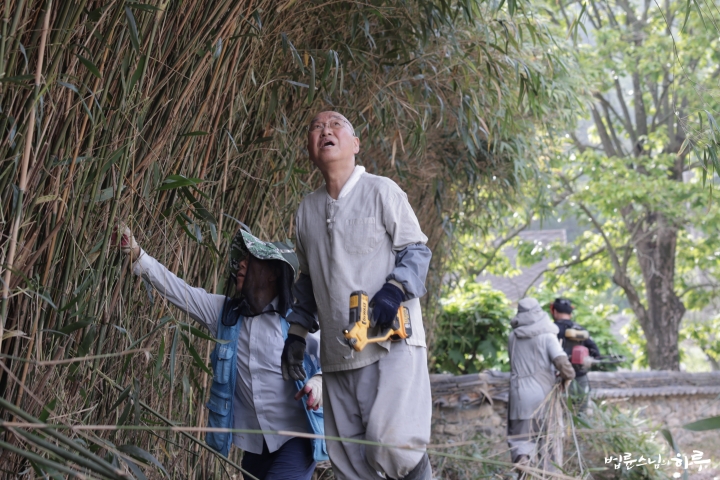
After trying various tools, Sunim used the one that cut best and began cutting the bamboo stalks one by one. Although arrow bamboo isn’t thick, the stalks were taller than a person and densely covered with branches and leaves, making the work challenging. One person held the bamboo while Sunim cut it.
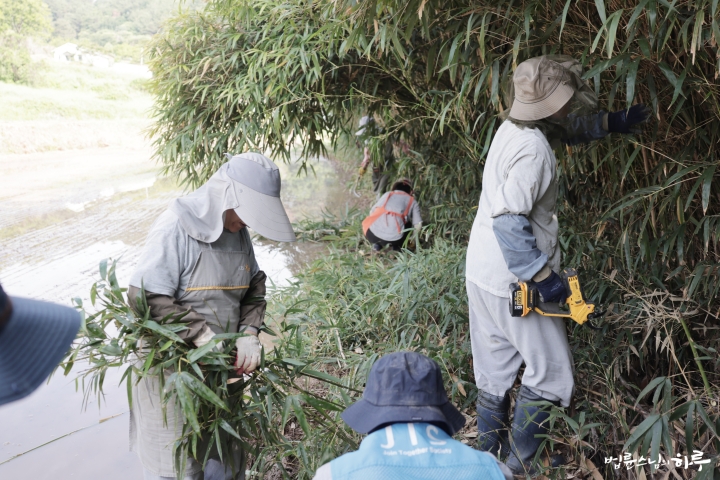
The Dharma Teachers dragged the cut bamboo and loaded it onto the truck.
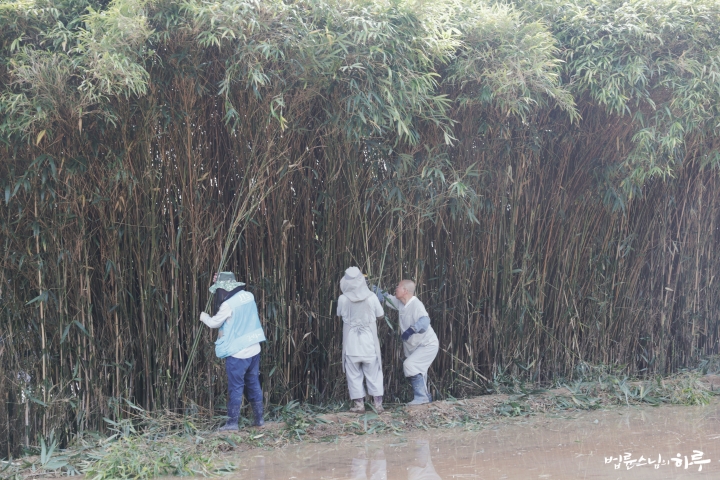
A path emerged where there had been none. The shadow cast over the rice paddy also shrank. Sunim worked from the front toward the back, while Dharma Teacher Beopan worked from the back toward the front using a bladed string trimmer to cut the bamboo. As the bamboo covering the paddy embankment was cleared, the path opened up cleanly.
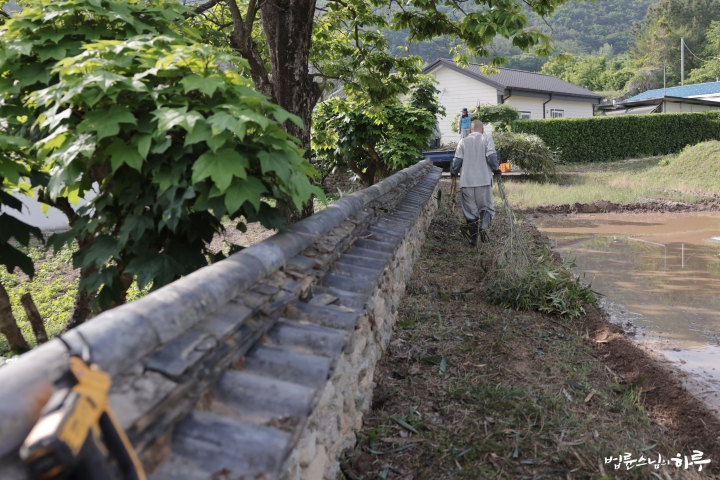
Each time Sunim cut bamboo with the automatic pruning shears, his fingers hurt from pressing the button. The battery was heavy, and he had to adjust the angle, which required considerable hand strength. Once the path was cleared, Sunim put down the pruning shears and helped move the bamboo.
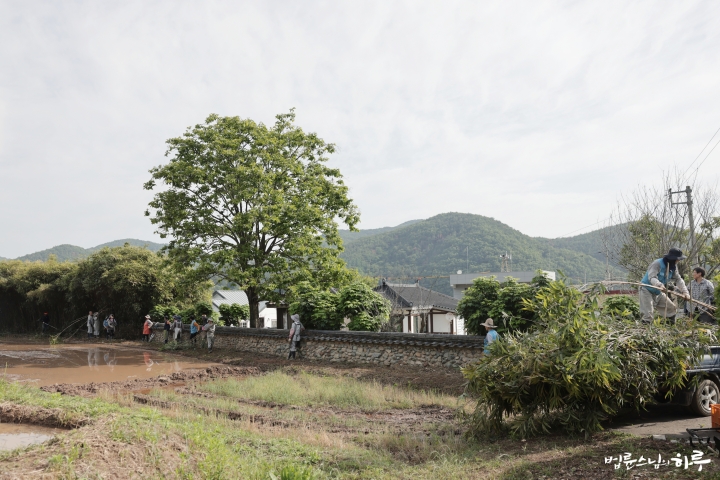
When the cut bamboo was loaded, the truck was filled to capacity. The bamboo was transported to Dubuk Jungto Retreat Center and stacked near the shredder.
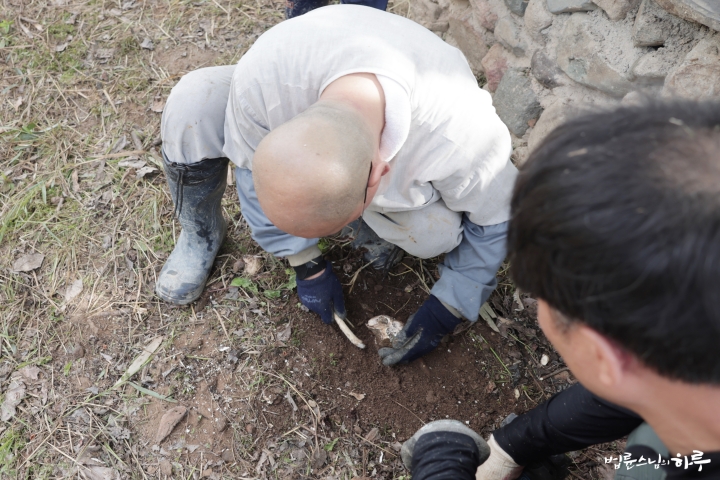
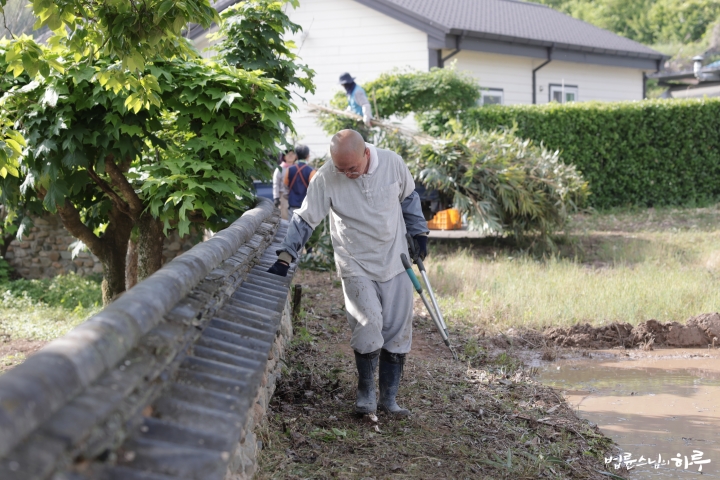
Sunim cut tree stumps protruding from the ground. Since people could trip over them while passing by, he used a saw to cut them flush with the ground.
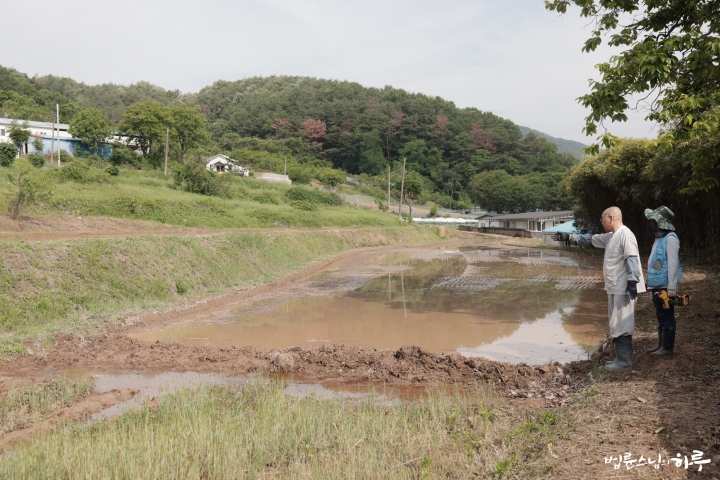
Once the paddy embankment path that had been hidden by the bamboo was revealed, Dharma Teacher Hyangjon asked Sunim to inspect the embankment, saying it seemed low. Sunim and Dharma Teacher Hyangjon walked around the paddy embankment, examining the low spots. They walked together to check which sections needed reinforcement.
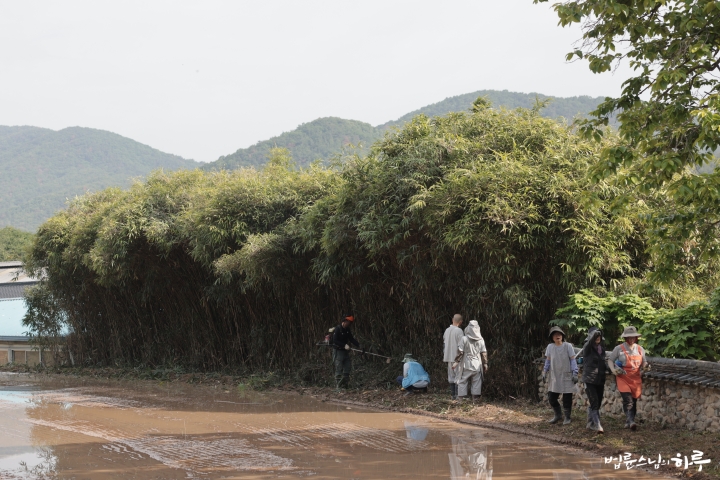
The bamboo-cutting work concluded around 8:40 a.m. The tools and boots were washed and put back in their proper places. Sunim and the Dharma Teachers changed out of their work clothes, briefly tidied up, and began Barugongyang (formal Buddhist monastic meal) at 10 a.m.
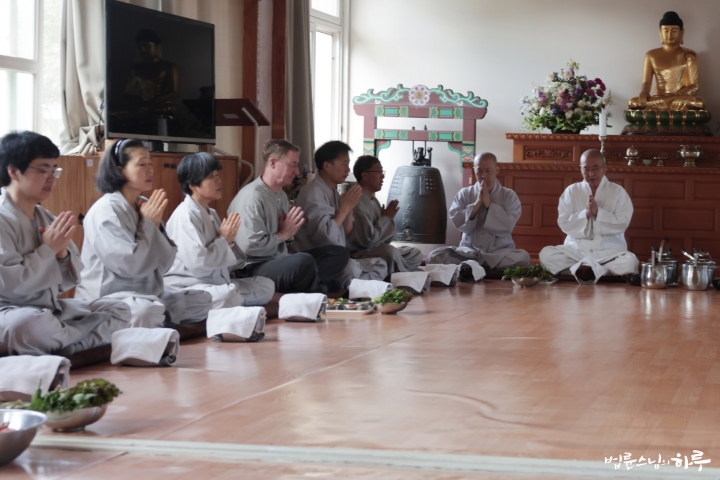
The sound of the moktak wooden instrument announced the start of Barugongyang. Everyone took their seats. Before sitting down, Sunim checked the arrangement of the cushions. Although the trainee in charge of arranging the cushions today had left about a hand-span between them, the men’s knees still touched. After readjusting the cushions, the Small Heart Sutra began with three strikes of the bamboo clapper, and Barugongyang commenced.
“Born in Kapilavastu, Attained enlightenment in Magadha, Taught the Dharma in Varanasi, Entered nirvana in Kushinagar.”
It was time for the morning assembly. After today’s announcements were shared, the members of the Sangha requested a word from Sunim. Continuing from yesterday, Sunim spoke about how to arrange cushions in daily life.
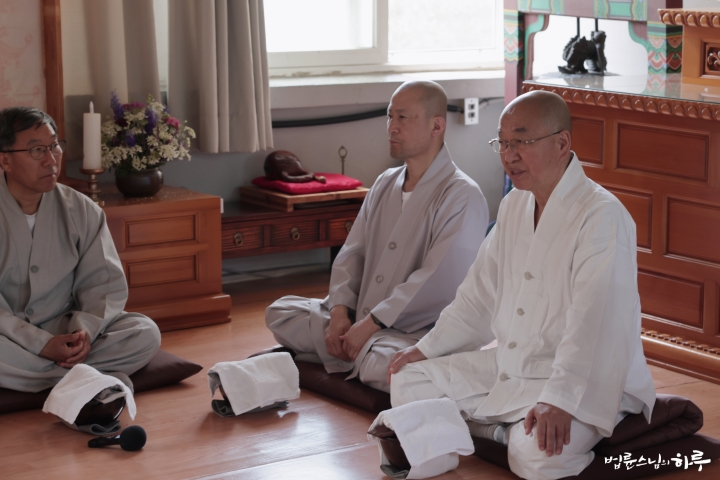
Dharma Teachers Should Inspect and Correct
Since the Jungto Society lay Sangha is divided into different regions, especially when living in cramped quarters at the trainee center, the way things are done in cramped spaces can just become the rule. Even chanting sometimes gets drawn out, but when they always do it that way among themselves, it becomes the norm. When you go to Sujata Academy in India and watch the students recite the Pancasila (Five Precepts), it’s completely drawn out and has become like a song. Since they learned it that way from childhood, that’s become the standard. So when Dharma Teachers visit different locations to participate in Barugongyang or attend an event, if the chanting melody has been stretched out, if any rules have been altered, or if practices for cramped spaces have become standardized, you should correct them. Only then can the same rules be maintained over time. Otherwise, there’s a risk that practices in the India community, Seoul community, and Mungyeong community will all become different from each other.When There’s an Empty Spot in the Middle, Don’t Everyone Shift
When Barugongyang begins, it’s normal to sit in order of seniority. However, if a spot in the middle becomes empty for some reason, instead of removing the cushion or having people move their bowls, the person sitting at the very end can simply get up and fill that empty spot. Then no one else needs to move. This is an emergency measure. The same applies during Dharma assemblies. We often see empty seats at the front and ask everyone to come forward, having everyone stand up and move forward. Don’t do that. Have the person guiding leave those who are seated where they are and just have the person at the very back come forward to fill the spot. That way, no one else has to move. The community has basic order, but rather than rigidly enforcing order, we also consider efficiency. Please keep this in mind.”After Barugongyang ended, the Dharma Teachers cleaned the dishes and living spaces by group.
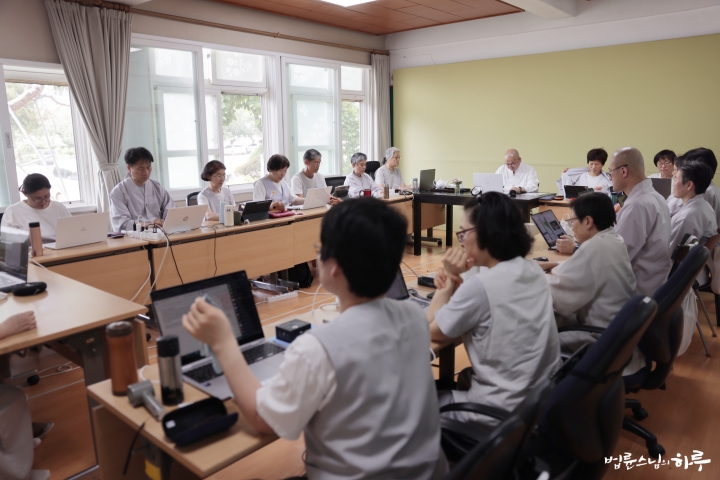
In the afternoon, Sunim discussed various topics with the Dharma Teachers. There was a discussion about culture in relation to Jungto Society’s future vision. The conversation covered diverse cultural topics, from memorial ceremonies for the deceased to monastic clothing. There were also discussions about various ideas that emerged after holding the Buddha’s Birthday Eve Cultural Festival and how to create and develop practice culture going forward. Discussions also took place regarding outreach activities and programs for the next generation—youth and young adults. Following this, they discussed reviewing community operational guidelines, organizing the social activities committee, foreign Jungto practitioners joining the community, and how to use the retreat center spaces. They also discussed running the Awakening Retreat and the use of its spaces, evaluation of this year’s Buddha’s Birthday events, and preparing programs for children visiting the center.
As they discussed numerous agenda items, it became time for dinner. They had an early dinner at 4 p.m. The menu was refreshing cold noodles served with well-fermented young radish water kimchi. Sunim praised the meal and thanked the kitchen volunteers who had prepared it, finishing his bowl of cold noodles. For dessert, they were served jet-black ripe mulberries. The Dharma Teachers who tasted the mulberries said they were delicious and wondered where they came from. The trainee who had prepared the mulberries explained. There was a large mulberry tree in the upper rice paddy behind the farm shed, and they had spread a tarp underneath so they could collect the mulberries that fell naturally. They had obtained the mulberries thanks to the farming team leader’s suggestion to lay out the tarp.
After the early dinner, Sunim and the Dharma Teachers held a discussion about Jungto Society’s future vision. They discussed enthusiastically until just before 9 p.m. After finishing the discussion, the Dharma Teachers watched the second episode of the SBS program . Since today had been a day of discussing culture, monitoring the entertainment program was especially meaningful. As Day 2 of the Sangha Dharma Teachers’ Retreat concluded, Sunim’s day also came to an end.
Tomorrow is Day 3 of the Sangha Dharma Teachers’ Retreat. There will be a Weekly Dharma Assembly in the morning, and intensive meetings and a walk are planned for the afternoon.
Since there was no Dharma talk for the public today, this post concludes with a conversation from the Dharma Q&A held last April at Kyungpook National University in Daegu.

**I Want to Change My Habit of Nagging at Work
**
“I’m a woman in my early 40s working at a company. I have a very meticulous and tidy personality. I’m quite sensitive, so I naturally notice everything around me without trying. This tendency often helps with my work. However, the problem is that I apply my standards to my subordinates as well. I consider double-checking work to be basic, and when that doesn’t happen, I scold the staff or react emotionally. I get stressed thinking, ‘I can see it, why can’t they?’ I try to understand that others may see things differently, but when I actually face their mistakes, I lose my temper before I know it. As a result, I tend to nag a lot at work. I want to change this. What should I do?”
“But I criticize others’ mistakes excessively.”
“Mistakes should be pointed out.”“Yes, that’s true, but…”
“See? You immediately defend yourself as being right. (Laughter) You have no choice but to live as you are.”“Is there a way to point things out while hurting others less? I’m going to point things out anyway, so I’m wondering if there’s a way to hurt others less and also calm my own anger.”
“Suppressing anger actually risks making it explode more powerfully later. At first you smile and endure, then you grit your teeth and endure, and eventually it bursts out in a big way. So for you, it might actually be better to express things little by little as they come up, even if it sounds like nagging. Koreans often say they can’t endure more than three times. ‘I let it go once, twice, but three times is too much!’ Anger that’s held back like this eventually explodes all at once, creating bigger conflicts and wounds. On the other hand, expressing things as they come up may be somewhat bothersome, but it doesn’t escalate into big fights. To fundamentally solve this problem, you need to let go of the thought ‘I am right.’ In relationships, ‘I am right’ is only your standard, not the other person’s. For example, when two people walk together, one might be ahead while the other is behind. The one in front thinks, ‘Why aren’t they hurrying up?’ and the one behind thinks, ‘Why are they rushing so much?’ This often happens between married couples too. When going out, the husband may already be outside the gate while the wife is still getting ready. The husband thinks, ‘My wife always comes out late,’ and the wife thinks, ‘He always goes out by himself first.’ This is because their roles and situations differ. The husband mostly does outside work and doesn’t do housework, so he can leave as soon as he puts on his own clothes. The wife, however, has to do housework—closing windows, checking the kitchen, tidying various things—so it inevitably takes more time. So the wife thinks, ‘My husband always goes out alone first,’ and the husband thinks, ‘My wife is always late.’ Everyone sees from their own perspective. In the end, it’s just your standard. Listening to your story, you sound a lot like me. It hasn’t been easy for me to live this long with this kind of personality either. (Audience laughter) The thought ‘I am right’ is only your standard. Everyone sees others from their own standard, but there’s no absolute standard to begin with. From your perspective, the other person seems inadequate, but from their perspective, you might be a person who nags and interferes too much. In this state, the problem can’t be solved. If you truly want to change yourself, you need to accept the fact that ‘the other person and I are different.’ It means understanding, ‘Oh, that’s how they are.’ But can you do that? The reason I’m hesitant to even mention this is that I don’t think it will work for you.”“I’ve been watching a lot of Sunim’s videos lately. You’ve taught about ‘awareness,’ so these days when I’m about to get angry, I think, ‘Ah, I’m getting angry,’ or ‘I’m about to get angry!’ and I can endure it at least once.”
“You shouldn’t endure. Enduring is not awareness. Enduring means you’re already angry. If you suppress anger when you’re already angry, pressure inevitably builds up and explodes. When I observe myself, I see this too. So don’t endure—just be aware: ‘Ah, I’m getting angry.’ When you notice ‘I’m getting angry!’ before you’ve actually expressed it, there are no side effects. If you’ve already expressed anger, instead of blaming yourself with ‘I got angry again,’ just repent by saying, ‘I’m sorry I got angry.’ But this kind of repentance is difficult for you. That’s because you think you got angry because the other person was wrong. You don’t recognize ‘my anger is my problem,’ but instead think ‘you are the problem,’ which makes repentance difficult. So every time you get angry, you need to repent. Because it’s not the other person’s problem—it’s your problem. There are three approaches. First, live as you are. Accept yourself with ‘this is just my personality’ and live with it. You’ll get angry sometimes and get criticized for it. Second, practice ‘awareness.’ As you mentioned, to get criticized less, just be aware: ‘Ah, I’m getting angry!’ or ‘I got angry.’ This softens things a bit. Even when you do get angry, you’ll quickly apologize, making you someone people can get along with. Third, fundamentally understand that we are simply different. Right and wrong don’t inherently exist—we are just different. We have different personalities, different beliefs, different thoughts. When you reach this state, there’s nothing to be angry about. To summarize, when you understand others, there’s nothing to be angry about. But when you have right and wrong, anger arises. At those times, you should practice awareness. If even that is difficult, you have no choice but to just live as you are. However, that comes with some suffering.”“Yes, thank you for your words. I’ll try.”
“Try what?”“To be aware so I don’t get angry.”
“You shouldn’t try not to get angry. If you try not to get angry, with your personality, will anger arise or not? When you try not to get angry but still get angry, you’ll abuse yourself, thinking, ‘Can’t I even do this?’ That’s the same as blaming others. Just as you say, ‘Can’t that person even do this?’ you’re saying to yourself, ‘Can’t I even do this?’—abusing yourself. It’s just blaming others turned into blaming yourself. Blaming anyone like this is not practice. Practice means not blaming anyone. When you get angry, just be aware, ‘I’m getting angry.’ If you got angry, just repent by saying, ‘I’m sorry I got angry.’ More fundamentally, just understand that ‘we are different.’ Then there’s nothing to be angry about. Recently, I went to India for a broadcast shoot. The broadcast team didn’t know much about India, but they were the ones planning and executing things. Since I’ve been to India about 100 times, watching them work made me feel a bit frustrated. However, the others who came along were visiting India for the first time, so they had no sense of any problem. If you don’t know, you have no reason to feel frustrated. Because I knew so well, I kept thinking, ‘It would be easier if we did it this way.’ Knowing is the disease. (Laughter) Since this broadcast wasn’t led by me but rather I was tagging along on someone else’s shoot, I had to do what the PD said. But knowing things, I kept wanting to comment. ‘It would be better to do it this way rather than that way’ kept trying to come out of my mouth. At times like this, just be aware: ‘Ah, this is what’s happening with me.’ There’s no inherent right or wrong. Those people don’t think they’re doing anything wrong. When I asked them, they said they were doing well. They said this is just how it’s done. (Laughter) So what could I say to that? Conversely, if those people looked at me, they might think, ‘Goodness, Sunim isn’t doing what he’s told.’ It’s just a difference in perspective; there’s no right or wrong. First, when you get angry, be aware: ‘I’m getting angry!’ Second, if you did get angry, repent: ‘I’m sorry I got angry.’ Third, if even repentance is difficult, you can just live by losing your temper and being criticized. But you’ll have to accept some consequences. The important thing is that whatever choice you make, you don’t need to grit your teeth and force yourself. Just keep practicing steadily—you should never strain yourself. If you strain, you’ll inevitably get stressed.”“I understand, Sunim. Thank you.”