Are There Times When Sunim Feels Afraid or Angry?
May 25, 2026 - Day 1 of the Community Dharma Teachers' Retreat
Hello. Starting today, the Community Dharma Teachers’ Retreat will be held at Dubuk Jungto Retreat Center for three days. Every year after the Buddha’s Birthday celebration, Sunim takes time to discuss overall matters related to the management of Jungto Society with the community Dharma Teachers.
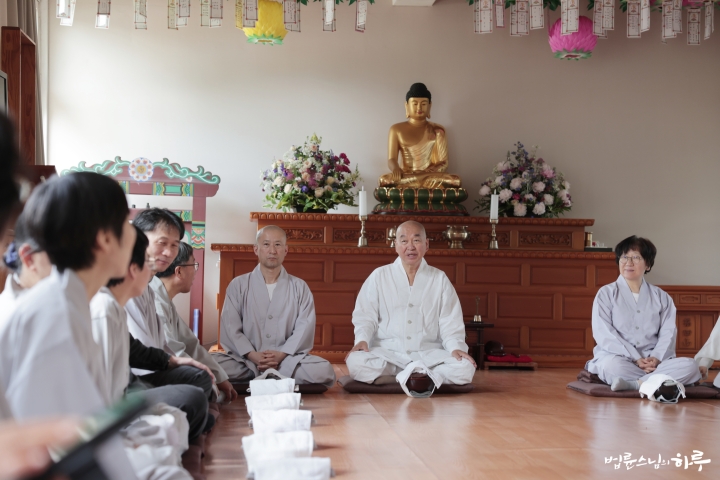
Sunim began the day with morning practice and meditation. At 10 a.m., he had Barugongyang (formal Buddhist monastic meal) with the resident members and Dharma Teachers in the Dharma hall of Dubuk Jungto Retreat Center. After Barugongyang, the morning assembly began, and various announcements regarding the schedule and daily life were shared. Then, the Sangha members requested a word from Sunim.
While having Barugongyang today, Sunim spoke about something the Sangha needed to look into together.
“Starting today, we have the Community Dharma Teachers’ Retreat. When I sat down for Barugongyang on the cushions arranged in the Dharma hall today, I noticed that the men’s knees extended beyond the cushions. Because the cushions are placed too close together, the knees touch one another. This makes everyone shrink and become tense. Since the spacing between cushions is narrow, the space between the bowls is also tight, making it inconvenient when placing the side-dish trays. When the space for Barugongyang is sufficient, please arrange the seating with about a hand-span of space between cushions. In today’s case, even though there was extra space toward the back of the Dharma hall, the cushions were placed right next to each other. When having Barugongyang in the dining room, the space is narrow, so cushions are placed close together. But when there is ample space like today, please arrange the cushions with proper spacing, taking into account the side-dish trays as well. Since we’ve been having Barugongyang in the narrow dining room for so long, you may think it is standard to place cushions tightly together. However, the original standard is to leave space between cushions.”After speaking about the arrangement of Barugongyang cushions, Sunim looked at Craig, who had joined the meal, and asked:
“Craig, how is community life going for you? How are you finding it?”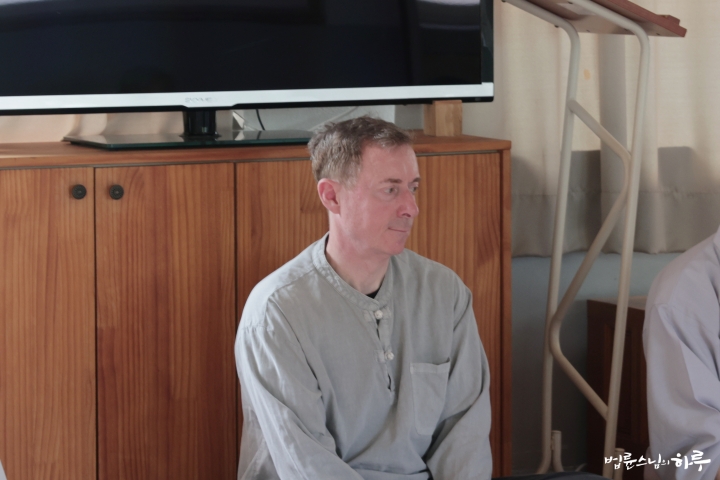
Craig, a newspaper journalist who belongs to the International Division and graduated from Introduction to Buddhism, works remotely as a journalist while participating in the “One-Month Farmer” program at the Dubuk community. On behalf of Craig, who is not yet fluent in Korean, the head of the farming team shared an update. He explained that on weekends, when Craig is not working as a journalist, Craig fully joins the farming team for work practice, and especially plays a big role in tasks requiring physical strength. After listening, Sunim offered Craig some words of encouragement.
“Please find a balance so that your work isn’t disrupted.”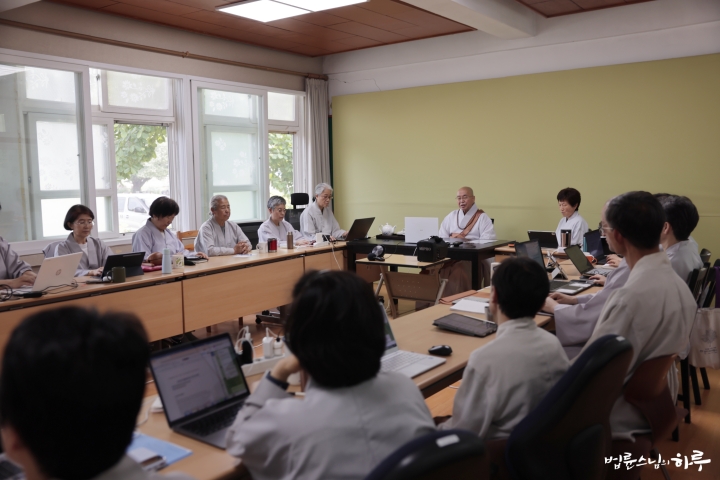
After Barugongyang, the Community Dharma Teachers’ Retreat began at 11:30 a.m. Twenty-one people gathered in the retreat hall, and six more joined online, bringing a total of 27 community Dharma Teachers together.
When Sunim entered the retreat hall and took his seat, the attendees requested the Dharma teaching with the Cheongbeopga (Song of Requesting Dharma) and three bows.
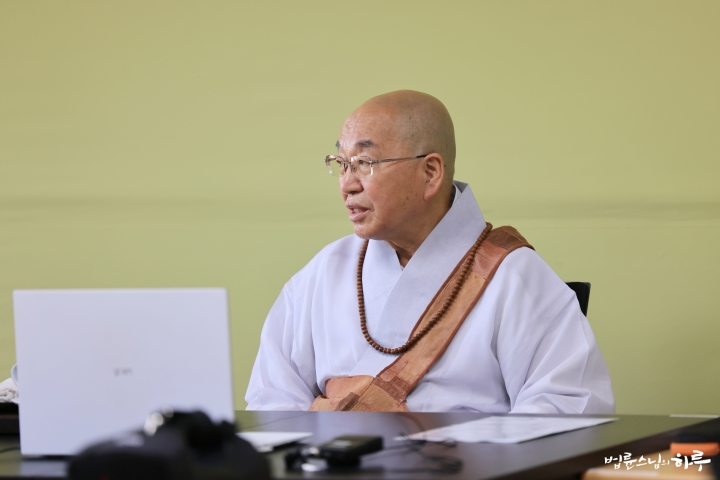
Sunim’s opening Dharma talk followed.
Beginning the Community Dharma Teachers’ Retreat
“Every year, after the Buddha’s Birthday celebration, the Community Dharma Teachers have set aside time—anywhere from three days to a week—to hold a retreat together. During this period, we review how the Buddha’s Birthday celebration went overall and address current issues from the past year. We also discuss in depth the long-term vision for the future of Jungto Society. In addition, for Jungto Society to remain healthy for a long time to come, it is most important to keep a practice-oriented perspective at the center. So we have been having conversations about how to establish this perspective properly. Last year, we couldn’t hold the retreat because of the 100-Day Dharma Talk, so this is the first Community Dharma Teachers’ Retreat in two years.The Second 10,000-Day Practice and a Sustainable Jungto Society
Originally, my plan was to lead only up to the first 10,000-Day Practice, and then let go of everything from the second 10,000-Day Practice onward. That’s what I had been thinking for a long time. However, when the second 10,000-Day Practice actually approached, circumstances didn’t allow it to happen as planned. So I continued as before through the first 1000-Day Practice of the second 10,000-Day Practice. Instead, starting from this second 1000-Day Practice, the structure of the Gyeolsa Practitioners has been somewhat reorganized. Those aged 65 and over, who are not particularly efficient in decision-making, have been excluded from the discussion structure where possible. The intent is to streamline the meeting structure so that discussions do not become too sprawling. So starting this year, I have also decided not to attend meetings. If I don’t attend, decision-making may become somewhat slower, or decisions may be less than ideal. But after all, when I am gone, someone will have to make decisions, won’t they? Even if it is somewhat lacking, we need to practice and adapt on our own from now on, so that Jungto Society can continue stably and sustainably into the future. From this perspective, we are currently implementing these changes on a trial basis.Wrapping Up Social Activities and the International Division, and New Tasks
During this second 1000-Day Practice, I plan to gradually wrap up much of Jungto Society’s internal work and domestic projects. Currently, work in the social activities and international divisions still remains. In fact, these two areas may be ones that need to be expanded more actively at this point in time. So how to develop these two areas going forward, and for how long to continue them, requires further discussion and review. For the remaining areas, I believe it is appropriate to wrap them up quickly and cleanly, at least within this second 1000-Day Practice period. If there are specific and urgent issues that need to be addressed by the Community Dharma Teachers during this retreat, we will review them. If there are none, all the better. While Jungto Society’s long-term vision and activity plans are important, two issues have come to feel especially important: how to cultivate and deploy human resources going forward, and how to develop new content to share with the public. Society is changing rapidly, and especially with the emergence of artificial intelligence (AI), work efficiency has changed completely from what it used to be. Until now, Jungto Society has been relatively ahead of other NGOs and religious organizations in our society. But now, our strengths have become widely known, and most have been benchmarked. As a result, there isn’t much left that could be called our unique strength. The know-how we have built up over many years still remains, but beyond that, there are no particularly notable strengths visible. That is the reality.The Aging Crisis and the Development of New Content
The greatest crisis currently facing religious organizations and civic groups is “aging” and “declining participation” due to population decline. Jungto Society is not in an immediately serious crisis, but our activities have entered something of a plateau, and the aging issue is undoubtedly a challenge facing Jungto Society as well. So during this retreat, we need to put our heads together to figure out how to address these issues, even just at the level of ideas. The current Jungto Society has the capacity to maintain and manage the areas we have already cultivated. It may be somewhat demanding, but we manage. However, when it comes to developing new content while staying a step ahead in preparation for the future, I think we are currently at a standstill. In this situation, what should we do? Should we accept reality as it is and focus on maintaining and managing the status quo? Or should we, even if difficult, pursue change and renewal to respond to the future? Here too, rather than just prioritizing ideals, we need to plan with a clear-eyed consideration of our current capacity.Integrating Farming Experience with Practice and Cultural Programs
When I visited Hongneung last April, I saw that residents were running a hands-on rice-planting program on about 500 pyeong of land, using traditional methods with rope guides. I think we could also designate a day in spring as “Farming Promotion Day,” where the Sangha gathers together and children also come to try farming. We could use rope guides to plant rice, just like in the old days when King Suddhodana went out to the agricultural festival to encourage farming. Our purpose in farming here is not to increase yields but to directly experience an eco-friendly way of life. However, currently we are so caught up in just getting the farming done that we are quite overwhelmed. I’d like us to study more deeply how to connect this with practice, and how to integrate it with educational and cultural programs for the public.Buddha’s Birthday Programs for Children and Popularizing Emotional Culture
Quite a few children come to our Jungto Society Buddha’s Birthday celebration. From what I can see, there seem to be more than 50 of them. So for just that one day, it would be wonderful to prepare special programs for the children. For example, we could give each child a small gift, or gather them by age group—babies under three with their mothers, then kindergarteners, elementary school students, middle school students—and take commemorative photos with Sunim or give them mājeongsugi (the touching of the crown of the head as a blessing). The children may have come without knowing who Pomnyun Sunim is, but later, when they are 20 or 30 years old, even after Sunim has passed away, they can recall, “When I was little, I received mājeongsugi from Pomnyun Sunim and took a photo with him.” This can become a precious occasion that leads them to take refuge in the Buddha-Dharma and contribute to it. I have asked for this kind of thoughtful planning before, but because the person in charge keeps changing, it hasn’t been implemented well. From now on, the preparation team should set aside gifts for the children in advance and offer them with care to children who come with their families. As we considered cultural events this time, a task emerged: how to convey the Buddha’s teachings to the public in an emotional and heartfelt way. This is an area we have talked about for the past 30 years without actually carrying it out properly. Now is the time to put this into practice more seriously. On this occasion, we also need to boldly try renewing rituals such as the cheondojae (memorial rite), Dharma services, the Heart Sutra, and chanting by combining them with modern musical composition. Honestly, the cheondojae as it is now does not deeply move the public. Traditional rituals should be solemn and majestic by nature, but our current rituals are neither solemn and majestic nor modernly moving—they are in a somewhat ambiguous state. I’d like us to attempt improvements in this area more boldly.Pooling Jungto Society’s Capacity for Pop Culture Planning and Buddhist Works
I had a conversation with the Gilbeot writers about the program we filmed in India this time. The writers said, “Jungto Society’s Gilbeot has many excellent writers and many talented actors. There are also many outstanding producers and directors. If these people wrote the scripts, directed, and we ourselves appeared, couldn’t we create something far more moving and excellent than what the broadcasting station made?” It was a good suggestion. Like this, we need to gather our abundant human capacity. Just as we gained new ideas in the publishing field by entrusting work to outside publishers, in the arts and culture field as well, we need to create what only Jungto Society can create with our own capacity. Beyond simply listening to Dharma talks and publishing books, we need to plan diverse cultural content such as videos, dramas, and music. Not long ago, while talking with pianist Lim Hyun-jung (임현정), we agreed to try “A Meeting of Instant Speech and Instant Music,” in which Sunim gives a Dharma Q&A and, based on its content, the feelings are expressed through piano music. Beyond a simple music performance, presenting a new form of cultural content that incorporates culture and entertainment would surely delight the public.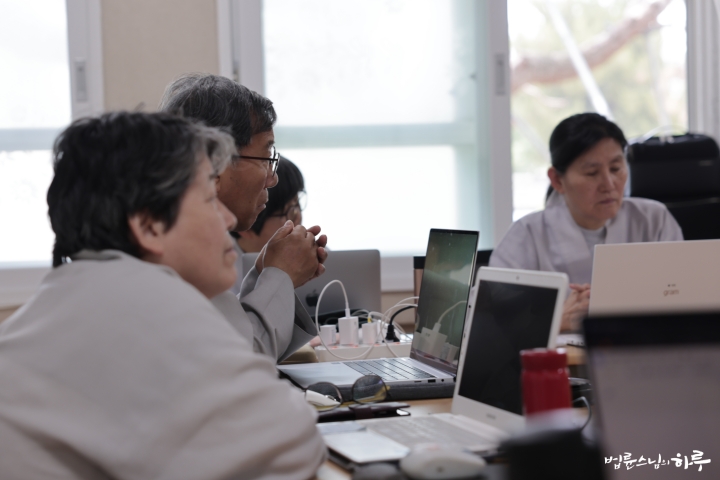
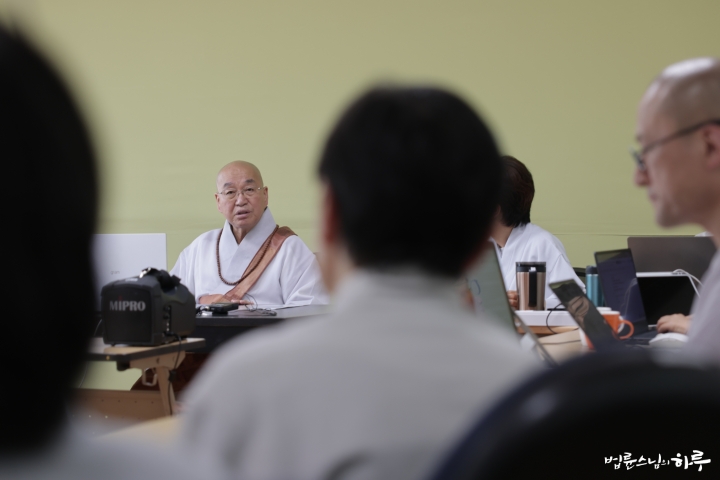
Sunim’s opening Dharma talk came to an end. He quickly reviewed manuscripts and handled urgent business matters before joining another meeting, where he engaged in in-depth discussions with the Dharma Teachers about current issues facing Jungto Society.
The weather forecast predicted rain all day tomorrow. Since farming work cannot be done in the rain, the schedule was adjusted to do farm work late this afternoon. The Dharma Teachers also prepared for the work and were to gather at the field up on the hill.
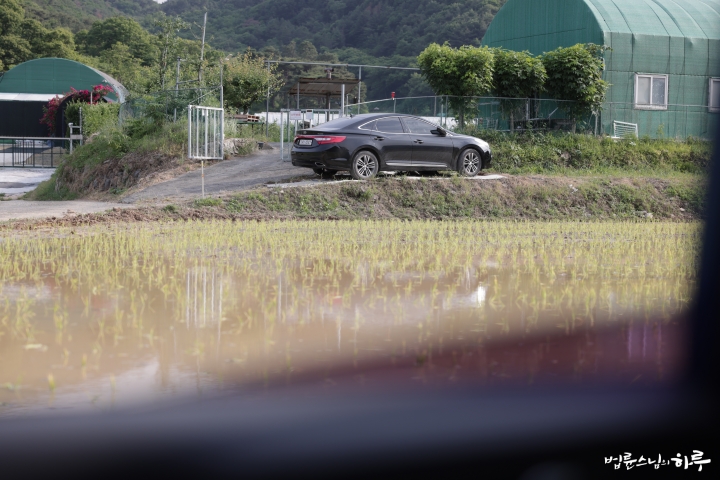
Around 5 p.m., Sunim left the retreat center and headed to the rice paddy where transplanting had just been completed. He wanted to check whether the rice seedlings had been planted in straight rows. Compared to other paddies where transplanting had been finished, some rows appeared slightly uneven.
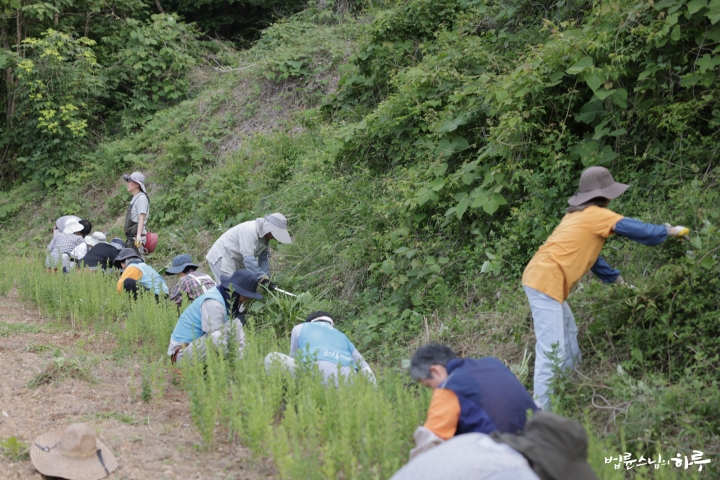
Sunim changed into his work clothes, gathered his tools, and headed up to the field on the hill. It had been a while since he last visited this field, as the last time he had weeded the bellflower and deodeok fields was at the end of April. In the meantime, the weeds had grown considerably.
“Please cut down the kudzu vines first. If the kudzu vines are tangled, they keep getting caught in the string trimmer blade.”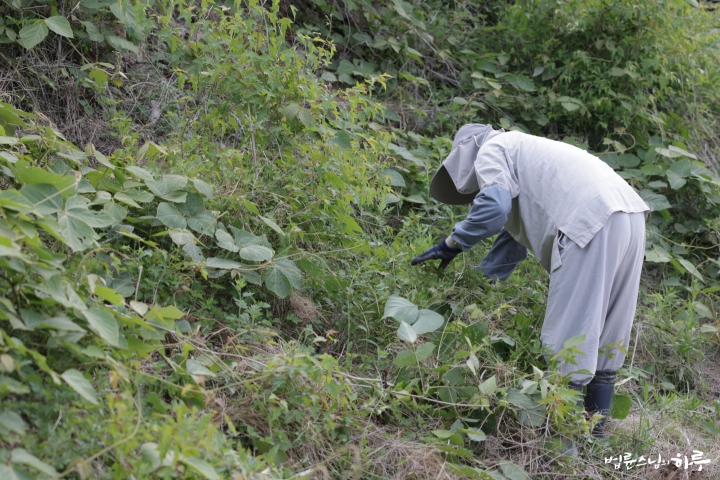
Sunim used a sickle to cut the kudzu vines creeping into the bellflower field. By removing the vines first, he made it easier for the Dharma Teachers to operate the string trimmers smoothly. Meanwhile, the Dharma Teachers continued weeding the bellflower field and operating the string trimmers.
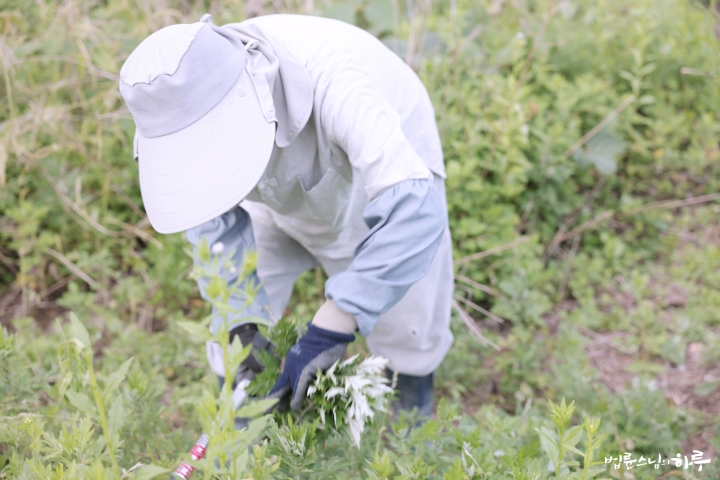
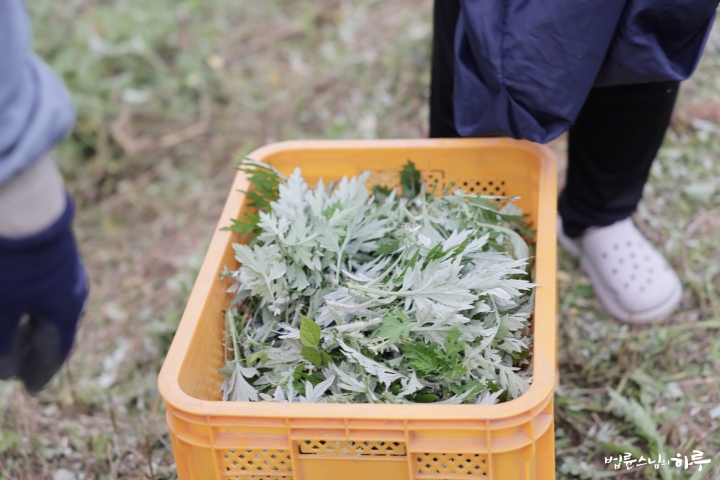
Sunim moved to the deodeok field on the lower level. Since the deodeok field receives ample sunlight, mugwort had grown abundantly. Sunim began harvesting mugwort with his sickle. Because the mugwort had grown tougher since April, Sunim carefully held only the soft tips and snipped them off with the sickle. The container box quickly filled up with light green mugwort.
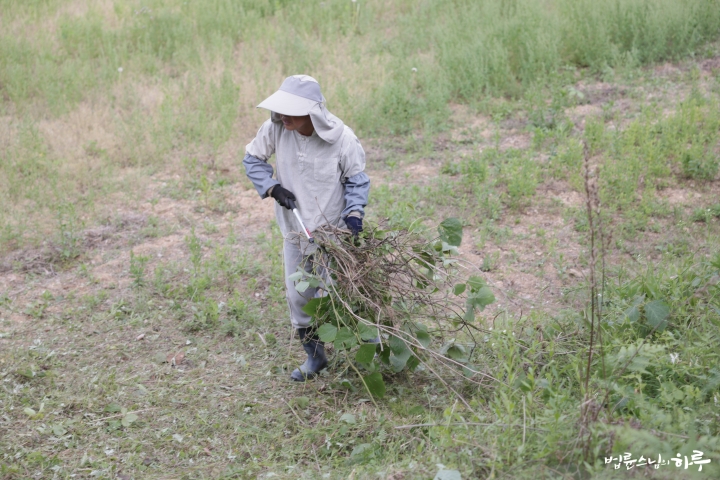
Sunim gathered the cut kudzu vines from the hillside and neatly tossed them outside the field to clear the area.
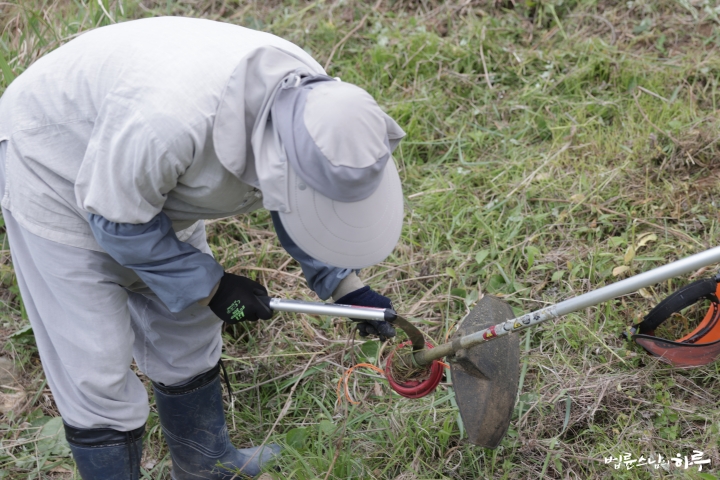
One of the Dharma Teachers operating a string trimmer had to stop working. When the kudzu vines became entangled in the trimmer line and prevented it from running, Sunim cut the vines loose with his sickle.
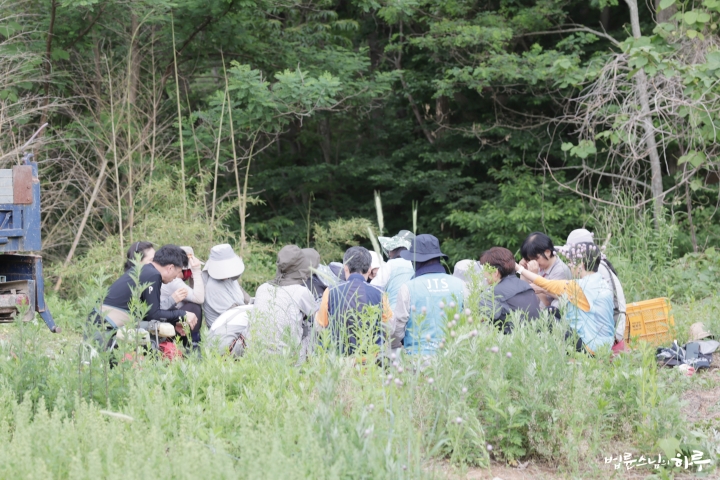
An hour and a half after starting the work, everyone took a brief break. As they enjoyed snacks brought along for the break, lively conversation blossomed between Sunim and the Dharma Teachers. From stories about the days when rice was transplanted by hand to discussions about acupuncture treatments and health care, the 30-minute break passed by in no time.
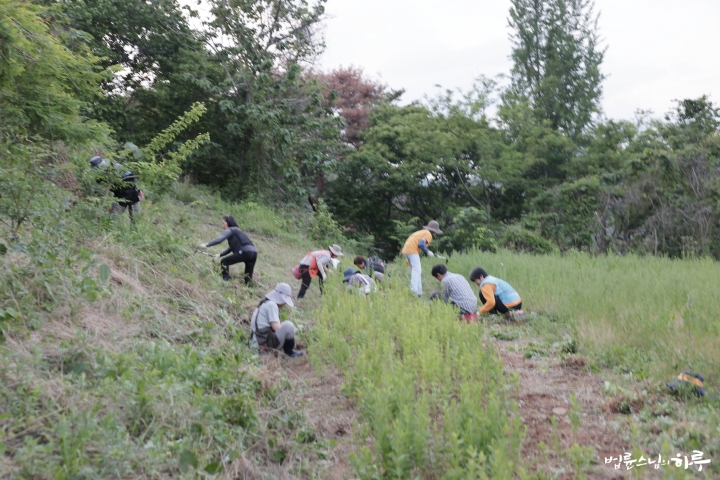
As the sun began to set, mosquitoes started swarming in. After packing up the snacks, everyone began the final stretch of work.
Sunim finished weeding the remaining areas of the bellflower field and cleared away the last of the kudzu vines. Finally, he began trimming the mugwort that had been harvested.
“Anyone who wants to eat mugwort rice cakes tomorrow, come over quickly and help trim the mugwort.”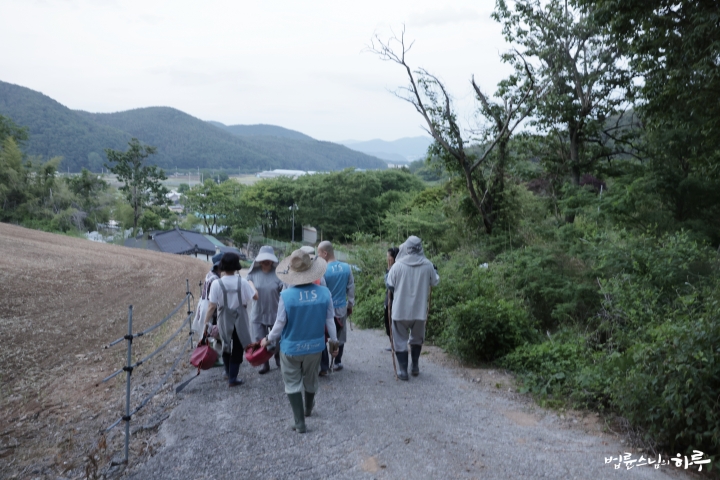
At Sunim’s words, the Dharma Teachers who had just finished weeding gathered around the container box filled with mugwort. With many hands helping, the large pile of mugwort was trimmed in no time. After gathering the tools and coming down from the field, it was around 7:30 p.m.
Sunim changed out of his work clothes, had dinner, and concluded the day’s activities. Tomorrow, the second day of the community Dharma Teachers’ retreat is scheduled.
Since there was no Dharma talk for the public today, this post concludes with a conversation from the Dharma Q&A held last April at the Silla Cultural Center.
Are There Times When Sunim Feels Afraid or Angry?
“I’m curious whether Sunim also experiences fear or anger. If so, how do you handle it?”
“Yes, thank you.”