Buddha’s Birthday Is a Day to Vow to Awaken from Ignorance and Become Free from Suffering.
May 24, 2026. Buddha's Birthday Celebration Ceremony, Public Figures' Dharma Assembly, Youth Talk Talk, Condolence Visit Hello. Today is Buddha's ...
Hello. Today is Buddha’s Birthday, in the Buddhist year 2570. In the morning, a celebration ceremony was held for members of the Sangha, and in the afternoon, another celebration ceremony was held for public figures. In the evening, ‘Youth Talk Talk’ was held for young people.
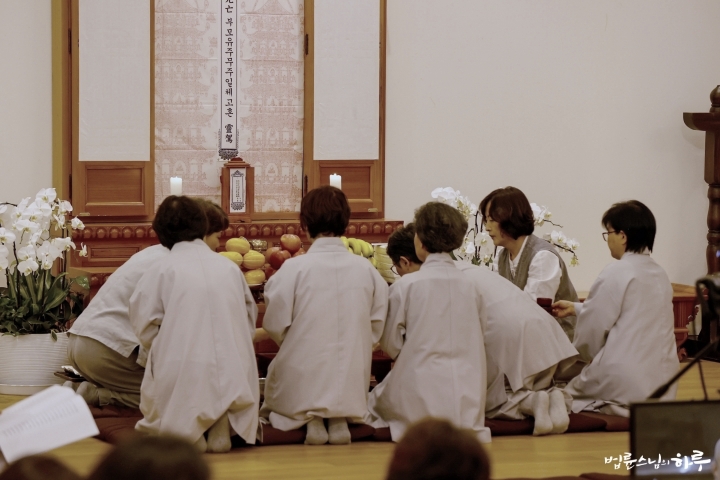
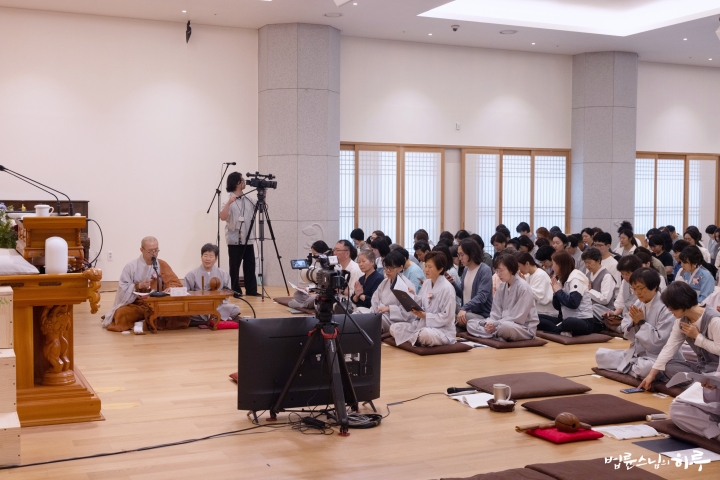
Beginning with the ringing of the bell to signal the start of the ceremony, the first part of the celebration ceremony—the cheondojae (memorial rite for the deceased)—was held at 9 a.m. in the Dharma Hall on the 3rd floor of the Jungto Social and Cultural Center. After the offering ceremony, Yusu Sunim served as the presiding monk, and Dharma Teacher Hyangjajae led the moktak as the cheondojae was performed.
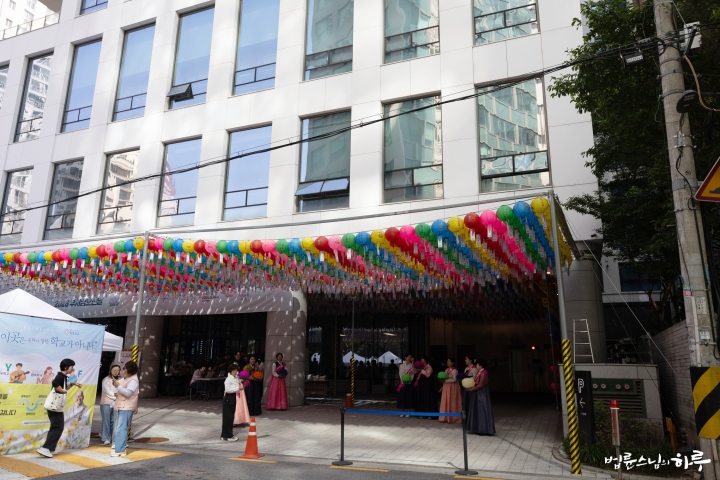
About 1,200 Jungto Society members were seated in the Dharma Hall on the 3rd floor, the basement auditorium, and the 1st-floor lobby of the Jungto Social and Cultural Center. About 3,200 more members at the main temples of Jungto Society in Korea and abroad participated in the celebration ceremony via live broadcast. Additionally, everyone who participated in the lotus lantern donation campaign watched the live broadcast online from their homes.
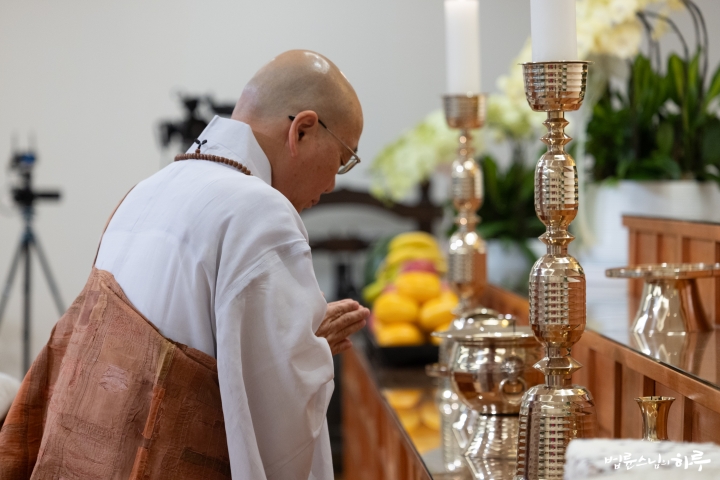
Sunim offered incense, praying for the liberation of all sentient beings.
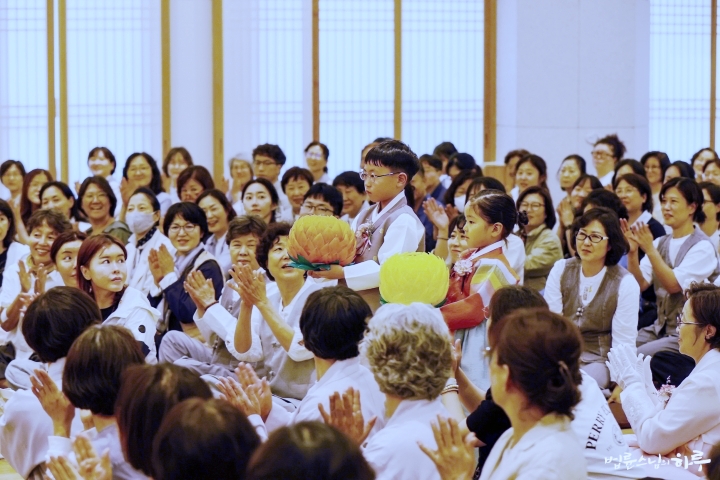
Representing the next generation, children Lee Seeun and Lee Seungjun offered lotus lanterns before the Buddha.
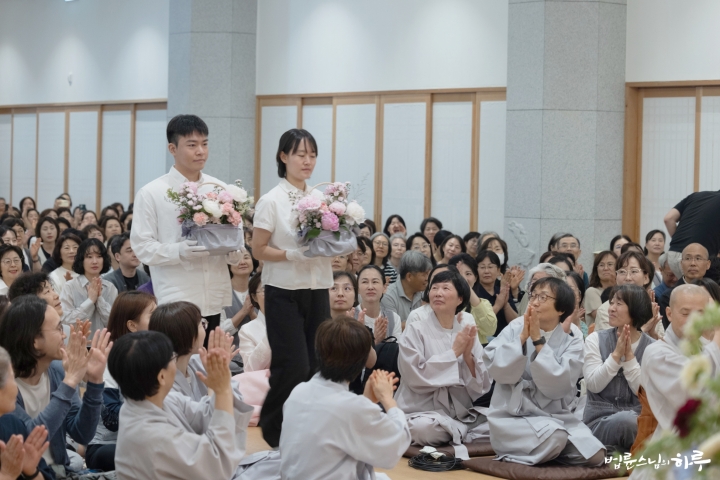
Representing the young volunteers, Lee Hyeonseung and Han Seona offered flowers before the Buddha.
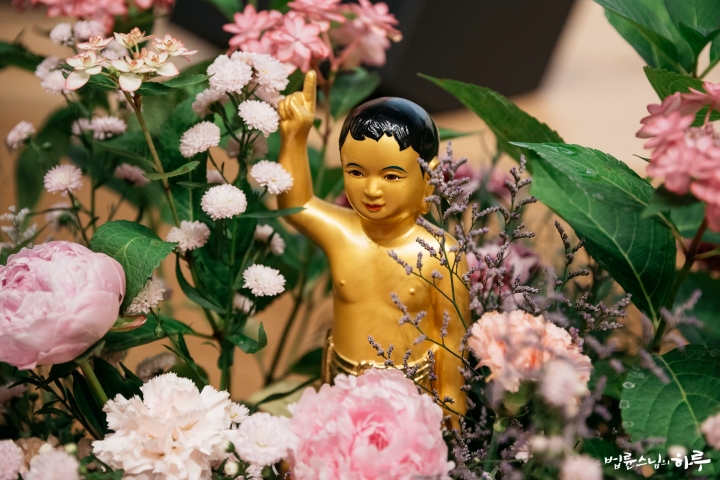
A video presentation showed Buddha’s Birthday congratulatory messages sent from fellow practitioners around the world. Bishop Park Kyung-jo of the Anglican Church of Korea, former Cheondogyo leader Park Nam-soo, and Gilbeot actors Jo In-sung, Han Ji-min, and Lee Sang-hee delivered video messages of congratulations on Buddha’s Birthday. This was followed by messages of hope from volunteers at chapters in Korea and abroad.
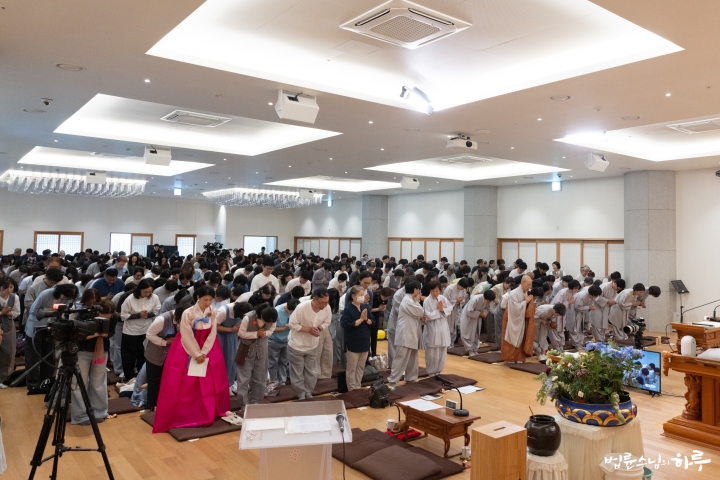
The Sangha requested the Dharma from Sunim by singing the Dharma-requesting hymn and offering three bows.
“Dear Jungto practitioners, fellow Buddhists, viewers, and citizens. Today is the day the Buddha was born into this world. This year is the Buddhist year 2570. The Buddhist Era (佛紀) refers to the years counted since the Buddha entered nirvana, also known as the era of the Buddha’s passing (佛滅紀). Therefore, the day the Buddha came into this world was about 2,650 years ago, on the 8th day of the 4th lunar month, on a warm spring day like this.”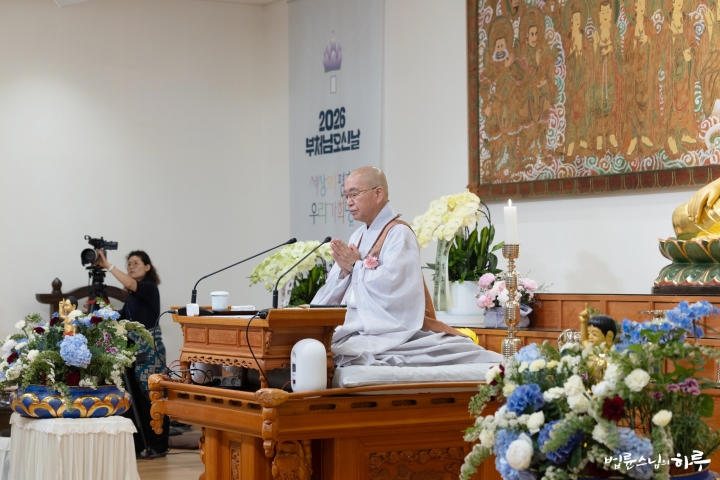
Sunim gave a detailed explanation of the background of the Buddha’s birth, the meaning of ‘Above the heavens and below the heavens, I alone am the World-Honored One; the three realms are full of suffering, and I shall bring peace to them’ (天上天下 唯我獨尊 三界皆苦 我當安之), which the Buddha proclaimed as he took seven steps and gave his lion’s roar after being born, the reason for enshrining the baby Buddha statue on Buddha’s Birthday, the reason for performing the bathing ceremony, and the reason for lighting lotus lanterns.
“There are two main cultural events held on the 8th day of the 4th lunar month. The first is the lotus lantern offering, lighting lanterns with the wish to attain Buddhahood through that merit. The second is the bathing ceremony (浴佛儀式), in which the body of the baby Buddha is washed. Receiving the prediction ‘I too shall attain Buddhahood in a future life’ through the bathing ceremony is called gwanjeong sugi (灌頂授記). Gwanjeong is a ceremony in which a brush dipped in water is used to mark the point between the eyebrows. It carries the meaning that this place holds not the physical eye but the heavenly eye (天眼), the eye of wisdom, and that this eye is being opened.The Meaning of the 8th Day of the 4th Lunar Month
So what does the 8th day of the 4th lunar month mean to us today? In life, we go through many painful experiences. We get stressed, and we fall into sadness. Why does such suffering arise? When we look closely, it’s ultimately because things don’t go the way we want. We get stressed when someone we wish would disappear doesn’t, and conversely, we suffer when we lose what we don’t want to lose. We suffer when we want to be with someone but are separated, and we suffer when we want distance but they remain close. Ultimately, it’s not a matter of being near or far—the root cause of suffering is that things don’t go our way.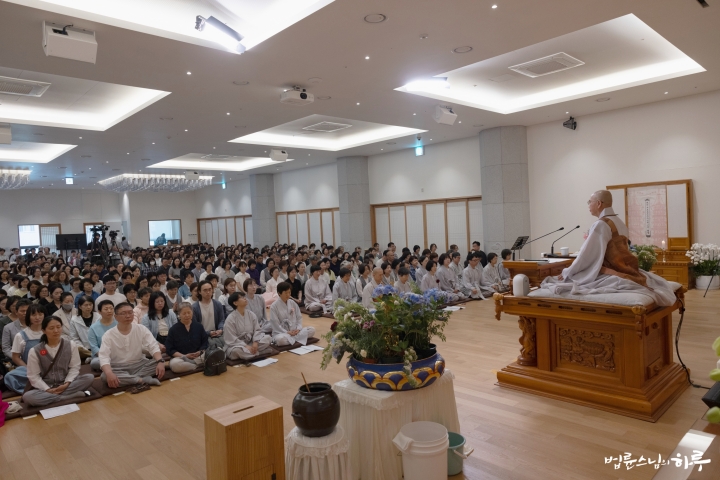
The Perspective of Practice
However, the perspective of practice is a bit different. The notion that I am suffering now because my wishes aren’t being fulfilled is a narrow and biased view. It’s only seeing one side. In the human world, it’s impossible for all things to go according to one’s wishes from the start. Moreover, would it really be a good thing if everything went as we wished? It might seem good if we think only of ourselves, but imagine if every person had all their wishes fulfilled. The world would become even more chaotic and confused. Looking at the whole, it’s precisely because people’s wishes don’t all come true that the world maintains itself at this level. So is it the powerful or the powerless who cause all kinds of disturbances in the world? Having power means being able to do many things as one wishes. When a powerful person says, ‘If you don’t listen to me, I’ll crush you with force,’ we call such a person bad. Yet at the same time, many people secretly want to be like that. It’s contradictory. Although our wishes cannot all be fulfilled, if we think they must be, we feel happy when they are but suffer when they aren’t. So suffering (苦) and pleasure (樂) inevitably keep repeating. Even while attending temple or church, we say, ‘This time it worked’ or ‘This time it didn’t work.’ Even when getting fortune-telling or saju readings, we say, ‘It was spot on,’ and other times, ‘It wasn’t right.’ Thinking that something which cannot happen must happen is itself a mistake. This is foolishness, what Buddhism calls ignorance (無知). Looking at the world as a whole, some things happen and some don’t. Not everything works out, nor does everything fail. If it works out, that’s fortunate; if not, we can try again. If that still doesn’t work, we can find another way, and if it still fails, we can give up. The problem is the attachment that ‘things must go exactly as I want.’ That attachment is the cause of suffering. The ignorance of not knowing this principle is the cause of suffering. If we awaken from this ignorance and let go of attachment, there is no suffering. We can live without suffering exactly as our current conditions are. This doesn’t mean we should leave reality as it is. We can change things if needed. If something doesn’t work, we can study and try again, and if it still doesn’t work, we can give up. Whether to do it or not is our own choice. The point is simply that whether we do it or not, we don’t need to be bound by it and suffer over it.Practice: The Path to Protecting Oneself Without Suffering
People ask, ‘How can a human being live without suffering?’ But think about a rabbit or a squirrel. Would a rabbit or squirrel understand the way humans suffer? Probably not. Through practice, we can protect ourselves without suffering anytime, anywhere. We can also change the world if needed. As mentioned before, practice is the path to becoming the master of one’s own life and the master of the world. The Buddha was the first to discover this path and guided many people along it. Countless people escaped from suffering, and those people gathered together to make the world more peaceful.What Matters Most in Practice Is Awareness
From birth to now, we live as if we had never once opened our eyes. So we always grope around searching for the way. If we just open our eyes properly even once, we would no longer stumble, yet because of our lifelong habit of living with closed eyes, the moment we are not careful, we unconsciously close our eyes again. This is just like when we have a nightmare. No matter how hard we run in the dream, there is no escape, but at some moment, we think, ‘Could this be a dream?’ Then do we continue trying to run, or do we try to open our eyes? Of course, we try to open our eyes. At first, our eyes may not open easily and we struggle, but once we somehow snap our eyes open, it all becomes nothing. Similarly, while struggling to resolve our suffering, there are moments when awareness arises—’This might be my ignorance,’ ‘Am I being stubborn?’ ‘Am I greedy?’ That is just like realizing it’s a dream. So in practice, awareness is the most important thing first. We must know ourselves. We must be able to examine our own state. If we examine ourselves intensively for about a hundred days, we begin to see a little of what kind of person we are. However, just knowing doesn’t immediately bring change. We always revert to our habits. If we practice steadily for about a thousand days, changes gradually occur. We hear from people around us, ‘You’re less stubborn these days,’ or ‘Mom has changed a bit.’ Of course, some people change in an instant. But at minimum, we need to practice diligently for about a thousand days. Today is the day we commemorate the one who first opened that path—Gautama Siddhartha, who became a practitioner, attained enlightenment, and became ‘Gautama Buddha.’ Originally, ‘Buddha’ is a common noun meaning ‘one who has awakened.’ So anyone can become a Buddha. However, because this person first opened that path in human history, when we say ‘the Buddha,’ it has come to be used virtually as a proper noun referring to him. Today is the day we commemorate the birth of that Buddha. But if asked, ‘Is today exactly that day?’ actually no one knows. What matters about a commemoration day is not exactly when the actual date was, but which day we choose to remember together and reflect on its meaning. Memorial Day is also for us to honor those who sacrificed for the country. So in Southern Buddhism, the full moon day about a week after ours is designated and commemorated as Buddha’s Birthday.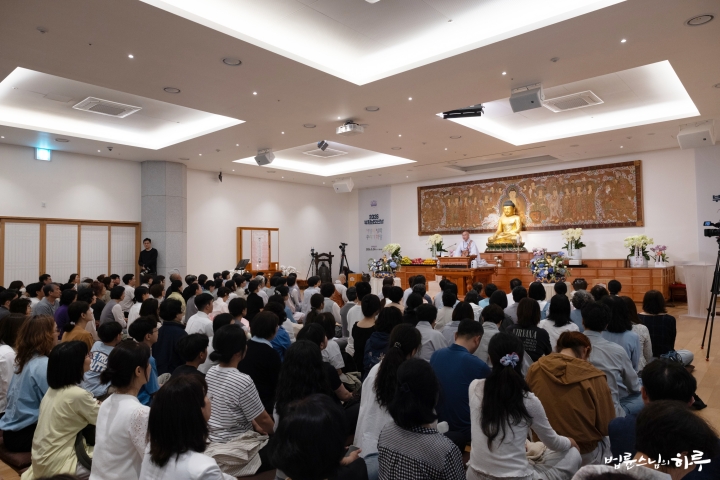
Then came the time of ‘Praising the Birth’ (Gangsaeng Chantan), a ceremony and cultural event praising the Buddha’s birth. Members of the Sangha stood up and read aloud, alternating with Sunim, the writing praising the Buddha’s birth. They then sang together ‘The Song of the 8th Day of the 4th Lunar Month.’
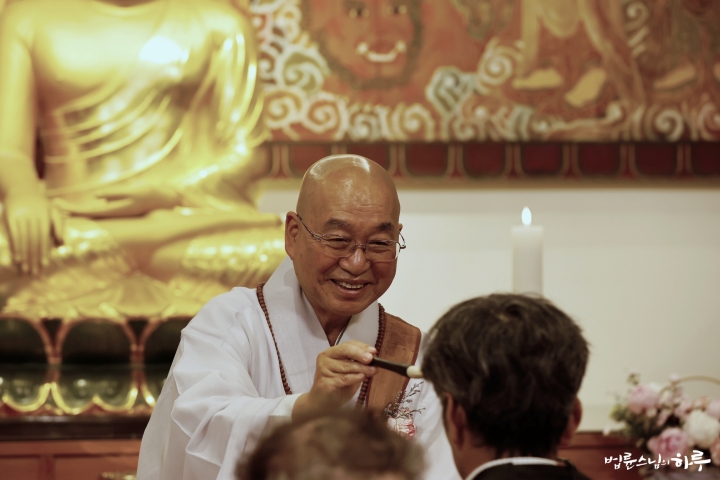
Two representatives playing Queen Maya performed the ‘bathing ceremony’ of washing the baby Buddha, and the majeong sugi (anointing the crown) was conducted. Sunim performed an ‘online anointing’ for online viewers who could not participate in person. Holding a brush dipped in scented water and facing the camera, Sunim said:
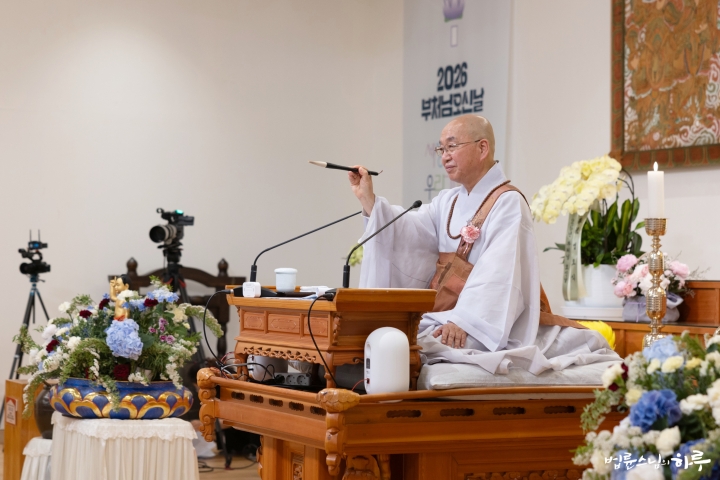
The online anointing concluded with applause from those gathered.
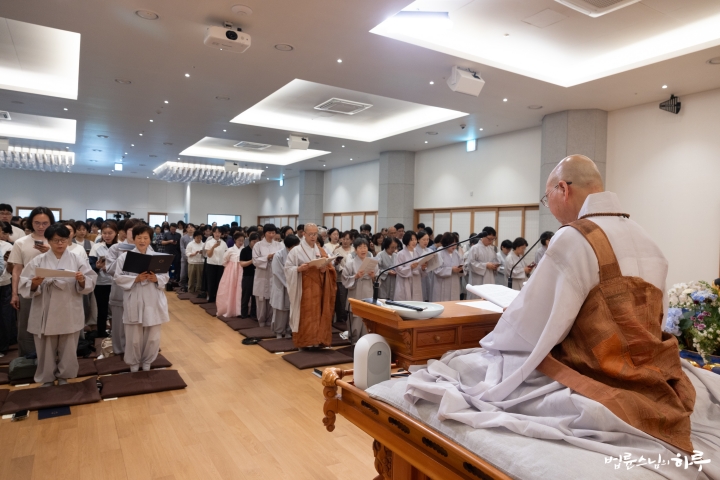
Sunim and the Sangha then proceeded with the ‘Birth Declaration.’ As before, Sunim and the Sangha alternately read sections describing the Buddha’s birth. This was followed by the reading of the vow.
The celebration ceremony concluded with words of thanks and congratulations from Yang Yundeok, President of Jungto Society, followed by the Four Great Vows and the closing hymn.
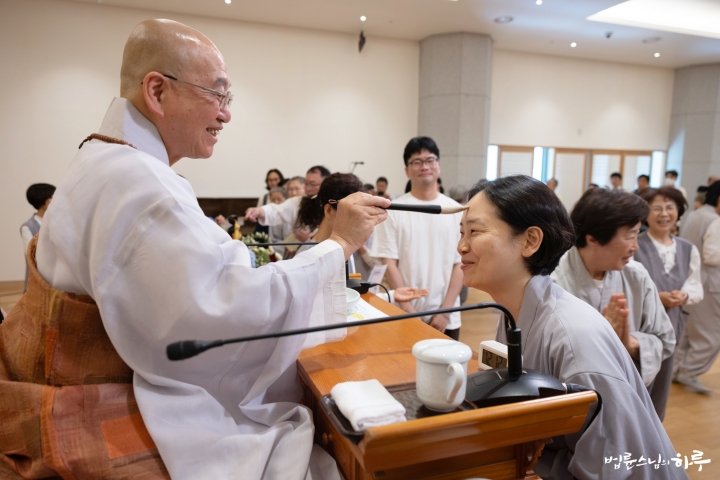
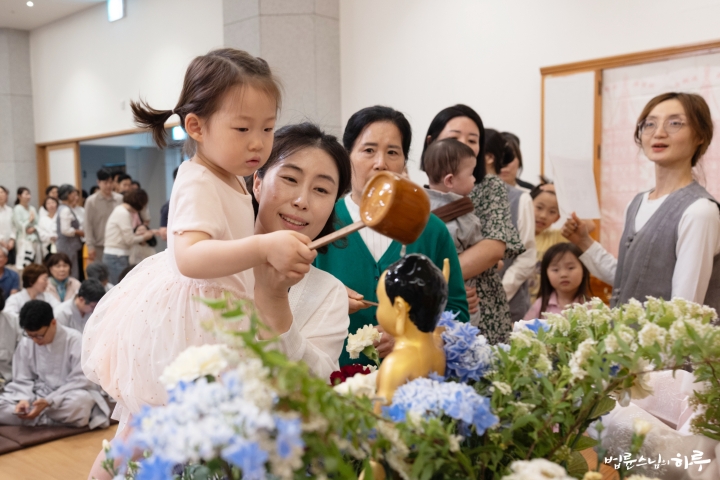
Participants who visited the Jungto Social and Cultural Center lined up to receive the anointing, and Sunim performed the anointing for about an hour. After a brief lunch, around 2 p.m., Sunim toured the Jungto Social and Cultural Center, encouraging volunteers and expressing his gratitude.
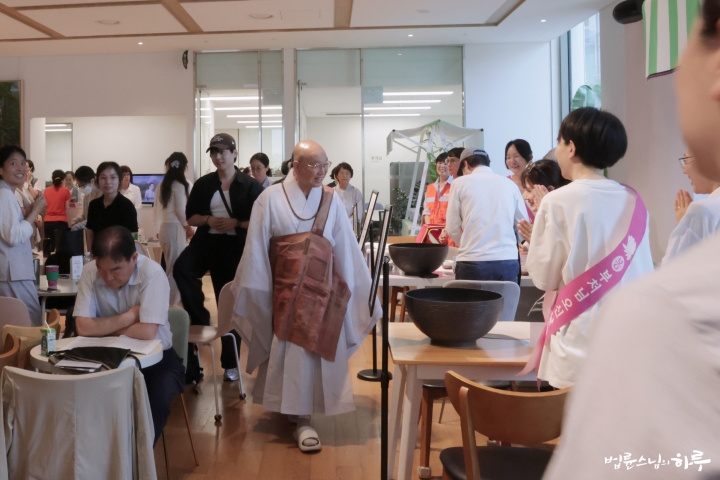
Starting from the 5th floor and going down one floor at a time, Sunim looked around the center. He observed what was happening and met with volunteers.
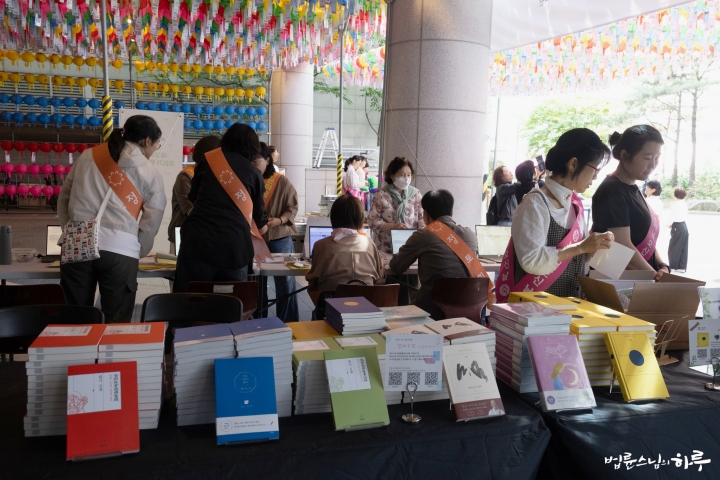
In the 1st-floor lobby, preparations were underway to welcome public figures, and booths were operating in the outdoor courtyard.
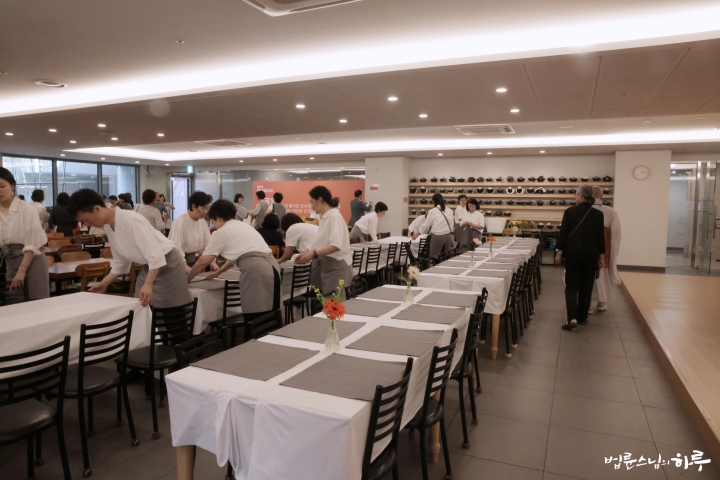
In the basement kitchen, volunteers were busy preparing dinner for the guests and setting up the dining hall.
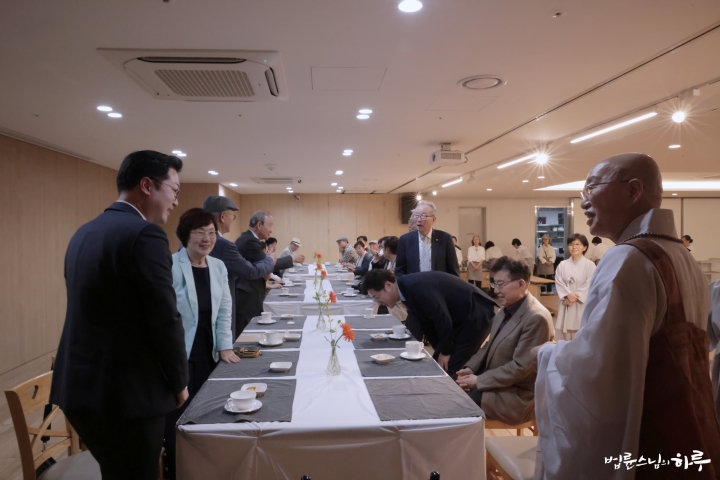
A few guests who had arrived at the center earlier than the public figures’ Dharma assembly time were sitting at tables on the stage. Two writers from the SBS entertainment program ‘Pomnyun Road – Sunim and Guests’ came and greeted Sunim. They talked about the response to the first broadcast on the 19th. During the conversation, more guests continued to arrive at the tea reception area.
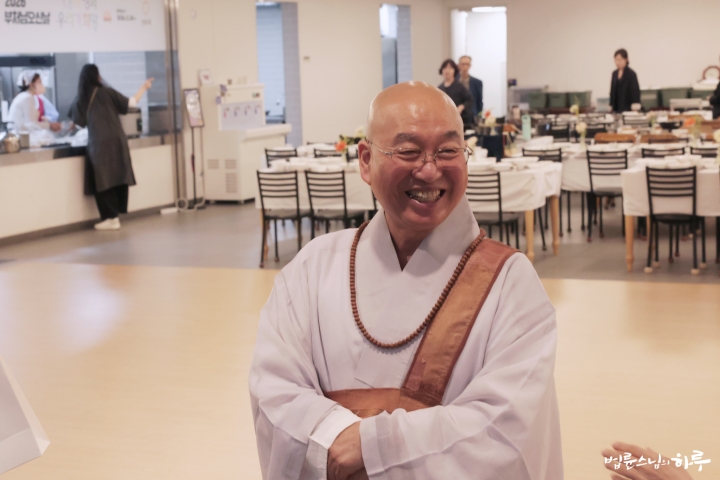
Sunim welcomed the guests, greeted them, and directed them to tables. As the time of the public figures’ Dharma assembly approached, more and more guests came to greet Sunim. When the tea reception area on the stage filled up, Sunim guided people to tables in the dining hall. Some guests Sunim hadn’t seen in a long time were there, and some said they had watched the broadcast Sunim appeared on. As they exchanged updates and greetings, it became five minutes before the public figures’ Dharma assembly. Sunim led the way to the large auditorium in the 3rd basement where the public figures’ Dharma assembly would be held. The auditorium was just three floors down. Sunim suggested taking the stairs, so the guests used the stairs to reach the auditorium.
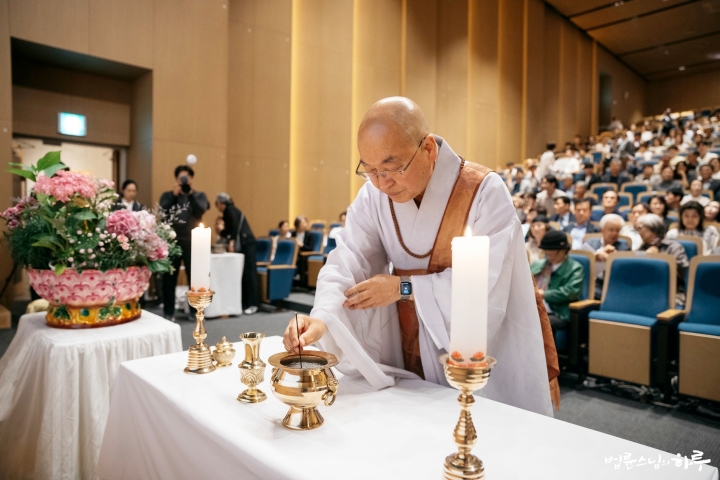
At 3 p.m., the bell sounded to begin the public figures’ Dharma assembly. Sunim lit candles and offered incense before the Buddha, praying for the liberation of all sentient beings.
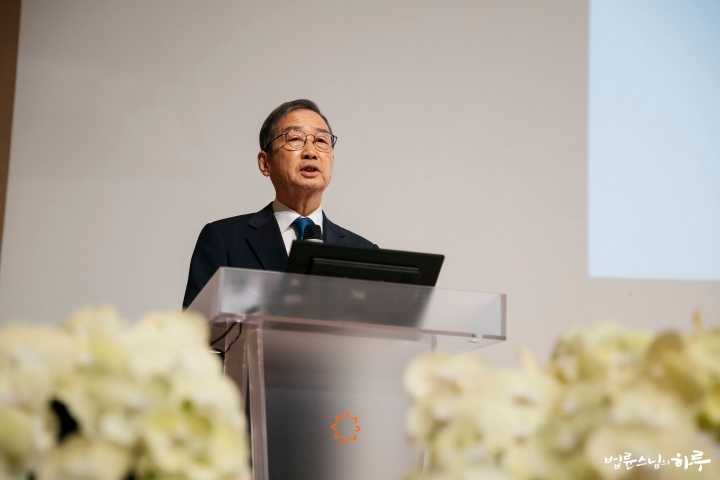
The public figures’ Dharma assembly is held annually on Buddha’s Birthday, and the event was hosted by Kim Byung-jo, who is active in Jungto Society’s Gilbeot. The public figures’ Dharma assembly is held each Buddha’s Birthday with neighboring religious leaders and public figures to reflect on the true meaning of the Buddha’s birth.
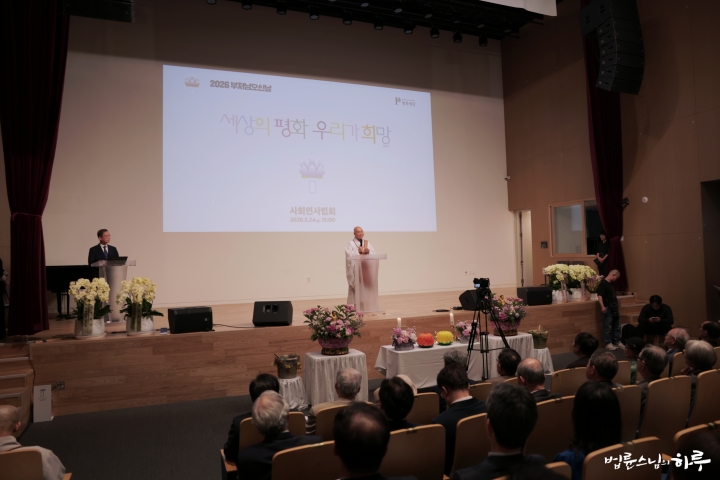
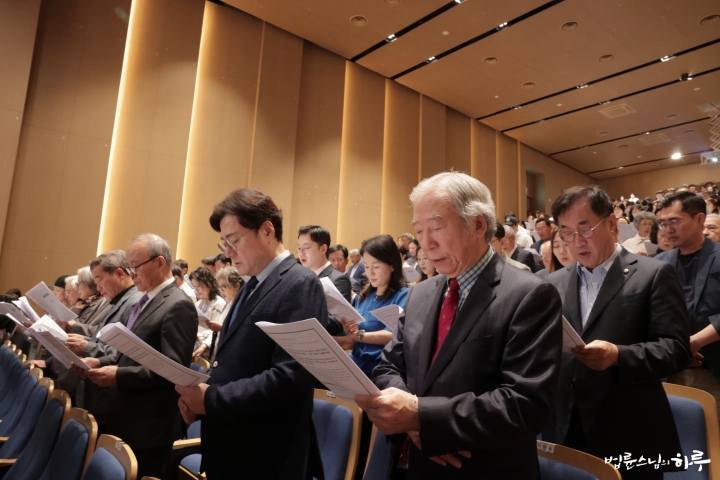
After reciting the Three Refuges and the Words for Practice, the praising of the birth took place. Sunim came up to the stage, and he and the public figures took turns reading the ‘Praising the Birth’ section describing the Buddha’s birth.
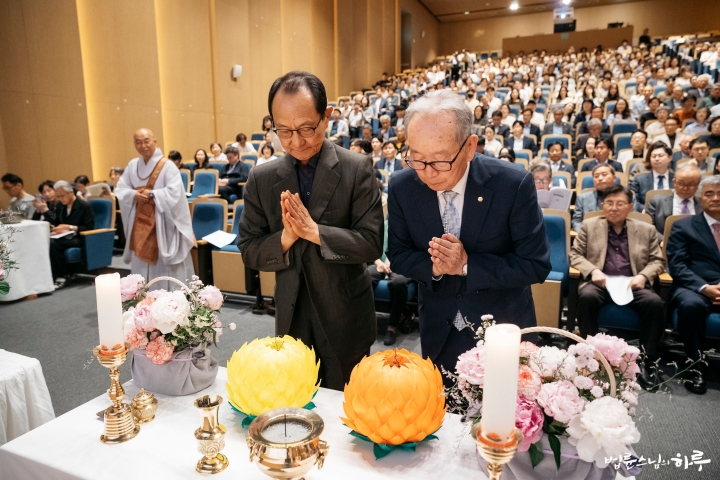
Representing neighboring religions, former Cheondogyo leader Park Nam-soo and Reverend Park Jong-hwa, senior pastor of Kyungdong Presbyterian Church, offered lotus lanterns before the Buddha to symbolize illuminating the Dharma hall.
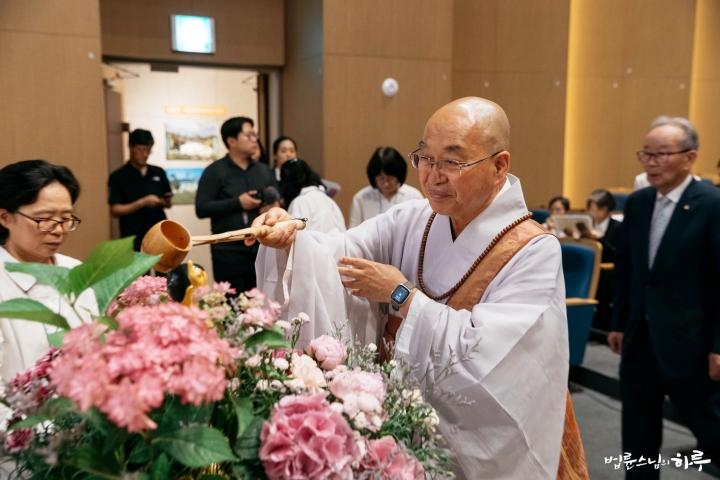
Then, a volunteer dressed in beautifully prepared hanbok came out to help with the bathing ceremony. Sunim performed the bathing ceremony first. Kim Byung-jo called the names of those participating today from the list. Various public figures came out in order to participate in the bathing ceremony.
Sunim came up on stage and recited the vow together with the public figures. This was followed by Sunim’s greeting. Sunim expressed gratitude to those who attended the public figures’ Dharma assembly and explained the order of the program. He then gave a brief Dharma talk on the meaning of Buddha’s Birthday.
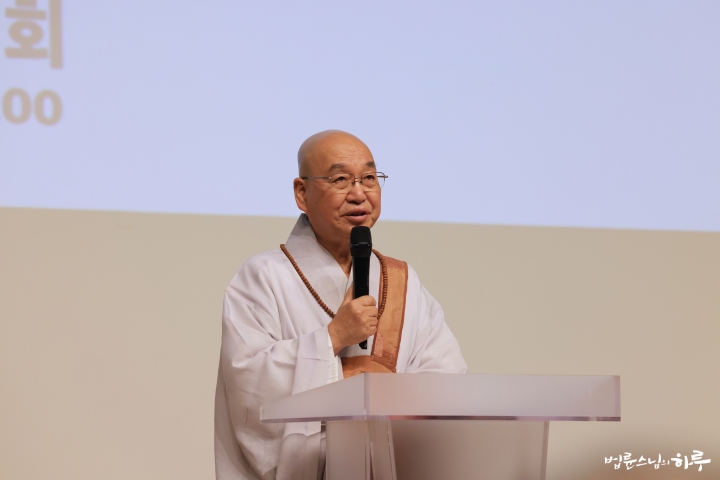
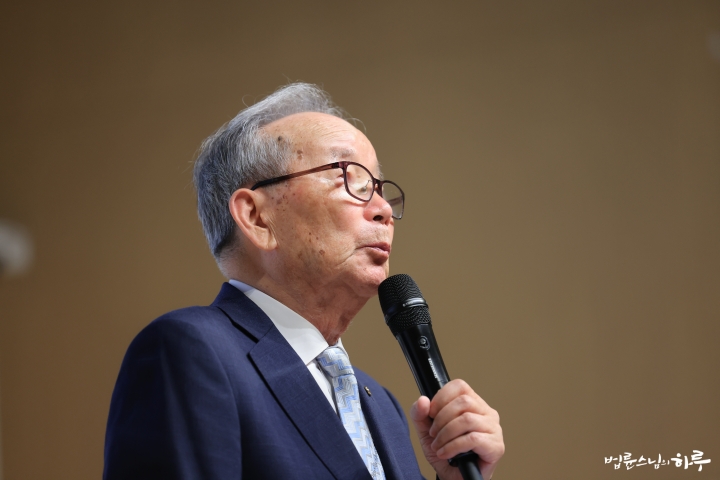
Then, representing neighboring religious leaders, former Cheondogyo leader Park Nam-soo gave a congratulatory address.
“As a follower of Cheondogyo, I don’t know much about Buddhist truths and teachings. However, this year on Buddha’s Birthday, I was surprised to see the installation at Gwanghwamun Plaza. Along with two Bodhisattva statues, the 13-story stone pagoda from Bohyeonsa Temple, an ancient temple on Myohyangsan in the North, was set up as an installation. (omitted)
Personally, I am reminded of Cheongun Sunim, who stayed at Bohyeonsa Temple on Myohyangsan and spent his whole life sweeping the temple courtyard. I still vividly remember meeting Cheongun Sunim and sharing Dharma conversations as a neighboring religious leader at the Tripitaka woodblock commemoration assembly held at Bohyeonsa Temple. It still feels fresh when I think of it now. On this Buddha’s Birthday, I sincerely hope that the deep meaning of erecting the Myohyangsan stone pagoda in Gwanghwamun spreads widely in the hearts of all our citizens. Once again, congratulating you on Buddha’s Birthday, I conclude my greetings and congratulatory remarks here. Thank you.”
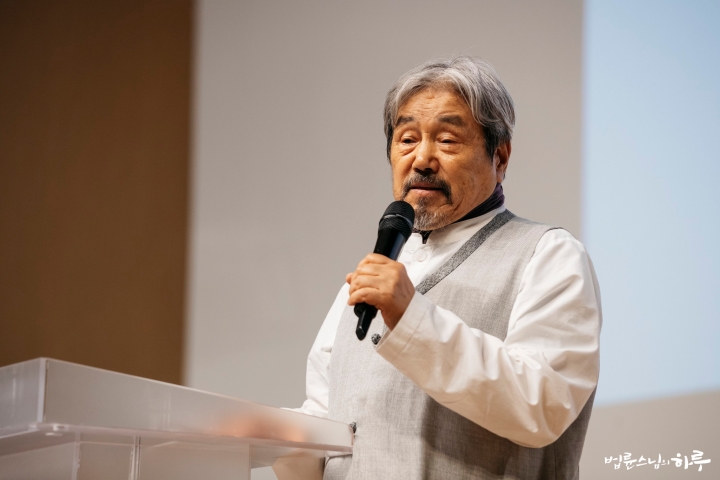
Next, Pastor Lee Hae-hak gave a congratulatory address.
“The world today is more prosperous than at any time in the past, but people still live in deep suffering. On this Buddha’s Birthday, I too find myself reflecting—’Have we also been living in convenience and complacency?’ Seeing this violent world, we say ‘This is wrong,’ sometimes saying ‘I oppose this,’ fighting, explaining, taking to the streets to protest. But at some point, without realizing it, we become stained by that violence, tamed, and accustomed. When we suddenly look back, we find ourselves hardened by authoritarianism and violence like the character in Kafka’s ‘The Metamorphosis.’ I sometimes fear that we have reached a stage where self-reflection cannot easily fix things. So sometimes I despair. (omitted)
Today I reflect again. We should no longer applaud only what is successful, splendid, and magnificent, but should also cast a warm gaze on what is lacking and marginalized. Knowing that behind every success there is necessarily harm and behind every splendor there is necessarily miserable darkness, I want to recover a life where I can rejoice in existence itself like a child, a life where I can be happy as if playing pretend in the place closest to God. This is my confession today before Venerable Pomnyun Sunim on Buddha’s Birthday.”
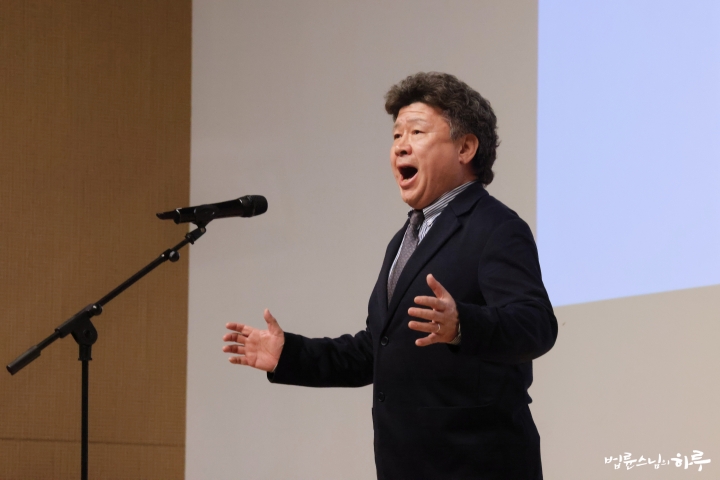
Then came a cultural performance. Professor Kim Hong-tae, an elder of Kyungdong Presbyterian Church, came to Jungto Society again this year as always and gave a celebratory performance. After passionately singing ‘Boribat’ (Barley Field), he gave the following remarks.
“This is my 20th year coming for Buddha’s Birthday. (Applause from the audience) There’s something that surprised me when I came in. I’m not sure if Sunim remembers. Sunim, please put a piano on this nice stage. (Audience laughter) When I came into the auditorium, I saw a piano and thought, ‘Oh! Did the Buddha hear my prayer?’ (Audience laughter) If you invite me again next year, I’ll try to do a more varied cultural performance. (Applause from the audience) Since it’s a joyful day, I’ll sing one cheerful song and step down.”
Then Professor Kim Hong-tae passionately sang the lively ‘To the Land of Hope.’
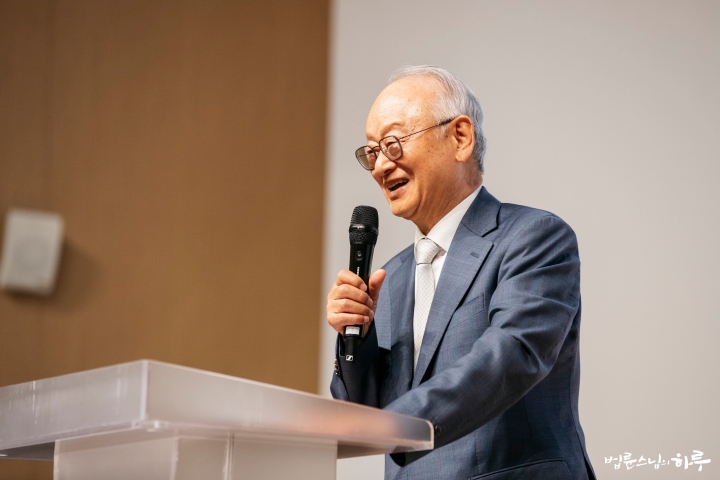
The next speaker, representing senior figures of society, was Chairman Lee Boo-young of the ‘100 Years of Liberation National Companions Preparatory Committee.’
“If we add up the distance that Venerable Pomnyun Sunim has traveled for peace on the Korean Peninsula and in East Asia, he has taken so many flights that the distance is probably uncountable, and his journey has been extremely difficult and long. In this way, Jungto Society and the Peace Foundation have worked hard to protect peace on our Korean Peninsula and create a world without war in East Asia.
This year marks the 81st anniversary of liberation. And in 20 years, it will be the 100th anniversary. When I think back a bit on whether the 80th and 100th anniversaries of liberation we are facing are going as we hoped. (omitted)
Ultimately, let’s live not just for ourselves today, but with the goal that by the 100th anniversary of liberation, we can coexist peacefully and exchange with the North. Even if unification doesn’t happen, that’s okay. Even if unification happens after the 100th anniversary of liberation, if we can establish such restraint, tolerance, and coexistence within us, wouldn’t that ultimately be the great road to unification? We talked about such things. (omitted)
In 2045, the young people born then who will come of age should be able to say things like, ‘This country is livable. Our fathers, mothers, grandmothers, and grandfathers really did well.’ I think that’s what we should aim for.”
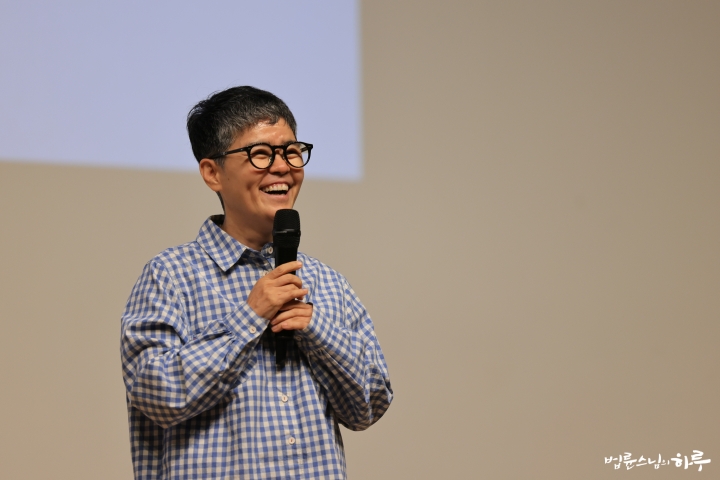
Finally, we heard a congratulatory address from writer Noh Hee-kyung, representing Gilbeot.
“Since many good words have been said before me, I thought it would be good to share why Gilbeot is at Jungto Society and how Gilbeot came to be here, so I stepped forward. After I went to the Awakening Retreat, there’s one thing I came to keep in mind. ‘I really don’t know much. If I forget this, it’ll be a disaster. The reason my life was still painful was that I acted superior, that I didn’t study what was making me suffer.’ That was it. So from that day on, I started doing 108 bows. And as I did, the Dharma teacher said, ‘Why don’t you guide the people around you, your colleagues, to study the mind together and do good deeds like this?’ So I started guiding a little. But I got so much criticism from those around me. The biggest criticism was that Noh Hee-kyung was using her position and power to use actors. (omitted)
I want to do good work—to work with the sick, the hungry, the uneducated. When Venerable Pomnyun Sunim said to work together with JTS Korea, I wondered why I couldn’t invite my colleagues, what I was afraid of that prevented me from calling them. After thinking about it, from then on I started inviting them. When people said I was using actors, I said, ‘Yes, I’ll use them well.’
Gathering people one by one, and people whose lives became happy joining in the relief activities that Sunim and fellow practitioners are doing, this has been going on for about 24 years now. Now many people worry about not having children. But you don’t need to worry. There are plenty of fellow practitioners. Although parents are not here, Venerable Pomnyun Sunim and our Dharma teachers—teachers are abundant. It’s time to retire. But I’m not worried. There is plenty of work at Jungto Society. Many people also worry. What will happen to this world when the Buddha is gone? Who will guide us? Jungto Society also has such worries. Who will lead Jungto Society when Venerable Pomnyun Sunim is gone? Many people worry about these things, and I’m one of them, but I think there’s no need to worry. Just as the Buddha has been present in this world enduringly for over two thousand years, I believe Jungto Society and our disciples will also continue enduringly, carrying on his will. Thank you. Thank you, Buddha.”
Writer Noh Hee-kyung’s congratulatory address based on her own experience was deeply moving.
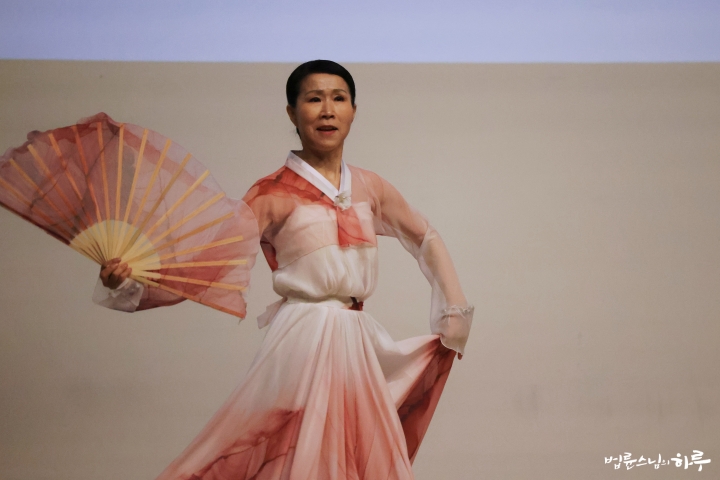
Then came a meaningful cultural performance. Kim Yoon-hee, a PhD in sociology from Seoul National University, performed the ‘Jaenggang Dance.’ The Jaenggang Dance is a dance that Choi Seung-hee, North Korea’s world-class dancer, adapted from a shaman dance, which her disciple Kim Baek-bong then reworked. Although not a professional dancer, she expressed the pain of national division through dance with full passion. She received great applause from the audience.
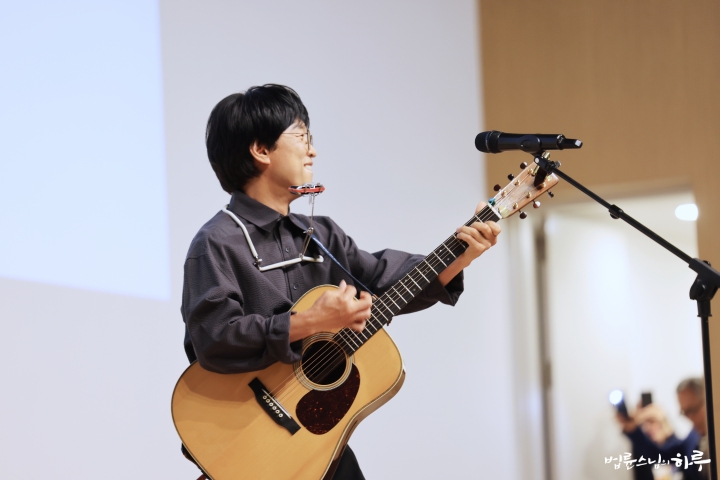
One last performance remained. National singer Park Chang-geun came on stage and sang two heart-stirring songs, plus one encore. The auditorium quickly turned into a concert hall as participants listened to the songs and gave great applause and response.
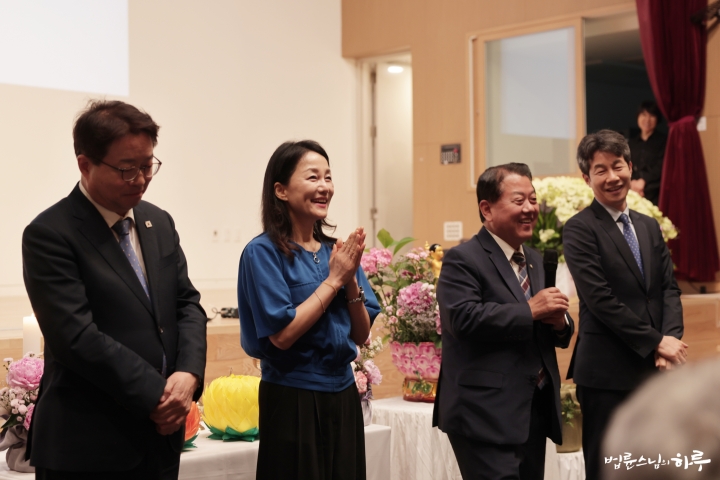
Finally, Sunim gave the closing remarks. Sunim gave brief closing remarks and invited the National Assembly members who had come today onto the stage to create a space for them to greet the audience. Assemblymen Yoon Geon-young, Kim Byung-ki, Lee Jae-jung, and Yeom Tae-young came to the front of the stage and gave greetings. Sunim explained well the situation that some public figures had to leave early due to scheduling and could not be given time to greet the audience in the middle because the congratulatory addresses ran long.
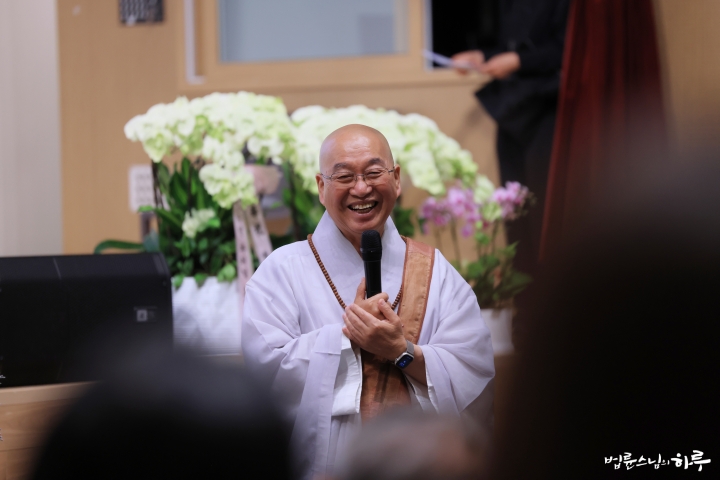
Sunim expressed his gratitude to the guests who attended the public figures’ Dharma assembly and explained the simple souvenirs—telling them to have dinner after the Dharma assembly ended and to be sure to take home mugwort rice cakes made from mugwort he had personally gathered.
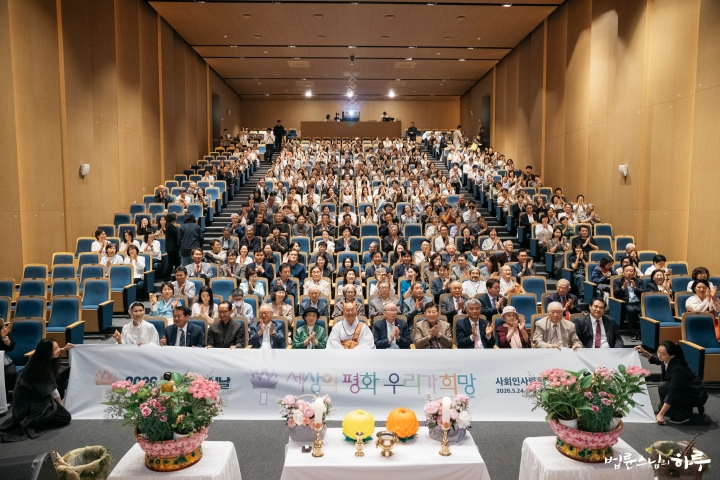
After taking a commemorative photo, the public figures’ Dharma assembly came to a close. At 5:30 p.m., the guests went down to the 1st basement and had dinner of bibimbap.
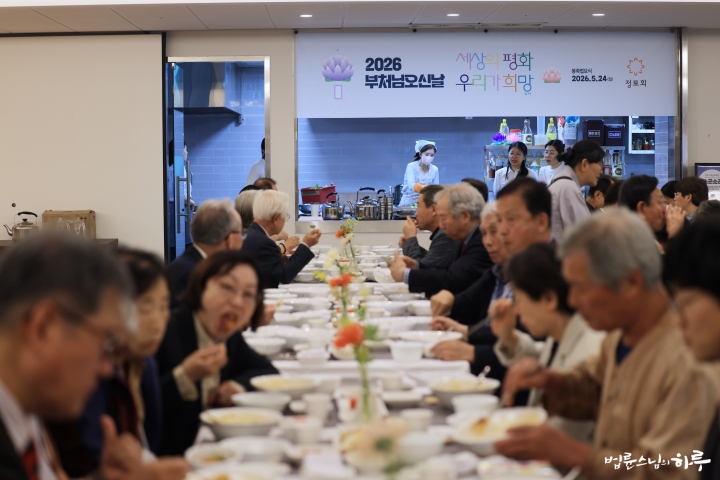
Sunim looked around carefully to ensure the guests could have their dinner comfortably. Sunim also sat at a table and had bibimbap for dinner. After quickly finishing his meal, Sunim went around the tables expressing thanks to the guests. Standing near the dining room entrance, Sunim greeted each public figure who had come today one by one. At the end, he greeted and took photos with Gilbeot members who had eaten on the stage. He also took photos with the meal preparation team that had prepared the offerings. Once most of the guests had left, Sunim came to the office to prepare for the next evening Dharma assembly.
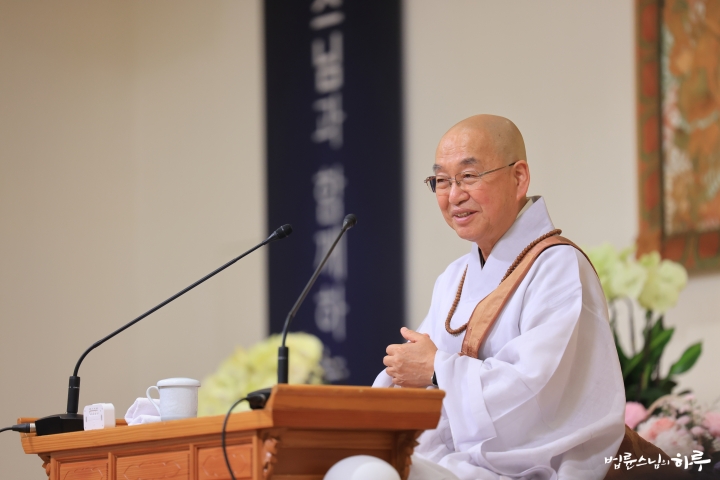
At 7 p.m., the Dharma Q&A for young people, ‘Youth Talk Talk,’ was held in the Dharma Hall. A total of 450 young people participated in today’s Youth Talk Talk.
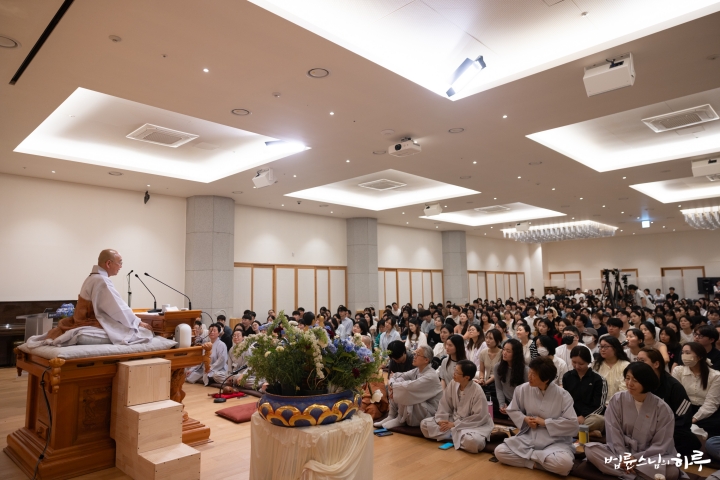
Half of the young people who attended today were general young people, not Jungto Society members. Young people who could not fit into the Dharma Hall on the 3rd floor watched the venue live on a screen connected online from the 5th floor.
The Dharma assembly began, and after the ceremony of the Three Refuges and the Words for Practice, young volunteer Oh Ye-ju gave an opening song performance. The young people requested the Dharma from Sunim by singing the Dharma-requesting hymn and offering three bows.
Sunim gave a keynote Dharma talk for the young people and conversed with them. A total of four young people had conversations with Sunim with the following questions.
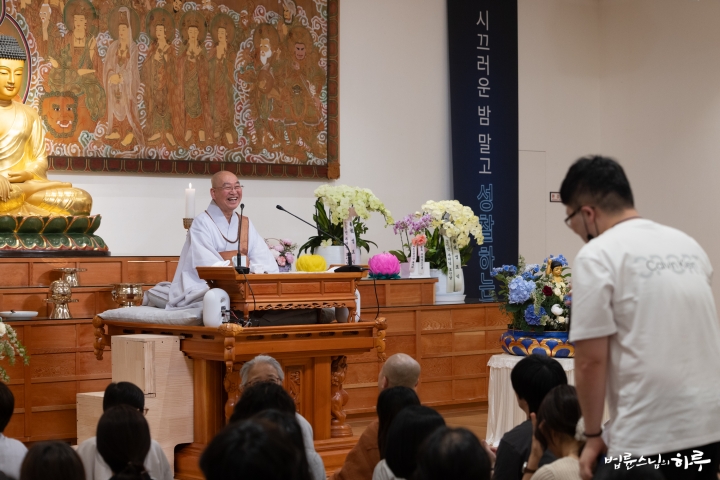
The closer the person, the more I get angry, apply my own standards, and get irritated when things don’t go my way. Even though I say I won’t do that, I end up imitating exactly what my father did, which I hated. I’m in a cycle of getting angry out of frustration and then apologizing. I want to let go of the stubbornness and pride that says, ‘I’m doing good and right things like practice, exercise, and study—why don’t you do it too?’
Korea is now entering a super-aged society, and the burden of support on the younger generation is rapidly increasing. However, as the discussion of extending the retirement age focuses on maintaining employment for the older generation, young people are suffering from the double burden of job shortages and increased support obligations. To resolve this asymmetry between generations, what institutional measures should be prioritized socially, and what attitudes should young individuals hold to avoid being left behind in this massive trend?
I can’t find any man who catches my eye. But I want to get married.
Rather than working diligently to succeed, I want to hit a jackpot with one app and quickly escape my company. Hearing that we can make apps with AI these days, I’ve been making and releasing apps with AI on weekends and after work. So far, I’ve sold 60 and earned 150,000 won. But I still can’t give up the thought that this will hit big someday, and I keep checking sales status all day at work. I know this ‘one big shot’ mindset is wrong, but if you tell me to let it go and live ordinarily, I don’t think I can do that either. Sunim, can I hold onto this jackpot mentality? Or should I let it go?
When ‘Youth Talk Talk’ ended, it was past 9 p.m.
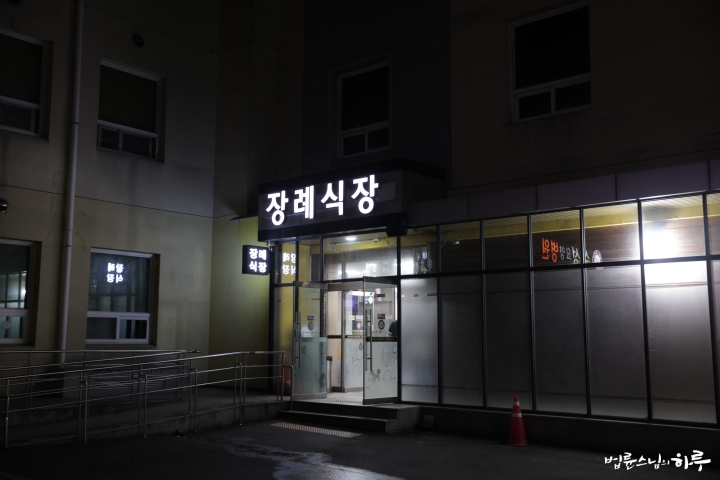
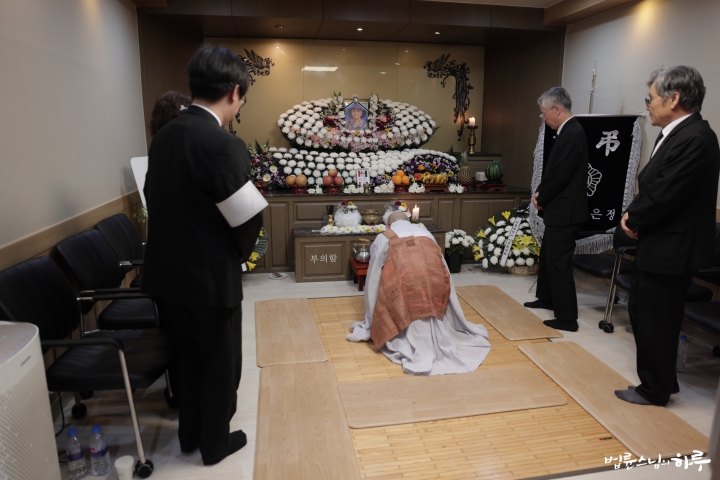
Sunim got in a vehicle right after the Dharma assembly ended to go to a funeral home in Daegu to pay condolences. Because it was Buddha’s Birthday, there were events, Dharma assemblies, and guest reception schedules all day, so it was impossible to visit the funeral home during the day. Attorney Yeo Young-hak, who served as auditor of the Peace Foundation, had lost his mother, so after finishing all the day’s schedules, even though it was late, Sunim headed to the funeral home. Upon arrival, it was 12:30 a.m.
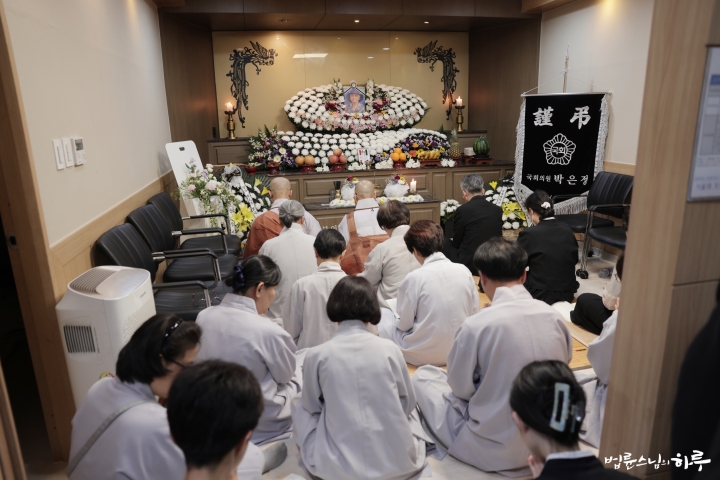
Hearing that the Dharma teachers of the community were also on their way to the funeral home from Seoul, Sunim waited and held the spirit deliverance prayer together with them. Sunim repeatedly expressed his apology, saying he was sorry for coming to pay condolences so late at night and preventing the chief mourner and bereaved family from resting. After the community Dharma teachers arrived at the funeral home and the spirit deliverance prayer was held, they headed to the Dubuk Jungto Retreat Center.
It took about an hour by vehicle from Daegu to arrive at the Dubuk Jungto Retreat Center. It was 2:30 a.m. Sunim unpacked his belongings and ended the long day.
Tomorrow, a retreat will be held with the community Dharma teachers.