“I Want to Live Humbly Like a Single Blade of Grass by the Roadside, but I Wonder How I Can Do That.
May 22, 2026. Aekwangwon Outing, Happy Conversation Lecture at Chonnam National University
May 22, 2026. Aekwangwon Outing, Happy Conversation Lecture at Chonnam National University
Hello. Today, Sunim went on an outing to Ssanggyesa Temple with the residents of Aekwangwon in the morning, and in the evening, he gave a “Happy Conversation” Dharma Q&A lecture at Chonnam National University.
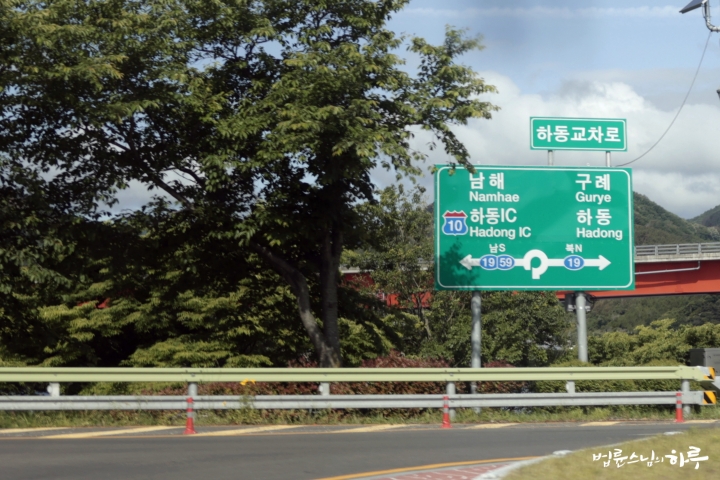
Sunim began his day with early morning practice and meditation. After finishing breakfast, he departed from Dubuk Jungto Retreat Center at 6:30 a.m. for Ssanggyesa Temple in Hadong-gun, Gyeongsangnam-do.
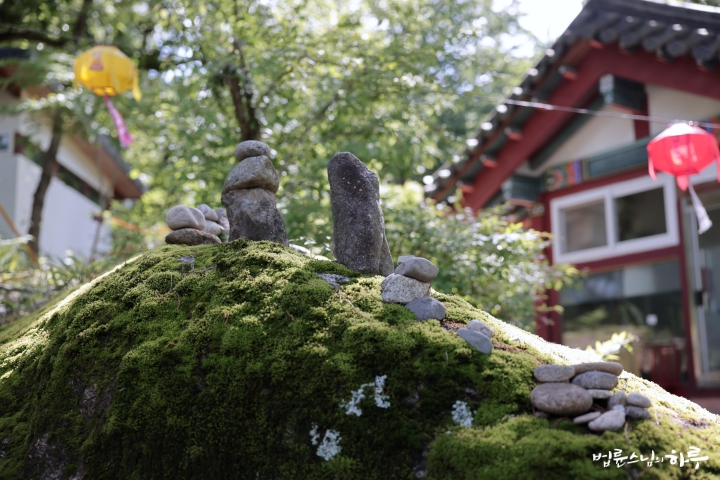
Today was the day for an outing with the residents of Aekwangwon. Sunim’s connection with Aekwangwon began 23 years ago. In 2003, when Typhoon Maemi caused severe damage to the southern coastal regions of Korea, Aekwangwon on Geoje Island also suffered significant flood damage. At that time, JTS helped with the recovery efforts at Aekwangwon. After the recovery was complete, Sunim asked Director Kim Im-soon (김임순) what she would like help with going forward. The director replied, “For people with disabilities, going on outings is the most difficult thing. We would appreciate help with outings.” Since then, Jungto Society has been organizing outings with the residents of Aekwangwon every spring and fall. In the first half of the year, the outings are held with residents who have milder disabilities, and in the second half, with residents who have more severe disabilities.
This Aekwangwon outing was prepared by the Gyeongnam Branch. From Aekwangwon, about 30 residents with milder disabilities and staff members totaling 42 people attended, along with 45 Jungto Society members, making a total of about 90 people who joined the outing.
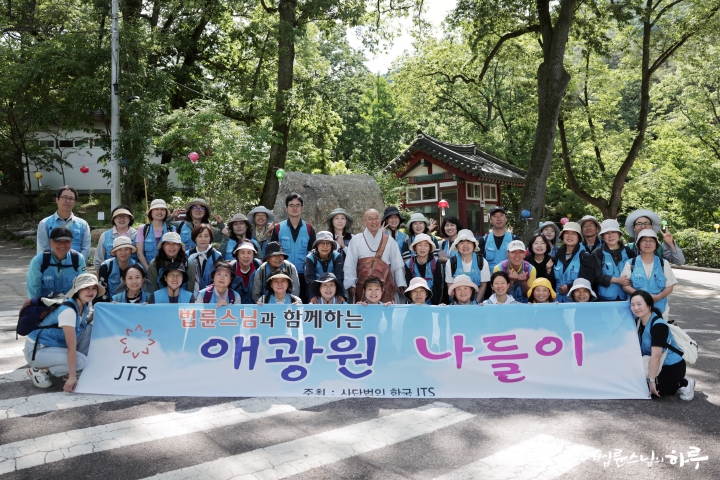
At 9:30 a.m., the group arrived at the Ssanggyesa Temple parking lot. Sunim warmly greeted the volunteers at the parking lot. Before the outing began, everyone took a group photo together with the volunteers. The buses carrying the Aekwangwon residents stopped at two rest areas on the way to Ssanggyesa Temple, so their arrival time was somewhat delayed. While waiting for the buses, Sunim attended to urgent business over the phone.
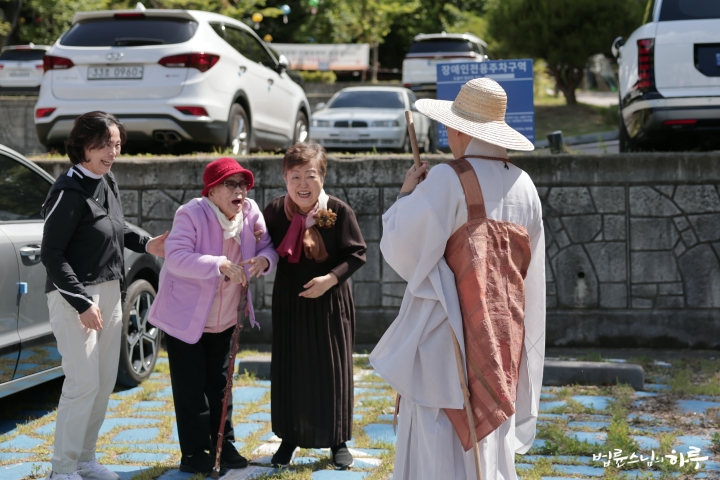
Then the advance vehicle from Aekwangwon arrived. Director Kim Im-soon, who is 103 years old this year, stepped out of the car. Sunim approached the car and warmly greeted Director Kim Im-soon, who was seated in a wheelchair. Director Kim Im-soon had joined the Aekwangwon outing after a long time.
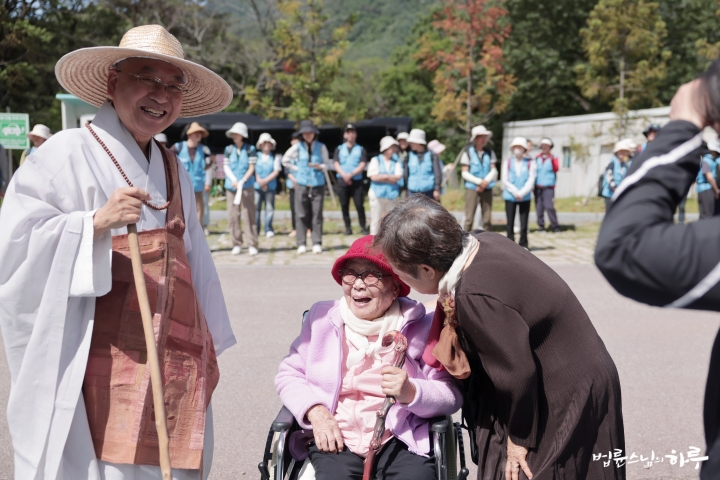
Director Kim Im-soon was delighted to hear Sunim’s voice and nodded in response.
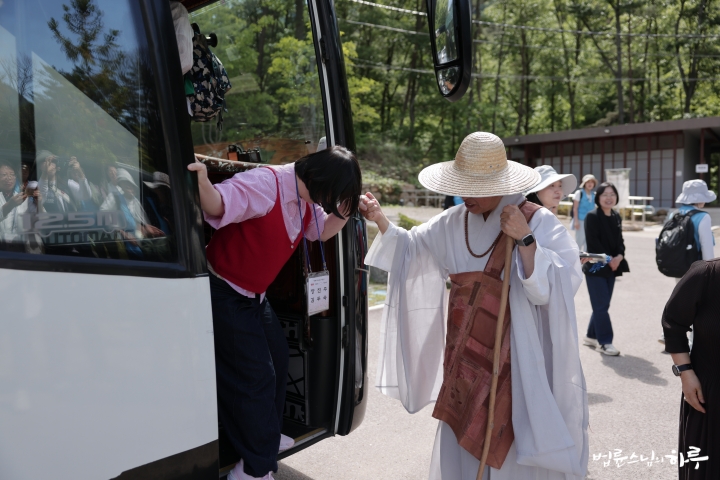
Finally, the two buses arrived. Sunim stood at the bus entrance, taking each resident’s hand and greeting them one by one.
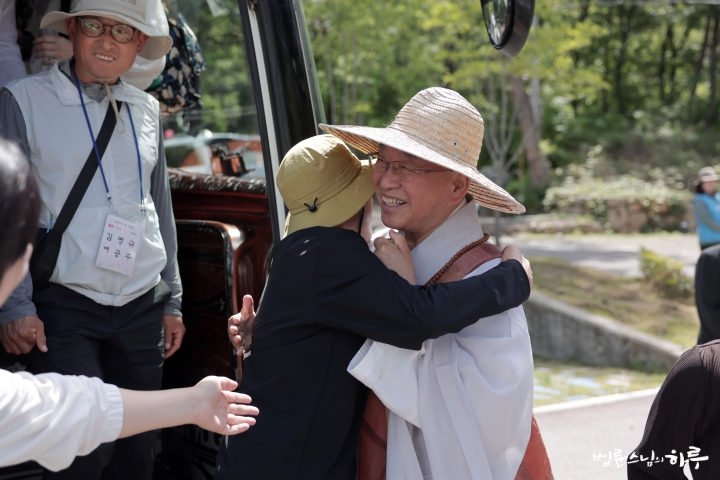
Some residents recognized Sunim and greeted him warmly. For today’s outing, each resident was paired with one volunteer to spend the day together. Once paired up, the group moved toward the entrance of Ssanggyesa Temple.
Everyone gathered in front of the information board at the entrance of Ssanggyesa Temple. Sunim greeted everyone through a wireless microphone.
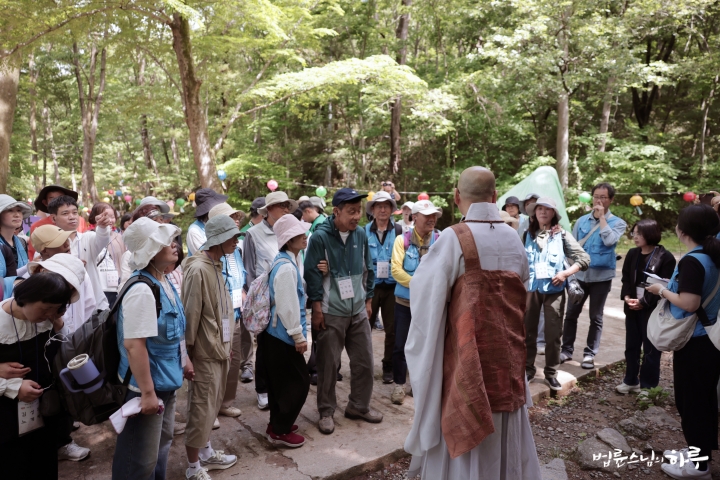
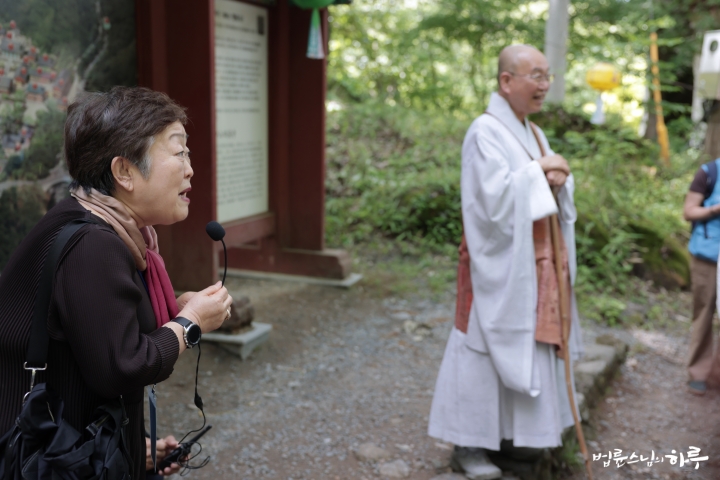
Following this, Song Woo-jung (송우정), the CEO of Aekwangwon (애광원), gave her greeting.
“Everyone, I’m so happy that we can meet Venerable Pomnyun Sunim and the Jungto Society volunteers on such a warm spring day and visit this wonderful place called Ssanggyesa (쌍계사) together. I hope you all have a wonderful day today. (Yes!) It’s nice to come here in spring, isn’t it? We usually come in autumn, but it’s also lovely to visit when the flowers are blooming in spring. Sunim and all the Jungto Society volunteers have taken time out of their busy schedules to spend the day with the Aekwangwon family. We’re so grateful, aren’t we? Shall we all say ‘thank you’ together? (Thank you!) Let’s have a wonderful time.”
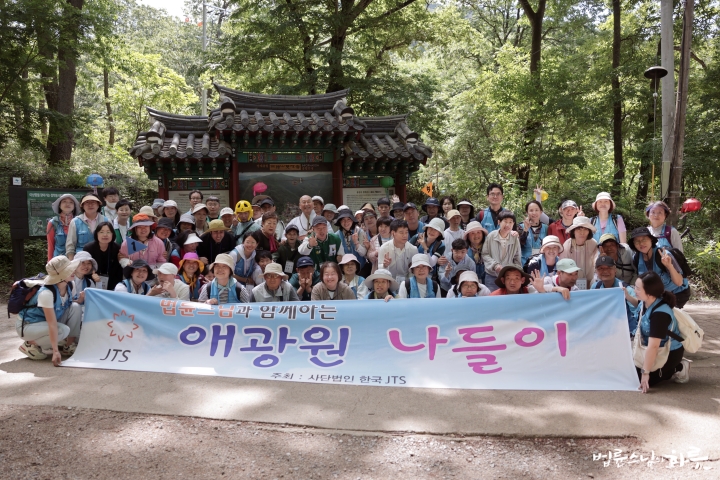
After taking a group photo together, everyone walked up toward the Iljumun (One Pillar Gate).
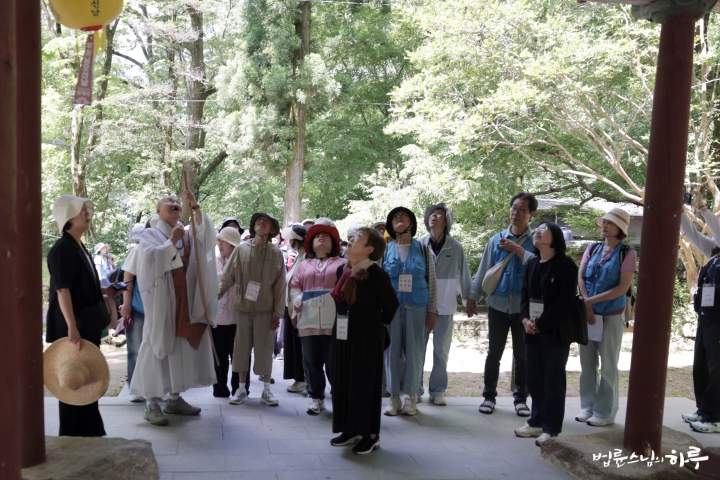
Sunim continued his explanation in front of the Iljumun.
“This is called the Iljumun. It says ‘Samsinsan Ssanggyesa’ in Chinese characters. Based on the Iljumun, the outside is the world of sentient beings, and the inside is the world of the Buddha. Now we will pass through the second gate. It is called the ‘Geumgangmun’ (Vajra Gate). In Buddhism, vajra means breaking through ignorance and attaining wisdom. The fierce-looking statues inside the Geumgangmun are deities that drive away evil spirits. The one riding the lion is Manjushri Bodhisattva, and the one riding the elephant is Samantabhadra Bodhisattva.”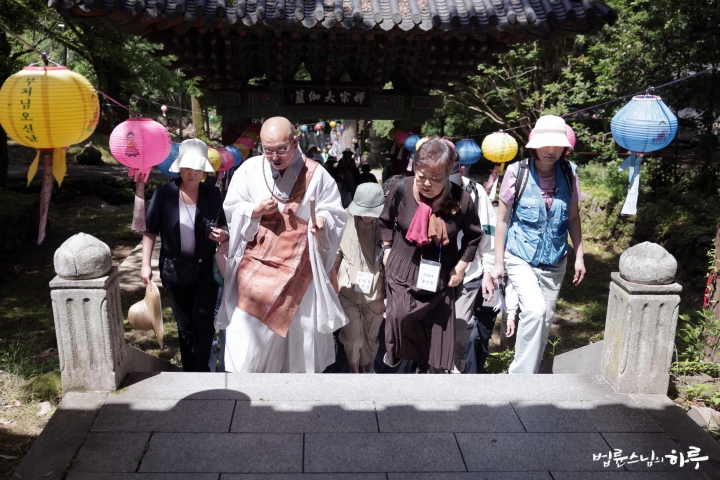
Walking a little further, another gate appeared.
“This is the Cheonwangmun (Heavenly Kings Gate). From here, you are entering the heavenly realm. Four heavenly kings are enshrined here, which is why they are called the Four Heavenly Kings. They are deities that protect good people and drive away bad people. They are the heavenly deities who guard the east, west, south, and north.”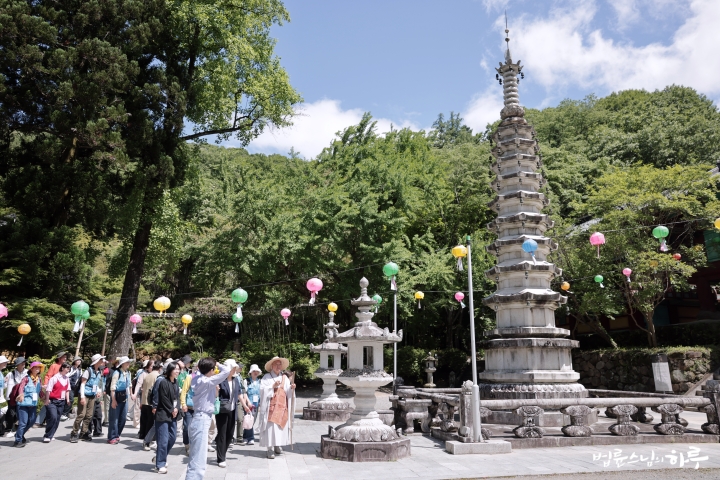
Next, a nine-story stone pagoda came into view. After walking around the nine-story stone pagoda, everyone headed toward the Daeungjeon (Main Buddha Hall). Since there were so many people and the space inside the Daeungjeon was too small for everyone to enter and pay respects, and because it would take a long time given the physical difficulties of some participants, everyone offered three bows together in the front courtyard of the Daeungjeon before moving on.
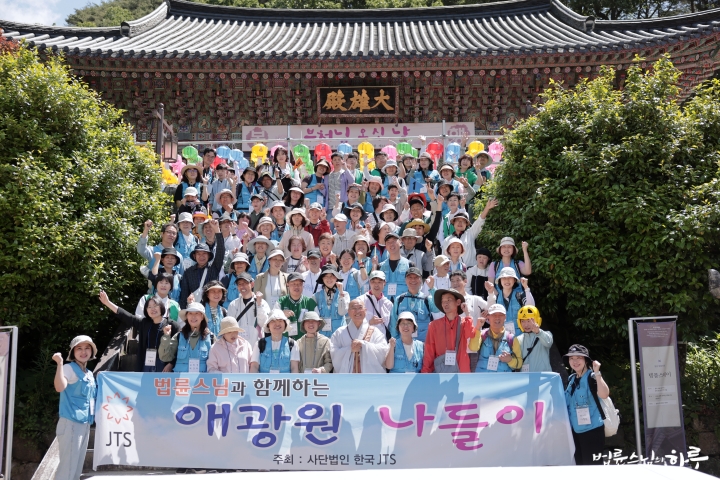
Everyone gathered again on the steps of the Daeungjeon for a group photo.
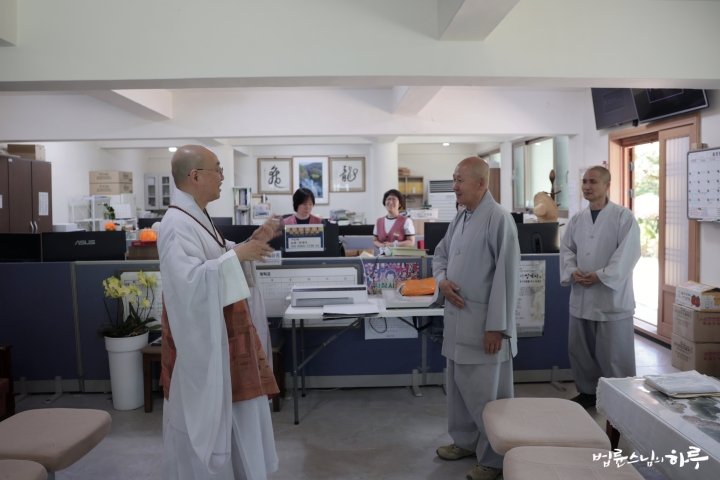
While the outing participants were taking photos in groups, Sunim headed to the Ssanggyesa administrative office. Sunim expressed his gratitude by delivering a donation for Chopail (Buddha’s Birthday) lotus lanterns to the Ssanggyesa administrative office, which had kindly provided the venue for the Aekwangwon outing.
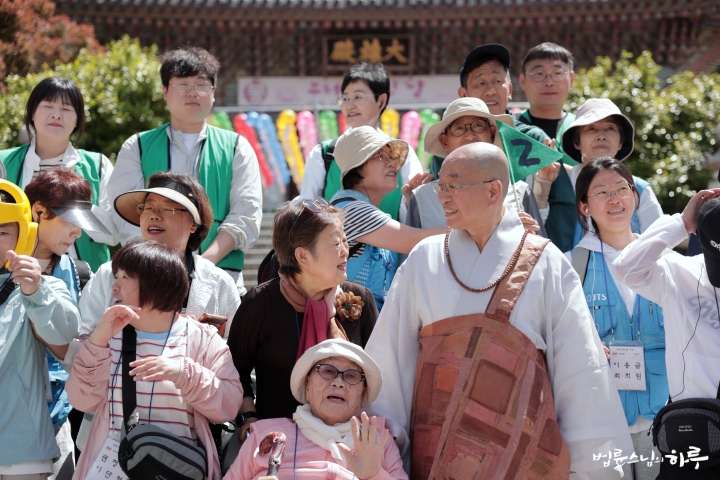
At the parking lot, Director Kim Im-soon (김임순) was waiting to take a photo with Sunim. The director, the CEO, and Sunim took commemorative photos with the residents in groups, taking turns.
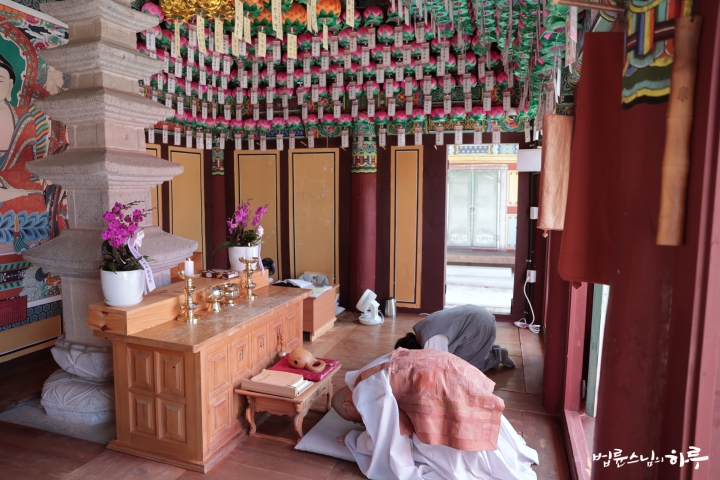
After the photo session, everyone moved to the Geumdang (Golden Hall), which is famous at Ssanggyesa. The path from the Daeungjeon up to the Geumdang involved a series of steep stairs. Sunim and the Aekwangwon residents looked out for each other as they carefully climbed the stairs. Inside the Ssanggyesa Geumdang, instead of a typical Buddha statue, there is a seven-story stone pagoda called the “Yukjo Jeongsangtap” (Sixth Patriarch’s Crown Pagoda). It is said that beneath this stone pagoda are enshrined the skull (頂相) relics of Master Huineng, the Sixth Patriarch of Seon Buddhism. Sunim entered the Geumdang and offered sincere prayers. Three Buddhists who had been praying inside the Geumdang recognized Sunim and approached him to offer three bows in greeting. After coming out of the Geumdang, Sunim advised the outing participants to take their time looking around and to be careful on their way down.
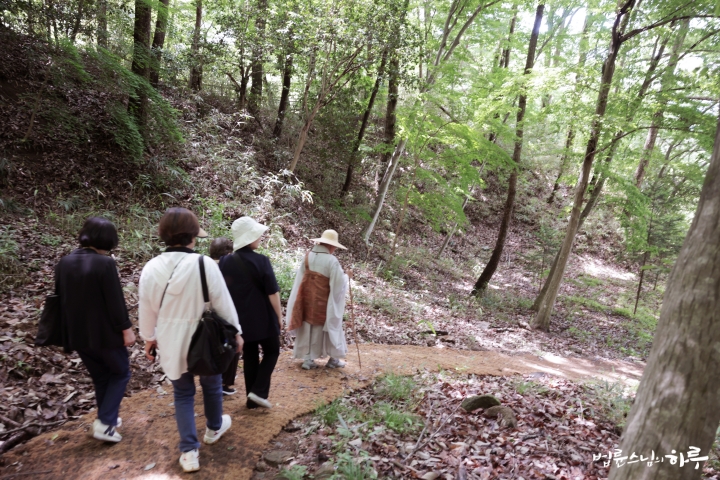
Sunim then walked down along the gentle walking path together with CEO Song Woo-jung. While explaining stories related to the Ssanggyesa Geumdang to the CEO as they descended, Sunim spotted a spring along the path and stopped.
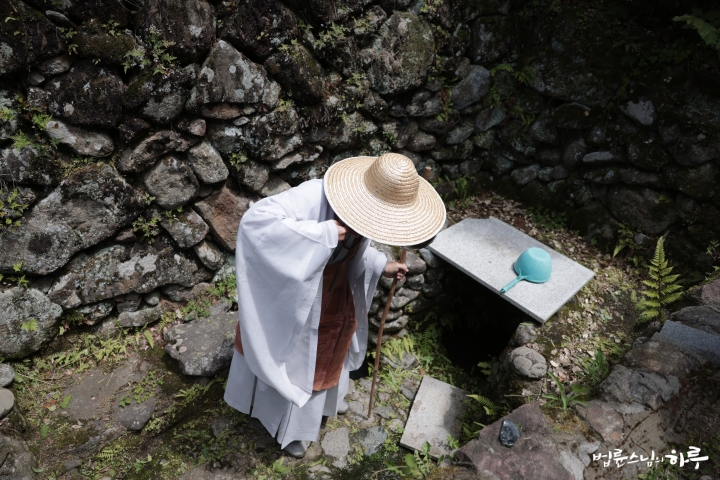
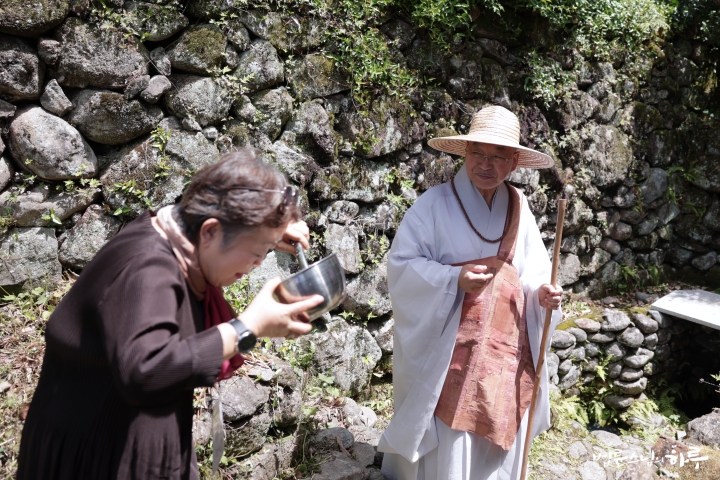
Sunim scooped up some spring water with a gourd dipper placed nearby, took a sip, and then offered some to the CEO to taste. Right next to the spring with its delicious water, there was a small pool of stagnant water, in which a dead frog was floating. Sunim noticed the dead frog but could not retrieve it himself because the sleeves and hem of his monk’s robe were long. He quietly mentioned that it would be good if one of the volunteers could remove the frog from the pool. At this, the chapter leader of the Geoje (거제) branch rolled up her sleeves and carefully scooped out the dead frog. Sunim then walked slowly down to the Ssanggyesa parking lot.
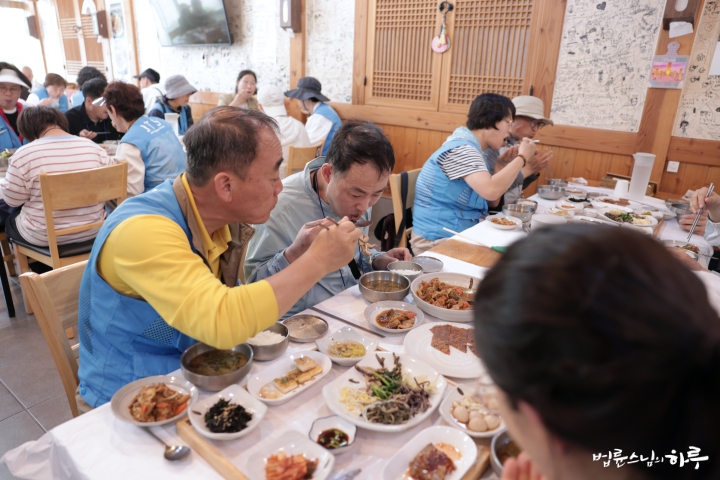
Sunim boarded the prepared vehicle and headed to a nearby restaurant. All the outing participants gathered at the restaurant and enjoyed a delicious bibimbap meal together. The restaurant owner recognized Sunim and gifted him plum gochujang. In return, Sunim expressed his gratitude by presenting his new book, Tak! A Dialogue on Awakening, as a gift.
After lunch, the group drove for about 30 minutes to arrive at Songnim Park in Hadong. Located along the Seomjin River, this site features a dense pine forest and was designated as Natural Monument No. 444 of the Republic of Korea in February 2005. The lush green pine forest blended beautifully with the white sandbanks of the Seomjin River.
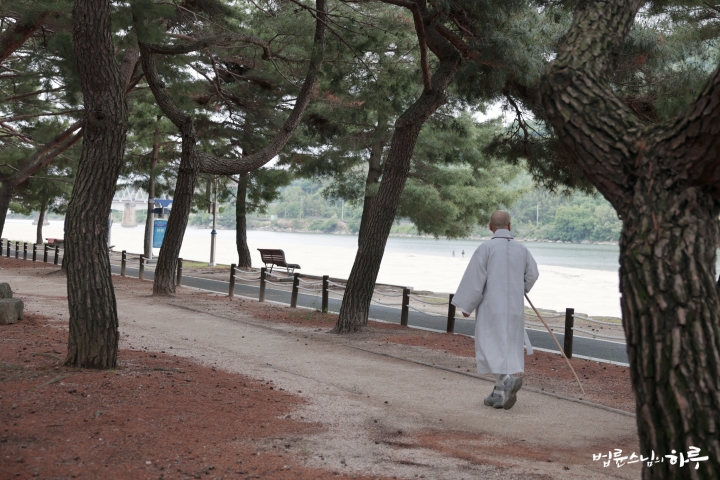
Sunim took a stroll along the riverside path toward the area where the Aekwangwon family had gathered. The outing participants had already settled in a spacious open area near the restroom in the pine forest.
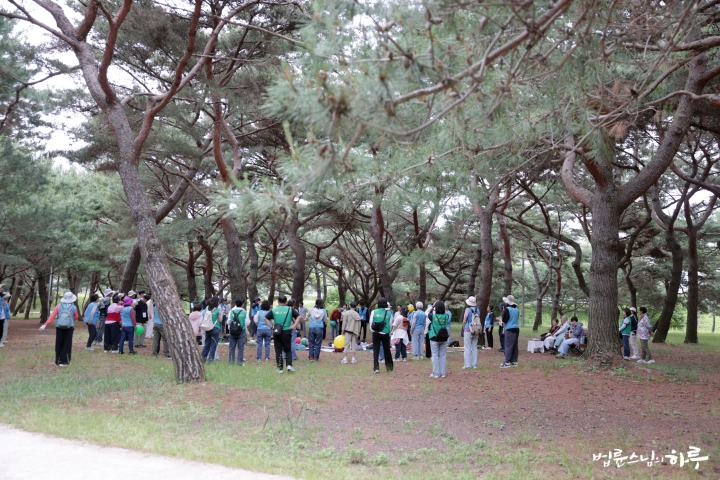
The eagerly awaited recreation time began. A volunteer senior recreation instructor from Tongyeong led light warm-up exercises to upbeat music, lifting the energy of the entire venue.
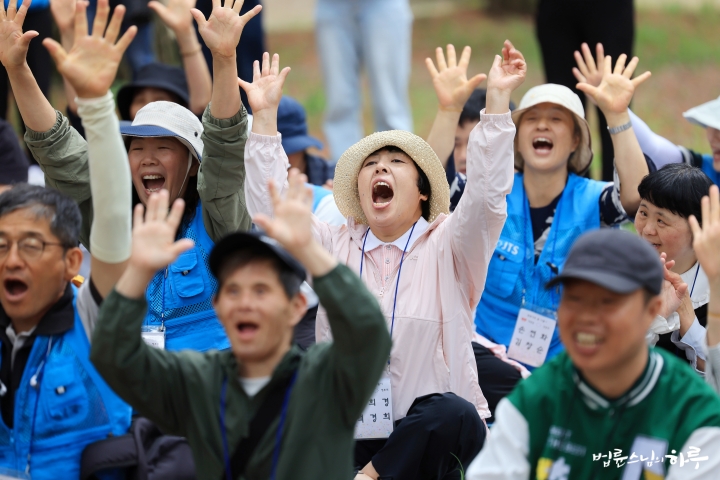
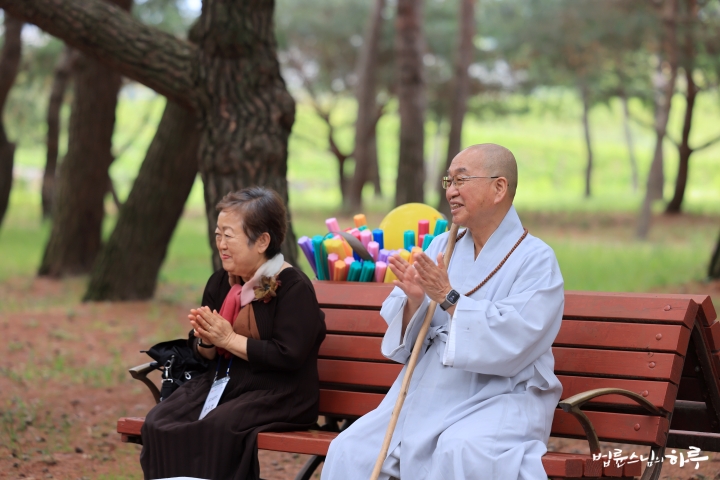
Fun games using balloons and stickers followed, and the Aekwangwon residents enjoyed a lively dance session to the music. At the end, all participants formed a long line and played a train game together, filling the entire area with joyful energy.
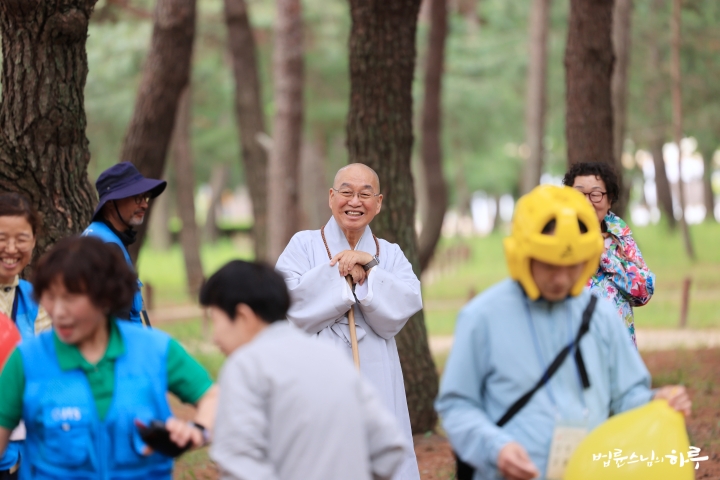
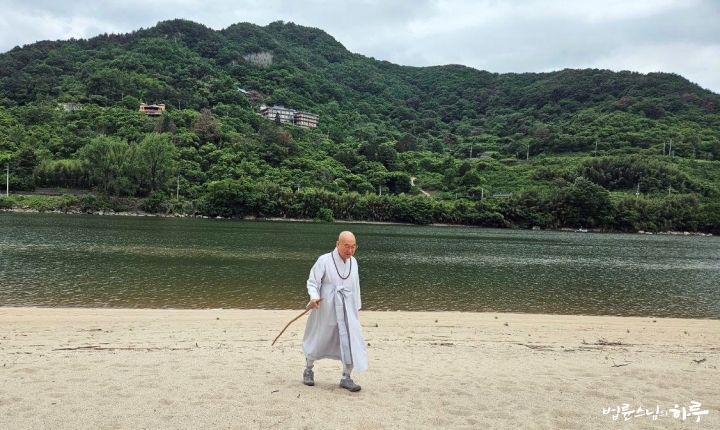
After watching the start of the recreation for a while, Sunim walked down to the Seomjin riverside and carefully observed the surroundings. The river water was relatively clear.
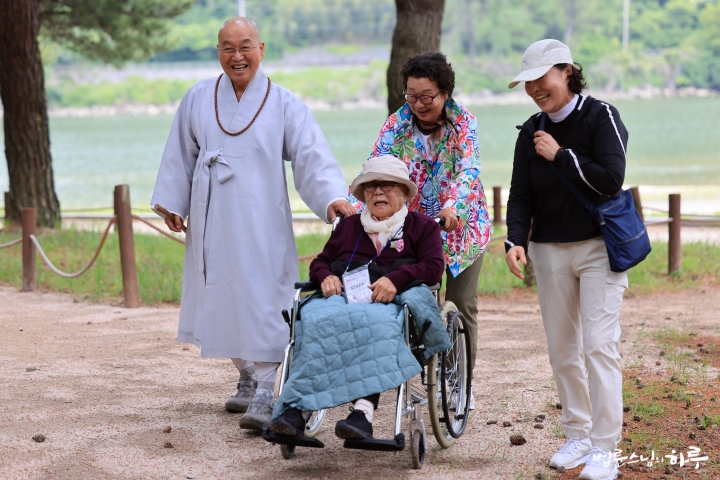
On the way back from his brief walk along the riverside, Sunim met Director Kim Im-soon, and the two returned together to the open area where the celebration was taking place, watching with delight as the participants enjoyed themselves.
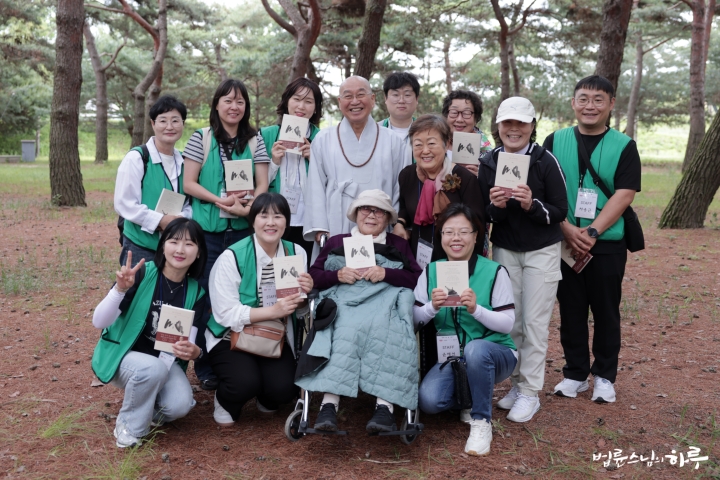
The delightful recreation time came to a close. Sunim presented his new book, Tak! A Dialogue on Awakening, as a gift to the Director and CEO of Aekwangwon, as well as to the teachers who work tirelessly behind the scenes to ensure the residents can live healthy lives. It was now time to wrap up the program at Songnim Park and move on to the next destination. The volunteers asked Sunim to share some closing remarks.
Instead of giving a farewell speech, Sunim suggested that everyone sing a hymn together. Aekwangwon was founded on Christian principles, so the Director, CEO, and residents all joined in singing the hymn along with Sunim, who led the song.
“Nearer, my God, to Thee, nearer to Thee! E’en though it be a cross that raiseth me; still all my song shall be, nearer, my God, to Thee~”
When the song ended, warm applause erupted.
“Did you have fun today? Where shall we go next time? If there’s anywhere you’d like to visit, please let me know anytime.”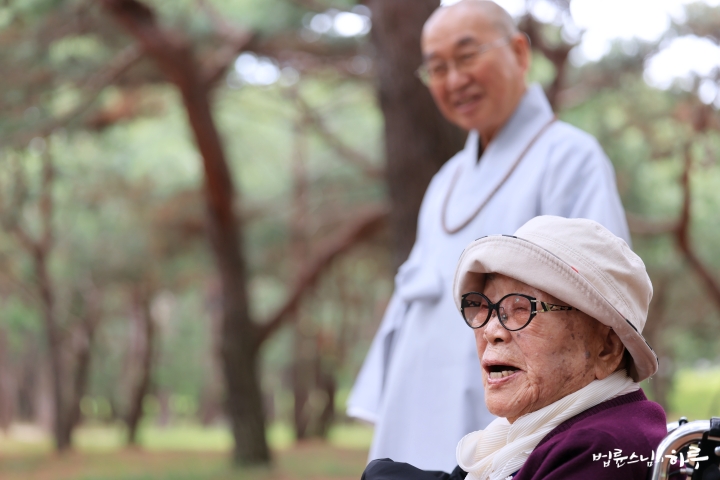
Following Sunim’s remarks, Director Kim Im-soon offered warm closing words.
“I am so grateful that God has given us such wonderful weather and time today, and that Venerable Pomnyun Sunim has come all this way to be with us and join in our volunteer activities. Thank you so much.”
As soon as the Director finished her remarks, Sunim called out, “Hallelujah~!” The participants burst into laughter and gave thunderous applause.
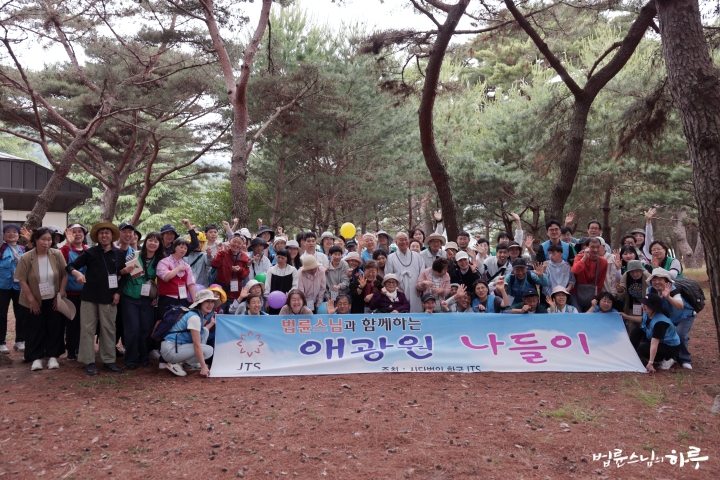
After taking a final group photo, everyone moved to the vehicles.
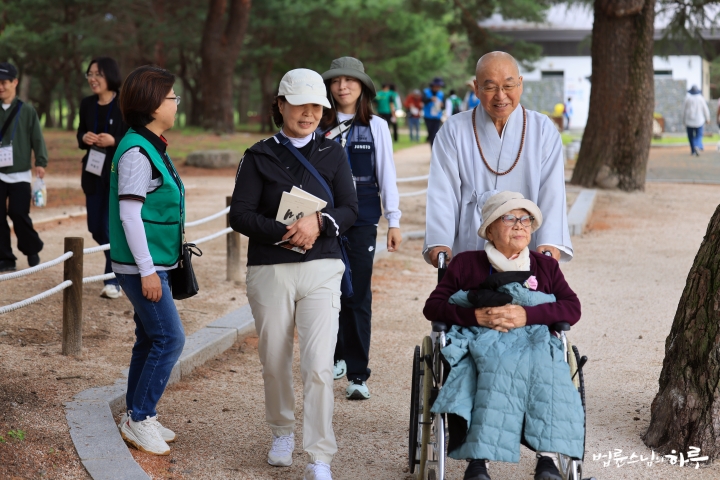
From the open area to the parking lot, Sunim personally pushed Director Kim Im-soon’s wheelchair, walking together along the beautiful riverside path.
The final destination of the Aekwangwon outing was “Haetteul Ranch.” After a 40-minute drive, the group arrived at the ranch for the remaining program—an animal feeding experience. However, even after entering the destination address into the navigation, the ranch was not easily visible. Upon arriving at the location indicated by the navigation, there was nothing in sight. Other participants had reported they had already arrived, but there were no buses or people to be seen.
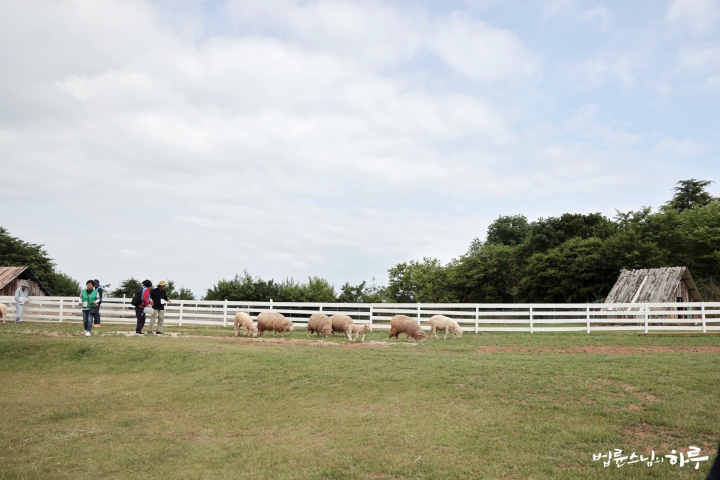
Fortunately, a volunteer had come out to meet them and guided them along the path. As they walked up, a wide-open green pasture suddenly came into view. It was completely hidden from the road outside, but after crossing a gentle hill, the beautiful ranch was revealed.
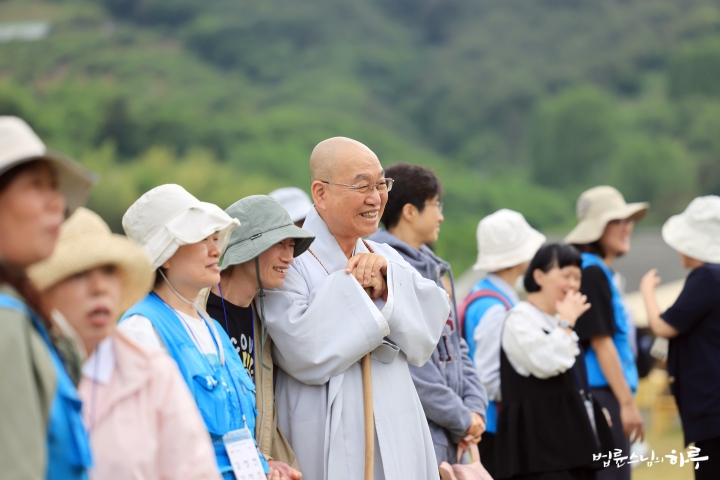
Participants who had arrived earlier were strolling on the grass in small groups, enjoying their time.
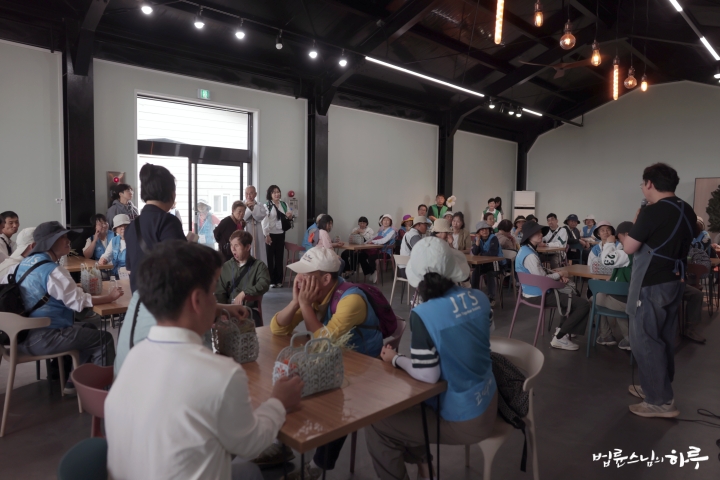
Before the animal feeding experience began, everyone moved to the training room for a brief safety orientation. The instructor explained which animals should be fed grass and which should be fed carrots. He also reassured them that even if the animals opened their mouths wide out of excitement, they wouldn’t bite, so there was no need to be afraid. The residents each picked up a basket of feed and headed into the ranch.
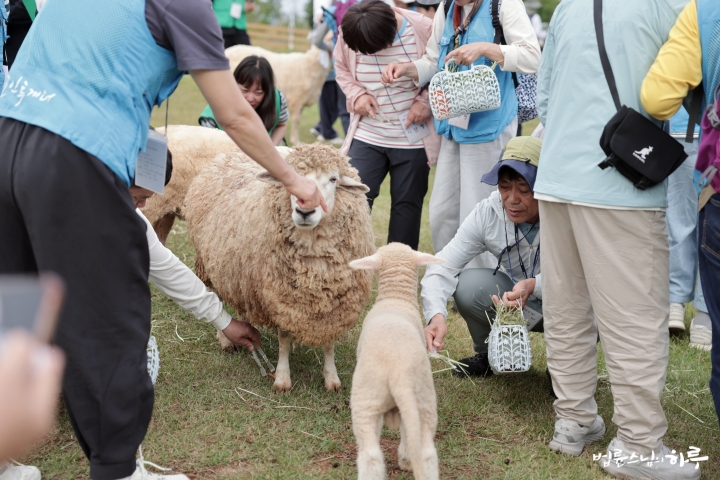
They approached various animals—goats, sheep, horses, rabbits, chickens—and offered them food. Although some residents hesitated at first, intimidated by the approaching sheep, they quickly got the hang of it and enthusiastically participated in the experience. Sunim also approached a sheep and fed it a carrot. As they walked around the ranch feeding the animals, the laughter of the Aekwangwon residents never ceased.
Before they knew it, it was 4 p.m. A “Happy Conversation” Dharma Q&A was scheduled for 7:30 p.m. at Chonnam National University in Gwangju. Considering the tea meeting with university officials before the lecture, Sunim had to leave no later than 4 p.m.
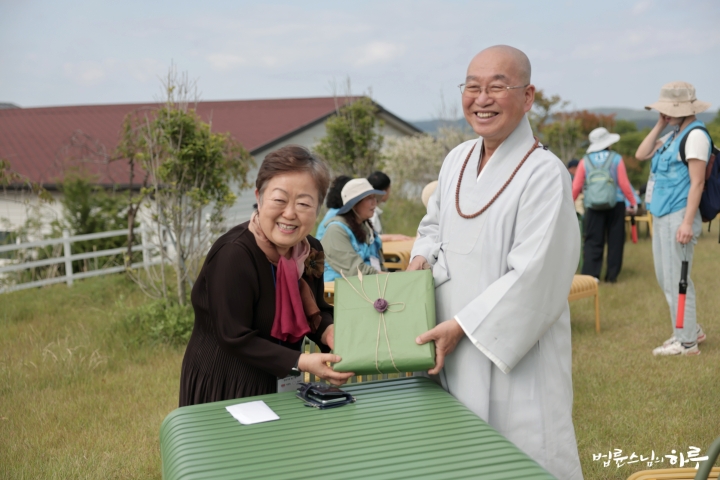
Sunim politely apologized to CEO Song Woo-jeong for having to leave early due to the evening lecture schedule and not being able to stay until the end. He then handed over a donation he had prepared, expressing his wish to offer fruit to the residents in celebration of Buddha’s Birthday. The CEO also presented Sunim with a thoughtfully prepared gift from Aekwangwon and expressed her deep gratitude.
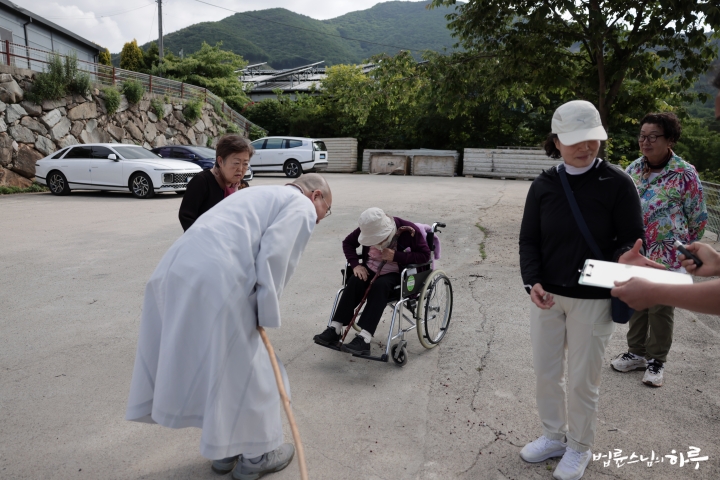
Before departing for Chonnam National University, Sunim approached Director Kim Im-soon, who was in a wheelchair and unable to come up to the upper part of the ranch, and respectfully bid her farewell before boarding the vehicle and heading to Gwangju. During the drive, Sunim attended to pending work and communications. He also briefly closed his eyes to rest. Before arriving at the lecture venue, Sunim stopped at the last rest area and had a simple bowl of udon for dinner.
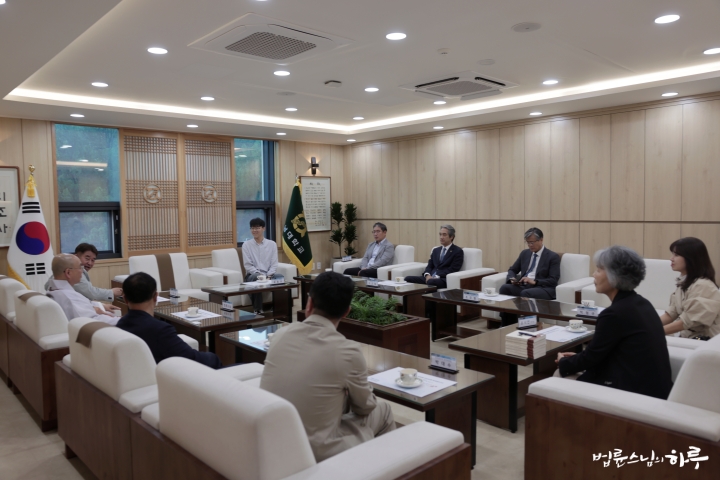
At 6:30 p.m., a tea meeting was held in the reception room of the President of Chonnam National University. Sunim met with President Lee Geun-bae of Chonnam National University, along with other university officials, and Yoon Dong-gyu, the President of the Chonnam National University Student Council, who co-hosted this Dharma Q&A. Thanks to the joint hosting by the Happy Citizens and the Chonnam National University Student Council, pre-registrations had been steadily increasing, with particularly high participation among those in their 20s and 30s. The number of pre-registrants had already far exceeded the 900-seat capacity of the Chonnam National University auditorium. Sunim left a message in the guestbook and presented each person attending the tea meeting with a copy of his new book, Tak! A Dialogue on Awakening.
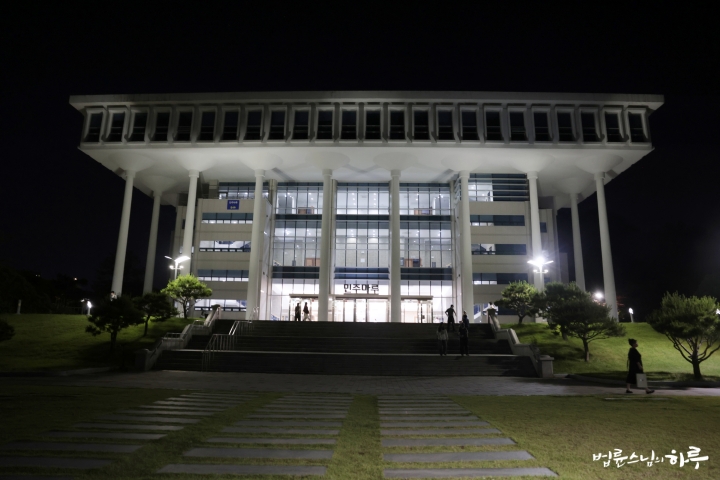
As the lecture time approached, Sunim made his way to the lecture hall.
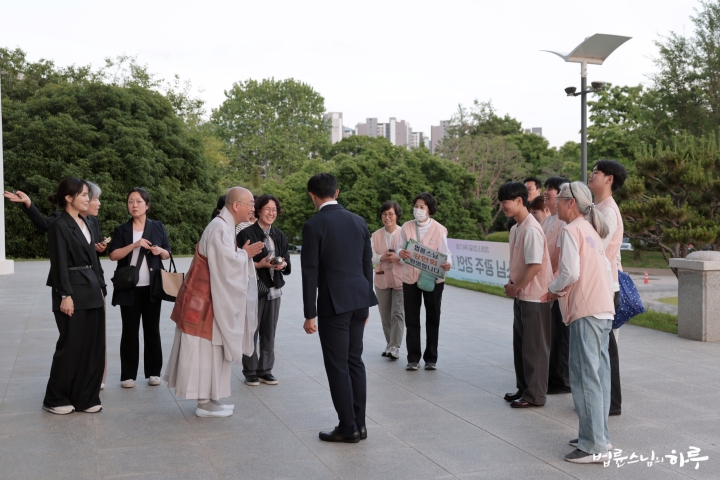
The lobby of the auditorium was bustling with citizens registering for the lecture. Sunim warmly greeted the citizens and volunteers who had come to attend the lecture, then took a brief moment to catch his breath in the waiting room before heading backstage.
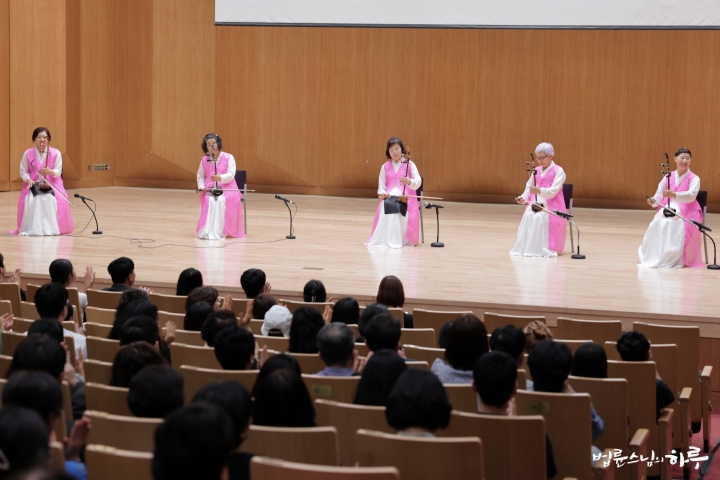
Prior to the main lecture, a haegeum performance was held as a pre-show. Five performers took the stage and played three pieces—”Chilgapsan,” “A Happy Person,” and “Holo Arirang”—with beautiful melodies. Sunim listened to the haegeum performance from backstage, and after the performance, he encouraged the performers and took a commemorative photo with them.
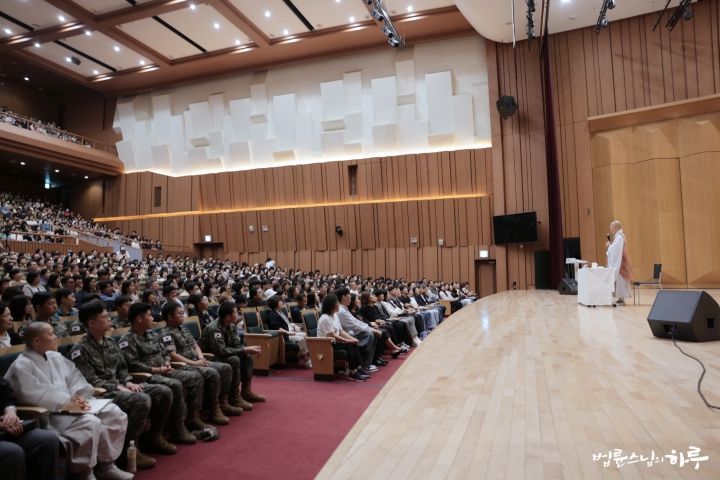
Soon after, the introductory video about Sunim ended, and Sunim finally walked onto the stage with a bright smile. The applause from the audience was thunderous.
“Hello, everyone. Spring is now coming to an end. I’m so glad to meet you, the citizens of Gwangju, on this late spring day. Today’s Dharma Q&A is specially co-hosted by the Chonnam National University Student Council and the Happy Citizens. Please give a round of applause to the President of Chonnam National University, the Student Council President, and the Chonnam National University alumni association, all of whom are here in person. The university has shown great consideration for the citizens of Gwangju. Since this is a joint event, the use of the auditorium and parking are free, and my lecture is also free of charge. (Everyone laughs) When I became a monk and studied Buddhism, I didn’t pay any tuition. So wherever I go, I give Dharma talks without ever accepting lecture fees. Because I learned for free, I lecture for free. But it’s not entirely free. To be precise, it’s a pay-it-later system. If, through our conversation in the Dharma Q&A, you are able to set down even a little of the heavy burden in your heart, then share that gratitude with the people around you. You can give financially or volunteer your time. Rather than calculating labor in terms of money, let’s give to each other and build a better society together. If you find even a little joy through today’s conversation, please share that joy with your neighbors. The Dharma Q&A is the easiest kind of lecture in the world. Since I don’t know what questions will be asked, there’s no way to prepare in advance. So I can just show up empty-handed. Usually, it’s the lecturer’s responsibility to make a lecture useful or interesting, but in the Dharma Q&A, we create it together with the questioner. If the question is interesting, the Dharma Q&A becomes interesting. There’s no set topic that must be covered. Depending on the question, it can become like a school lecture, or sometimes it becomes a counseling session. We talk about whatever is on your mind. If you wonder, “Why is that person asking such a question after coming all this way?”—then go ahead and raise your hand and ask your own question. There’s no fixed theme. Just as water takes the shape of whatever vessel holds it, the content of our conversation changes depending on the questioner. Some people ask, “Venerable Pomnyun Sunim, how do you always give the right answer?” But I have never given an answer. If I were giving the right answer, it would be “instant Q&A,” not “Dharma Q&A.” I simply have a conversation. No matter what someone talks about, a conversation can be had. Whatever subject is brought up, it’s possible to listen and exchange a few words. That’s why anything is fine to talk about. However, since this is a public gathering, please refrain from using profanity. Also, please refrain from sharing stories that many people would find excessively offensive. For example, if a young person has a sexual concern they’d like to discuss, please adjust your expression so that listeners aren’t made uncomfortable. And if a questioner does bring up such matters, those listening also need to be understanding. What feels uncomfortable for us to hear may be something painful that the person needs to share. Also, you must not gossip about what is shared during the Dharma Q&A. Whatever is said is simply material for conversation. If someone talks about their husband or wife, it is merely an example of a couple’s daily relationship—what matters is not whether the facts are true. Through our conversation, if you realize, “Oh, it’s not a big deal,” or “I could try doing it this way,” then you may feel you’ve found an answer. But I haven’t given you an answer. If awareness arises, you’ve found the answer yourself; if awareness doesn’t arise, you simply haven’t found the answer yet. I only help you to look into yourself through our conversation.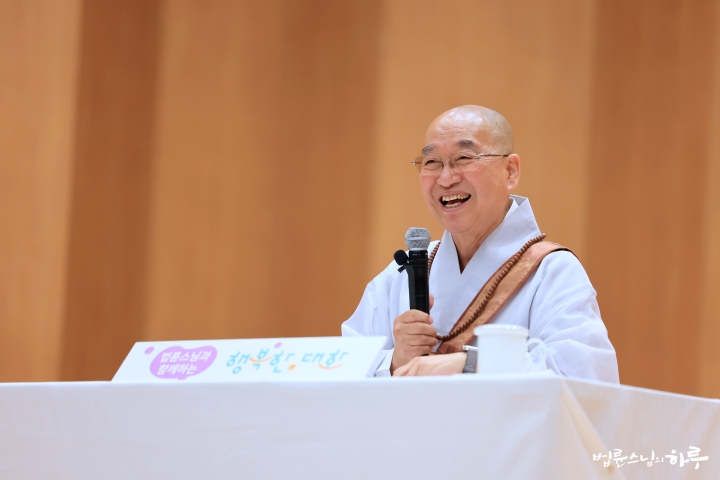
The dialogue with the audience began. Five people had been selected in advance as questioners, and four additional questioners had the chance to speak on the spot. Among them, this post introduces the conversation with a 21-year-old young man who won the chance to ask his question through a game of rock-paper-scissors after simultaneously raising his hand with others.
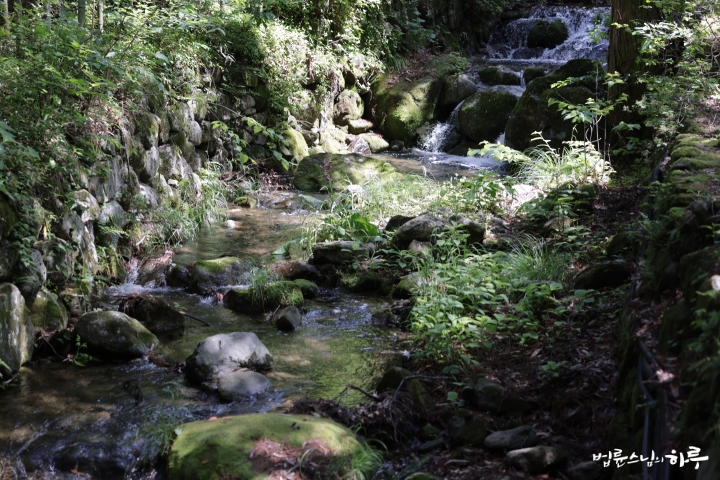
**I Want to Live Humbly Like a Single Blade of Grass by the Roadside, but I Wonder How.
**
“I’m 21 years old and a second-year student majoring in Korean language education. There are about three things I remember from Sunim’s teachings. The first is, ‘Try living like a single blade of grass by the roadside.’ The second is, ‘Don’t be ashamed of your past self. Even your present self can be flawed and make mistakes.’ Lastly, there’s the teaching about ‘being aware of one’s feelings.’ What I would like to ask is that when I recall my younger self, feelings of shame still arise. I truly want to live like a single blade of grass by the roadside. Could you tell me what kind of mindset I should have in my prayers and life to live with a humble attitude while also being gentle with myself?”
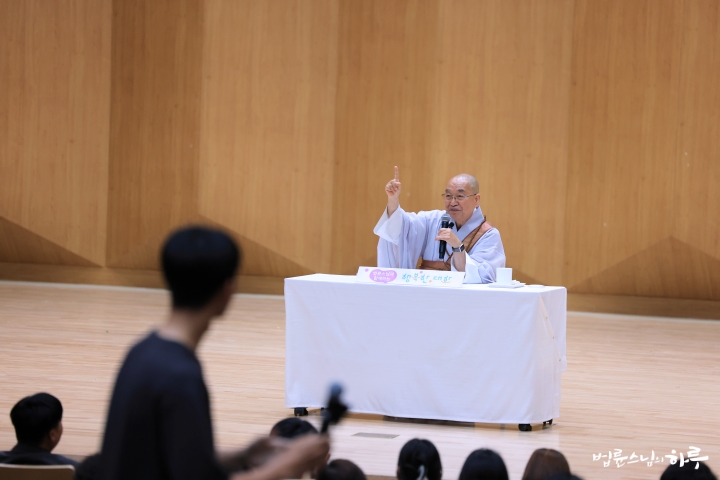
“That sounds difficult.”
“For example, it means seeing your superior and subordinate the same way, without distinction. Seeing a wealthy person and a poor person, a student and a professor, all the same. When you see things this way, you don’t treat people differently based on whether they are higher or lower than you in status—you simply treat them as fellow human beings. You’re just treating them as one person, but people in the world say, ‘That person isn’t servile even in front of high-ranking people; they’re so confident.’ And when you treat people of lower status without showing off and simply as equals, people in the world evaluate you saying, ‘That person is truly humble.’ So ‘dignity’ and ‘humility’ don’t exist separately. You just need to see an apple as an apple and a pear as a pear. You don’t view apples as better and pears as worse—you see them equally. Even in a world where discrimination exists, if you don’t discriminate and treat each being equally as they originally are, then people in the world will look at you and say, ‘That person is dignified in front of those in high positions and very humble toward those in lower positions.’ Saying ‘I will be humble’ doesn’t make you humble. If you do as you please, and someone says, ‘You’re a bit arrogant,’ then just be a little more humble. If someone says, ‘You’re a bit servile,’ then live with dignity. By doing this, you naturally find the point of balance. It’s not easy for a young person to live with humility and dignity from the start. Even small things don’t go well from the beginning. In the old days, people made rope by twisting straw, and even that didn’t go well at first. You have to keep twisting the straw with both hands to develop the skill. When you accept others’ evaluations thinking, ‘That makes some sense,’ people say you’re easily swayed. And when you try to hold your own center, others may see you as ‘stubborn.’ Being ‘stubborn’ or ‘easily swayed’ isn’t fixed. When it’s time to listen to others, if you ‘hold your own center,’ others will see you as ‘stubborn.’ When it’s time to hold your center, if you listen to others’ words, you’ll be called ‘gullible.’ It doesn’t fit perfectly. You need to accumulate many experiences and find appropriate harmony. This is the ‘Middle Way (中道),’ which is the most important thing in life. The Middle Way isn’t achieved through theory. For example, when tightrope walking, the way to walk without falling is to step straight on the rope without leaning to one side. In words, it can be summed up in one sentence: ‘Just walk straight.’ But when you actually get on the rope, it’s not so easy. That doesn’t mean it’s impossible. Is it possible to do it right away just because it’s possible? No, it isn’t. Life is the same. The method is surprisingly simple, but it takes much practice to internalize it with body and mind. You try this way and that, and sometimes you fall, but you climb up again, fall again, climb up again, and at some moment, you find yourself walking with appropriate balance on your own. This is life.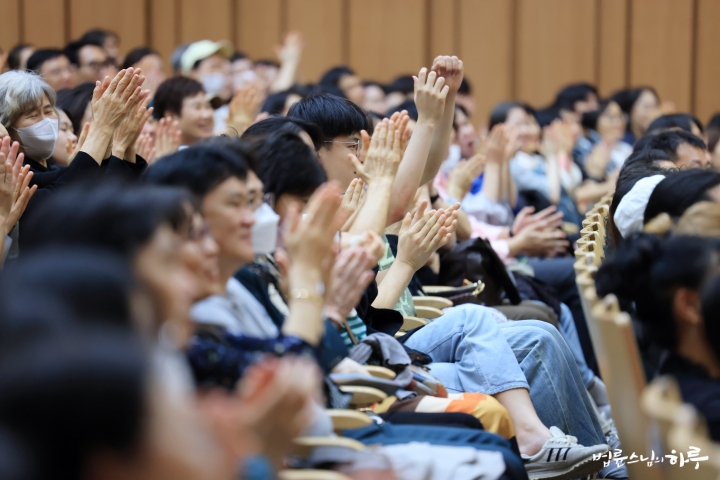
“Yes, I need to listen well.”
“I don’t mean that you should obey unconditionally; you can understand it as ‘accepting things lightly.’ Just take it as, ‘Oh, this is the professor’s perspective,’ or ‘This is how my friend sees it!’ When you approach things this way, those experiences become helpful to you.”“Yes, thank you.”
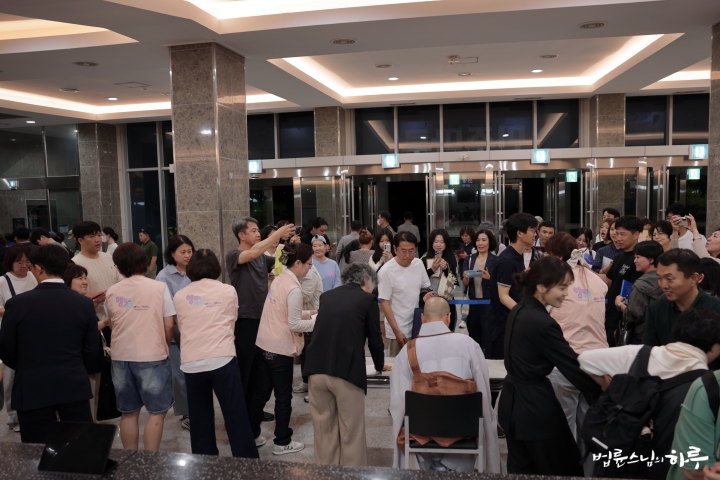
After the conversation with the audience ended, there was a book signing event. Many people stood in a long line to get their books signed. As they received Sunim’s signatures, they greeted Sunim, expressing their gratitude or wishing him good health.
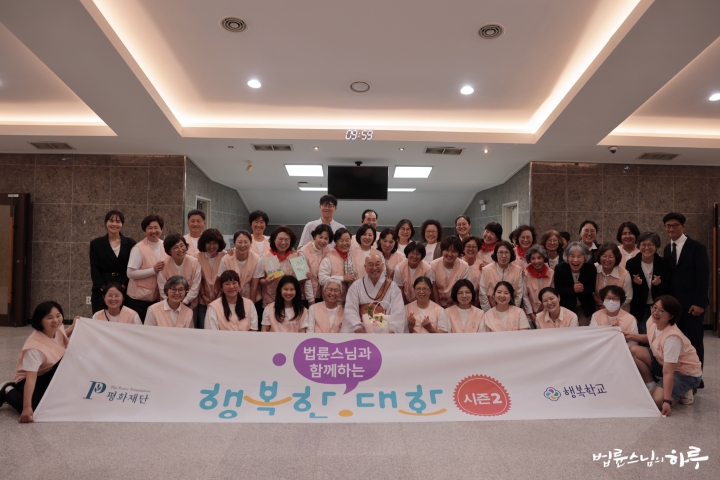
Afterward, Sunim took a group commemorative photo with the Happy Citizens who had prepared the Dharma Q&A lecture, bringing the entire lecture schedule to a close. It was 10 p.m. when Sunim finally got into the vehicle and departed for Seoul. By the time he arrived at the Seoul Jungto Center in Seocho-dong, it was past 1 a.m. Today, Sunim’s day was a long journey that began in Dubuk, included a visit to Aekwangwon in Hadong, Gyeongnam, then moved on to Gwangju for a lecture, and finally arrived in Seoul.
Tomorrow morning, there will be an online Dharma Q&A for the Jungto Dharma School, and in the afternoon, Sunim plans to participate in the cultural festival on the eve of the Buddha’s Birthday.
“