How Should I Deal with Recurring Anxiety and Fear in Romantic Relationships?
May 20, 2026 – Interfaith Gathering, Weekly Dharma Assembly (Morning), Peace Foundation Planning Committee Meeting, Weekly Dharma Assembly (Evening)
Hello. Today, Sunim’s schedule began with an interfaith breakfast gathering, followed by the morning Weekly Dharma Assembly, an afternoon Peace Foundation Planning Committee meeting, and concluded with the evening Weekly Dharma Assembly.
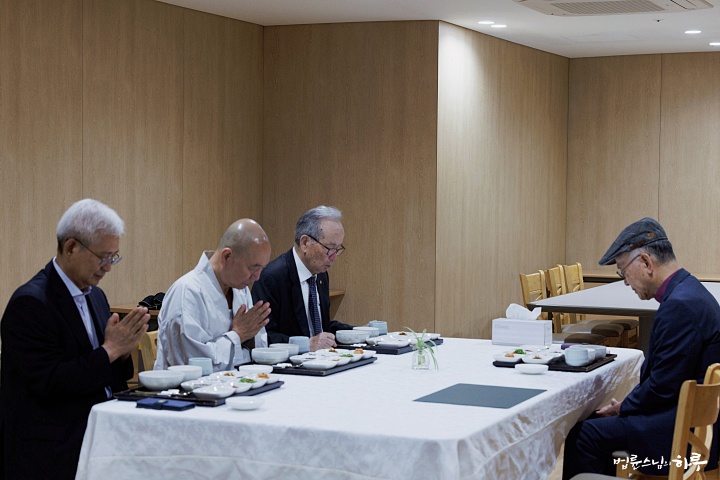
Sunim began the day with early morning practice and meditation. Around 7 a.m., he made his way to the basement dining hall of the Jungto Social and Cultural Center. Today was the day for the monthly “Interfaith Gathering for National Reconciliation and Peace.” The bishop, the Won-Buddhist minister, and the Cheondogyo leader arrived at the center one by one, and Sunim warmly welcomed each of them. Around 7:20 a.m., once all the participants had arrived, the Peace Foundation staff and volunteers brought out a carefully prepared meal. Sunim and the religious leaders began the gathering by sharing breakfast together. First, Cheondogyo (천도교) Leader Park Nam-soo offered a prayer before the meal.
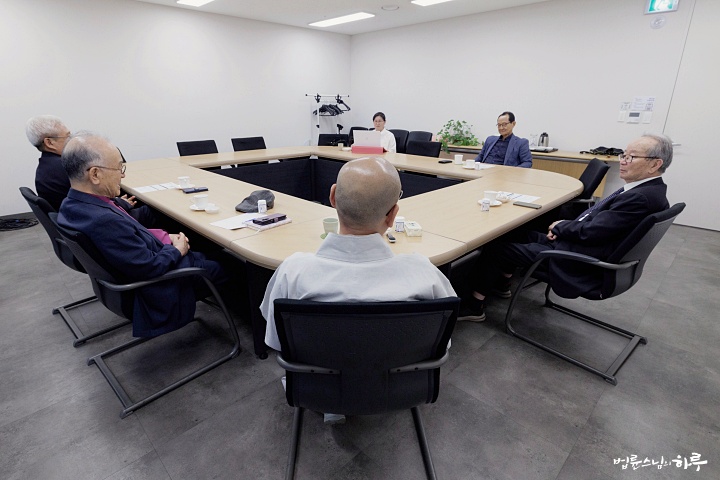
After finishing breakfast, the religious leaders moved to the Peace Foundation conference room on the 10th floor to continue their in-depth conversation.
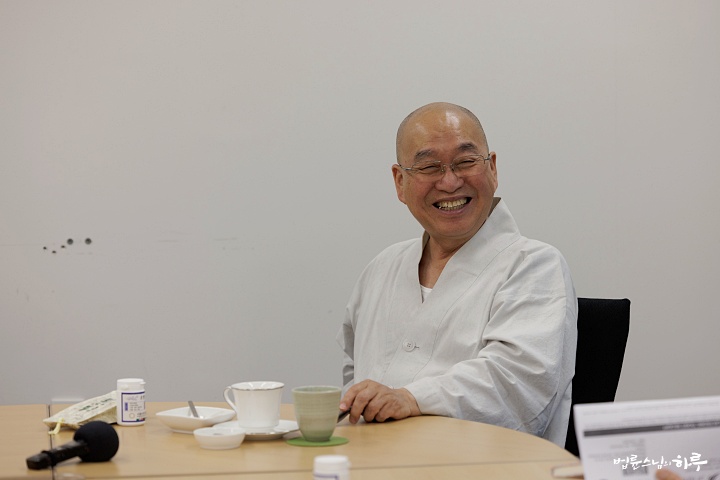
First, Sunim shared the outcomes of his recent visit to Washington, D.C. the previous week, where he had met with U.S. government officials, members of Congress, and think tank representatives to discuss peace on the Korean Peninsula. The discussion then turned to the upcoming June 3rd nationwide local elections and the current political situation in Korea. Promising to meet again at the social leaders’ Dharma assembly for Buddha’s Birthday this coming Sunday, today’s interfaith gathering came to a close.
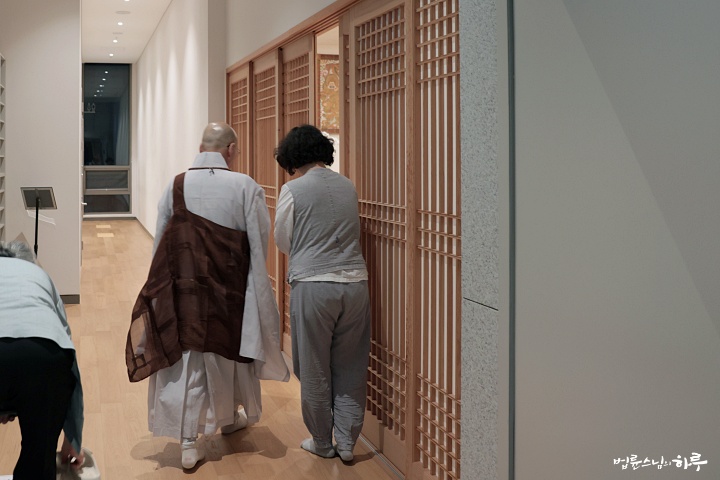
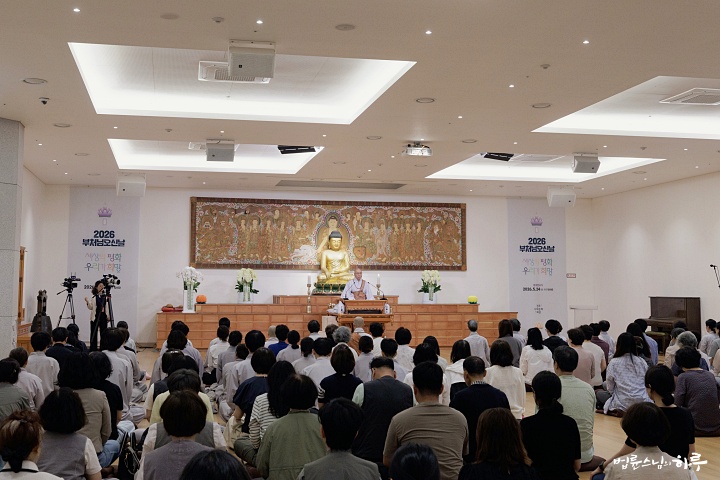
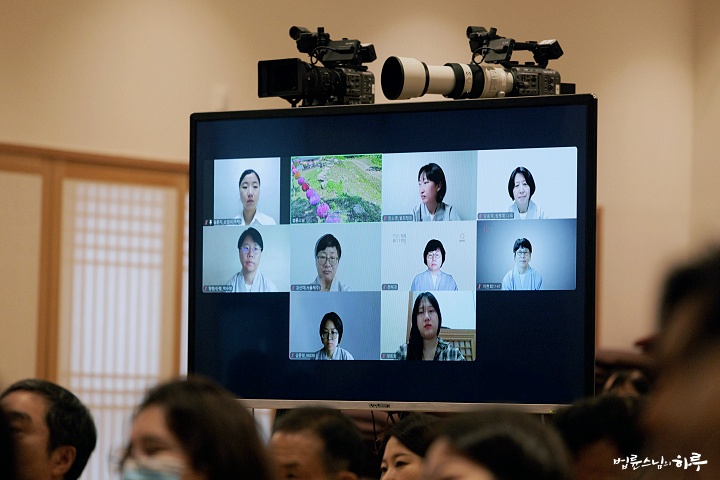
At 10 a.m., Sunim headed to the Dharma Hall on the 3rd floor. Today was the Weekly Dharma Assembly, where participants reflect on their daily lives and examine their practice through Sunim’s Dharma talk. About 100 members of the Sangha attended the assembly. After beginning the assembly with the Three Refuges and the recitation of the Heart Sutra, everyone watched the “Weekly Jungto Practitioners News” video, which featured updates from Jungto practitioners at each main temple and practice site over the past week.
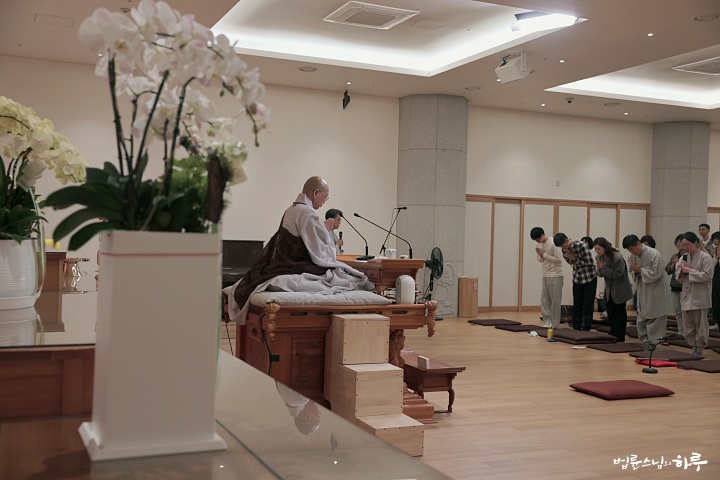
Then, the members of the Sangha invited Sunim to give his Dharma talk by singing the Cheongbeopga (청법가, Song of Requesting the Dharma) and offering three bows. After a brief moment of silent meditation, Sunim began his Dharma talk.
“Hello, Jungto practitioners. It’s May, the tail end of spring. I spent the past week in Washington, D.C. While I was there, some days the high temperature was only 15 degrees Celsius with strong winds, making it feel like winter. But by the time I was returning to Korea, the temperature had risen to 34 degrees. Within just a week, the high temperatures fluctuated by 19 degrees, from 15 to 34 degrees—a dramatic change. Looking at the news, I saw that some areas in Korea reached as high as 36 degrees. I also heard that early-season beachgoers have already started flocking to Haeundae (해운대). It seems that our weather is changing, with shorter springs and longer summers. This Sunday, May 24th, is the 8th day of the 4th lunar month—’Buddha’s Birthday.’ At Jungto Society, we will hold a celebration Dharma assembly at 10 a.m. to commemorate Buddha’s Birthday. I hope all Jungto members will participate in person at the celebration if possible. If attending in person is difficult, please join online so we can reflect on the meaning of Buddha’s Birthday and celebrate together. On the same day at 3 p.m., a commemorative Dharma assembly will be held at the Jungto Social and Cultural Center. Even those who are not Buddhists—including social leaders, politicians, government officials, civic group members connected to Jungto Society’s activities, as well as members of Gilbeot (길벗), a group of entertainers working in broadcasting, film, and the arts—will all be joining us. There will also be a Dharma assembly for young people at 7 p.m. The day before the celebration, on Saturday, a ‘Jungto Cultural Festival’ will be held from 4 to 6 p.m. as an eve-of-celebration event. Special performances will begin at 2 p.m., so I hope many of you will come and enjoy it together.Peace on the Korean Peninsula Is Something We Must Safeguard
Over the past week, I carried out various activities in Washington, D.C., the capital of the United States. As for Jungto Society activities, on Saturday I held a Dharma Q&A with Jungto members in the U.S., and I also held an online Dharma Q&A for international branch members in Europe. When holding online Dharma Q&As for the international branches from Korea, they are always scheduled in the evening based on U.S. Eastern Time, which makes it difficult for those in Europe to participate since it falls in the middle of the night for them. So while I was in Washington, D.C., I held a Dharma Q&A timed to European hours. On Sunday, there was an opening ceremony for the meditation hall, which had been completed after seven years of construction. Originally, we had planned to build a three-story building with a Dharma hall, meditation hall, lodging, and other comprehensive retreat facilities. However, during the process, the regulations changed, and we could no longer construct buildings that required wastewater treatment. Since we had to build under the condition that no water would be used, we ended up creating only the meditation hall space. So we decided to use the original existing building as lodging, while the new building would be used for events such as meditation and Dharma talks. Although the scale turned out much smaller than originally planned, I think we can use it as it is for the time being. Many Jungto practitioners participated in the opening ceremony, helping to prepare and celebrate the event together.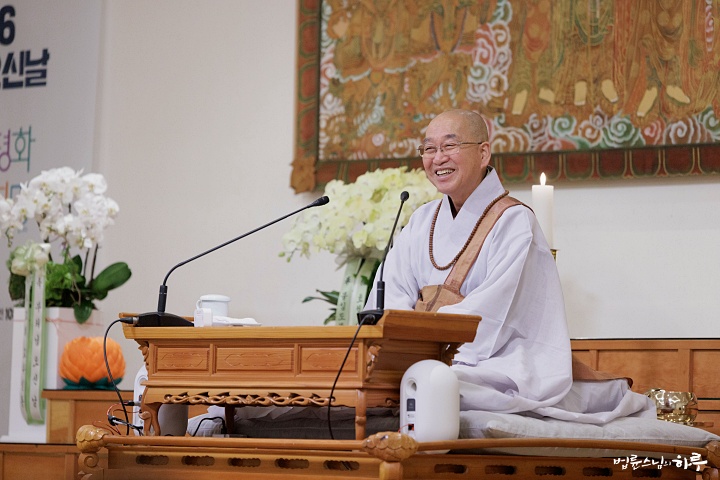
What Economic Benefits Could Come from Improved U.S.-North Korea Relations?
“If relations between the United States and North Korea improve, what economic benefits could the U.S. gain? In countries like Iran or Venezuela where oil is produced, there is at least the justification of securing rights to oil. But with North Korea, it’s easy to think that even establishing diplomatic relations would bring little economic benefit. However, North Korea has large deposits of various non-ferrous metals, including gold, copper, zinc, magnesite, and rare earth elements. Simply having reserves or producing these resources is not meaningful in itself. The smelting process must take into account both economic viability and environmental concerns. Smelting in South Korea or the United States lacks price competitiveness compared to China. Additionally, the environmental pollution generated during the smelting process is serious, making it difficult to develop related industries.” “Currently, China accounts for more than 80 percent of the world’s rare earth production. Rare earth elements are essential resources for high-tech industries, so their importance is growing more and more. Recently, the United States used large quantities of weapons in its conflict with Iran, and to replenish these, it needs key materials like rare earth elements. In this process, China is using its rare earth supply as leverage to keep the United States in check. South Korea also depends on Chinese imports for about 80 to 90 percent of its rare earth consumption, and Japan is in a similar situation. Therefore, if problems arise in Korea-China relations, China could apply pressure through trade restrictions, which could become a major obstacle to our country’s high-tech industries. In this regard, if smelting facilities can be built for the resources buried in North Korea to enable mass production, it would help diversify our dependence on China for rare earth elements.”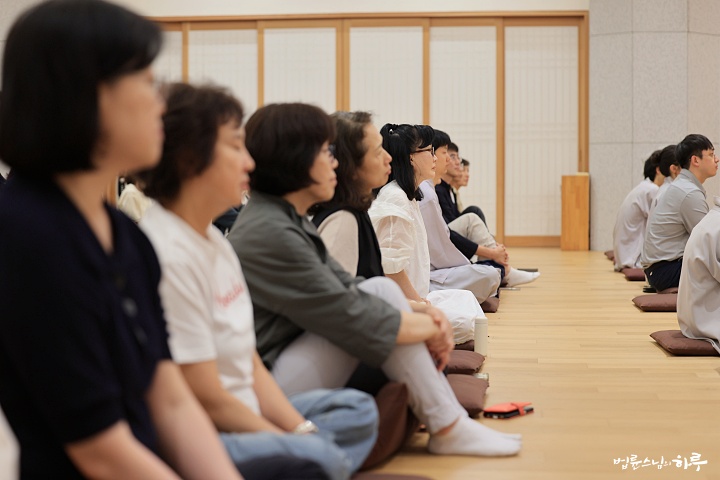
SBS Broadcast of “Sunim and Guests”
“Last night, SBS aired ‘Sunim and Guests.’ Did any of you watch it? I haven’t seen it yet. I thought it was a cultural program when we filmed it, but the broadcasting station people called it an entertainment program.” (Laughter from the audience) “I participated because I thought it would help popularize Buddhism, but many people opposed my appearance. They said appearing on such an entertainment program didn’t fit the image of a monk. Still, some argued that we need to find ways to make Buddhism more accessible to the general public. That’s why I decided to appear. How was the content of the broadcast? Was there anything worthy of criticism? At the interfaith gathering this morning, Park Nam-soo, the head of Cheondogyo, also watched it with interest and shared several comments. He said the lines that stood out to him were: ‘Don’t leave food behind—eat it all,’ ‘To understand the people’s lives, you must visit the markets,’ and ‘Giving alms out of pity can sometimes turn people into beggars.’ He also noted that the rich and poor are not entirely separated but coexist mixed together. These are characteristic features of Indian society, but I’m not sure how general viewers perceived them.” “In upcoming episodes, we go to Bodh Gaya and have various conversations about the Buddha’s teachings. I wanted to talk more about the Buddha’s enlightenment in Bodh Gaya. However, since it was an entertainment program, I couldn’t do as I wished, and they didn’t show much interest in Sujata Academy either. Looking back, I think they were very cautious about appearing to promote the work of a specific organization. In any case, I wondered how they would make five episodes out of five days of filming, but it seems they managed to include all sorts of diverse stories. So even though Venerable Pomnyun Sunim appears, Sunim may not be very visible.” “Jungto Society communicates with the public through various media such as Dharma Q&A, YouTube, and books, so we have a relatively broad base. Nevertheless, Jungto Society’s executives have recently been saying, ‘Even Jungto Society has a weak base.’ In that regard, I thought it would be necessary to participate in programs like this to expand our reach.”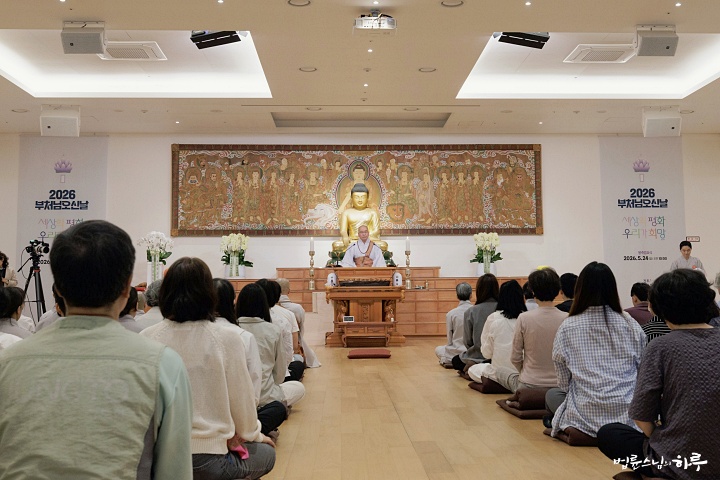
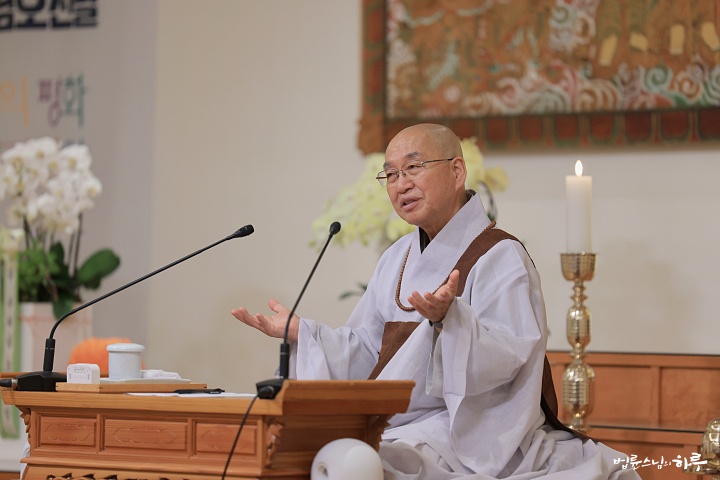
At the morning Weekly Dharma Assembly, there was one person who had submitted a question in advance. After the Dharma talk, Sunim had a conversation with the questioner.
How Should I Deal with the Anxiety and Fear That Keep Repeating in My Romantic Relationships?
“When I’m in a romantic relationship, even the slightest change in the other person’s tone or reaction makes me think, ‘Does he dislike me? Is he trying to break up with me?’ I try to hold it in, but eventually I end up getting angry or sulking heavily, and this pattern keeps repeating. Most of my relationships ended badly, and I was even told by an ex-boyfriend that I seemed to have borderline personality disorder. That comment prompted me to visit a doctor, who said I don’t have borderline personality disorder but do have some traits on the spectrum. He said that rather than medication, it’s more important to change the behavioral patterns and perspectives that keep repeating in relationships. He said that the emotions that follow after I get angry are anxiety and depression. It seems to have become a habit of the mind. The doctor said I seem to be the type who is fine normally but whose emotions become activated when I’m in a relationship. He even suggested I try dating to check my actual state within a relationship. Right now, I’ve been taking mood-regulating medication for about six months and visiting the hospital every two weeks. But the consultation time is only about three minutes or so, and I’m confused about whether I’m actually getting better or whether the treatment is working. How should I clearly see and deal with the anxiety and fear that keep repeating in relationships? I’d like to ask in what direction I should move through practice and prayer.”
“Not eat apples.”
“In the same way, if your anxiety becomes severe only when you’re in a relationship, you can simply not be in a relationship. (laughter) Your words carry the assumption that ‘I must be in a relationship.’ But is there really a reason you must be in a relationship? I’m living just fine without being in one. (laughter) Your fixed ideas about romantic relationships seem to be at play here. If being in a relationship works out fine for you, then by all means be in one. But if every time you’re in a relationship, the same personality issues keep coming up, then you can simply not be in one. It’s just like how if eating apples always causes an allergic reaction, the problem is solved by not eating apples. If you get pollen allergies every spring, you can wear a mask or refrain from going outside. I recently met a Korean-Canadian who said he always suffered from atopic dermatitis when he was in Korea. But when he traveled to Canada, his atopy got better. Thinking that health is the most important thing, he boldly quit his good job and immigrated there. Pain is hard, but itching and scratching is also no small ordeal. I also have a cold allergy in winter, and whenever I come back inside after being out, I get itchy. Without realizing it, I rub the spot with my hand or even my foot until it bleeds, so I understand how he feels. If you can get rid of the symptoms, you might as well immigrate. Don’t say, ‘Medicine doesn’t work either.’ The point is to move away from the cause. But the fact that you say this problem comes up every time you’re in a relationship suggests that you’ve been in relationships with many different people, doesn’t it? Others would be incredibly envious to hear this. Some people have a hard time even getting into one relationship, while you keep getting into relationships with one person after another. In a way, this is like complaining about luxury when you have it good. (laughter) First, not being in a relationship is the easiest path. If your emotions become intense and the relationship becomes difficult as soon as you start one, then simply don’t enter into one. Second, there’s also the method of changing partners whenever those emotions arise. You don’t seem to have much difficulty starting relationships, so you can break up and meet someone else, break up and meet another person. Whether you meet one person all year long or meet twelve different people, one each month for a year, it’s still dating. Is meeting just one person necessarily better? The reason most people try hard to stay with one person for a long time is because it’s hard to find the next person after breaking up. That’s why they try to even fix their own habits to maintain the relationship. But in your case, if you can meet another person whenever your partner leaves, there’s no need to force yourself to change. You can just meet people according to your nature and change partners, so it’s not a problem. Among you, there are people who prefer holding a permanent position at one company, but why do you tie yourself down to one workplace? You could work at one company for a year, another company for a year, work in Korea for a year, then go to Japan and work there for a year—you’d get to see a lot and have a great time. Of course, if you have nowhere to go, that becomes a problem. In that case, it’s better to stay at one workplace. If you broke up with someone and then couldn’t find another partner for ten years, you’d have to be careful, but you have the ability to meet many different people, so as I see it, there’s no big problem. Just live according to your nature, and if you break up, meet someone else. Third, however, if you want to date one person for a long time, you need to fix your temperament a bit. Since you said you have personality issues, I would have suggested going to a psychiatrist if you hadn’t already, but you’ve already been to the hospital, and you mentioned that while it’s not a severe mental disorder, you tend to react somewhat sensitively. You’re taking medication to calm your emotions, so that’s fine. You don’t need to worry about how long you’ll have to take it. You can take it until the symptoms ease. If you decide not to be in a relationship, you can stop taking the medication as early as tomorrow. If you decide to date but change partners whenever your temper flares up, you also don’t need to take medication. But if you want to stay with one person longer and calm your sensitive reactions, then taking a stabilizing medication is the only way. The important question isn’t ‘how long will I take the medication’ but ‘how long will I date this person.’ Your partner might leave because of your personality, but as you date, you might also come to dislike your partner. In that case, you don’t need to take medication either. If you don’t like the person, there’s no need to keep dating them while taking medication. (laughter) There is not just one path. The duration of taking medication depends on what you aim to achieve. Your doctor’s suggestion to try dating is also one approach. To check whether your medication is effective, you can try dating. Date while taking the medication, then date while off the medication, and test yourself. If someone with an apple allergy wants to know whether their allergy medication works, they have to eat an apple to find out. Through testing, you can discover whether the medication doesn’t work even when eating an apple, or whether it works but you need to take it every other day. Even if you practice meditation, instead of asking a monk, you should examine yourself. Whether through medication or through practice, you—not someone else—must find the answer. In my case, to find out whether my allergy medication relieves the itching, I would have to go out in the cold winter and then suddenly come inside to a warm room. Only then can I see whether the allergy appears. Then once, in Germany, I tried a children’s lotion and found it eased the itching a bit. So I brought some back and apply it every day in winter. It doesn’t cure the condition, but I’ve learned for myself that it relieves the symptoms. You also have no choice but to test yourself like this. When you talk with people who have allergies, everyone has their own experience. So they tell you, ‘Don’t take this medicine, don’t do that, don’t eat that food.’ Some things suit my constitution and help me, while others don’t help at all. In the same way, you need to find what works for you and adjust little by little. There are many paths. You can choose not to date, or you can keep dating different people. If you want to date one person for a long time, take the medication while dating, and if you don’t like that person anymore, stop the medication and stop seeing them too. (Laughter) You need to try this and that and find your center.”“Thank you.”
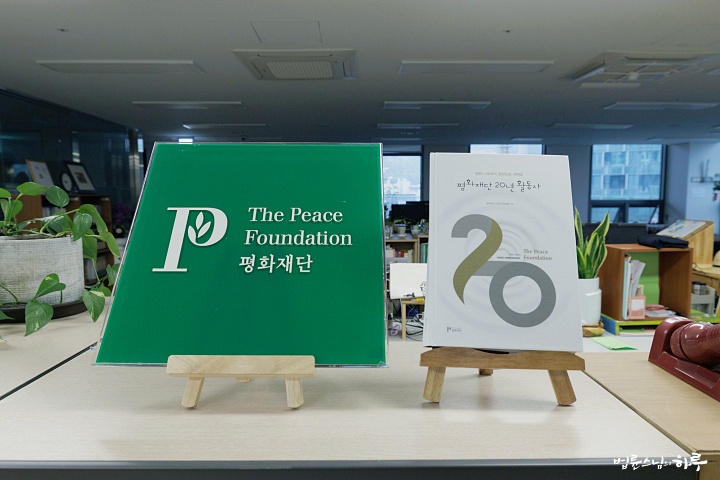
After the Weekly Dharma Assembly, Sunim had lunch, rested briefly, and attended to some work. Then from 4 to 6 p.m., he participated in a Peace Foundation Planning Committee meeting.
At 7:30 p.m., the evening Weekly Dharma Assembly was held in the Dharma Hall. When Sunim entered the Dharma Hall, the members of the Sangha watched the ‘Weekly Jungto Practitioners News’ video together, and then requested the Dharma teaching with the Song of Requesting the Dharma and three bows. Sunim began his Dharma talk with stories from his visit to Washington, D.C. for peace on the Korean Peninsula, and spoke about the upcoming Buddha’s Birthday ceremony.
In particular, during the evening Dharma assembly, Sunim shared thoughts about the upcoming June 3 nationwide local elections. With the official campaign starting tomorrow, Sunim offered a Dharma talk on the perspective voters should hold during the campaign period and on election day.
The Attitude Voters Should Have Ahead of the Local Elections
“With the June 3 nationwide local elections approaching, the official campaign period begins tomorrow, 13 days before election day. Once campaigning starts, as long as you don’t engage in illegal acts like offering money, it’s legal to say things like, ‘That person does a great job.’ But if you said the same thing today, it would be a violation of election law. (Audience laughter) In this election, we will elect heads of metropolitan local governments such as the mayors of Seoul and Busan and provincial governors, as well as district mayors, county heads, and city mayors. There will also be elections for city council members, provincial council members, and county council members, along with superintendents of education and by-elections for vacant National Assembly seats. The first thing you must remember is that the Republic of Korea is a democratic republic, and the owners of a democratic republic are its citizens. As citizens and owners of this country, you must not give up your rights and must cast your precious vote. If you think a particular candidate would do a good job, you can actively promote them. Whether or not you belong to a particular party, active campaigning is allowed during the campaign period. You may also vote early on early voting days. Rather than refusing to vote out of suspicion of election fraud, it’s better to actively monitor and participate. While we cannot yet say that democracy is complete in Korea, the election system itself is fairly well established as democratic. The problem is that the process by which the elected power is exercised is still not democratic but authoritarian. Whether it’s a mayor, a county head, or a president, they bow their heads only when seeking votes, but once elected, they behave as if they themselves were the owners. Then we end up bowing our heads beneath them. For us to move toward a more democratic society, we should not only act as owners during the two weeks of campaigning but also, in our daily lives, ensure that they serve as our public servants, working for the country and its people. However, when those elected behave like the kings, magistrates, or governors of old, that is not a true democratic nation. Because power has been exercised this way for so long, even though we have become a democracy, we have not escaped the old habit of rulers lording over the people and the people obeying. As I see it, citizens act as owners only for about two weeks every four years. During those two weeks, candidates come to us saying, ‘I’ll do a good job, please vote for me,’ but once those two weeks pass, they change as if it had never happened. So at least during those two weeks, we must properly play our role as owners. Furthermore, the very process by which power is exercised in daily life must become democratic. For that to happen, power must be decentralized.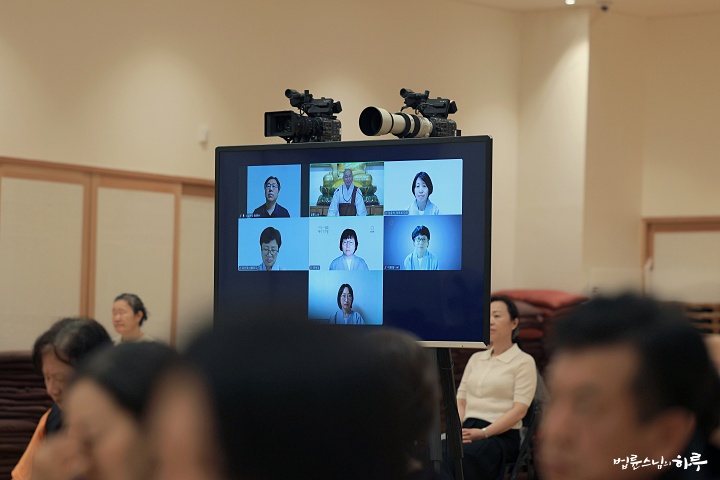
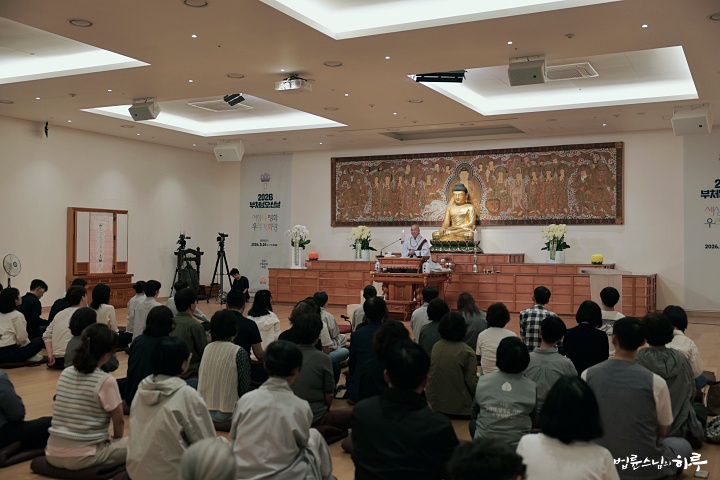
After delivering the keynote Dharma talk, Sunim engaged in a conversation with those who had submitted questions in advance. Following the evening Weekly Dharma Assembly, Sunim returned to his office, completed necessary work-related communications, and wrapped up the day.
Tomorrow will begin with a breakfast meeting with experts on North Korean affairs, followed by consecutive meetings with security experts at The Peace Foundation in the morning. In the afternoon, a Dharma Q&A lecture is scheduled at the Suanbo(수안보) Training Center for tax officials of the Seoul Metropolitan Government.