Seeing Things as They Are Has Two Meanings
May 19, 2026 - Arrival in Korea
Hello. Today marks the conclusion of Sunim’s seven-day visit to Washington D.C., as he returns to Korea.
Yesterday, Sunim boarded a flight from Washington Dulles International Airport bound for Incheon Airport, traveling for 15 hours to Korea. He arrived at Incheon International Airport around 5:30 p.m. Korean time on the 19th.
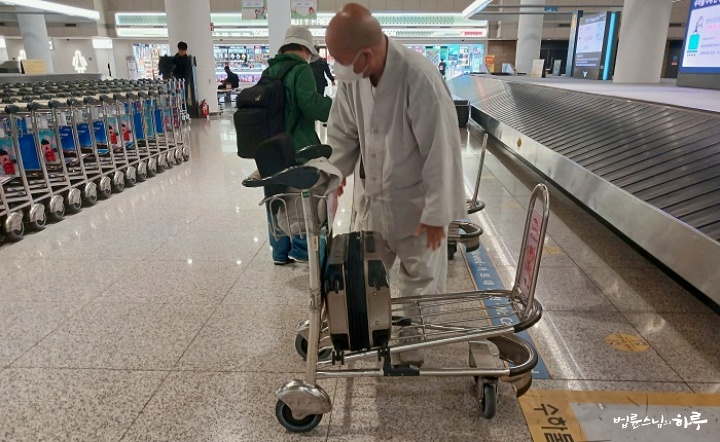
After disembarking, Sunim headed to the baggage claim area to collect his luggage. After a short while, the conveyor belt began to move and bags started coming out. Watching another passenger load several immigration bags onto a cart, Sunim quietly remarked:
“We used to travel with a lot of luggage in immigration bags like those. When two or three of us went together, we’d carry five or six of them at a time.”For this visit to Washington D.C., Sunim packed as many of his books as possible into suitcases and brought them to the Washington DC Jungto Center. The books were given as gifts to guests Sunim met during meetings, and Jungto members who visited the US center were also able to purchase various titles by Sunim.


Once all the luggage was collected, it filled two airport carts. The bags were carefully loaded into the vehicle, and Sunim headed to the Jungto Social and Cultural Center.
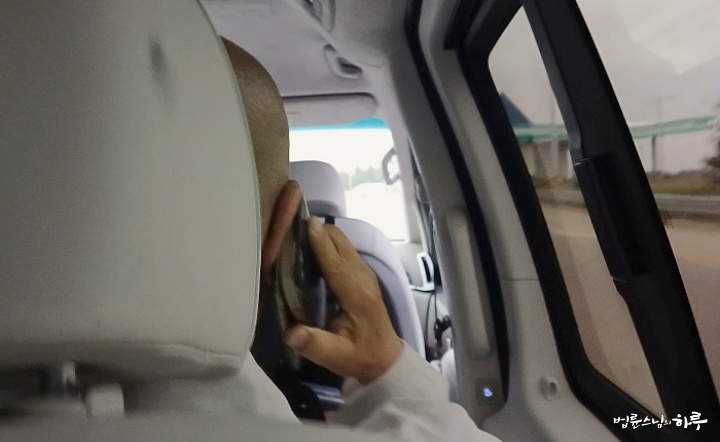
As soon as Sunim got into the vehicle, he began attending to urgent work-related communications. Upon arriving in Korea, along the Han River, the fringe trees planted along the streets were in full bloom with white flowers.
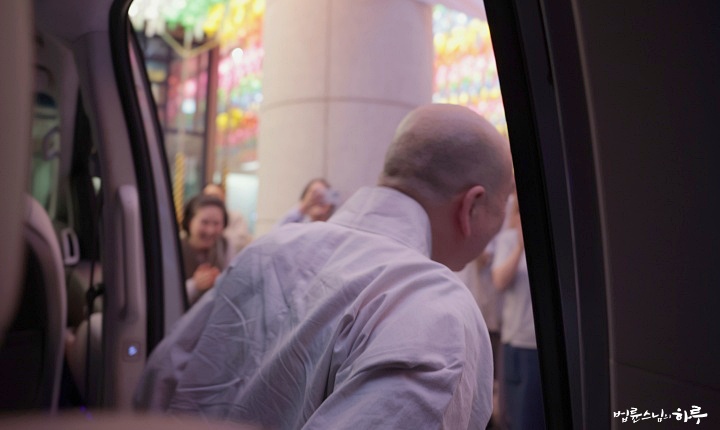
Around 7:20 p.m., Sunim arrived at the Jungto Social and Cultural Center, where members of the Sangha who had just finished evening service came out to the first-floor courtyard and welcomed him with enthusiastic cheers.
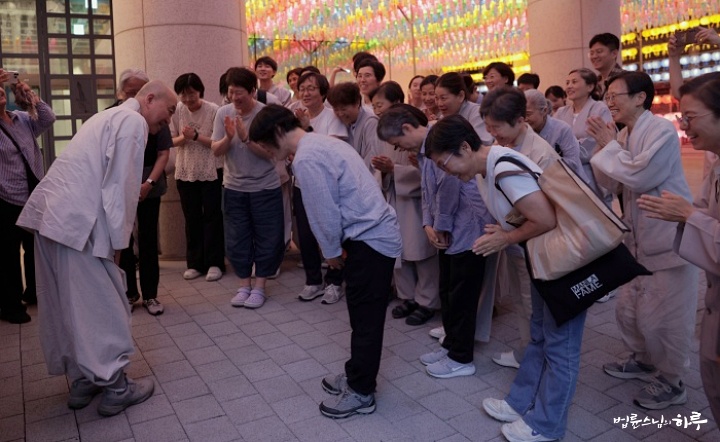
Sunim stepped out of the vehicle and greeted everyone. After unpacking and having dinner, he concluded his day.

Starting tomorrow, Sunim’s regular schedule in Korea begins. In the morning, he will attend the monthly Religious Leaders’ Gathering for National Reconciliation and Peace, followed by a Dharma talk at the Weekly Dharma Assembly held in the Dharma Hall. In the afternoon, he will attend a planning committee meeting at the Peace Foundation, and in the evening, there will be another Weekly Dharma Assembly at the Dharma Hall.
Since there was no Dharma talk today, this post concludes with a Dharma Q&A session held during a meeting with Jungto members at the Washington DC Jungto Center.

Seeing Things as They Are Has Two Meanings
“When you say ‘see things as they are,’ how can I know whether I am truly seeing them as they are? Also, does ‘reality’ refer only to the phenomena that appear right before our eyes, or does it include what lies beneath the surface as well? And how is ‘seeing things holistically’ related to seeing things as they are?”
“When we say ‘see things as they are,’ there are two main meanings. For example, when I say ‘I see this cup,’ one meaning is that I see the cup itself as it is, and the other is that I observe the state of my mind that arises while looking at the cup. Likewise, if someone says, ‘Hey, you fool!’ one aspect is hearing the words exactly as they are spoken, and another aspect of reality is being aware of what kind of feeling arises within me as I hear those words. However, when people hear ‘see things as they are,’ they tend to think only of external objects. But more important than looking outward is being aware of ‘what is the state of my mind right now’ when I hear a sound, see something, or find myself in a particular situation. This is the heart of what it means to see things as they are. Looking inward is far more important than looking outward. Yet when we say ‘I see this cup as it is,’ we focus only on the external object and miss observing our mind as we look at the cup. Next, even when we look at this cup, its appearance changes depending on our position and posture. If the cup were hanging from the ceiling, it would look one way when I look up from below, another way when I view it from the side, and yet another way when I look down from above. But we usually picture only the view from the front. So if asked to draw the cup, most people draw only the front view. In the end, we often see only one side of things. This isn’t just about cups. The same applies when we look at people. For example, when we think of someone, we may form an image based on their facial features, or we may judge them based on a single event, like a conflict we experienced while working together. Or we may form a favorable impression based on the single experience of receiving a gift. When evaluating someone, people don’t just look at appearance—they form an image centered around particular experiences or events. As a result, even when talking about the same person, each individual forms a completely different image. If you ask ten people to describe one person, all ten will describe them differently. If you ask about their personality, you’ll get different answers, as if they were talking about different people. We call this ‘prejudice.’ In the end, we are not seeing the person themselves, but rather the image of that person formed within us. When someone says, ‘My husband is this kind of person,’ they are not actually describing their husband but rather the image of their husband they hold in their mind. That image differs from person to person. So it’s not easy to know who the real person is. In such cases, we should set aside our prejudices as much as possible and avoid clinging to a single image. The husband seen by the wife, the father seen by the children, the colleague seen by coworkers, the boss seen by subordinates—we need to see from multiple perspectives together. Only when we see comprehensively can we come a little closer to the person’s actual reality. This is what we call ‘seeing holistically,’ and in a word, it is ‘insight.’ Looking from multiple perspectives is insight, and that insight is wisdom. When we view others through wisdom, we can see them as close to reality as possible. Of course, ‘as it is’ doesn’t mean knowing something 100 percent completely. It simply means that through insight, we can come closer to reality. This is one aspect of looking outward. From another angle, being aware of the state of mind that arises moment by moment is extremely important in practice. We become angry and develop hatred because we fail to see things holistically. It’s because we are trapped in our own image of things. For example, if my husband embraced another woman, from my perspective he might be a bad person, but from the woman’s perspective, it might not necessarily appear that way. Or if a wife or husband donates a large sum of money to a temple, the temple might see it as a good deed, but the family might not understand and say, ‘We don’t have enough money for ourselves—why are you doing that?’ Like this, when we look at an action comprehensively, it’s difficult to say definitively that it was good or bad. Right and wrong are merely judgments that arise depending on the perspective of the observer. The action itself inherently has no right or wrong, no good or bad. There is only the action. Yet depending on the perspective from which we view it, we create thoughts like ‘this is a good deed’ or ‘this is an evil deed,’ ‘this is right’ or ‘this is wrong.’ Because of those thoughts, we praise and criticize. But when we view it holistically, there is actually nothing to praise and nothing to criticize. This is called emptiness (空).”“Then when we fail to see holistically and certain feelings arise, can we understand this to mean that we ‘failed to see reality as it is’?”
“Yes, that’s right. When we fail to see reality as it is, all sorts of feelings arise—whether good or bad. The reason feelings arise is always because we compare. The event of breaking one leg itself is neither a good thing nor a bad thing. We feel it’s a bad thing because we compare it to when our leg wasn’t broken. Conversely, we feel ‘at least it’s fortunate’ when we compare it to having both legs broken. In other words, the event of breaking a leg itself is neither fortunate nor unfortunate. It is simply an event. What kind of feeling arises in that moment is ultimately a matter of how I perceive things. Depending on the angle from which I view it, it becomes either fortune or misfortune. The moment we say ‘fortunate’ or ‘unfortunate,’ a feeling has already arisen. In Zen Buddhism, this is called ‘a thought has arisen.’ That’s why we are told to return to the state before a thought arises—and that is what a hwadu (Zen koan) is. Once a thought arises, it is already divided into the two branches of fortune and misfortune. If that’s the case, it’s better to view it as fortunate. This is what we call a positive mindset, and viewing it as misfortune is what we call a negative mindset. However, most of us generate negative thoughts, which is why our lives become unhappy. In truth, your life is inherently neither unhappy nor fortunate. It is simply lived, just as a rabbit or an ant lives its life. But because we generate negative thoughts every time a thought arises, we come to believe that ‘my life is unhappy.’ Since we’re going to generate thoughts anyway, the point is to generate them positively. Then people ask, ‘Breaking a leg is a bad thing—do I have to force myself to call it a good thing? Isn’t that not the truth?’ But in reality, it is neither unfortunate nor fortunate—it is emptiness (空). So since we’re going to generate a thought anyway, it’s better to generate it positively. If a husband dies, viewed negatively, one might think, ‘Did I commit many sins in a past life?’ Viewed positively, one might think, ‘I wanted to try living alone, and now I have the chance.’ This doesn’t mean that the death was a good thing; it means viewing it as also being okay. ‘I’ve tried living together, and now living alone is also okay.’ This is viewing it positively. When living together, there are often times when you want to be alone, right? But if I were to ask for a divorce first, I might be criticized. However, if the other person leaves, the opportunity to live alone arises. Normally, if a husband treats you well, you feel you have a good marriage. When such a husband leaves, it feels like an even greater misfortune. Because he was a good husband, it becomes more unfortunate. Conversely, what if a husband who didn’t earn money, only drank, and made life difficult were to leave? You might feel it’s fortunate. Like this, things are inherently neither fortunate nor unfortunate—it depends on the angle from which we view them. Yet we cling to and become trapped by the unfortunate side and suffer. The truth is, fortunate elements are included as well. To be more precise, it’s not that elements of fortune and misfortune coexist; rather, things are inherently neither. When we generate a thought, it becomes either fortune or misfortune. But because we mostly generate thoughts toward misfortune, our lives become full of suffering. If we generate thoughts toward fortune, our life itself doesn’t change, but our mind becomes at ease. That’s how we become able to say, ‘I am happy.’ The state of emptiness is neither misfortune nor fortune. Feeling that your body is not what it used to be as you age is generating a negative thought. In the past, at 85, it would have been difficult to even move. But these days, even past 80, we can be active like this. So we could also view it as, ‘It’s fortunate that I can move around this much at this age.’ But we always compare with our younger days. That’s why we say, ‘Growing old is sorrowful.’ Also, compared to the situation of being bedridden later in life, the current state is much better. So we can view it as, ‘My current life is more than okay.’ Nevertheless, we generate far more thoughts toward unhappiness. We compare ourselves with when we were young, when we earned a lot of money, when we were popular, and view the present negatively. Like this, we have become accustomed to always interpreting any situation negatively through comparison. Inherently, reality is neither positive nor negative. However, since we live by constantly generating thoughts, the point is that we should generate them positively. Your current age, health, wealth, and relationships—all of these are simply emptiness. How a few ants move around isn’t particularly important to us, right? But to the ants, it would be a very big deal. Likewise, things are inherently empty, but we keep complaining by comparing with the good times in the past. So saying ‘now is good’ ultimately means generating thoughts positively.”