What Perspective Should Teachers Hold When the Logic of Power Seeps Into the Classroom?
May 18, 2026. Departure from the United States
Hello. Today, Sunim concluded his seven-day visit to Washington, D.C. and traveled back to Korea. In the morning, he departed from the Washington DC Jungto Center, and in the afternoon, he headed to Washington Dulles International Airport to board a flight bound for Incheon International Airport.
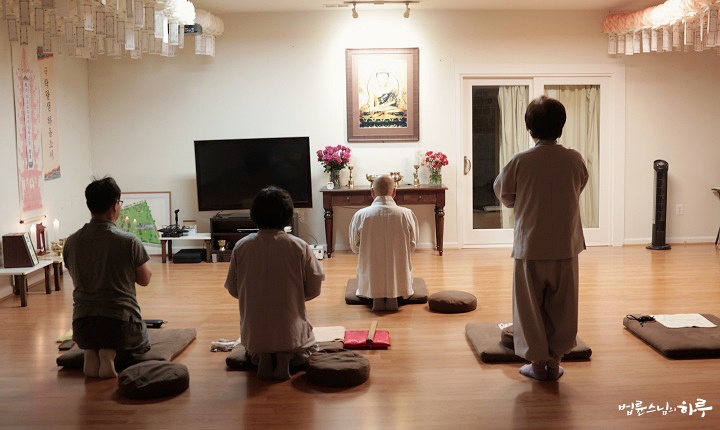
Sunim began the day with early morning practice and meditation. After proofreading manuscripts, he went to a nearby restaurant for breakfast.
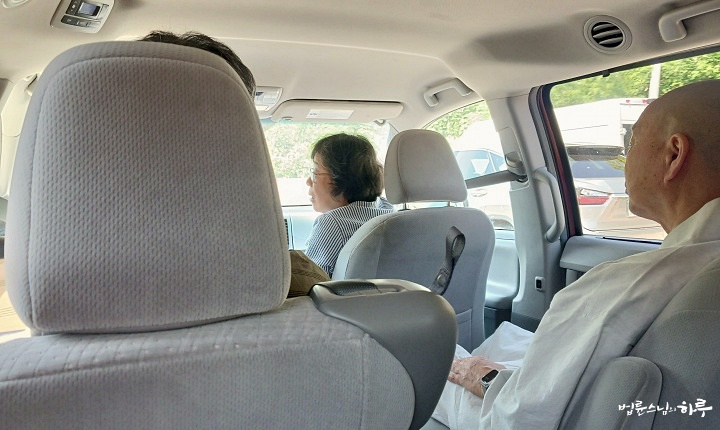
On the way to the restaurant, Sunim offered detailed suggestions to Dharma Teacher Beophae and Min Deokhong about areas where the meditation hall could be improved. He once again emphasized matters that needed attention so that members could use the space without inconvenience, such as ways to reduce the echoing of speaker sounds inside the meditation hall and how to remove the smell of paint.
After breakfast, Sunim returned to the center and prepared for departure. While packing the luggage to take back to Korea, the time came to leave for the airport.
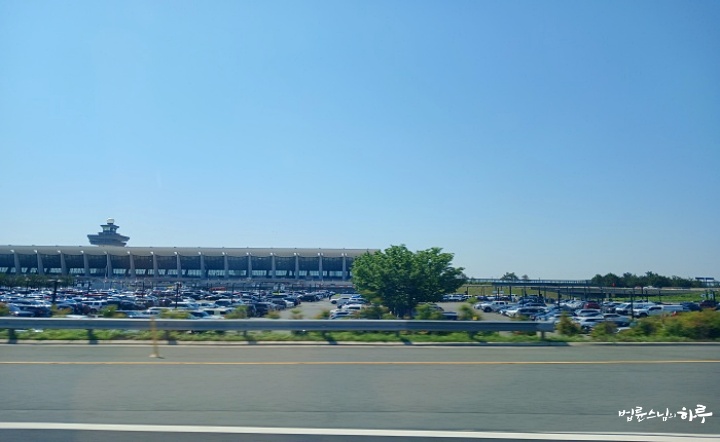
At 10:30 a.m., Sunim left the Washington DC Jungto Center and headed to Washington Dulles International Airport.
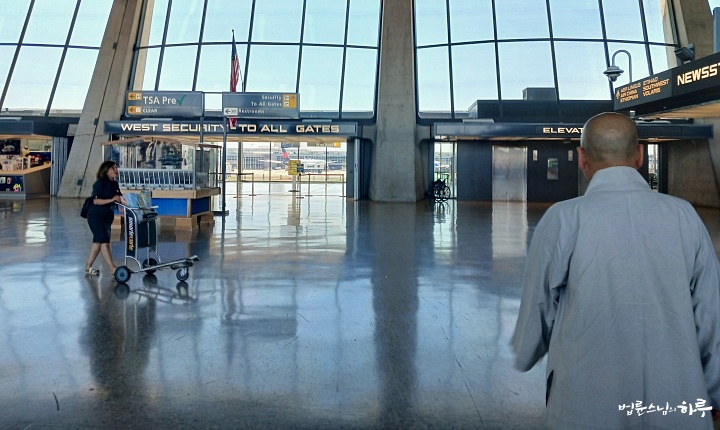
At the counter, the luggage was checked in, and Sunim went through the departure procedures. As he entered the departure area, Sunim expressed his gratitude to Dharma Teacher Beophae and Min Deokhong for their hard work throughout the Washington, D.C. schedule.
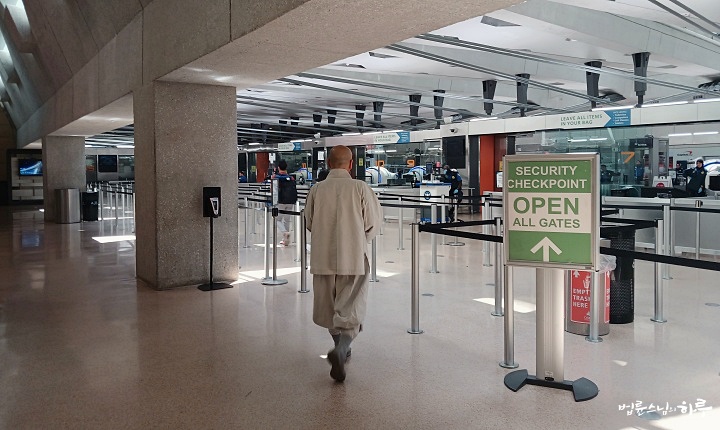
After entering the departure area, Sunim passed through the security checkpoint and took the underground AeroTrain shuttle to the boarding gate.
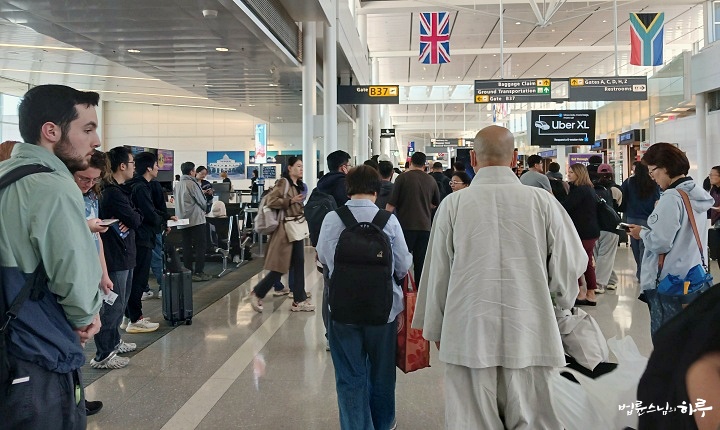
After waiting at the gate for about an hour and then boarding, the plane took off at 1:20 p.m. local time. The flight will take 15 hours, with arrival at Incheon International Airport expected around 5:20 p.m. Korea time. Sunim rested on the plane during the journey to Korea.

Tomorrow, Sunim is scheduled to arrive at Incheon Airport around 5:20 p.m. Korea time and then travel to the center.
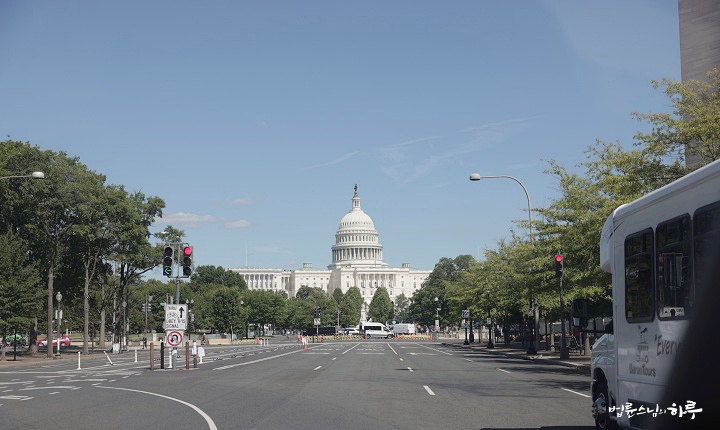
Over the past eight days, as part of activities for peace on the Korean Peninsula, Sunim held a total of 21 meetings with officials from the U.S. government, Congress, and think tanks to discuss improving North Korea–U.S. relations and promoting peace on the Korean Peninsula. During his stay at the Washington DC Jungto Center, he conducted three online Weekly Dharma Assemblies and Dharma Q&A sessions, held two Dharma Q&A sessions with U.S. Jungto members, and participated in the opening ceremony of the meditation hall at the U.S. center, where he delivered a commemorative Dharma talk. Throughout Sunim’s Washington, D.C. schedule, Jason served as the interpreter, Dharma Teacher Beophae and Min Deokhong provided logistical and driving support, and Choi Malsoon prepared the meals, allowing the Washington, D.C. visit to proceed smoothly.
As there was no Dharma talk today, this post concludes with content from a recent online Friday Dharma Q&A session.
What Perspective Should Teachers Hold When the Logic of Power Seeps Into the Classroom?
“I am an elementary school teacher who teaches English. While conducting classes, I observe many different sides of children. What stands out to me especially is that children who have loud voices or behave roughly often dominate the classroom atmosphere. At such times, I feel as though it reflects a cross-section of our society. Something similar happened recently. I was running a class where all the children stood up, and those who got the answer right kept standing, while those who got it wrong or were too slow had to sit down. When a student who usually speaks loudly was eliminated early on, he started expressing dissatisfaction and disrupting the flow of the class. According to educational guidelines, the correct response would be to admonish him or stop his behavior, but for several reasons, I couldn’t do so. First, the other children are very mindful of that student, so if I restrained him hastily, the overall atmosphere might collapse even more. Also, with children like this, admonishment often backfires. Lastly, even when I point out wrongful behavior after class, students or parents often take it negatively. While it’s a necessary process according to educational guidelines, in reality children tend to feel hurt rather than reflect on their behavior, and this easily turns into complaints from parents. When I shared these concerns with people around me, they told me not to respond emotionally and to handle it moderately. But I feel as if I’m hitting the wall of some structural defect in our society within the classroom. So what I’d like to ask is, how should I view this reality, and how should I respond in this situation? What perspective would be best for teachers in a similar position to mine to take in their work?”
“The world doesn’t always operate according to our wishes or thoughts. Sometimes things go as we hope, and sometimes they don’t. When things go our way, we feel happy, and when they don’t, we usually fall into suffering—sadness or frustration. That’s ordinary life. What we call practice is essentially finding a way to live in this world that doesn’t go as we wish, without falling too deeply into suffering. The ancient sages, having lived in the world, came to realize that the world doesn’t fulfill all our wishes. So from the question ‘Is there a way to live without suffering even when the world doesn’t go our way?’, mind training—that is, practice—began. We usually consider the state in which everything happens as we wish to be the ‘best life.’ So sometimes we try to achieve what we want by borrowing the power of others, and when that fails, we rely on religion and pray to some transcendent being. This is the reality of how we live. However, entering the modern era, humanity began to view the world through the eyes of reason rather than emotion, and the tendency to solve social problems more rationally grew stronger. Especially after experiencing the Second World War, humanity came to reflect on how much unhappiness emotional and dogmatic actions by a few could bring to society as a whole. The values we speak of today—social justice and human equality—were formed upon such reflection. However, entering the 2000s, several concerning trends have re-emerged. One is that as the long era of peace continues, past reflection has gradually faded, and emotionally driven, foolish judgments are increasing again. Another is that as inequality deepens, the influence of a small minority is growing larger. Although production has increased thanks to advances in science and technology, distribution has not been equitable, so the gap between rich and poor is actually widening. In the past, it was said that the income of the top 10% was comparable to that of the remaining 90%, but these days some say the top 1% matches the rest 99%. If this trend continues, the possibility that important social decisions will be concentrated in the hands of a few also grows. After the World War, the international community maintained order by cooperating through international organizations like the UN. Recently, however, the logic of power has grown stronger again, and within each country, the influence of a small minority is growing. The arbitrary attitudes of some leaders are not limited to powerful nations but are appearing in many countries. The classroom is no exception to this. As you mentioned, it can be said that this aspect of society is seeping even into the world of children. So first, it’s necessary to understand this reality. If you cling to the ideal that everyone should be equal, or that there must be rules and order, the gap with reality can actually make things harder for you as a teacher. As that continues, you may even start wondering, ‘Can I keep doing this work?’ Ideally, such things shouldn’t happen in schools. But this is an era in which the influence of parents has grown enormously. Unlike in the past, many parents now have higher levels of education and broader social experience, so the balance of power within schools has also shifted. Amid these changes, the influence on children often comes more from parents than from teachers. As you mentioned, if you handle a child poorly, it can lead to parental complaints or protests, so teachers inevitably feel pressured. This is the current reality. Therefore, teachers now are in a position where they must do more than simply teach children—they must also manage their relationships with parents. Accepting this point first is necessary. Second, the question is how to respond within this reality. Just understanding the situation and leaving it as is would mean education is hardly needed at all. But trying to fix everything will lead to conflict with reality. So some degree of adjustment is necessary. Rather than aiming for 100% of educational goals as in the past, it’s necessary to approach things at a more realistic level of around 70%. You shouldn’t leave the behavior of a few loud children unchecked, but it’s also not easy under current conditions to fully control them. The situation has changed from the days when a teacher’s authority was absolute. If you want to continue your teaching career, above all you need to respond appropriately to reality. If you just leave things alone, you fail as a teacher; if you try to fix everything, you’ll easily become exhausted by the feeling that your own capacity is insufficient. So some degree of compromise and adjustment is needed. But trying to handle it alone is too burdensome, so it’s necessary to distribute roles and address it together. In the past, about 70% of a teacher’s role was teaching, and the rest was administrative work. Today, teaching takes up less than half, with responding to parents, guiding problem students, and administrative work taking up a larger share. In that case, rather than simply reducing the number of students per teacher, it’s necessary to restructure the roles themselves. Some teachers can take charge of classroom teaching as before, while others can be dedicated to students who don’t adapt well to school or to dealing with parents. For example, when a problem arises in a class, rather than the homeroom teacher intervening directly, a dedicated counseling teacher could take charge of counseling the child and, if necessary, connect with parents or external institutions. This structure could be more effective. Even in cases like the current situation where one student continuously disrupts class, it can be more effective for a separate counseling teacher to handle it rather than the homeroom teacher. When the homeroom teacher intervenes directly, emotional friction with the child easily arises, and parents may overreact out of anxiety, worrying, ‘Is the teacher giving our child a bad evaluation?’ When the issue is discussed with a counseling teacher who is not the homeroom teacher, the response can be less sensitive. The homeroom teacher should try to maintain smooth relationships with children and parents as much as possible, while the counseling teacher takes the role of approaching from the angle of ‘this behavior is causing difficulty in conducting class, so appropriate guidance or treatment is needed.’ This kind of role division is necessary. Such systemic changes are needed for educational settings to operate stably. But currently, we still haven’t escaped much from the old framework where teachers are directly responsible for every child. When it comes to physical health issues, we respond systematically through various specialists such as nutritionists, school nurses, and doctors. But when it comes to mental difficulties, responses are still rather passive. This is something that must be continuously discussed and improved in education going forward. It’s also necessary to acknowledge that, as an individual teacher, it’s difficult to fully realize educational goals 100% under current conditions. But since you can’t give up on education, you need to adjust your goals somewhat. If you give up on everything due to the various concerns I mentioned, you end up giving up on your role for other children as well. Conversely, if you try to apply things equally to even one such child, the child’s resistance can harm the entire class. So it’s necessary to try various methods, finding directions that minimize harm while maximizing educational effects. Above all, what matters most is not trying to bear this problem alone. You need to find ways to respond by discussing it with fellow teachers or the principal, appropriately distributing the work. Rather than approaching it as a personal issue—’this is a problem child,’ or ‘the parent is the problem’—it should be understood as a structural problem that can recur. Even if it’s not this particular child, similar problems can arise with another child. Ultimately, we are faced with a new challenge: ‘How do we solve this problem institutionally?’ Considering and solving this challenge together is the direction needed in today’s educational settings.”