The essence of practice is self-awareness. Change begins when we become aware on our own.
May 17, 2026 - Opening Ceremony of the Meditation Hall at the Washington DC Jungto Center (Part 1), Dharma Q&A ...
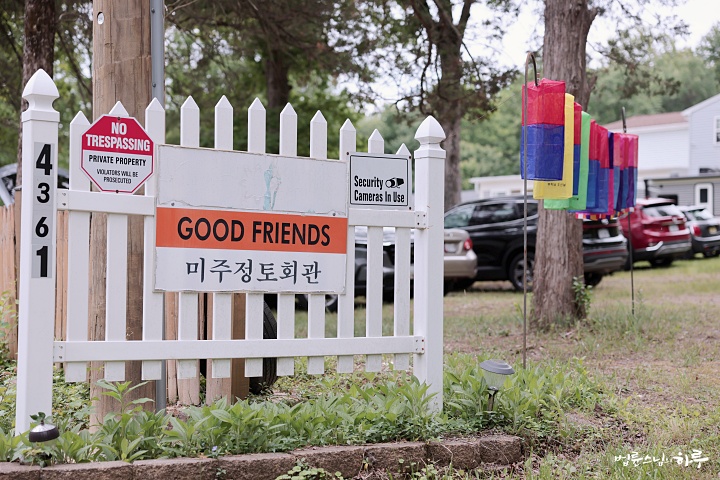
Hello. This morning, the opening ceremony of the Meditation Hall at the Washington DC Jungto Center was held, and in the afternoon, Sunim had a Dharma Q&A session with Jungto members.
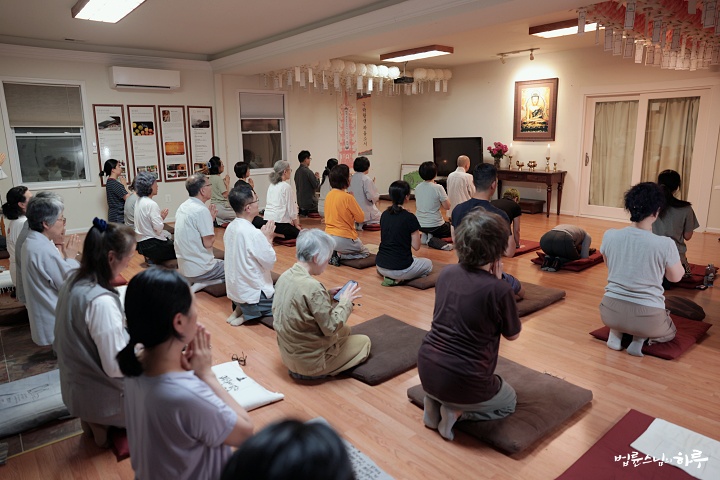
Sunim began the day with early morning practice and meditation. Many Jungto practitioners visited the Washington DC Jungto Center to prepare for the Meditation Hall opening ceremony, staying overnight to help with the preparations. With the Dharma hall filled with cushions and many Jungto practitioners, Sunim led the morning service and the 1000-Day Practice prayer.
Sunim had breakfast earlier than the rest of the Sangha members and then took a walk in a nearby park. It was a sunny spring day.
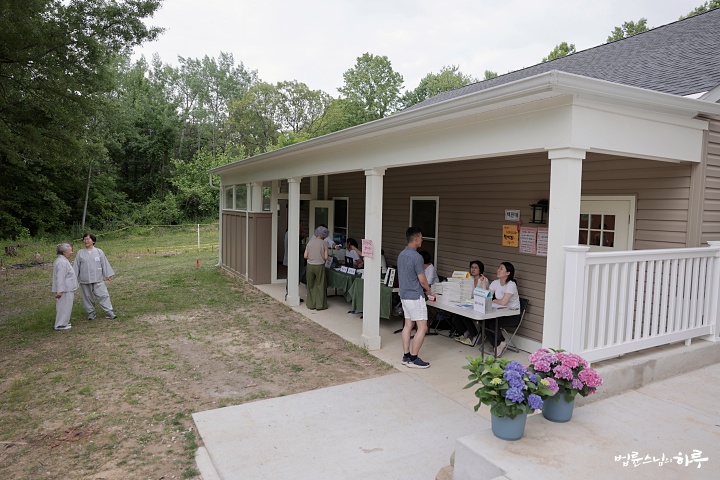
At 10 a.m., the opening ceremony of the Meditation Hall at the Washington DC Jungto Center began. Lee Hwa-young, the East Coast Group Facilitator of the North America and Europe Branch of the International Division, served as the master of ceremonies. Members from the North America East Branch, the International Division, and the Happiness Movement Headquarters gathered together.
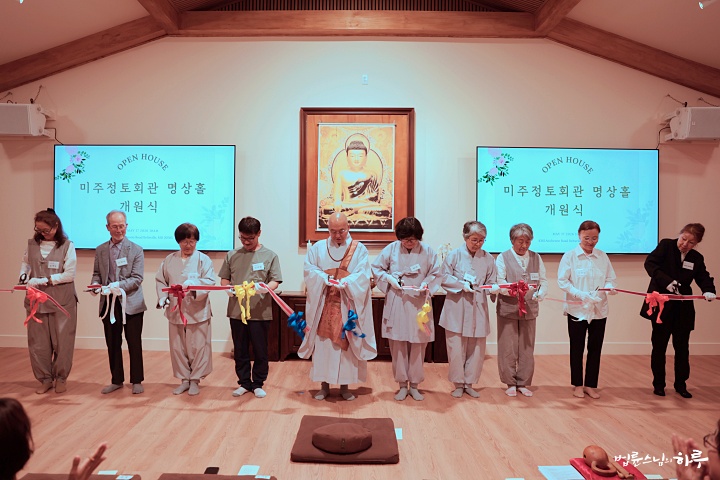
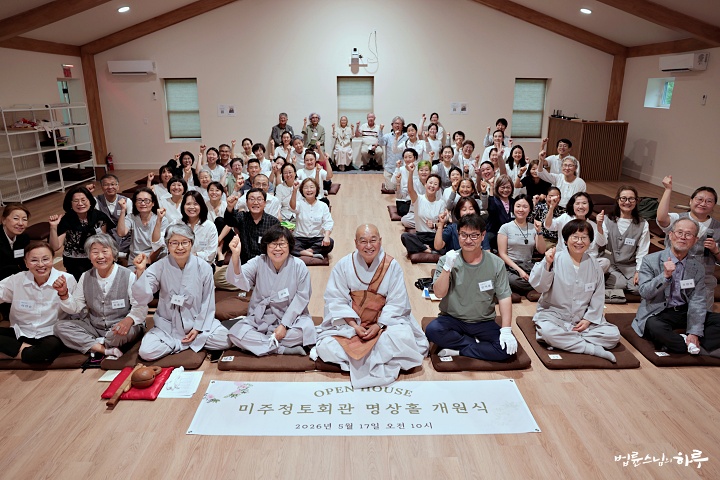
A ribbon-cutting ceremony was held to commemorate the opening. Sunim, along with those who had worked hard to make the Meditation Hall opening possible, came forward for the ribbon cutting. Afterward, a group photo was taken.
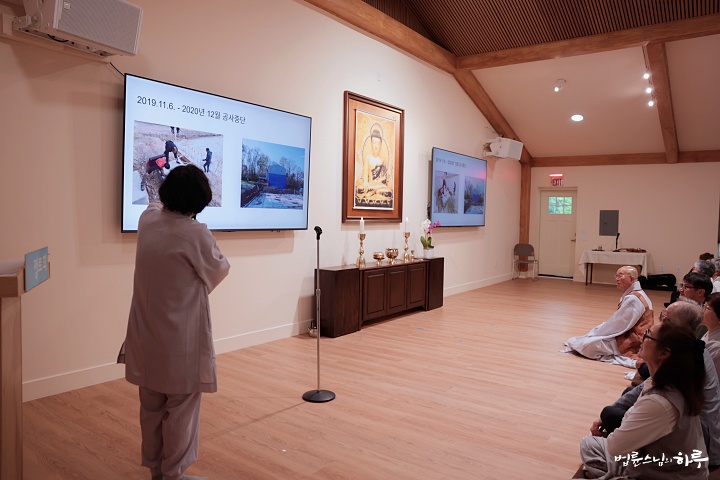
The main event began with the Three Refuges and the recitation of the Heart Sutra. Dharma Teacher Beophae, Secretary of the US Jungto Society, gave a report on the project’s progress and history. Through photographs, attendees were able to see the seven-year journey.
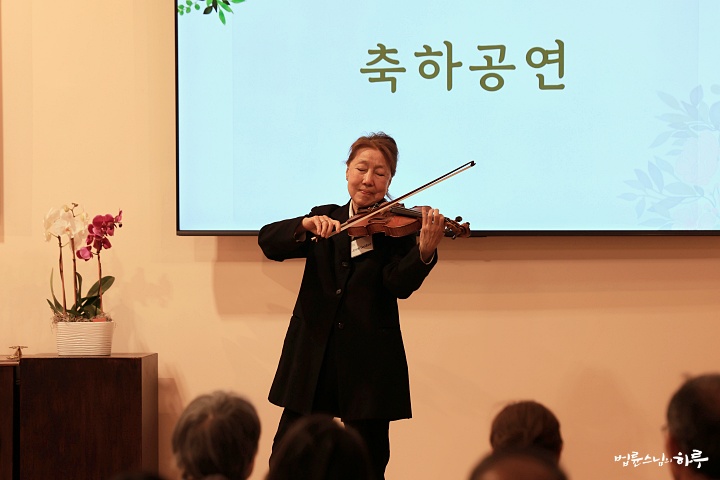
A performance was held to celebrate the opening of the Meditation Hall. Woo Jung-min played “Liebesleid” on the violin. The familiar melody filled the Meditation Hall. Following this, distinguished guests were introduced, and Dharma Teacher Beophae offered greetings.
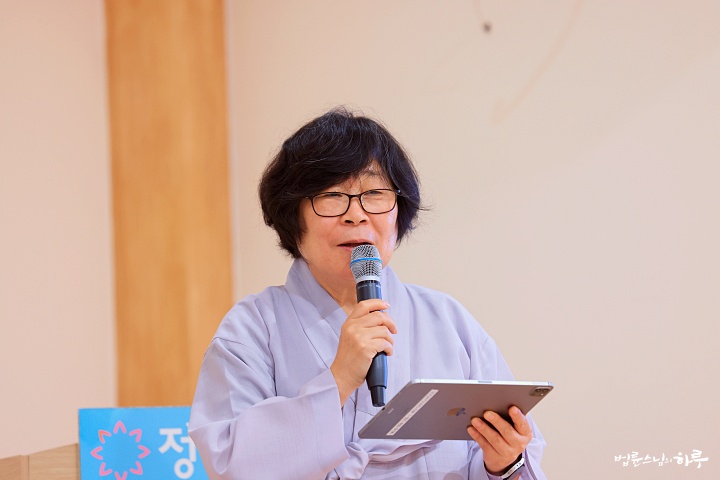
“I am delighted and grateful to be able to hold the Meditation Hall opening ceremony today with our guiding Dharma teacher present. Although there were many difficulties along the way—problems with the contractor, COVID-19, and communication issues with the county—thanks to the attention, encouragement, and support of so many people, we were able to bring this to a successful conclusion. I would like to express my gratitude once again. Through this construction project, I experienced firsthand that nothing goes the way I want. When the contractor disappeared overnight, the biggest lesson I learned was, ‘Promises are not made to be kept, but to be broken.’ Through these processes, it was a truly precious time during which I could see myself clearly and reflect on who I am. Although the tuition was costly, it was a precious experience and lesson that money cannot buy. My job now is to work even harder to make up for the losses and, together with all of you, turn this place into a wonderful space. Going forward, I hope to develop this place, centered in the North America East region, into a venue for the Awakening Retreat, the Sharing Retreat, meditation retreats, educational training programs, and even farming practice. I hope you will visit often with the mindset that ‘I am the owner of this place,’ look at the rendering, and help build it together. Please make full use of this space.”
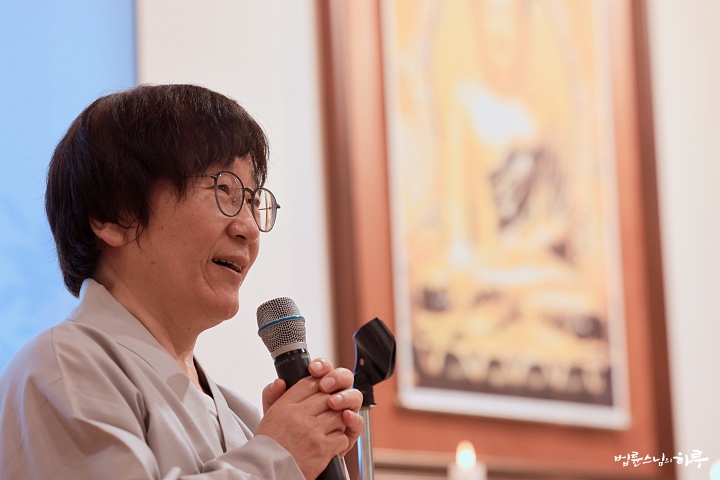
Dharma Teacher Myodeok, who oversees overseas branches, gave a greeting.
“I am attending this Meditation Hall opening ceremony on behalf of many people in Korea. After a long time, we are finally opening. It was hard work to prepare this, but it is a retreat space that we truly need. Just as it was built with great effort, I hope all of you will use it well. I sincerely congratulate you on the opening of the Meditation Hall.”
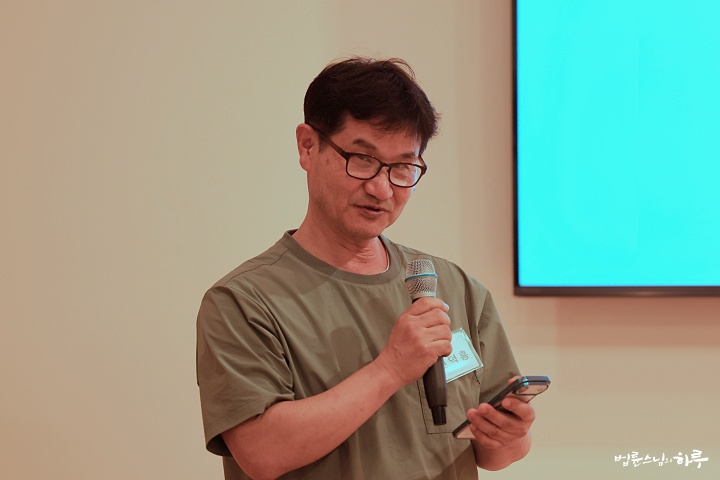
Min Deok-hong, who was in charge of the Meditation Hall construction and serves as the Executive Committee Chair of the US Jungto Center, also offered greetings.
“I am Min Deok-hong, who was in charge of the Washington DC Jungto Center construction. After seven long years, it is finally complete. I sincerely thank everyone who has shown interest, offered support, and walked alongside us throughout this time. We will continue to build this place step by step according to the rendering. Since this was built through the sincere efforts of so many people, I hope all of you will visit often and put it to good use.”
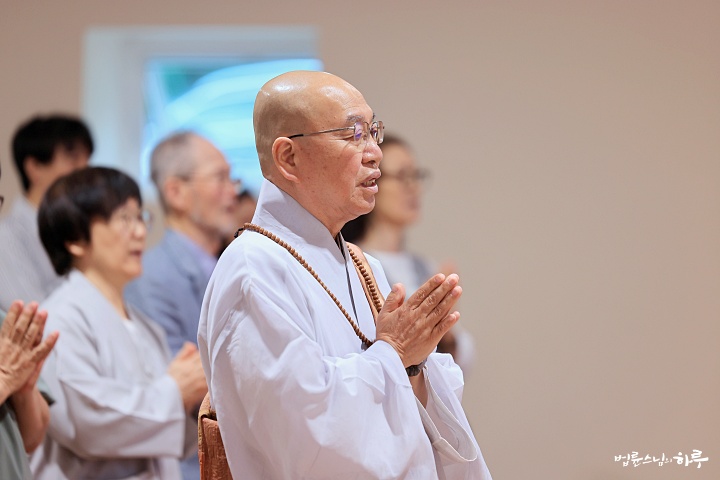
After the greetings ended, a table was set up, and with the Chanting for Requesting the Dharma and three full bows, Sunim was invited to give a Dharma talk commemorating the Meditation Hall opening.
“It is wonderful that we have all gathered and come together like this. I sincerely congratulate you on the opening of the Meditation Hall at the Washington DC Jungto Center. After many twists and turns over the past seven years, we have finally been able to hold this completion ceremony safely. Although the space is not as large as originally planned, I think this much space should be sufficient for our practice needs for the time being. I would also like to thank Woo Jung-min for the beautiful violin performance. Even at her age, her old skills remain intact. I would also like to express my gratitude to Dharma Teacher Beophae and Min Deok-hong, who worked so hard for this construction project. Dharma Teacher Beophae went through a lot of mental hardship, and Min Deok-hong took personal responsibility for everything during the second phase of construction, not entrusting it to contractors. Both of them truly worked very hard. Please give them a round of applause.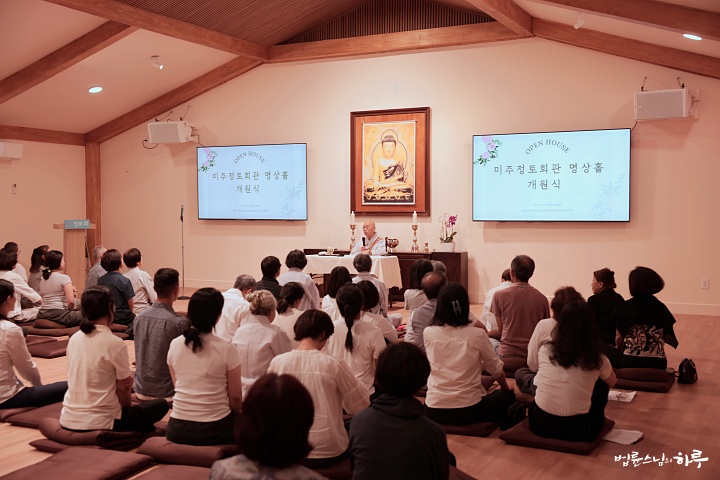
Sunim explained the originally planned meditation center. He also explained, in an easy-to-understand way, the difficulties encountered before the Meditation Hall was completed. The existing septic tank was too small, so a new septic tank had to be installed to proceed as planned. The contractor who was carrying out the work received money but did not pay the subcontractors, leading the subcontractors to file complaints. With the basement dug up, construction was halted, and the contractor disappeared overnight. On top of all that, the COVID-19 pandemic struck, and construction was suspended for a long time. During that time, the sewage-related regulations changed, making it practically impossible to resume construction as planned. In the end, permission was granted only on the condition that no new septic tank would be installed and no water would be used, which resulted in the current space of the Meditation Hall. Sunim also shared examples of the many twists and turns experienced during the construction of the Jungto Social and Cultural Center in Seoul, similar to those experienced during the Meditation Hall construction at the Washington DC Jungto Center.
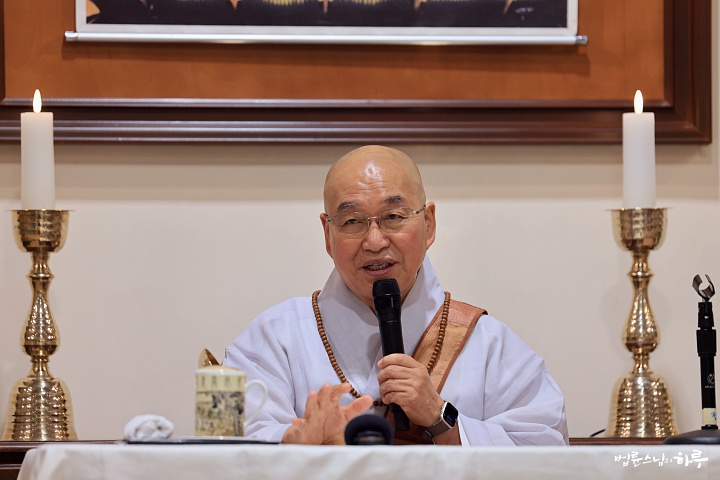
Sunim mentioned the difficulties of the construction project and urged members to take good care of and beautify both the indoor and outdoor grounds so that the hard-earned Meditation Hall of the Washington DC Jungto Center could be put to good use. He continued his Dharma talk about the purpose of going through such a difficult construction project.
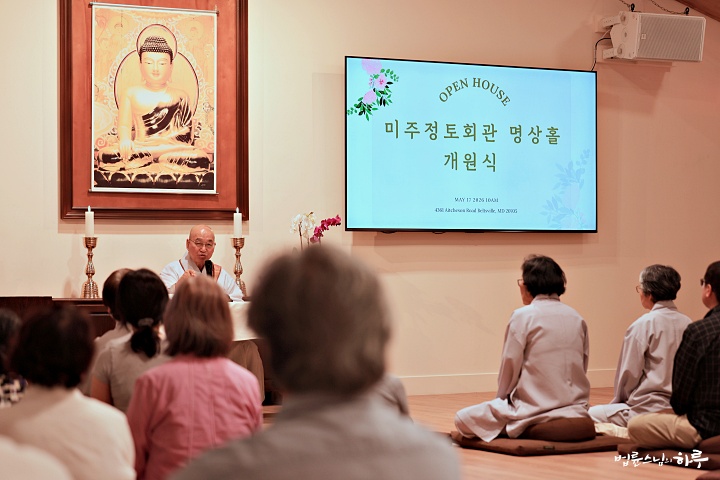
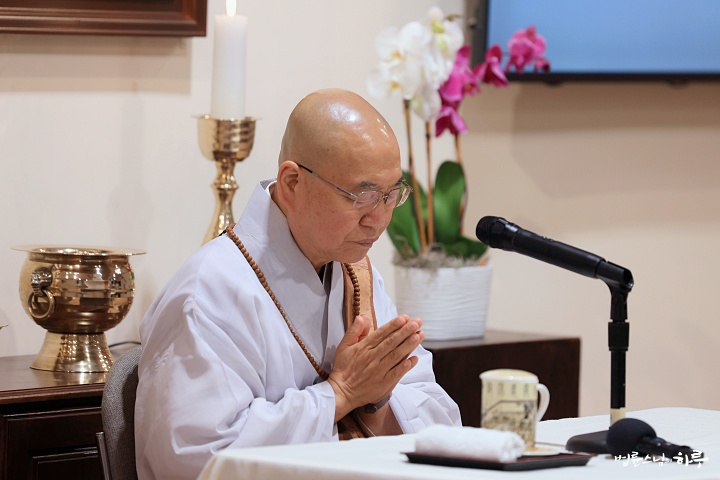
Establishing a Practice-Oriented Perspective Is Essential
What you need first is to establish a practice-oriented perspective. However, because we have lived for so long with the view that ‘the cause lies outside ourselves,’ even when we listen to a Dharma talk and think, ‘Ah, I see,’ we revert to our old ways the moment a situation arises. At such times, you need to recognize, ‘Ah, I lost awareness again.’ If you burst into anger, you become aware, ‘Ah, I lost awareness again,’ and return to your original state. This exercise itself is practice. If you bow or meditate with such a perspective, it counts as practice, but we should not call something practice based on form alone. When we examine Buddhism, we find that the life and teachings of Shakyamuni Buddha rest largely on a practice-oriented perspective. And having a practice-oriented perspective does not simply mean knowing a great deal; it means that a respectable character is formed. Yet as Buddhism passed through 2,600 years, the mainstream gradually shifted toward religion and philosophy. When it becomes, ‘If you believe in the Buddha, you will receive blessings,’ or ‘You will go to a good place after you die,’ that is no longer practice but faith. So throughout history, Buddhism as practice has been revived again and again under the name of a ‘new Buddhism,’ only to drift back toward religion. So what should we do? Rather than debating whether Buddhism is a religion or a philosophy, what matters is to have a practice-oriented perspective. When you have such a perspective, it does not really matter what a person believes or what ideology they hold. What matters is how that person responds to sensations and how they act. Whatever religion one believes in or whatever ideology one holds is not the essence. The standard of practice is the attitude one shows when facing a situation and the action one chooses. As a result, one comes to stand in a position that transcends religion. That said, Jungto Society does not exclude religious or philosophical elements altogether. Some of those elements are present. If I had to put it in terms of proportions, there are some religious elements, and as you study Buddhism, philosophical elements come along as well. What matters, however, is what lies at the center. In Jungto Society, the practice-oriented element forms the center. So when I hold Dharma Q&A sessions with people, there is hardly any religious tone or philosophical explanation. I simply engage in conversation from a practice-oriented perspective. But in the life we actually live, there is something called ‘culture.’ Within the culture of Jungto Society, there is Buddhist culture. So religious elements are naturally included as well. Practice also has its own principles, and explaining those principles brings in philosophical elements. That is why at Jungto Dharma School, you learn theory and philosophy. But in Dharma Q&A, such theory is not needed. We do not ask what religion a person believes in or what ideology they hold. Practice-oriented teachings are actually simple, but it is not easy to practice them and embody them in body and mind. We practice on our own, and we also gather like this to share, gradually internalizing it bit by bit. How do you learn basketball? You put the ball in the hoop. The principle is very simple. But when you actually try, it does not go in. So you have to keep practicing. As you practice, your success rate gradually rises. At first, you cannot make even one out of ten, then you make one, and eventually you reach seven or eight out of ten. But does that mean every shot goes in? No. Even the best player misses one out of ten. Practice is the same. Through repeated training, your time of being awake gradually increases. So what matters is steady practice. Repeatedly training yourself in this way is practice.
Becoming the Master of My Life Through Awareness and Mindfulness
However, the moment I become aware of myself reacting to external stimuli, a transformation occurs. The moment anger arises, if I notice, “Ah, I am getting angry,” I am not dragged along by that anger. When I reach a state where I respond but am not swayed, I am no longer a being dragged around by the world. Going further, I become a being who turns the world. When we are not dragged around by the world, we become the masters of our own lives, and when we can turn the world, only then can we truly be called the masters of the world. What’s important is not to eliminate karma but to become free from it. That’s why steady practice is necessary. To break through this ignorance, we participate in the Awakening Retreat, and we attend the Sharing Retreat to understand and share how our minds react. Sometimes we also do Meditation Retreats, where we practice maintaining pure awareness alone, without being dragged along by thoughts. Through these practices, we gradually become free from all the senses—what we see, hear, smell, taste, touch, and even our thoughts. There are people who actually experience such changes. There are people who say that just by listening to Dharma Q&A, their lives became much lighter and freer. They say they are much less swayed by family relationships and their surrounding environments than before. But the trigger for this change is different for everyone. Some feel the change through retreat programs, while others come to realizations after going on a pilgrimage to India. Someone who was trapped in feelings of inferiority because they were poorer than others might go to India and see people living and smiling in much more difficult circumstances than their own. In that moment, they realize that this is not a matter of poverty. This kind of self-realization at some moment—this ‘awareness’—is the key. Practice is ultimately awareness. Whatever Sunim says, whatever others say, that is secondary. Change begins when you yourself realize, “Oh, I am greedy,” or “I am stubborn.” So what is karma? It is precisely the state of not being aware, the state without knowing. After getting angry, we usually make three kinds of excuses. First, “I got angry without realizing it.” Second, “I did it out of habit.” Third, “I did it unconsciously.” These three are really the same thing. They mean we reacted in a state without awareness. This is not a choice but an automatic response. It is no different from being controlled by external circumstances. So practice is not something grand—it is simply stopping this automatic response through awareness. When we repeat a certain action, our brains have a tendency to automate it. If you repeat the same response several times, you will automatically respond after that without intending to. The reason this happens is that automation requires less energy. That’s why we feel comfortable when we are familiar with something. However, the problem is that without awareness, we react according to habit. In Buddhism, this is called karma. It is a state where responses repeated several times become automated, and we react automatically to external stimuli. Efficiency increases, but in that moment, I am not the master. I am moving without knowing. The way to move people is simple. If you know what they like, you can control them. If they like money, you move them with money; if they like status, with status; if they like praise, with praise. In the case of President Donald Trump, for instance, he is known to respond well to praise. So heads of state from various countries approach him by complimenting him, saying, “You are the best.” Since diplomacy is ultimately about handling human psychology, such methods are researched and utilized. Conversely, there is also a way of using pressure. When people are threatened, they become anxious, and this very anxiety is exploited. For example, if someone strongly insists, “Sell this 100-won item for 10 won,” at first you resist, saying it’s absurd. But as the pressure continues, you compromise, saying, “Well, at least 20 won…” The method in trade negotiations of first proposing high tariffs and then lowering them slightly works on a similar principle. Even though it was something that didn’t exist originally, people accept it, feeling, “At least it was reduced.” This too is a way of using human psychology. After experiencing this a few times, you start to catch on. But at first, most people are influenced. So as AI technology develops, people can be manipulated even more precisely, and this issue will become increasingly important in the future.Practice Is Cultivating the Strength to Protect Yourself
In fact, such methods have existed since ancient times. Ways of handling people by exploiting their psychology—using a honey trap on those who like women, using bribes on those who like money—have existed for a long time. Protecting yourself from such various stimuli and circumstances is the true path to becoming the master of your own life. But the important point here is that it’s not about saying “Don’t do anything.” Whatever you do, it’s fine as long as you are aware and choose. Even if it’s poisoned food, if you chose it knowing that fact, it is your responsibility. However, if you eat something thoughtlessly just because it seems good and later regret it, that is a choice born of ignorance. So practice is the work of cultivating the strength to protect yourself. And based on that strength, you become the center and change the world. Ordinary beings learn to steal when they live with thieves, and learn to curse when they live with people who curse. But practitioners are not stained even when they live together with such people. They do not curse even when beside cursing people, and they do not steal even when with thieves. Going one step further, the people around them actually begin to change. Those who used to curse curse less, and those who lived recklessly begin to restrain themselves. This is the power that changes the world. It is for this kind of life that Jungto Society was established, and this is why we are studying together like this. That doesn’t mean you shouldn’t engage in religious activities. Religion is a matter of personal freedom. Whether you pray or perform certain rituals, that is each person’s choice. However, in the name of Jungto Society, we cannot promote things like, “If you pray here, you will be admitted to Seoul National University.” This is because Jungto Society is not a faith community but a community of practitioners. The center of Jungto Society lies entirely in practice. That doesn’t mean we have removed everything except practice. In reality, there are some religious elements and philosophical elements as well. This is because we have to live while communicating with the world. So what is important is not whether to completely exclude these elements, but where we place the center. Jungto Society places that center on practice. Today, I want to emphasize that this meditation hall was built as a space for practice. Participating in this construction project does not mean you will go to paradise or receive blessings. Through this space, we aim to study together, share with one another, and live more awakened lives. When someone says, ‘This has been helpful, thank you,’ I respond, ‘Don’t just say it—try it yourself.’ Whether you volunteer or make an offering, do it not to receive blessings, but as an expression of gratitude. Jungto Society operates on this very spirit. Some contribute through offerings, others through volunteering—together we build this community. Today’s gathering was made possible thanks to the sincerity and participation of many people. That’s all for now. Delicious food has been prepared, so please enjoy the meal together, and after lunch, we will have time to listen to your stories.”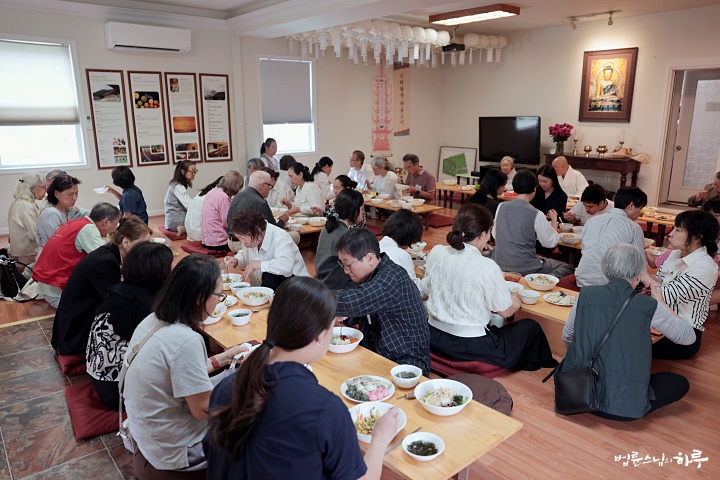
After Sunim’s Dharma talk, the first part of the US Jungto Center Meditation Hall opening ceremony concluded with a period of silent meditation, followed by chanting, offerings, and the Four Great Vows. Everyone then moved to the old Dharma hall for lunch.
The lunch for the opening ceremony featured bibimbap, cold cucumber soup, rice cakes, and fruit. The meal team, made up of Jungto members from New York, prepared the food with great care. Attendees gathered closely in the Dharma hall to share the meal together.
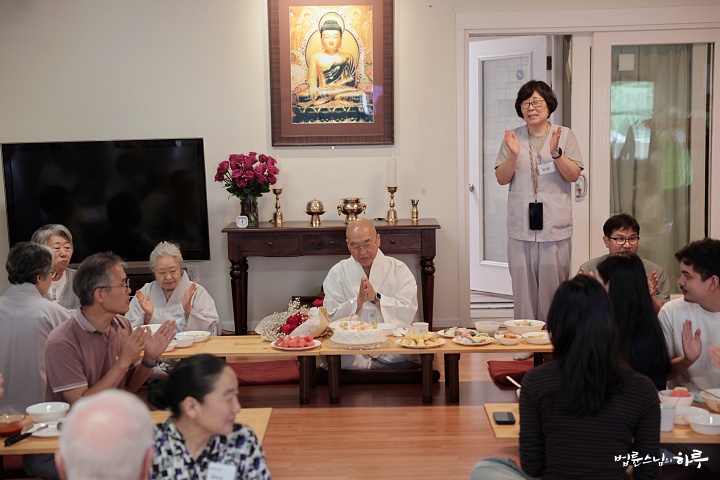
People gathered in small groups, chatting and enjoying bibimbap. After some time had passed, Dharma Teacher Beophae came forward and announced a special time to celebrate Teachers’ Day. Although Teachers’ Day had already passed, the Jungto practitioners prepared this celebration because today was the day they could meet Sunim and express their gratitude. Candles were lit on a homemade cake, and everyone sang “Grace of the Teacher.” A Jungto member presented Sunim with a bouquet of flowers as a token of appreciation. After the song, Sunim blew out the candles on the cake. It was a moment that the Jungto members had carefully prepared with hearts full of gratitude.
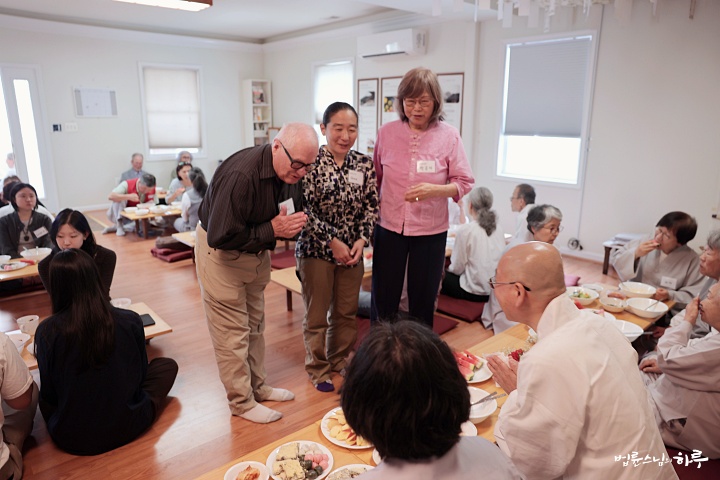
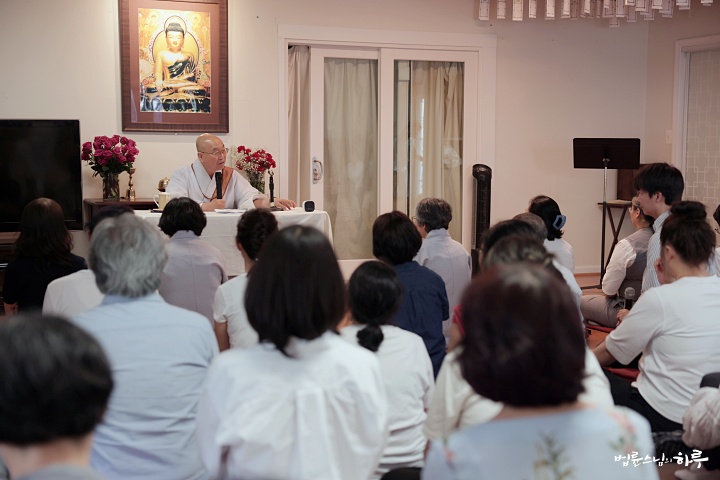
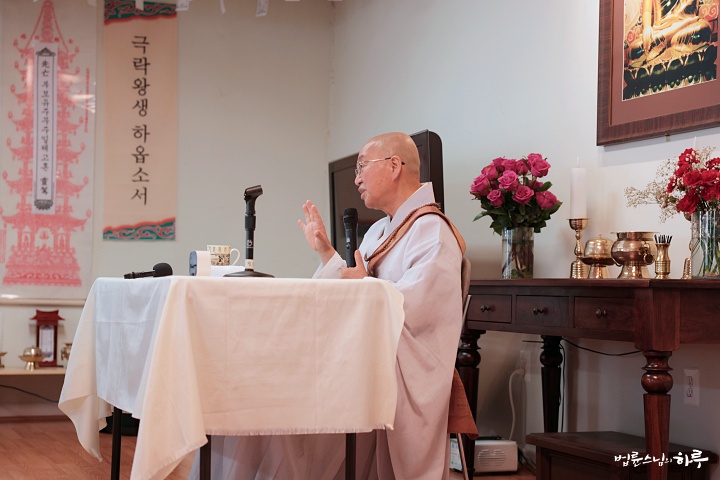
Afterward, some members came to greet Sunim personally. A family who had driven for three days from Colorado to meet Sunim came to the US Jungto Center and had a chance to meet him. Members cleaned up their dishes and prepared the Dharma hall for the Dharma Q&A session. Although the second part—the Dharma Q&A—was originally planned to be held in the meditation hall, since the new building’s odor had not yet dissipated, the session was held in the old Dharma hall instead. The hall, which had been used for the meal, was rearranged for the Dharma Q&A.
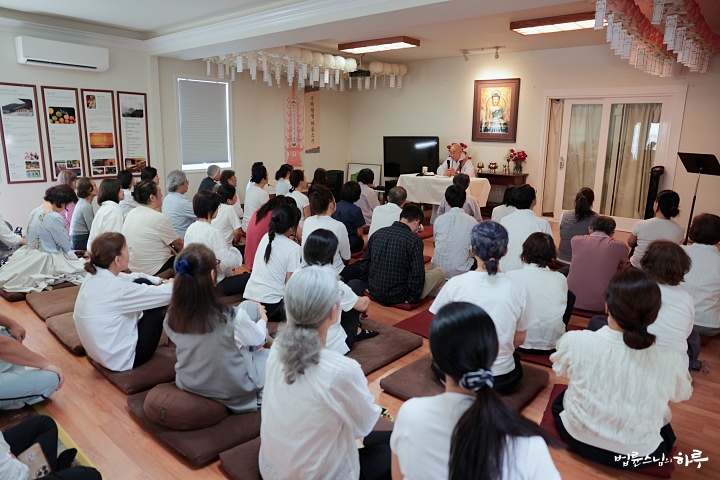
Starting at 1:30 PM, Sunim had a conversation time with the Jungto members who had gathered. There were three people who had submitted questions in advance, and four people asked questions on the spot. With the members’ honest questions, the Dharma Q&A session was both serious and at times lightened by hearty laughter. The following topics were discussed:
I am a doctor of Korean medicine, and two months ago I was sued by a patient, which caused me great suffering. After dedicated practice, I have become much more at ease. Still, when I get caught up in the thought, ‘What if I go bankrupt?’ I feel frustrated. I would rather just go bankrupt and find awakening through it, or let go right here and now and smile brightly.
I have heard that there is no right or wrong—only how I perceive things creates appearances. Does this also apply to acts like murder or sexual assault?
My older sister took her own life 19 years ago. We told our mother it was a heart attack, but three years ago, I drank alcohol and told her it was suicide. Every time I see my mother, I feel sorry and guilty.
The previous questioner mentioned filing a lawsuit one year after being sexually harassed. Can someone file a lawsuit at any time, whether five or ten years later?
In this rapidly changing era, what will become of humanity? Inter-Korean relations also change over time—how does Sunim view this?
During the Park Geun-hye administration, there was excitement around the phrase, ‘Unification is a jackpot.’ I heard that a certain scholar predicted, ‘A Buddhist leader will emerge from Korea and unify the North and South.’ Will we be able to see a unified Korean Peninsula during Venerable Pomnyun Sunim’s lifetime?
I have completed the Happiness School, the Jungto Buddhism Course, and the Jungto Sutra Course. What I felt while studying Buddhism is that at first, every term seemed to be explained kindly, but why must hwadu (key meditation phrases) be realized on one’s own? Seon dialogue seems very important, but is there a reason there are no specific, detailed explanations?
There were members who eagerly raised their hands wanting to ask questions, but since those who had come from far away needed to drive long distances to get home, the session had to end there, regrettably. Sunim then gave his closing remarks.
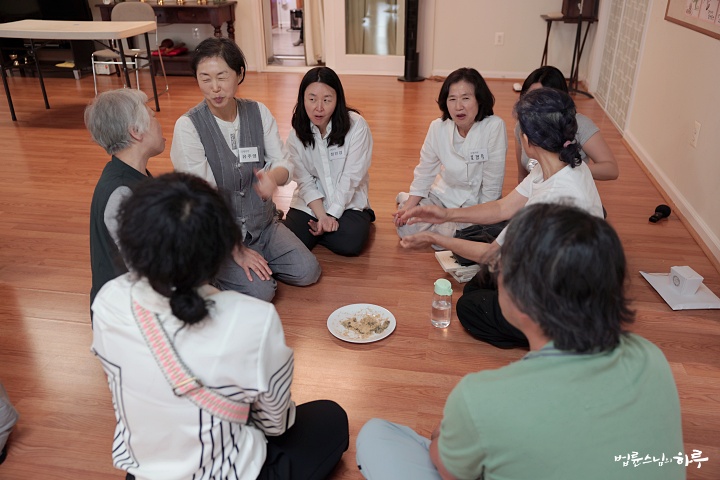
After taking group photos and holding a book signing, members enjoyed the mugwort rice cakes that Sunim had personally brought from Korea. These rice cakes were made with mugwort that Sunim and the Dharma Teachers had gathered themselves. The members loved the rich aroma of the mugwort. Those who needed to hurry home to catch their trains received take-home rice cakes and commemorative books before quickly leaving, while the remaining members stayed at the center to help clean up after the event.
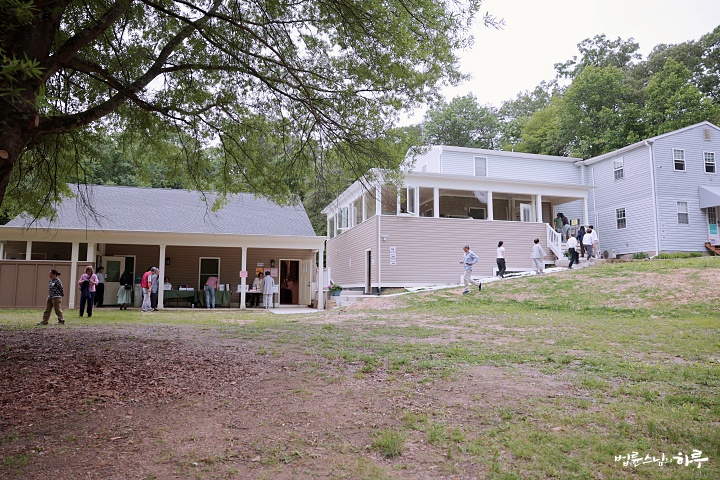
After dinner, Sunim rested and prepared for tomorrow’s trip back to Korea, bringing the day to a close.
Tomorrow morning, Sunim will leave the center and head to the airport, then board an afternoon flight back to Korea.