If Fate Is Predetermined, What’s the Point of Making an Effort
Feb 09, 26 - Lecture at National Institute of Technology (NIT), Visit to Vivekananda International Foundation
Hello. Morning has dawned in Delhi. Today’s schedule includes giving a lecture at the National Institute of Technology (NIT) in the morning, attending an international forum at the Vivekananda International Foundation in the afternoon, and then traveling to Gaya by night train.
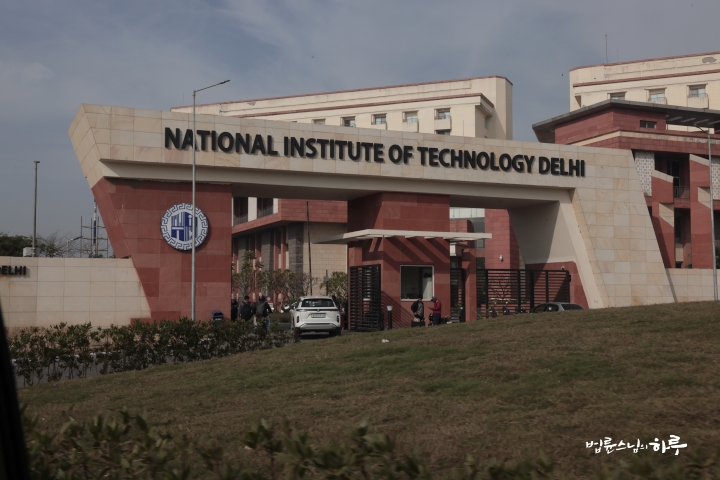
After completing his morning meditation and practice, Sunim worked on manuscript editing. After having a piece of toast for breakfast, he departed for the National Institute of Technology (NIT) at 8:30 AM. This marks the third year since Sunim began lecturing at this school.

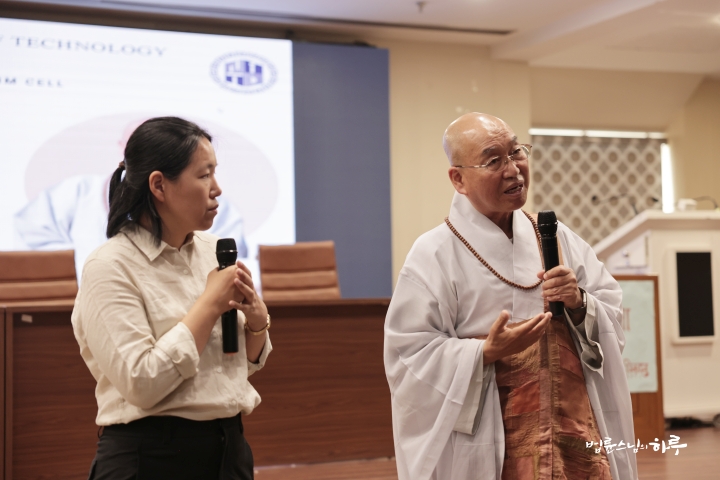
When Sunim arrived at the school at 10 AM, Kang Hye-jeong (강 혜정), who has been handling the practical arrangements for lectures in India, and Kim Mi-seon (김 미선) from the International Division, who serves as interpreter, were already there.
“The faculty and students are running a bit late, so they’d like to delay the lecture by about 30 minutes.”
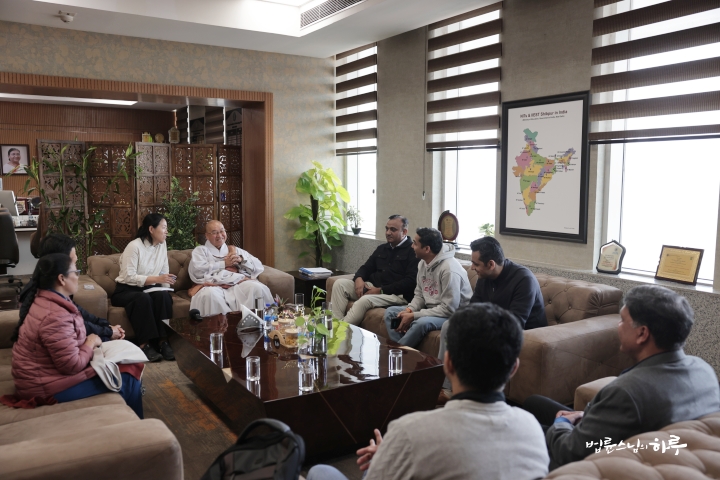
“Yes, let’s do that. We also waited about 30 minutes at Delhi University.”Sunim replied with a smile. After greeting the local professor who arranges the annual lectures, he spent some time in the waiting room. During this time, several professors came to greet Sunim.
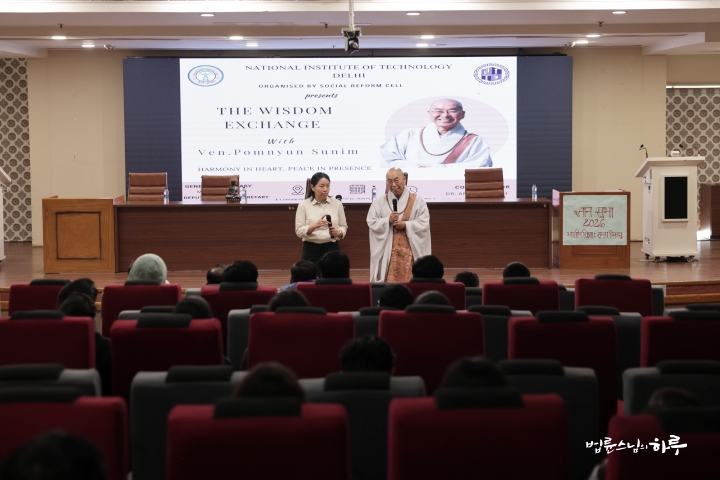
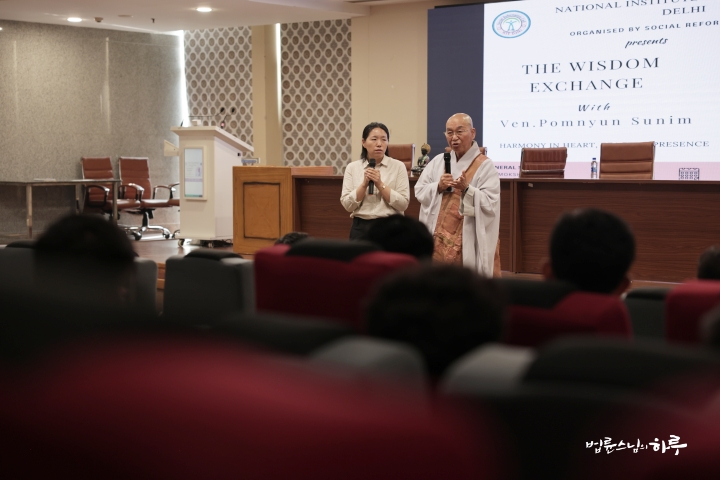
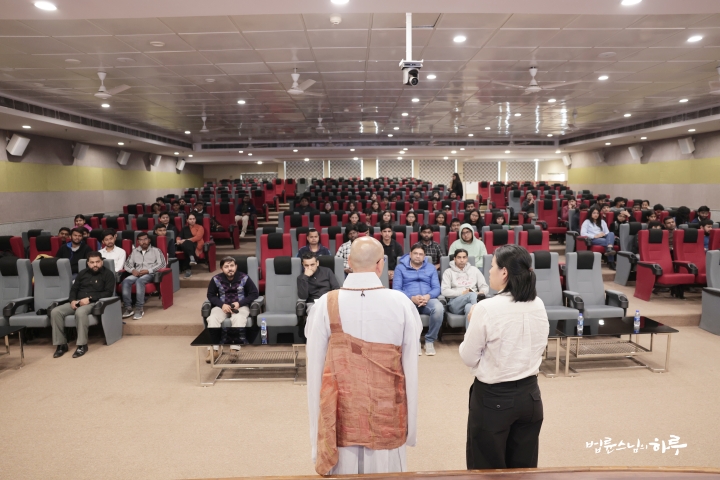
At 10:30 AM, they moved to the lecture hall. About 60 students had gathered in the auditorium. Sunim began the dialogue by sharing his childhood dream of becoming a scientist and explaining how Buddhism, like science, can be approached with an attitude of inquiry that constantly asks “why.”
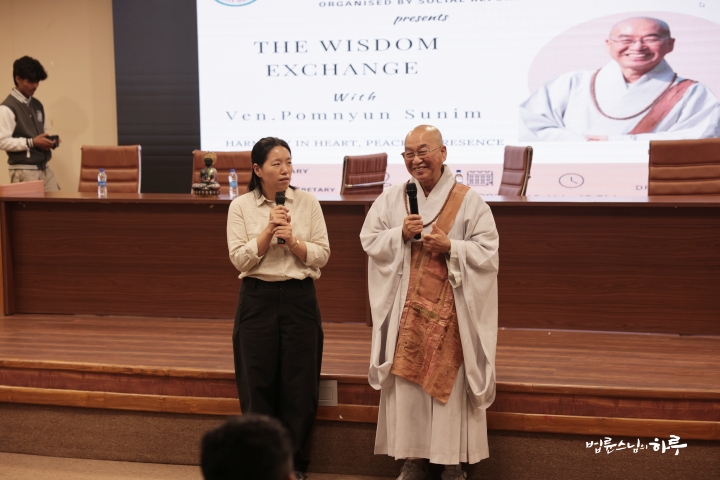
He then explained in detail what the Middle Way (중도) and dependent origination (연기) discovered by the Buddha are, and using the molecular structure of water as an analogy, he explained how the core Buddhist concept of ‘non-self (무아)’ is not a religious belief but aligns with scientific facts.
The Buddha’s Teachings from a Scientific Perspective
Since you are people who study science, let me explain using water as an example. If you divide water into smaller and smaller pieces, it’s still water. That’s why some ancient philosophers said water was the source of all things. In other words, they thought there was some fixed, unchanging substance called water. However, scientific investigation has revealed that water has no inherent substance. The smallest unit of water, the water molecule, is composed of hydrogen and oxygen bonds. If hydrogen and oxygen separate, the property of water disappears. Therefore, water has no inherent substance. We can say that while water exists, there is no essence of water. Then do the oxygen and hydrogen atoms that make up water have inherent substance? Atoms also have no substance (실체). Atoms are made up of subatomic particles smaller than atoms. Do subatomic particles (소립자) have substance? Subatomic particles are made up of even smaller quarks. In this way, nothing has inherent substance. This applies not only to material existence but also to living organisms and humans. Life is a highly complex material combination formed by genes. We also think our mental processes have a substance called ‘I.’ This is called ‘Atman.’ However, the Buddha said that Atman has no substance. Today I want to talk with you not about Buddhism as a religion, but about Buddha Dhamma (the Buddha’s teachings). I hope you will understand the Buddha’s teachings not as religion but on a common-sense level. The topic of our dialogue today will be about life’s anguish. We’ll talk about the various stresses and sufferings we experience in life. However, I want to mention that at the very foundation of our dialogue lies the fundamental Buddhist thought of the Middle Way and dependent origination.”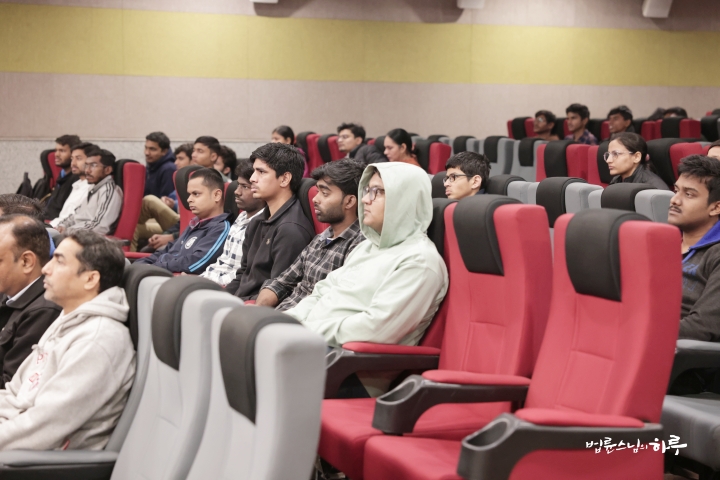
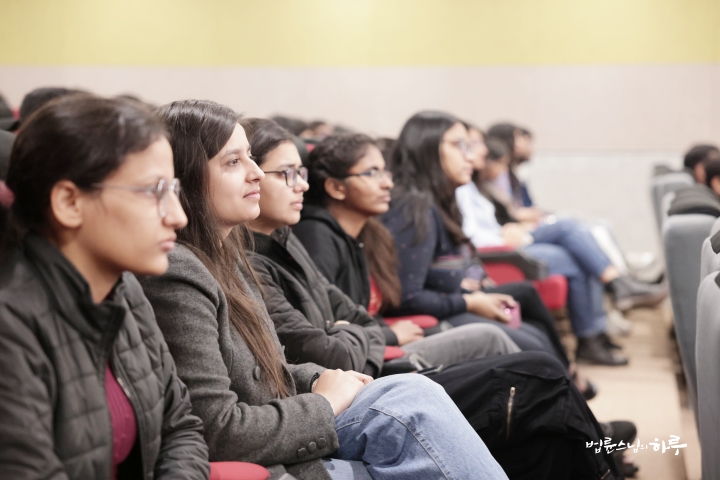
Next, anyone could raise their hand and ask Sunim questions. For an hour and a half, four students asked Sunim about their curiosities and engaged in dialogue.
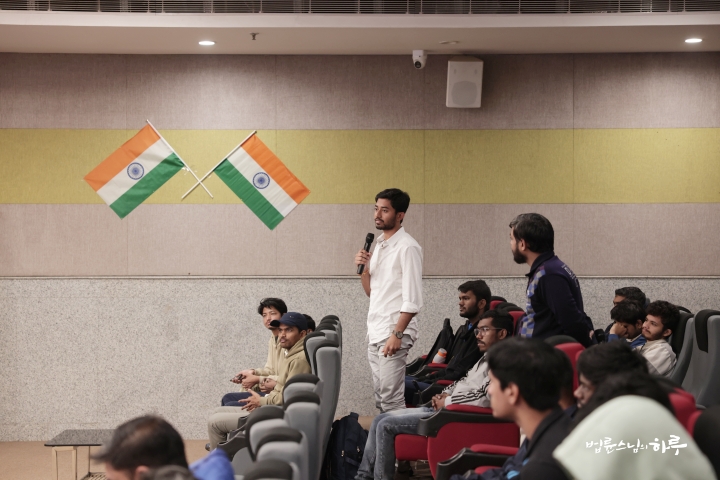
One of them wanted to know how the teaching of the middle way works in real life and asked what teaching of the middle way had brought the greatest change to Sunim’s life.
**You Suffer Because You Try to Accomplish in Three Attempts What Should Take Ten
**
“What teaching of the middle way has been most transformative in your own life?”
“No.”
“Thank you. I understand well.”
Questions continued to follow.
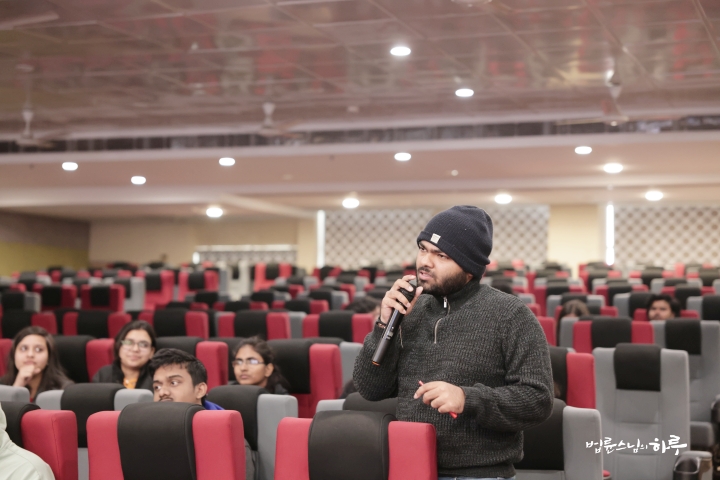
I’m convinced that the peace and enlightenment I’ve experienced within myself are absolutely necessary for society. How can I spread this experience quickly and effectively to society?
I’m curious about the meditation practices Sunim practices in daily life. Which practice is most helpful for maintaining equanimity and enlightenment?
As the lecture was coming to an end, one last student raised their hand. They asked Sunim what meaning there is in working hard if destiny is predetermined.
If Destiny Is Predetermined, What’s the Point of Making an Effort?
“There is a belief in destiny — that everything we are meant to accomplish in life is already predetermined. If that is the case, is there any point in making an effort to achieve something? On the other hand, if nothing is predetermined, and we may not get the results we want, then why do we work so hard?”
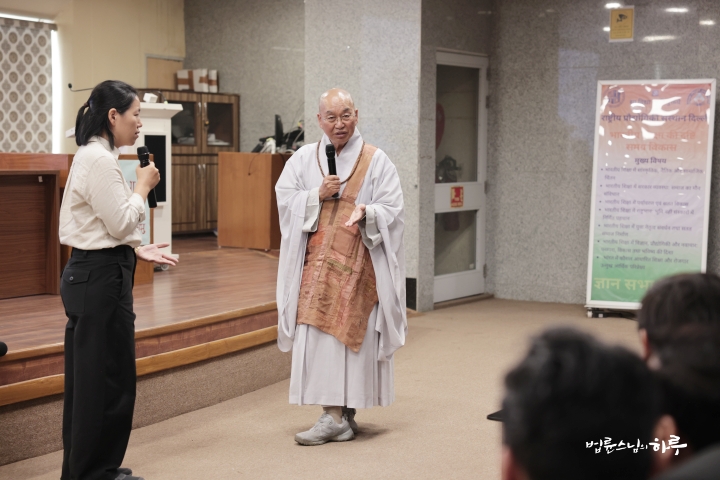
“Thank you. I understand well.”
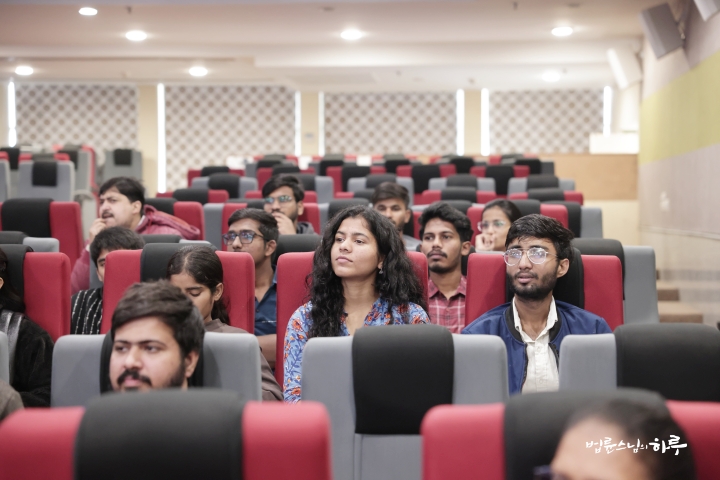
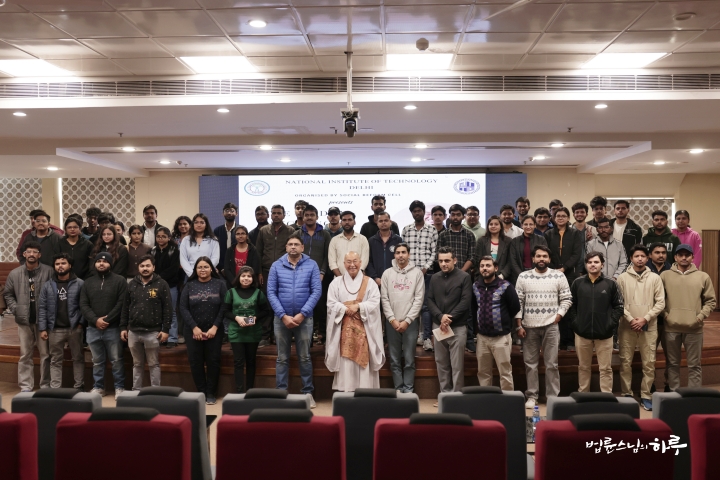
As Sunim concluded his lecture, thunderous applause erupted. The professors and students took a commemorative photo together, promising to meet again when Sunim visits India next time.
After finishing the lecture at 12:10 PM, Sunim immediately moved to the Vivekananda International Foundation.
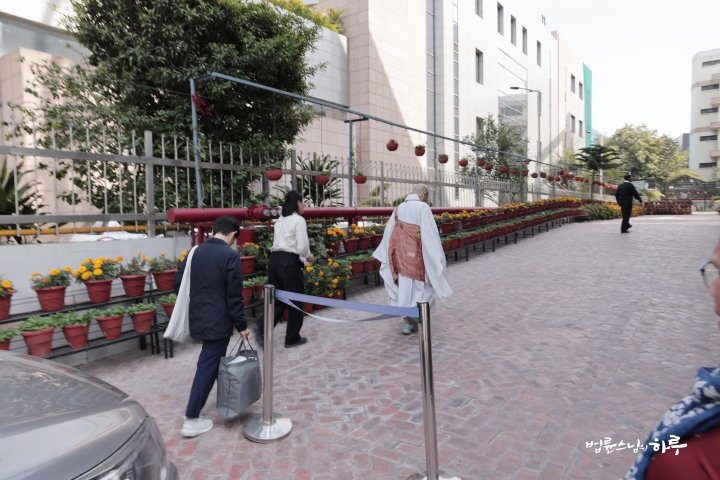
The Vivekananda International Foundation is India’s leading public policy think tank, established in 2009 in Chanakyapuri, New Delhi. Covering security, diplomacy, and public policy fields, it has been conducting international dialogues on conflict resolution and peace through its Hindu-Buddhist dialogue program called ‘Samvad’. Today, they hosted an international forum inviting Buddhist leaders and scholars from five countries including India, Korea, Malaysia, Thailand, and Cambodia to discuss Buddhist approaches to contemporary social issues.
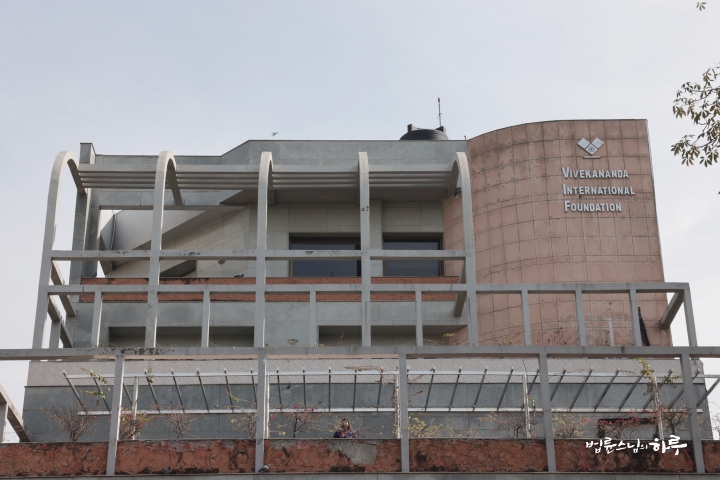
After a preliminary tea session at 2 PM, the forum began at 3 PM. The moderator asked for Sunim’s views on the topic: “What role can Buddhism play in our rapidly changing modern society, and how should it approach social issues?”
Sunim spoke about solutions to the most important problems facing humanity: peace, climate crisis, and poverty. He first brought up the changes in world order. He pointed out that the framework of international cooperation maintained since World War II is shaking, and that Western values alone cannot solve the problems. If the view of nature as an object of conquest has led to the climate crisis, then we need to find new solutions from the Eastern perspective that sees people and nature as interconnected and coexisting.
He also mentioned the issue of cooperation among Buddhist countries. In particular, he urged awakening, noting that neighboring Buddhist countries are not helping each other with their difficulties, while Western countries are coming to help.
Why Do We Turn Away from Our Neighbors’ Suffering While Speaking of Compassion?
“There are many people on this earth living in absolute poverty. This problem is concentrated in Asia and Africa. Yet those who help them are mostly people from Western countries. Why don’t neighboring Buddhist countries help with the difficulties of Buddhist countries, but Christian countries come to help? This is the question of why Buddhism, while speaking of compassion and love, turns away from the suffering of neighbors. As a result, while helping is good, that help sometimes ends up destroying traditional culture and communities. I’m not saying we should reject Westerners. I’m saying we should awaken ourselves. Let’s cooperate a little more and solve our problems ourselves. Most of Southeast Asia consists of Buddhist or Hindu countries. So I hope our dialogue will focus on ‘How can we cooperate to solve problems of peace, environment, and poverty?’ Also, while we should respect traditional culture, when it comes to issues of discrimination, we should overcome that discrimination and aim for equality. In other words, issues like women’s education and social activities, and education for people with disabilities and ethnic minorities should not be ignored in the name of tradition. These things don’t necessarily pursue equality based on Western thought – Buddhist thought also contains many values such as gender equality and human dignity. Democracy didn’t necessarily come from the West. There are many democratic operating methods in Buddhist Sangha operations as well. I’m not particularly insisting only on our culture. However, there are many good traditions within our own heritage. The question is how we can revive them. In the new world that will unfold, the era of solving problems by simply imitating someone else has passed. We need to solve problems with new ideas. I think these problems arose from Western values, so it’s difficult to solve them with Western thought. That doesn’t mean we can solve them immediately, but I think we should challenge ourselves to solve these problems from a new perspective. So I hope we can have the perspective of creating future civilization.”Sunim then shared his impressions from visiting Indian universities over the past few days.
“In the past few days, I visited three universities – Nehru University, Delhi University, and NIT – and had conversations with students. I heard that these students are the most talented in India. I asked them whether they would use all their talent just to make money, or also to solve the side effects that come from making money. Shouldn’t at least 10 percent of people play the role of cleaning up when someone makes a mess, for the world to be maintained? I wish everyone in the world would reduce consumption and live loving peace, but I think it’s difficult in reality. However, I think this earth can only be sustainable if some talented people like you participate in solving problems related to loving peace, helping those in need, and caring for the environment. That’s why I came here to find such people, and I’m visiting various places having these conversations. To fundamentally solve these problems, we need to do more research and practice. We don’t yet know what methods might exist, or even if they exist, whether we can actually implement them. But we can certainly find ways to address these problems. So I hope you will play such roles. I hope we can work together to find not just current development, but also how to solve the side effects that occur after this development.”During the subsequent Q&A session, discussions continued on a wide range of topics including peace on the Korean Peninsula, the relationship between religion and state power, and the balance between nuclear deterrence and Eastern philosophy.
Sunim said we need to solve current problems with Eastern wisdom, but in reality there are world leaders like Kim Jong-un (김 정은) who has nuclear weapons or those in power who want war. How can we diagnose and respond to such realistic problems with Eastern wisdom and ancient thought?
While Hinduism and Buddhism are religions closer to ways of life and are not organized, other religions that receive state support are systematically organized and spread the superiority of their religion. How can unorganized Buddhism and Hinduism provide alternatives to these religions?
In a reality where major powers ignore the rights of smaller nations, India has responded to external threats with nuclear deterrence, while Indian philosophy opens space for dialogue that considers even the opponent’s perspective. How can we find the right balance between realistic nuclear deterrence and the dialogue principles of Indian philosophy?
Sunim said that dialogue must continue for any problem in the world, even if there are conflicts. He concluded the dialogue by emphasizing that even if we cannot solve problems immediately, we must at least prevent situations from getting worse.
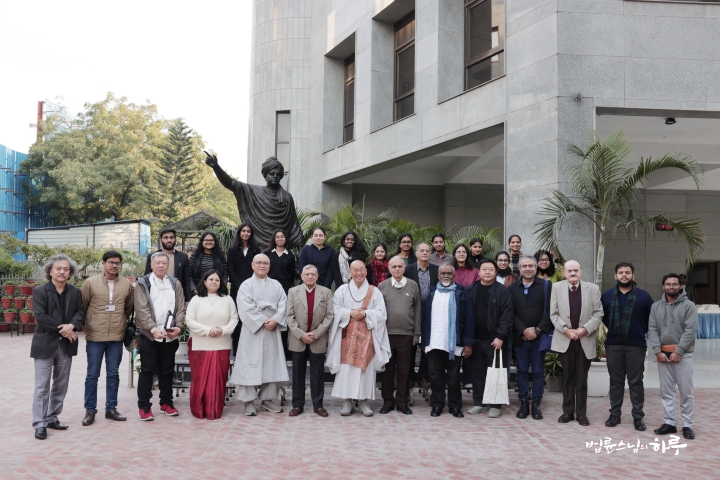
After finishing the forum at 4:20 PM, they took a commemorative photo and had a separate meeting with the Chairman of the Vivekananda International Foundation. Then Sunim had dinner at a nearby restaurant with Mr. Harsha, Chairman of INEB (International Network of Engaged Buddhists), and Mr. Moo, the Secretary-General, who also attended this forum.
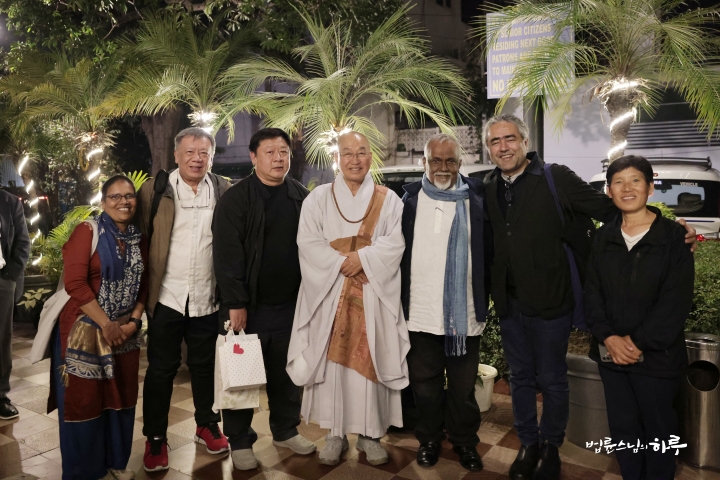
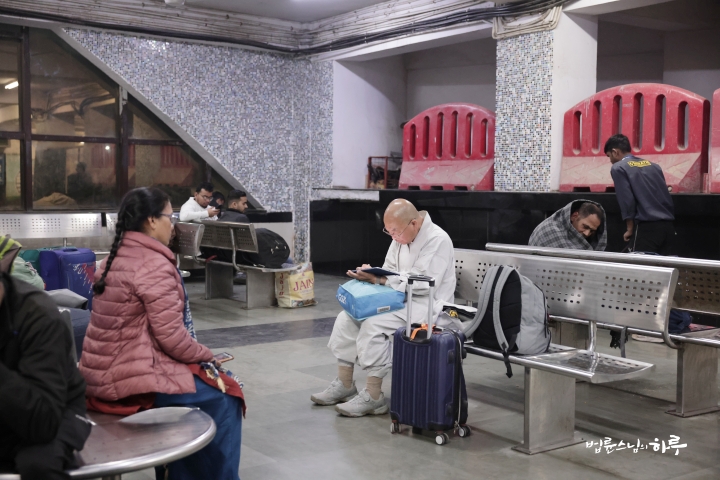
After dinner, they arrived at Anand Vihar Railway Station at 9 PM. Sunim spent time proofreading manuscripts in the waiting room.
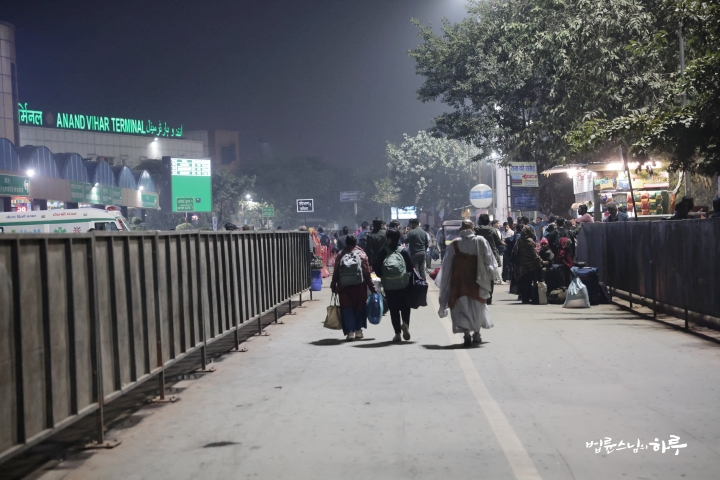
At 10:45 PM, they boarded the train and departed for Gaya.
They will arrive in Gaya tomorrow afternoon and proceed to Sujata Academy.