Should I pretend to be extroverted to be recognized at work?
Oct 28, 2024 - First day of visit to Bhutan, arrival in Nabji village
Hello. Today is the day Sunim arrive in Bhutan and travel to Nabji, a remote mountain village in central Bhutan.
He departed from Incheon Airport at 8:35 PM last night, flew for 6 hours and 10 minutes, and arrived at Bangkok Airport at 2:45 AM Korean time, which was 12:45 AM local time.

After retrieving his luggage and before changing planes, Sunim sat in restaurant chairs to proofread manuscripts and handle some work.
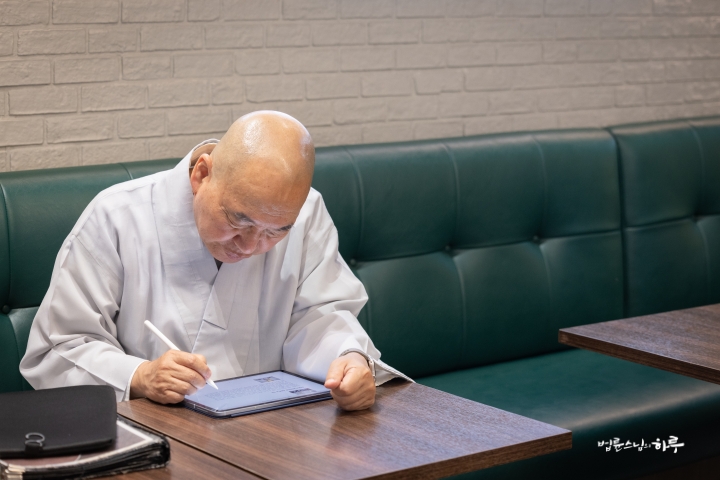
At 2 AM, Sunim checked in our luggage and completed boarding procedures to catch the flight to Bhutan.

However, Sunim discovered that the visa validity period and multiple-entry status written by Bhutan’s immigration on his passport had completely disappeared. During the last visit to Bhutan, his bag got wet, including the passport, and somehow only that information had been erased. At Bangkok Airport, they said he couldn’t board the plane until Bhutan’s immigration confirmed the visa. Due to the early morning hour, he couldn’t reach Bhutan’s immigration. As the boarding deadline approached, Bangkok Airport suggested changing our tickets to tomorrow’s 1 PM flight. After much pleading, he was finally able to get our boarding passes by signing a waiver accepting any consequences.
He arrived at the gate just before 4 AM. After a brief nap in the chairs, he departed from Bangkok Airport at 5 AM.
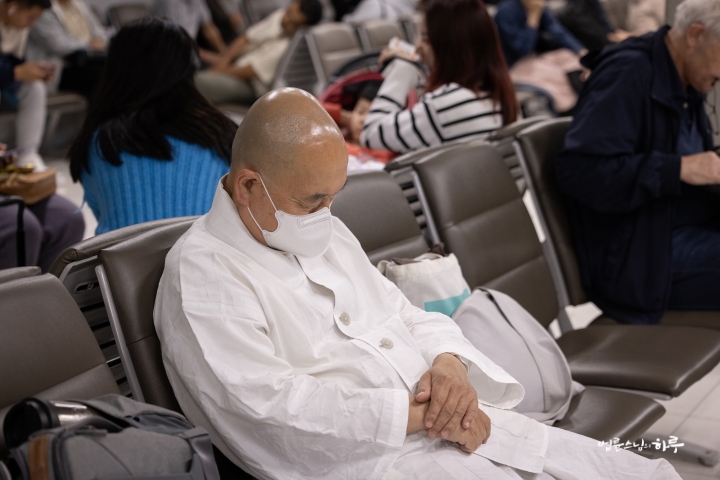

Having stayed up all night due to the check-in issues, Sunim fell into a deep sleep as soon as he sat down on the plane. While he slept soundly, day broke. The snow-capped Himalayan mountains were clearly visible through the window.

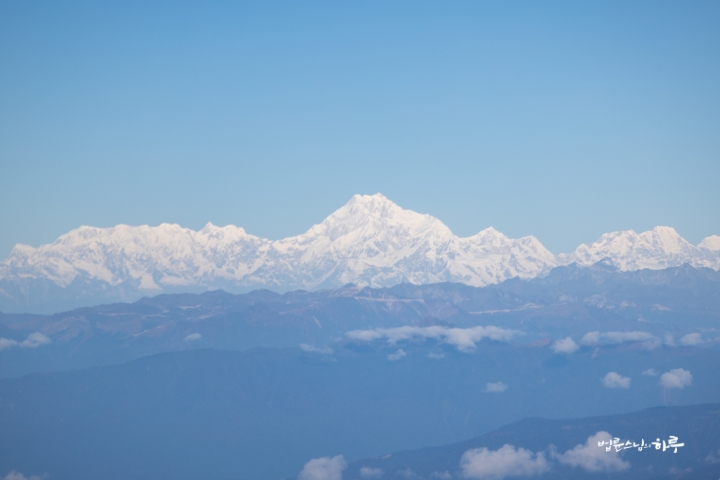
Looking down from the sky, Paro in Bhutan had turned into golden fields everywhere.

After flying for 3 hours and 10 minutes, passing through several valleys, the plane landed at Paro Airport at 7:15 AM.

After completing immigration procedures and retrieving our luggage, he exited the airport to find Rinchen Dawa, who will be interpreting during this visit, and Yeshi, a Bhutanese central government official, welcoming Sunim.
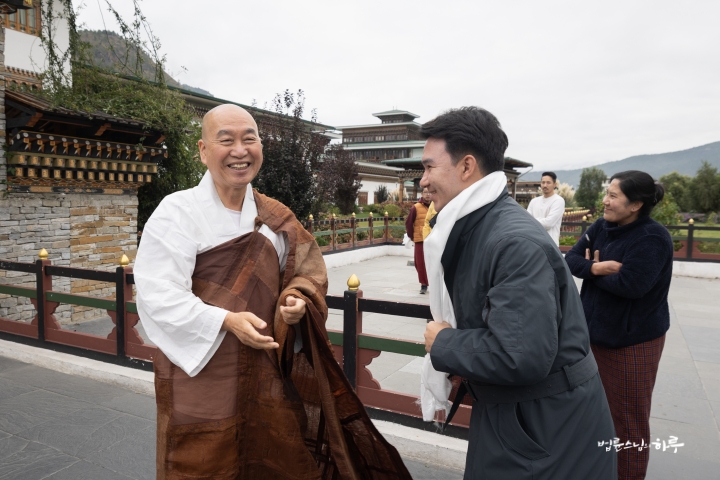
After exchanging warm greetings, Sunim departed from Paro Airport at 8:20 AM and began the long journey to Nabji village. He had to travel by car for 10 hours on winding mountain roads.
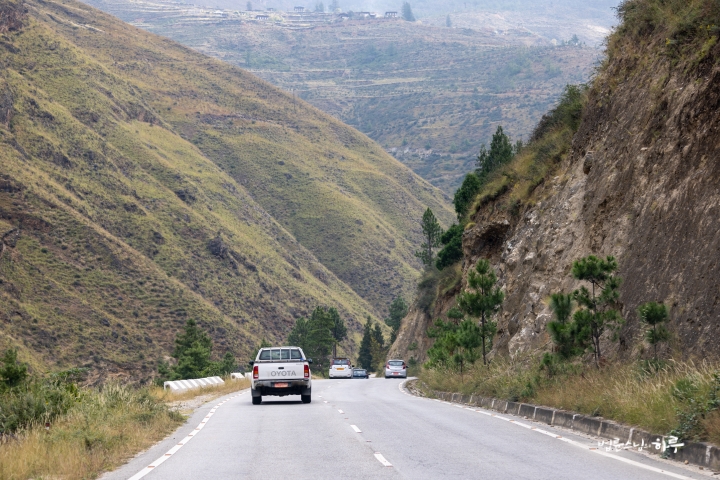
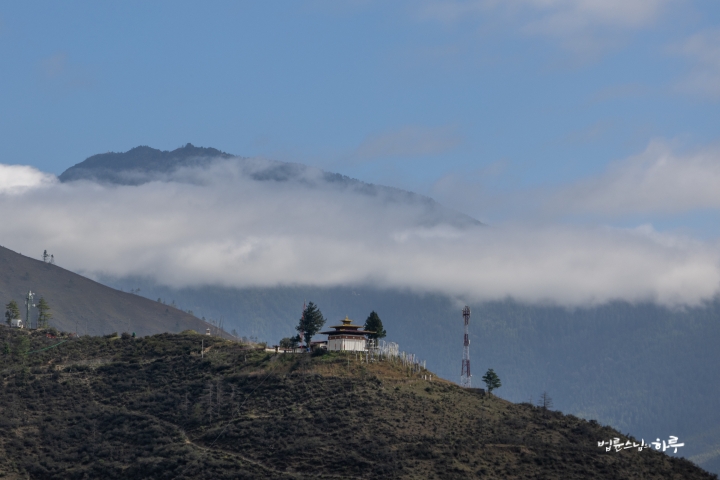
Sunim crossed over two mountains with an altitude of more than 3,000 meters above sea level.
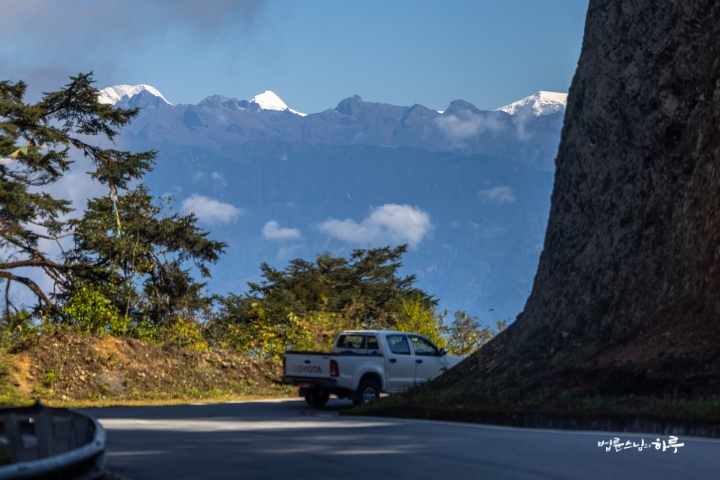

After driving for 5 hours, Sunim stopped at a restaurant for lunch at 1:10 PM.

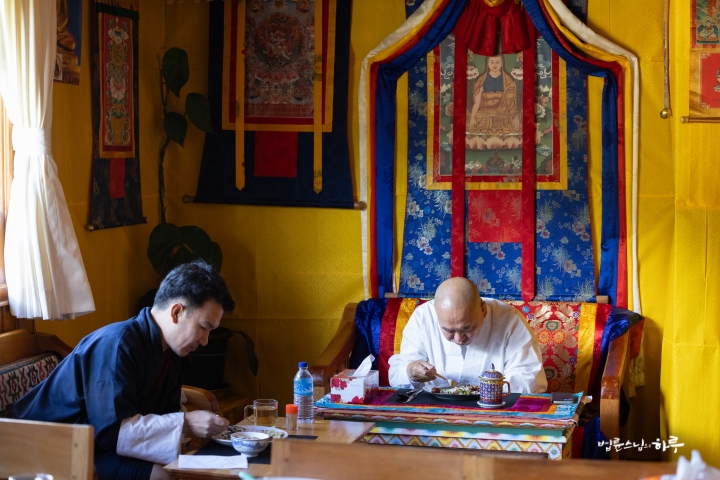
After finishing our meal, Sunim diligently continued the journey on mountain roads. As he caught up on sleep and chatted in the car, the sun began to set.
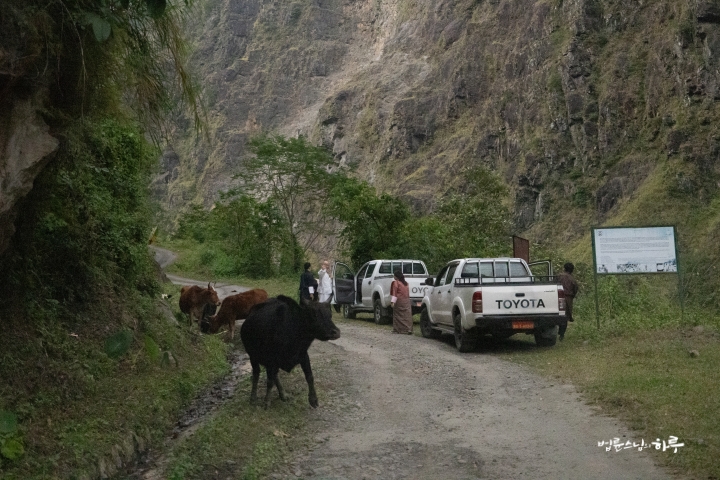

Exactly 25 hours after departing from Incheon Airport at 8:40 PM the previous night, Sunim arrived at the Nabji Chiwog guesthouse at 6:20 PM local time. Kolpu Gewog officials were waiting for Sunim in front of the dimly lit guesthouse.
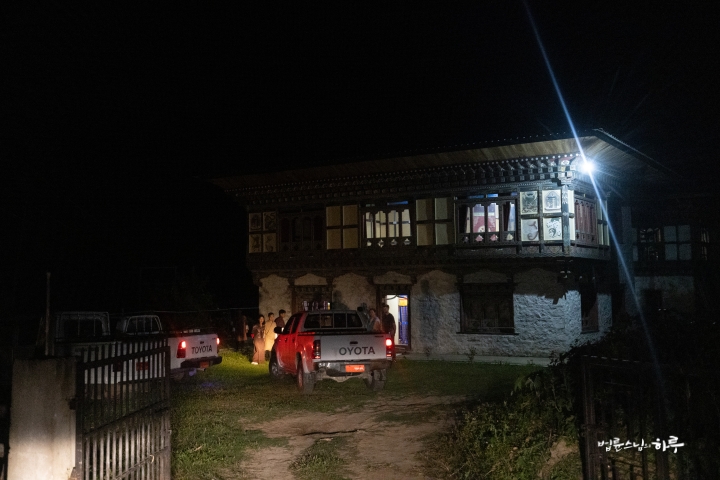
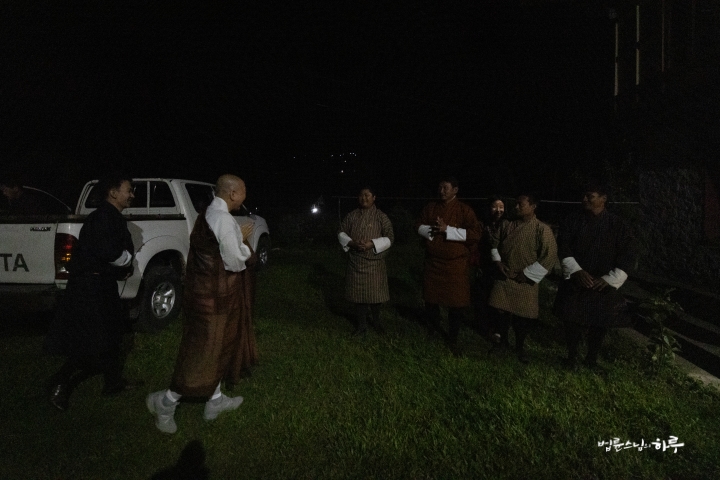
“Kuzuzangpo la!”
After exchanging warm greetings, Sunim entered the guesthouse. It had been two months since he last met during the JTS workshop in Zhemgang at the end of August.
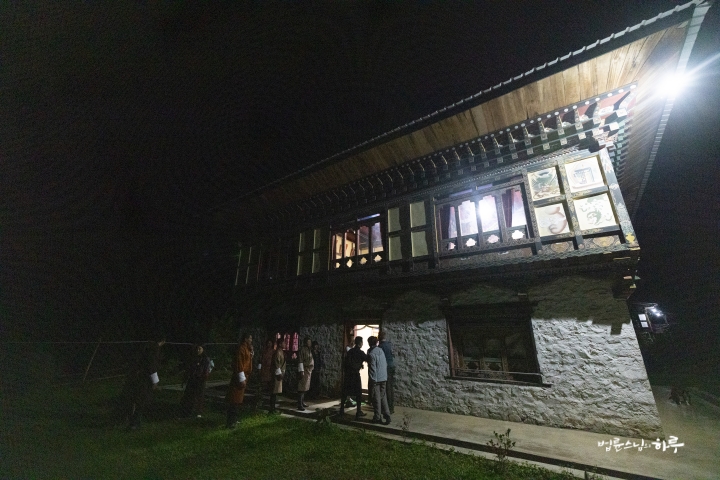
Today’s accommodation is a guesthouse run by local villagers. In Bhutan, slightly larger houses all have a prayer room set up inside.
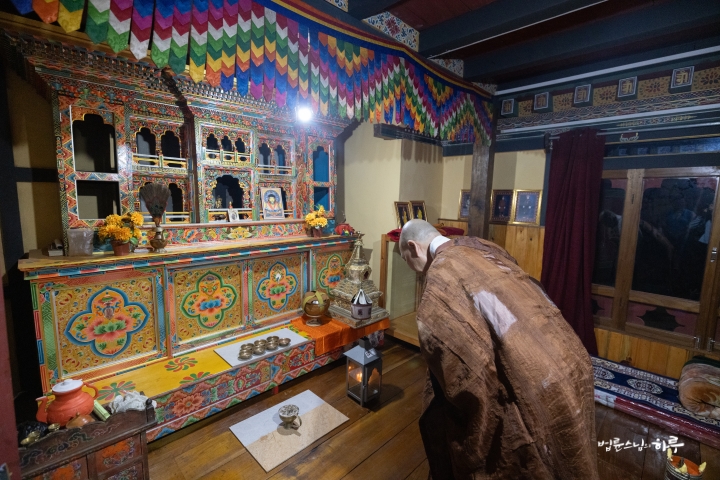
After Sunim paid respects at the prayer room, the Tshogpa (village leader) of Nabji Chiwog performed a ceremony praying to Buddha and local deities for the smooth progress of the project.
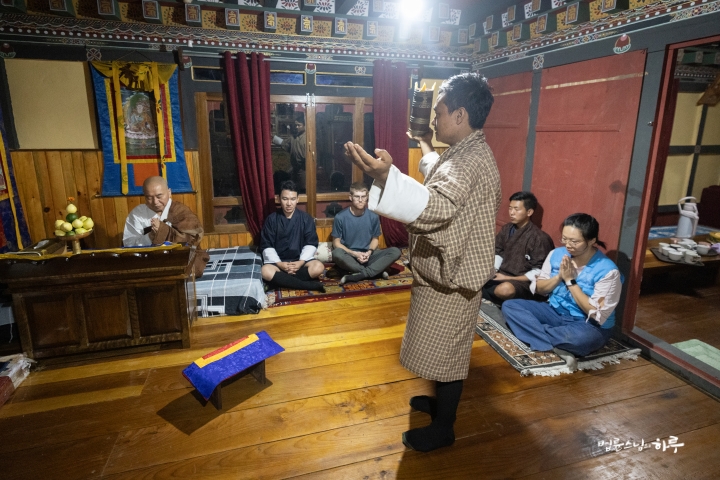
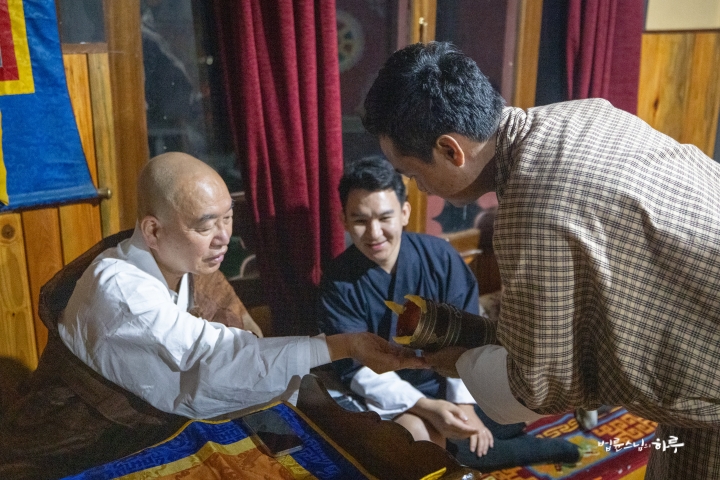
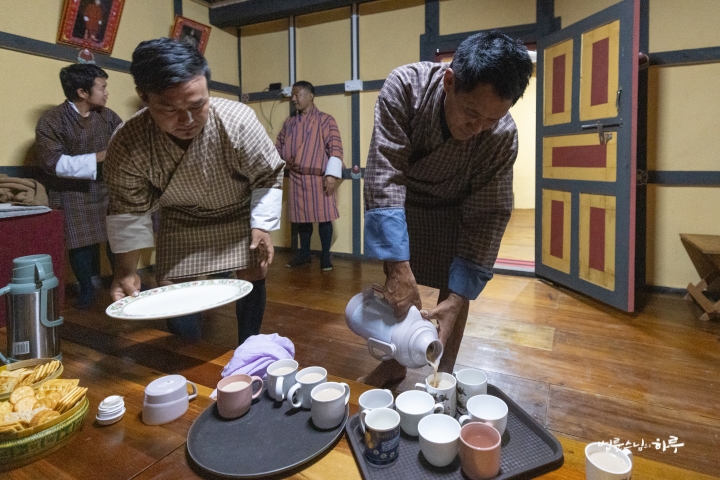
Then, tea and snacks were served.
A meeting was held for an hour with Sunim, leaders from three villages (Korphug Chiwog, Nabji Chiwog, and Nimshong Chiwog), the Gup and administrative officer of Korphu Gewog, the administrative planning officer of Trongsa Dzongkhag, and a central government official.
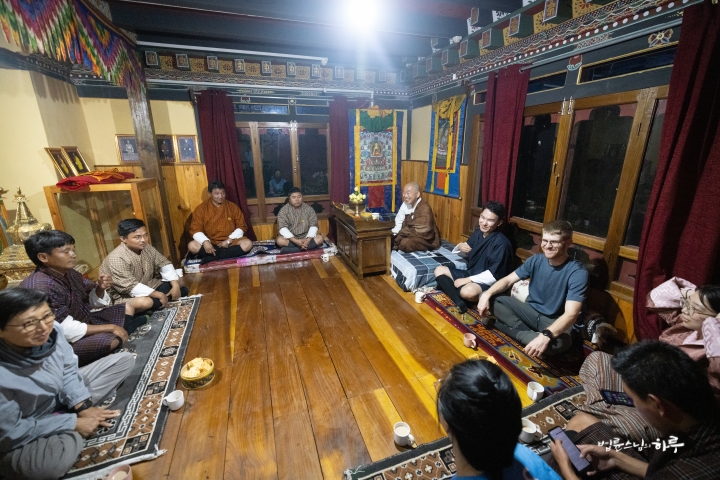
Over the past two months, Nabji Chiwog had been working on paving the roads within the village. Sunim first commended the Tshogpa for his hard work.
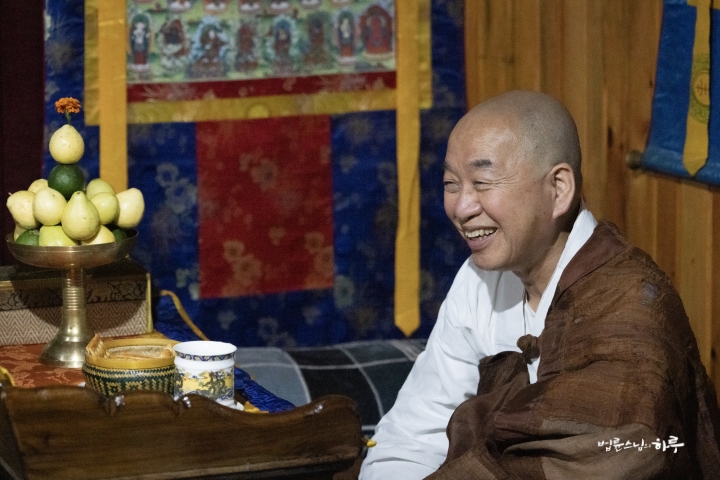
“It was easier to transport materials compared to when we were working on the water channel project because the roads were better.”
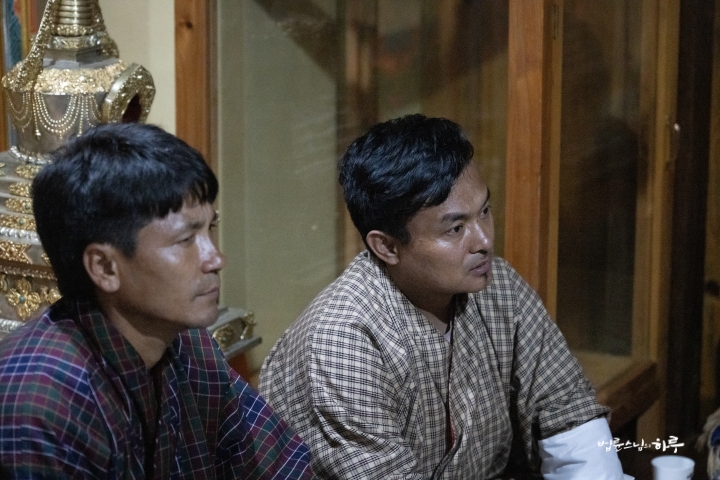
Sunim then explained the plan for tomorrow’s site visit.
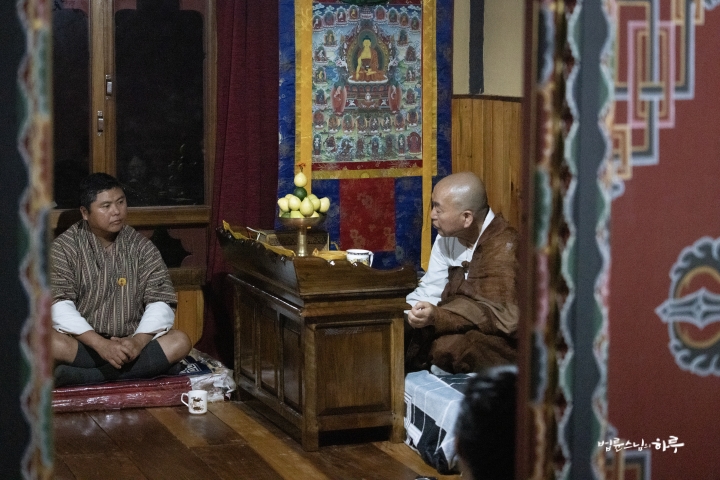
Additionally, there’s a proposal to use some uncultivated land as a demonstration farm run by JTS. We’ll decide tomorrow during the site visit whether it’s better to turn that land into rice paddies or an orchard.”
The Gup (head) of Korphu Gewog explained the discussions he had with residents about how to build the farm roads.
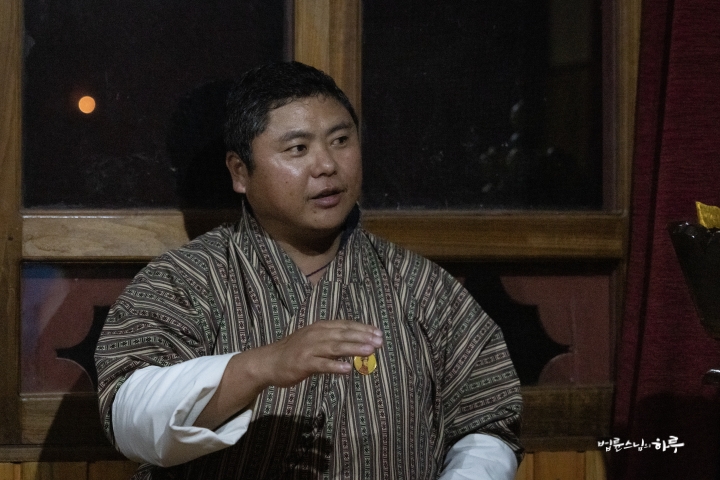
“When I discussed this with the residents, those who would have to give up more of their land opposed building the roads. There’s dissatisfaction because people won’t be contributing land equally.”
Sunim responded:
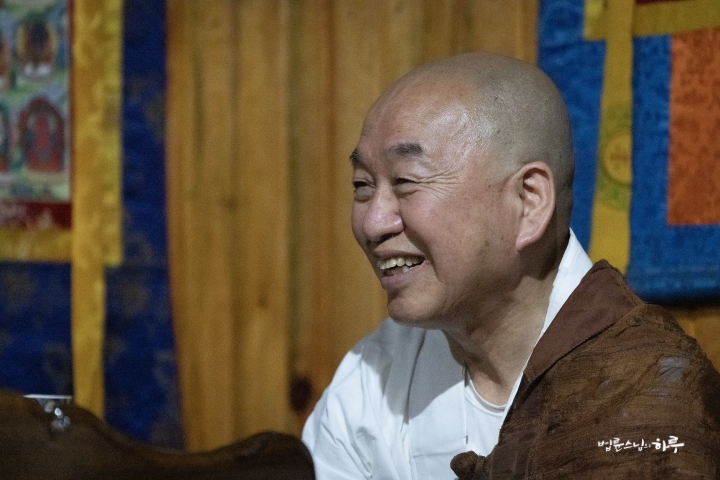

The Gup of Korphu Gewog once again explained the residents’ position. Sunim suggested making a decision after talking with the residents tomorrow.
“Residents find it difficult to give up their land because it’s an inheritance from their parents. In the past, when building roads in the village, there were instances where people signed agreements to give up their land, but when the excavators came to dig, they lay down on their land and strongly opposed it. It’s very painful for them to see their land disappear.”
“In that case, we’ll have to wait for 5 or 10 years. It will have to be done eventually, but we’ll have to wait. As people get older and weaker, they’ll have no choice but to introduce machinery, which means farm roads will be necessary.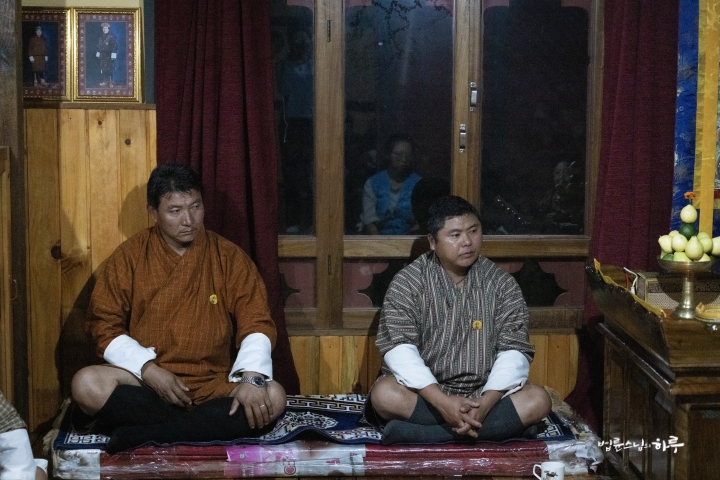
“Kadin Che!” (Thank you.)
After the meeting, he had a late dinner together.
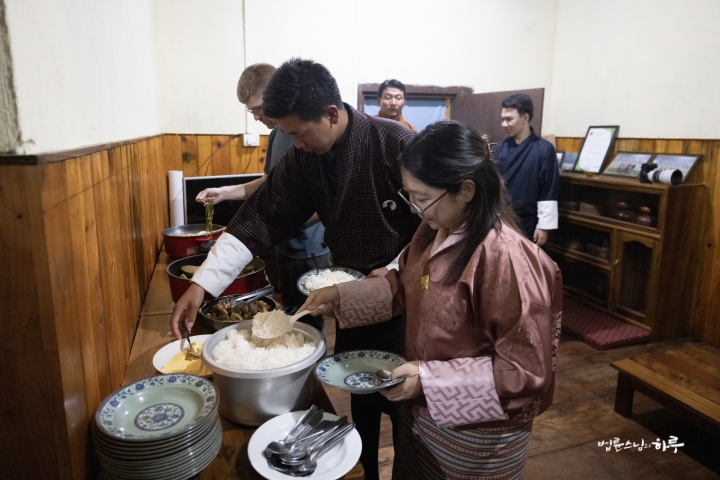
The table was set with Bhutanese food prepared by the Tshogpa of Nabji Chiok and kimchi and pickles made by the Korean JTS activist.
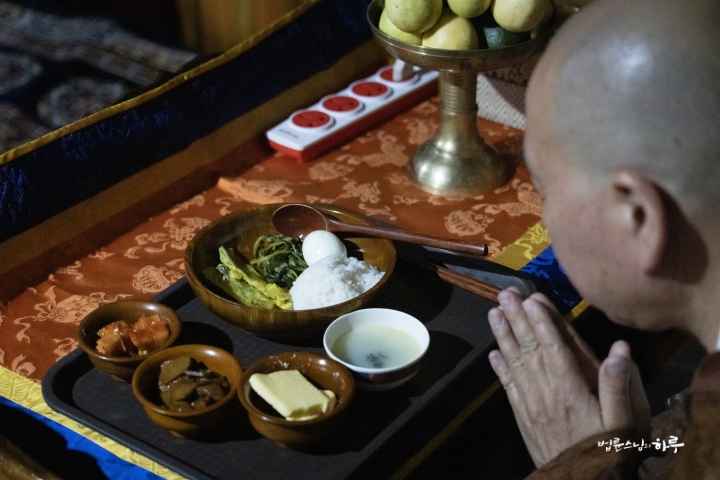
After the meal, when all the village leaders and officials had returned home, Sunim also went to bed.
Since there was no Dharma talk today, I’ll share a conversation between Sunim and a questioner from the live Dharma Q&A broadcast on the 25th.

Should I Pretend to Be Extroverted to Gain Recognition at Work?
“When you work at a company, extroverted people tend to receive better evaluations. For example, during meetings, you have to proactively speak up, and in the office, you have to show that you’re going to your colleagues to discuss and working hard and busily. Naturally, extroverted behavior becomes the standard, and people feel pressured to act extroverted. In contrast, I’m more introverted and prefer to work quietly and diligently on my tasks. As a result, my efforts are less visible, and I feel disadvantaged during evaluations. However, I’m not comfortable pretending to be something I’m not or exaggerating my abilities. I wonder why extroversion should be the standard for evaluation when people have diverse personalities. On the other hand, I understand that people can only be judged by what’s visible, so I’m conflicted about whether I should try to appear more extroverted to gain recognition at work.”
“You’re criticizing others for not recognizing diverse personalities and using a uniform standard for evaluation, aren’t you? Similarly, others could criticize you. There can be various criteria for evaluating people. Their choice to use extroversion as a criterion is their own decision, so why are you arguing about it?“
“It wouldn’t matter if evaluations only affected personal reputation, but they influence performance reviews, which is why it’s concerning. Even when doing the same work, introverted people often receive lower evaluations compared to extroverted individuals because they don’t actively promote their accomplishments. In such cases, it feels unfair to be at a disadvantage despite putting in the same effort.”
“For instance, if selecting track and field athletes, those who run slowly would naturally be criticized by the coach. In baseball, players who throw fast, catch well, or hit well would be highly evaluated. For soccer players, scoring or defensive skills would be the criteria. Singers would be evaluated based on pitch, rhythm, and tone. Thus, each profession requires different competencies, and the criteria for evaluating these competencies vary accordingly.
“After hearing your explanation, Sunim, I now understand that extroversion is the evaluation criterion required in my profession, and to receive a good evaluation, I need to be more proactive in speaking up. However, I find it difficult to accept that even when doing the same work, those who talk more about their achievements and present them well receive better evaluations.”
“If you want a good evaluation, you can do the same. If you don’t want to do that, you can give up on being recognized. Why are you arguing about this? If you want recognition, you can do it that way. It’s the same principle as practicing running if you want to run fast, or practicing kicking if you want to kick a ball well. If good self-expression leads to a good evaluation, you too can express and present your achievements well. If you can’t express yourself as well, you should accept the lower evaluation.”“It’s because I’m inherently not good at expressing and showcasing myself.”
“Then you can change your profession. You can move to a career where you don’t need to express yourself well. It’s like someone who is naturally not good at singing complaining about being evaluated solely on their voice. If you’ve realized ‘I’m not suited for this profession,’ you can switch to a different one. If you’re in an office job, sales, or public relations, being extroverted is necessary. In the past, self-promotion was sometimes viewed negatively, and even today, some professions may evaluate it poorly. For example, in a practice community like Jungto Society, someone who always exaggerates and promotes themselves would be evaluated negatively. Instead, expressing oneself less than one’s actual ability might be seen as humility and receive a good evaluation. However, in places like companies, there’s a saying ‘It’s the era of self-PR,’ meaning you need to express yourself well so that people can know about you and evaluate you accordingly. If the times demand it, and especially if your profession requires that ability, you should work according to that standard to receive a good performance review. If you can’t do that, you should accept a lower evaluation. So, it’s not appropriate to argue, ‘Why evaluate based on extroversion?'”“I see, I understand now.”
“Meditating monks might be evaluated on how long they can sit quietly. But monks who spread the dharma are evaluated on how well they speak. In a meditation hall, a monk who speaks well might receive a very low evaluation. In a group focused on spreading the dharma through speech, someone who remains silent and doesn’t speak won’t receive a good evaluation. So, it’s not logical to argue against the evaluation criteria set by that professional group.
“I understand. I’ll try to work according to the company’s evaluation criteria.”
“That’s not what I meant. Since you’ve joined a company with such evaluation criteria, if you want to receive a good evaluation, you should work according to those standards. But if you don’t want to do that, you shouldn’t expect a high evaluation. I’m not saying you should try to meet the evaluation criteria. In our current system, do you need good grades to go to university? Or not?”“Yes, you need good grades.”
“But if you decide not to go to university, you don’t need to get grades that meet the school’s evaluation criteria, right? The point is, you shouldn’t argue about why people are evaluated by grades if you’ve decided to go to university. I personally oppose ranking students by grades. If I had the authority to make decisions about education, I would eliminate all systems that rank by grades. But I don’t have that authority, and the current education system evaluates by grades, right? In this education system, to receive a good evaluation, you need to take tests and get good scores. If you refuse to be evaluated by test scores, you must accept a lower evaluation. I don’t mean you should try to be extroverted. I mean that if you want to get a good score under the current evaluation criteria, you need to work according to those criteria, and if you can’t agree with those evaluation criteria, you should accept receiving a lower score. It’s not about which is right, but about choosing one or the other. But right now, you’re being greedy. It’s contradictory to dislike conforming to the evaluation criteria but still want to receive a good evaluation.”“So you’re saying that if I want to receive a good evaluation, I should work according to the evaluation criteria?”
“Yes, that’s right. If you’re introverted and no matter how hard you try, it doesn’t work well, or if you don’t agree with such evaluation criteria, you should accept getting a lower evaluation score. Instead, you could try to get higher scores in other areas. They don’t evaluate based on just that one thing, right? When I was in school, I got high scores in Korean, English, Math, Social Studies, and Science. But at the end of each semester, they evaluate all subjects. My scores in Music, Physical Education, and Art were nearly failing. When they calculated the average of all subjects, my ranking dropped significantly. But that’s the evaluation method, so there’s nothing we can do about it. Similarly, we can’t ask to be evaluated only on what we’re good at and exclude what we’re not interested in from the evaluation. This is because the world isn’t made up of just people like us, but of various different people living together. Even in sports, there are various events like running, throwing, and even in archery, there are different categories. Some people might be good at one event, others at another, and some might be good at everything comprehensively. There can be various evaluation criteria. If you think the evaluation criteria seem unreasonable, you can accept a lower score, and if you want to receive a high score in the evaluation, you can work according to the evaluation criteria. However, if the evaluation criteria violate the basic rights guaranteed by the Constitution of the Republic of Korea, you should raise an issue. For example, if there are elements of human rights violations, racial discrimination, gender discrimination, or infringement on religious freedom, you should file a legal complaint.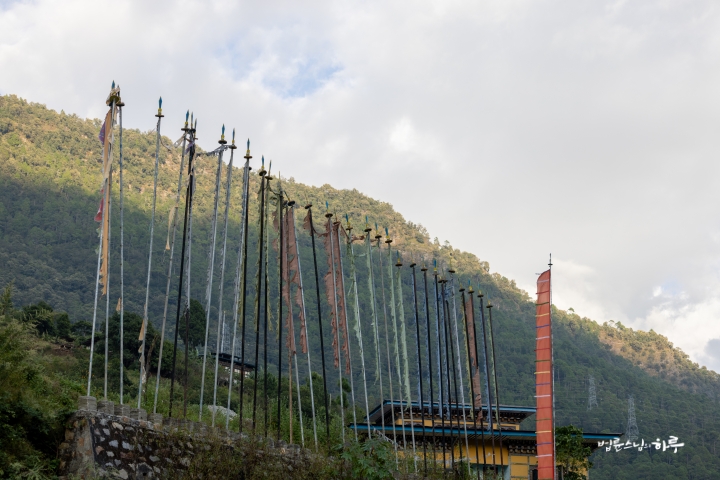
“Thank you.”
Tomorrow morning, Sunim will visit Nab Ji village and participate in rice harvesting with the residents. In the afternoon, he will meet with officials from Kolpu Gyeok, then travel to Panbang. In the evening, he is scheduled to meet with Governor Jemgang and other Bhutanese government officials.