For All Daily Life to Become Practice
Oct 14, 2024 - Opening Ceremony of the Semi-annual Retreat for Jungto Practitioners, Dharma Assembly for Leading Members, and Public ...
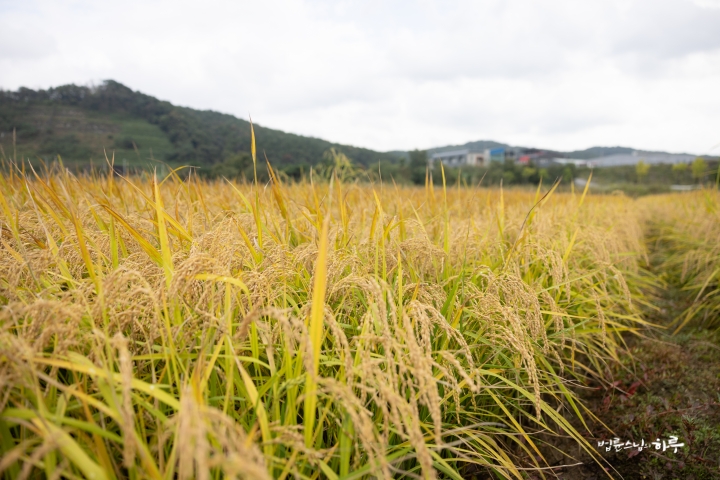
Good morning. A new day has dawned at the Dubuk Jungto Retreat Center. Today is the day when leading members gather in an online space once a month to listen to Sunim’s Dharma talk and engage in conversation.
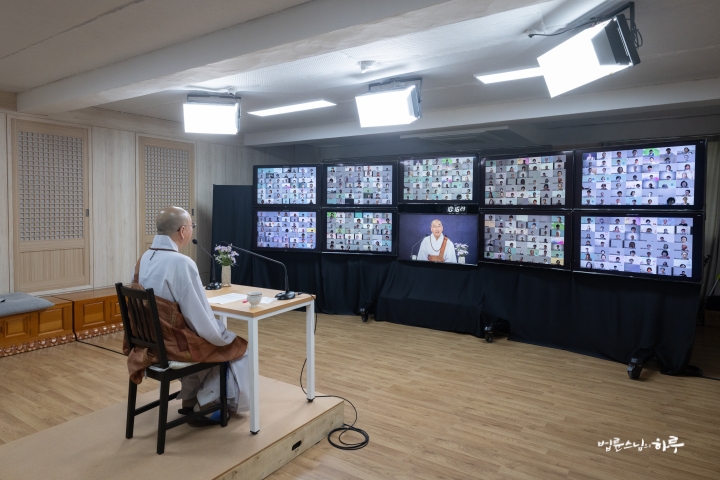
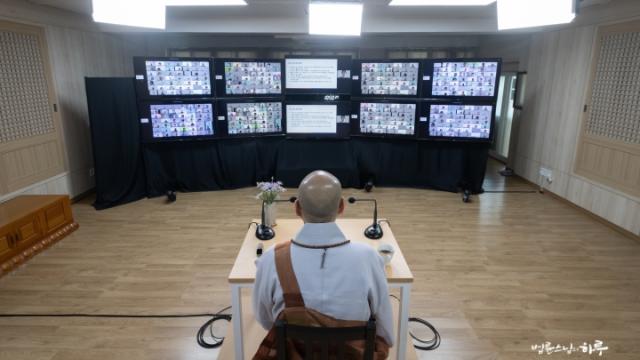
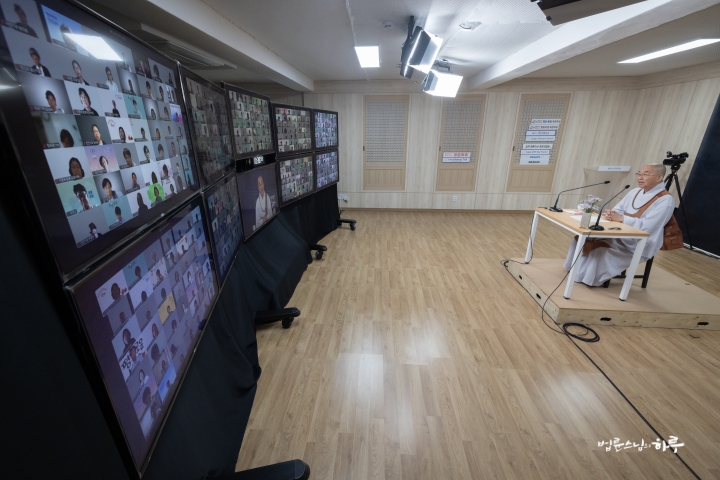
After completing his morning practice and meditation, Sunim took his place in front of the camera in the broadcasting room at 10 AM to conduct the Dharma assembly for leading members. Today’s assembly was planned to include the opening ceremony of the Semi-annual retreat for Jungto practitioners, a training program for Lay Member Group volunteers, and a public hearing for the development of Jungto Society.
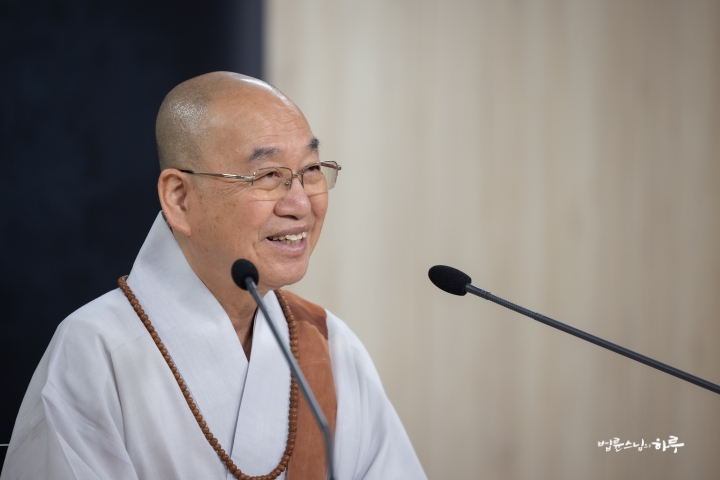
First, the Dharma teachers group presented the Semi-annual retreat training program, after which Sunim gave an opening Dharma talk on the mindset to adopt when approaching the Semi-annual retreat training.
The Season of Harvest: Recently Completed Projects
In particular, the construction of a school for Syrian children suffering from war and earthquake damage was completed after a year, and we held the completion ceremony the day before yesterday. This news was reported not only in Syria but also in dozens of places across the Middle East, giving great hope to many people. Many news reports contrasted images of buildings destroyed by bombings with the newly constructed large school.‘We hope that seeing new buildings rise in places that were reduced to ruins by destroyed buildings will inspire the Syrian people to overcome the damage caused by war and earthquakes and rise again with hope.’
We provided support with this hope, and it seems that our wishes are being realized to some extent.
Yesterday, I went on a pilgrimage to Gyeongju with about 800 Happy Citizens. We talked about how Silla, a small country located in the east, became the main player in our national history and achieved the dream of unifying the three kingdoms. We also took a walk through the autumn fields and engaged in conversations.
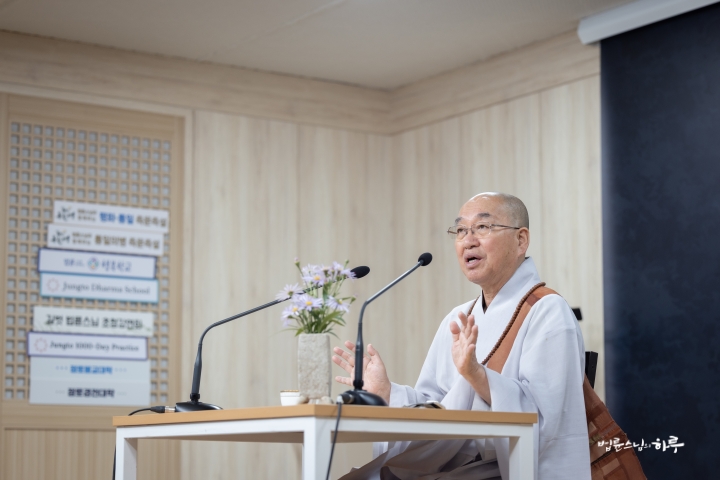
Rising from Failure Is Resurrection and Enlightenment
All new buildings are constructed on ruins like this. However, when we fail at something or things don’t go as planned, we often become frustrated or despair. We can rise above such failures, overcome frustration and despair, and be reborn anew. This is what Christianity calls resurrection and what Buddhism calls enlightenment.Jungto Society is a practice community. Rebuilding structures and engaging in social activities are not our main objectives. We should focus more on renewing our minds through these activities. Our goal in founding Jungto Society is to be reborn from the life of a foolish being to the life of a wise Buddha.
Therefore, whether due to natural disasters, social conditions, or family circumstances, the Buddha’s path is not about being swept away by surrounding conditions and suffering, but about actively responding to these conditions, adapting to the environment where necessary, improving what can be improved, and living as the master of one’s life. To follow the Buddha’s path, we must practice continuously. Practice means constantly reflecting on oneself to avoid being unknowingly trapped by one’s thoughts or swept away by one’s surroundings, and to be able to respond proactively. Practice is about being aware and observing so as not to become a slave to emotions and desires while being swept away by one’s karma, and instead becoming the master of one’s karma.
As we live, especially when trying to do something well, we often become attached to or caught up in external matters, missing opportunities to reflect on ourselves. That’s why Jungto Society holds the Semi-annual retreat practice twice a year, in spring and fall. Of course, we should practice being aware every day. However, the Semi-annual retreat practice is a program where we focus especially on reflecting on ourselves and practicing diligently. Although community members say they abandon everything and enter the practice site for intensive practice, in reality, apart from morning prayers, chanting, and formal meals, they work all day long. They may be dispatched overseas, conduct retreats domestically, or engage in various social activities – in a sense, they might be living even more worldly lives than you. While serving society in this way is good, it’s easy to lose one’s identity as a practitioner if not careful. So, no matter how busy, we set aside about three weeks in summer for ‘Angeo,’ where we put down all work and focus on meditation and the Semi-annual retreat practice to reflect on ourselves. Even if we can’t do a three-month retreat like monks, having these three weeks to focus solely on oneself allows us to continue our practice and service for a longer time.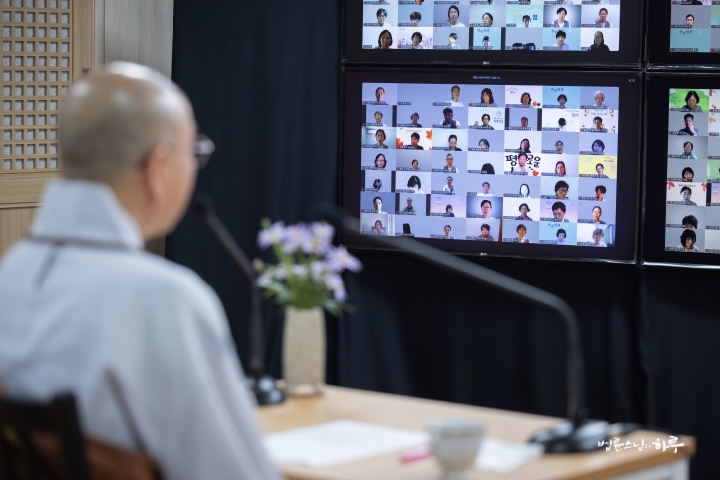
For All Daily Activities to Become Practice
When we’re working, we often say things like, “Let’s eat and then continue,” “Let’s rest and then resume,” or “Let’s sleep and then get back to it.” This is because resting is more efficient than continuing without a break. Eating is more efficient than working on an empty stomach. Sleeping and then working is more efficient than working without sleep. The point isn’t to focus on eating, sleeping, or resting as the goal, but rather to recognize that these activities are necessary for us to sustain our work. It’s not about resting because we’ve worked, or playing as a reward for our efforts, or sleeping because we’ve finished a task. Instead, we take breaks because they are essential for our overall well-being and productivity. That’s why we have sayings like “When resting, just rest,” “When sleeping, just sleep,” and “When eating, focus on eating.” In other words, rest isn’t about playing around; it’s an integral part of our work time. By adopting this practice-oriented perspective, all of our daily activities can become part of our practice.However, because we are not yet perfect, we often find ourselves getting caught up in our surroundings while working. That’s why during the Semi-annual retreat for Jungto practitioners, we should place more emphasis on practice. We prioritize practice, and if work gets delayed or we miss something, we accept it as it is. In our daily lives, we often finish our work before engaging in practice. But during the Semi-annual retreat, practice should be our top priority. This approach allows us to sustain our activities over the long term.
Why Practice Should Be the Top Priority
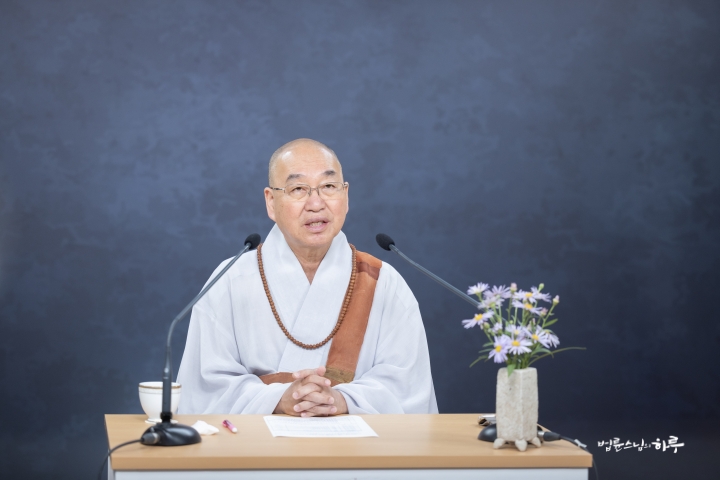
Among you, some consistently practice every morning, while others prioritize work and skip or completely neglect practice. You might make excuses that there’s no time for practice due to work. I understand the situation. However, if you neglect practice, you’re more likely to be swayed by afflictions. When faced with even minor difficulties, you’ll often find your mind wandering. But those who practice diligently can overcome any difficulty without being overwhelmed by it.Those who have neglected practice probably didn’t do so intentionally. It likely happened due to busy lives and work schedules. However, neglecting practice can easily lead you back to where you were before joining Jungto Society. So, at least during this Semi-annual retreat period, let’s prioritize practice above all else and give it a try.
When practicing alone, you’re limited to self-reflection. However, the Semi-annual retreat practice allows you to check your state with a Dharma teacher and receive feedback from fellow practitioners. This was highly valued even in Buddha’s time. When Ananda asked Buddha, “Isn’t having good Dharma friends half of the practice?”, Buddha replied, “Having good Dharma friends is the entirety of practice,” emphasizing the importance of fellow practitioners.
Time to Examine Ourselves Through the Eyes of Fellow Practitioners
However, even among fellow practitioners working together, conflicts are inevitable. If even married couples who love each other have conflicts, how can fellow practitioners avoid them? When conflicts arise, we often get caught up in emotions and forget that we’re Dharma friends. We might think, “Either I should quit, or you should.” But we must remember that we, imperfect as we are, have gathered to work for our neighbors and the world. Even if we have different preferences, thoughts, working styles, and methods, we should always remember that one, two, ten, a hundred, a thousand, or ten thousand such practitioners coming together can create the Jungto world we dream of.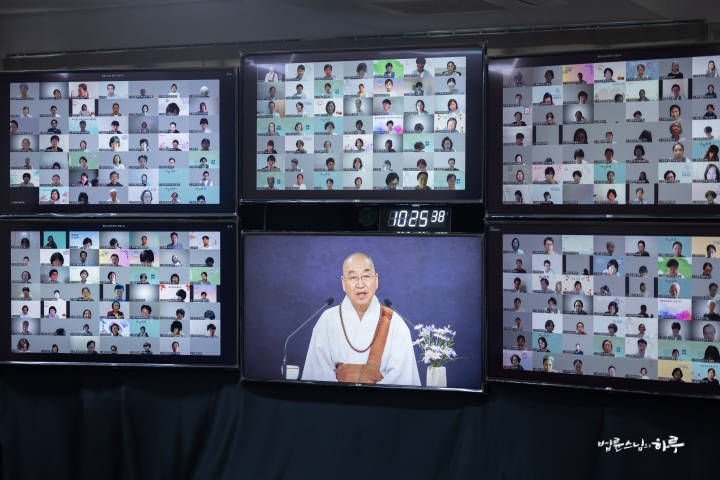
Although it’s becoming increasingly busy with various events, Sunim began the public hearing for the development of Jungto Society, reaffirming that practice should be the top priority above all else.
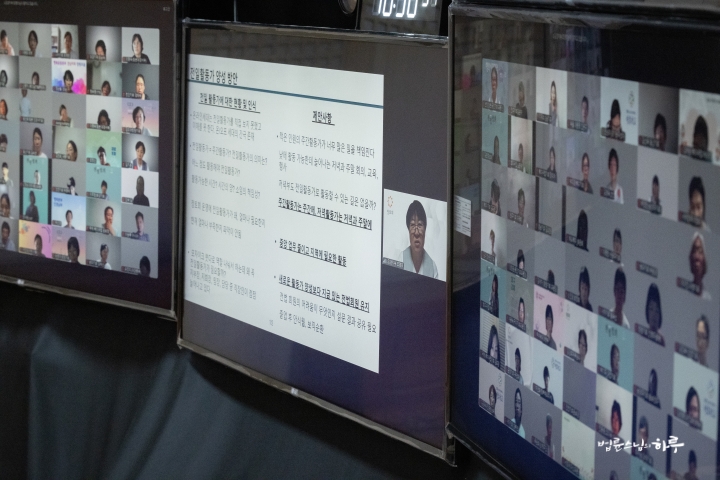
Each branch had a preliminary discussion on the topic “What should we do to break through Jungto Society’s stagnation?” First, the branch leaders presented the results of their branch discussions.
There were many proposals on various topics, including plans to revitalize the Jungto Social and Cultural Center, ways to nurture full-time volunteers who can take on practical responsibilities in various fields, and what each branch can do to support these efforts. After listening carefully to the discussion results, Sunim provided a summary.
Challenges Jungto Society Must Address for Continuous Development
However, the number of young people joining the community is decreasing, and with changing social trends, it has become difficult for the community itself to manage its current responsibilities. Activities such as conducting retreat programs, training sessions, producing ‘A Day in the Life of Sunim’, video editing, publishing, operating the Peace Foundation, and running JTS are still mostly handled by community volunteers. While lay members are involved in many activities, such as running the Buddhism Course and Sutra Course, most of Jungto Society’s social activities are still managed by community volunteers.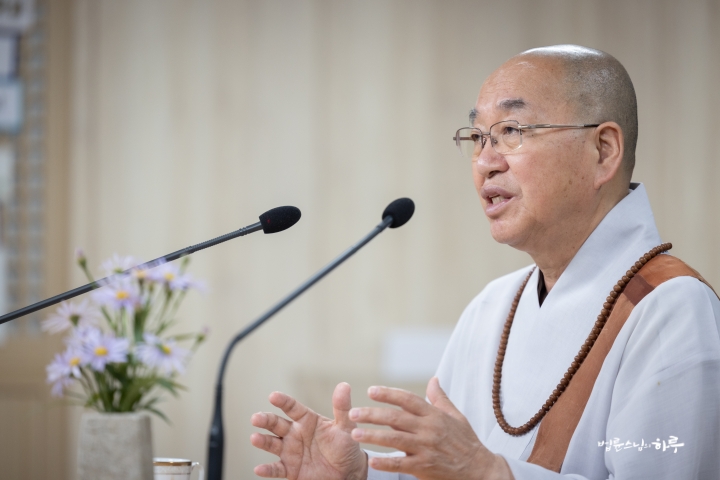
The biggest problem here is that we lack even the minimum number of necessary full-time volunteers. We’re not aiming to run Jungto Society primarily with full-time volunteers, but we’re struggling to find solutions because we lack even the minimum required number of full-time volunteers.
One current alternative is to solve the problem by hiring paid employees. Right now, 150 volunteers are involved in running the Jungto Social and Cultural Center. If we hired about seven paid employees, they could do all the work that 150 volunteers are doing. We could immediately solve the problem by hiring paid staff for various tasks you’ve suggested, such as ‘conducting weekend meditation programs’ or ‘holding children’s Dharma assemblies’. We could run even more diverse programs that you desire. If we hired paid staff for video filming and editing or book publishing, we could also engage in many profit-generating activities. If we hired paid employees for positions like JTS Secretary General or Peace Foundation Secretary General, all our staffing issues would be resolved. From an efficiency standpoint, hiring employees would be the quickest solution.
However, Jungto Society established a principle from its founding not to hire employees. This is because Jungto Society is a community of practitioners. Therefore, without hiring, there are two types of people who can become full-time volunteers. One is those who have entered the monastic life and live in the community, and the other is those who, while living at home, work for Jungto Society as if it were their regular job. People holding positions like Executive Director or Department Head fall into this category. As Jungto Society grows, the number of such personnel should increase accordingly, but the current problem is that it’s decreasing. This public hearing was organized to devise strategies for this issue. One solution could be to have more young people enter monastic life to supplement this area, but given the current cultural trends in Korea, this possibility is very low.
The third alternative involves housewives who don’t necessarily need to work outside the home. Although their numbers have decreased compared to the past, they still exist. Additionally, some people have specialized jobs that allow them to work online without commuting. Some of these individuals could fully participate in Jungto Society activities. To secure such personnel, it’s important for people to interact and inspire each other through offline activities. It might be difficult to find such committed individuals through online connections alone.
How to Complement Online Jungto Society with Offline Programs
For this reason, a proposal has been made to pilot an offline Jungto Dharma School at the Jungto Social and Cultural Center. As you worry, we don’t know yet whether it will fail due to not matching social trends, or if there will be a minority interested in participating precisely because of those trends. We can only reach a conclusion by experimenting.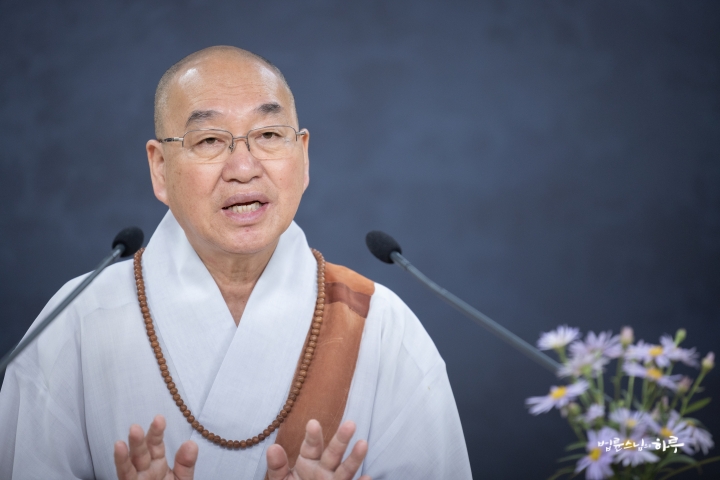
Following this, time was given for asking questions that arose during the discussion process or sharing additional suggestions.

Questions, answers, and discussions continued for two hours. It was decided that the content discussed today would be gathered by the executive unit to prepare another proposal, and with that, the public hearing concluded.

Combining the opening ceremony for the Semi-annual retreat and the public hearing, three hours had passed. The Dharma assembly for leading members concluded just after 1 PM.
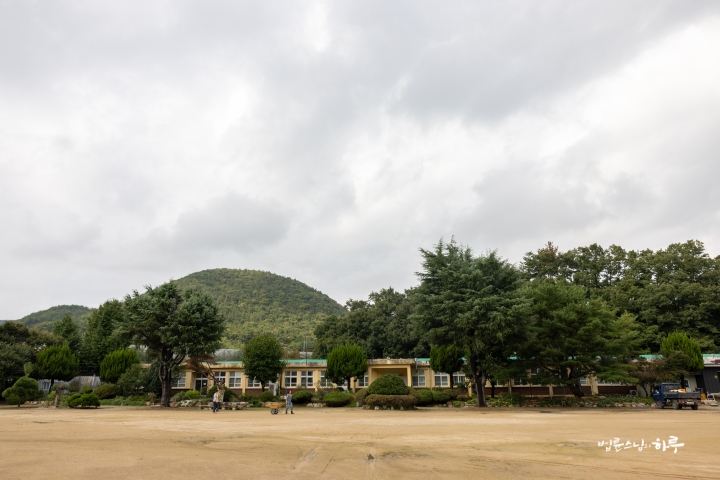
In the afternoon, autumn rain continued to fall. Sunim, feeling under the weather, rested indoors while attending to work.
As the sun set, at 7:30 PM, the Dharma assembly for leading members of the evening session began. Like in the morning, the Jeongil-sa opening ceremony was held first, followed by a public hearing for the development of Jungto Society.
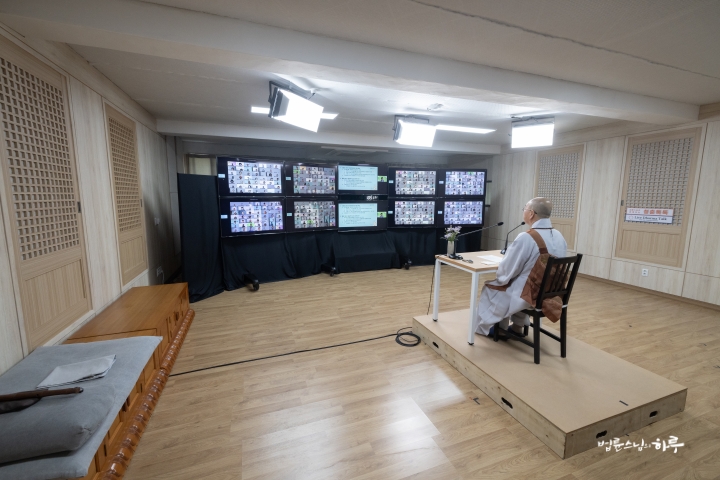
Each branch presented their discussion results, and then eight people asked Sunim questions and engaged in dialogue about their curiosities. After sufficient conversation and no more questions, Sunim gave concluding remarks.
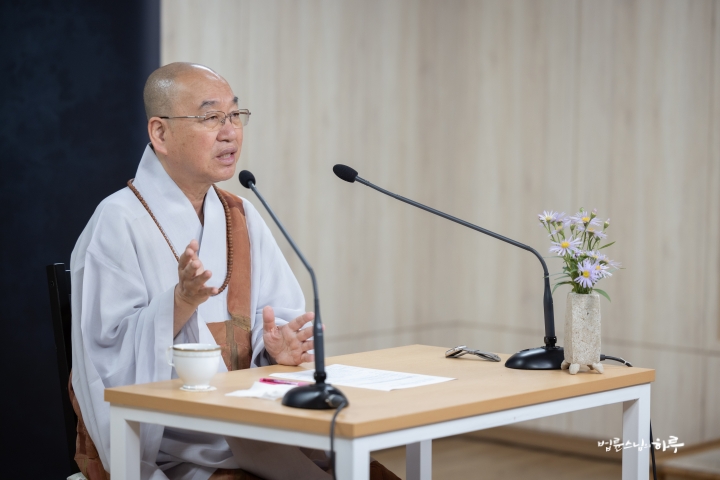
By the time the live broadcast ended, it was nearly 10 PM.
Tomorrow, Sunim plans to spend the entire day sightseeing around Gyeongju on an autumn outing with the mildly disabled residents of Geoje Aegwonwon.