A Person with a Deep Vow Is Not Easily Shaken
Jun 27, 2026 - Dharma Q&A for Introduction to Buddhism, Peace Foundation Tongil Euibyung Assembly
Hello. Today, Sunim held a Dharma Q&A for Introduction to Buddhism and attended the Peace Foundation Tongil Euibyung Assembly. After his early morning practice and meditation, Sunim revised some manuscripts and then moved to the studio to conduct the Dharma Q&A for Introduction to Buddhism.
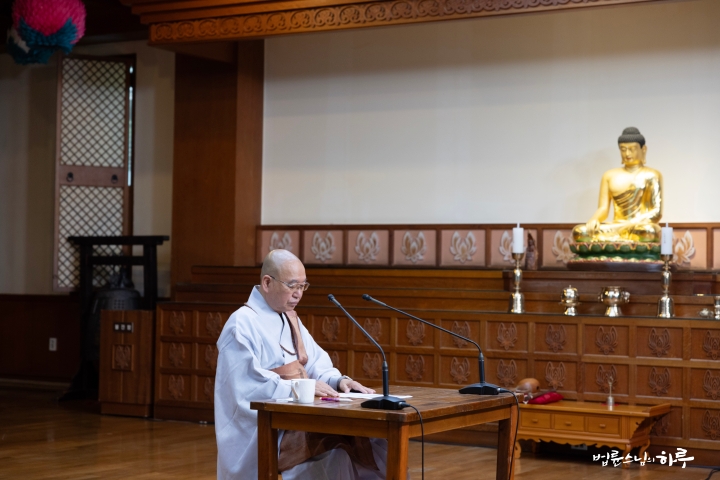
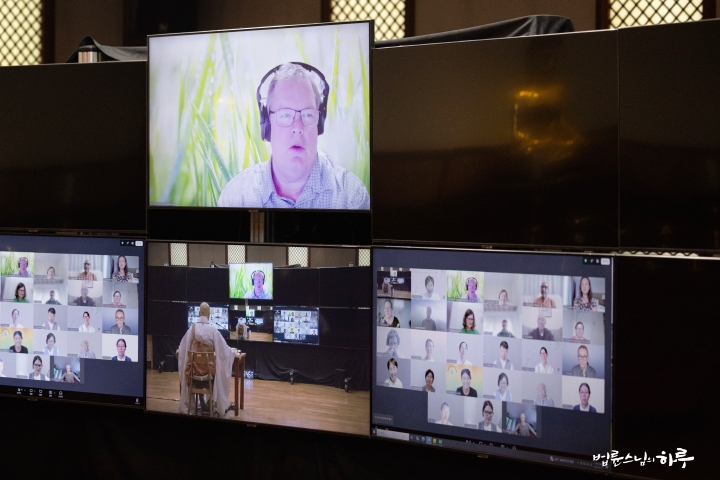
With 11 students from Introduction to Buddhism connecting online from various locations including the United States, Australia, and Canada, the Dharma Q&A on foundational Buddhism began.
Two students shared their reflections on studying at the Jungto Dharma School.
"'A life-changing experience'—that is how I would describe Introduction to Buddhism I in one phrase. Although I have only recently begun my practice, the Buddhist teachings I have learned in this course have greatly helped me see things as they are and understand how the human mind actually works. Through the weekly Dharma assemblies, daily sharing activities, and meditation, I have come to hope that it might be possible to live without suffering.
As a teacher myself, I could feel how much thought and care went into designing the Jungto Dharma School curriculum. The textbook is only 145 pages, but it contains wisdom deep enough to study for a lifetime.
Sunim's analogy that we should be 'players on the field, not spectators watching the game' has always stayed with me. Simply knowing the Dharma is not enough; we must become people who practice the teachings. Actually putting them into practice has been far from easy. That is why steady practice is necessary.
I sincerely thank the facilitators who always show thoughtfulness and sincerity. After every weekly Dharma assembly, I find myself feeling lighter and more at peace.
Recently, I watched a video about Venerable Pomnyun Sunim. He said, 'Become a person this world truly needs.' I, too, want to deepen my understanding and practice of the Buddha's teachings, and through a life shared with Jungto Society, become 'a person this world truly needs.' Thank you for listening."
Andrew's reflection, shared from Australia, brought to life the teachings found in the book with a moving sense of vitality. After the students' reflections, the Dharma Q&A began.
"Hello, students of the Jungto Dharma School. I listened carefully to both reflections. Thank you for sharing what you have learned and felt."The Way to End Suffering Learned Through Foundational Buddhism
"The Jungto Dharma School is largely divided into two parts. The first part teaches 'how the Buddha's teachings guide us to a state free of suffering, namely Nirvana.' The three core concepts are: the Middle Way (中道), which addresses 'how to practice'; Dependent Origination (緣起), which reveals 'what the truth of this world is and how things actually are'; and Nirvana (涅槃), through which 'I can reach a state free of suffering.'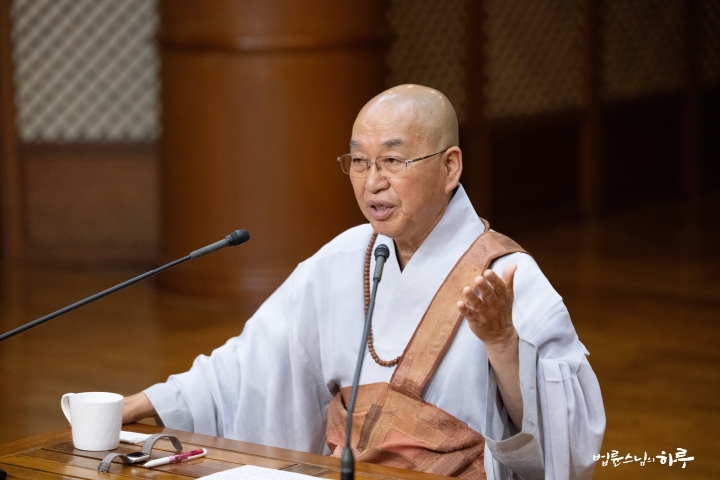
Concrete Methods of Practice Learned Through the Buddha's Life
However, the fundamental principles of Buddhism alone cannot fully address the real-world problems we face today. So, in the second part, we study 'the life of the Buddha.' We examine, through specific examples in the Buddha's life, how a person free of suffering lived within a society that held many problems. The representative social problems that caused people suffering during the Buddha's time were gender discrimination and the caste system of class discrimination. To address gender and class discrimination, the foundational teachings of Buddhism—the Middle Way, Dependent Origination, and the Four Noble Truths—are not enough on their own. To understand specifically how a practitioner, one who has attained Nirvana, or an enlightened being viewed gender and class discrimination, and what they did to improve those conditions, we must look at the Buddha's life. The mere results—'he discovered the Middle Way,' 'he realized Dependent Origination,' 'he attained Nirvana'—do not reveal the process of solving the problem. We can only understand the process and the trials that led to discovering and realizing the Dharma by examining the Buddha's life.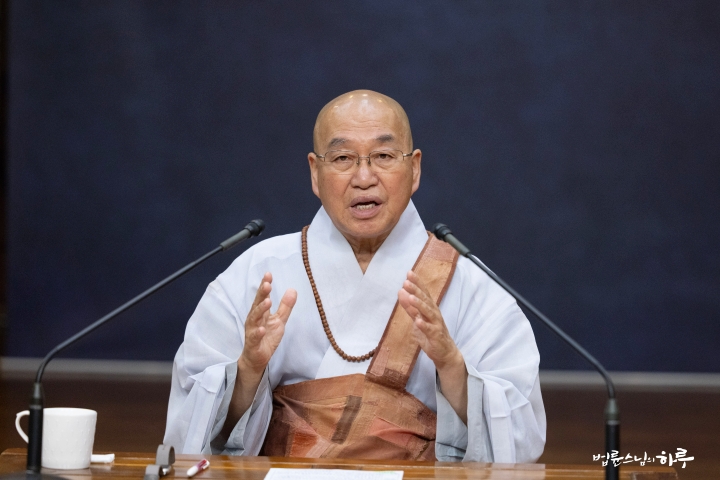
The Jungto Dharma School: A Place to Learn Buddhism as Practice
However, terms used in Indian traditional thought and those used by the Buddha sometimes share the same words but carry different meanings. For example, in Indian tradition, the term 'Karma' is often used to mean 'fate' or 'that which is destined.' In Buddhism, however, it means 'that which is formed' or 'that which has become habitual.' In other words, while the Indian tradition uses it as an unchanging concept meaning 'innate,' in Buddhism it carries the meaning of 'created,' and therefore 'capable of being extinguished.' In the traditional Indian concept, the term 'samsara' (輪迴) means 'a person dies and is reborn.' In Buddhism, however, it refers to 'the phenomenon of suffering and pleasure repeating themselves,' meaning that suffering arises again. To summarize, Buddhism as a religion often uses terms with the same meaning as in Indian traditional thought. On the other hand, Buddhism as practice uses the same terms with different meanings. At the Jungto Dharma School, we explain the Buddha's teachings to you from the perspective of practice. Buddhism as practice has a very clear goal: living daily life with less stress and without suffering, sadness, or anxiety—that is, reaching Nirvana. Therefore, whatever you believe or whatever philosophy you study is a matter of personal freedom. Belief, or religion, broadly speaking, is part of culture. Since cultures are different and diverse, we simply need to maintain a perspective that respects other cultures."After the keynote Dharma talk, three people asked questions. One of them said that doubts arose after observing the behavior of a monk at the temple she attends.
Does a Dog Have Buddha-Nature?
"This has nothing to do with whether a dog has Buddha-nature. And this is something that can be accepted. Because this is that person's individual preference, that is, his attachment. It is simply one person's preference, unrelated to the Buddha Dharma."A monk is completely absorbed in his pet dog. He takes the dog everywhere, constantly takes photos of it, buys treats, dresses it in clothes, and even allows the dog into the Dharma hall where funeral rites and various Buddhist ceremonies take place. Is this behavior acceptable? Does a dog have Buddha-nature?"
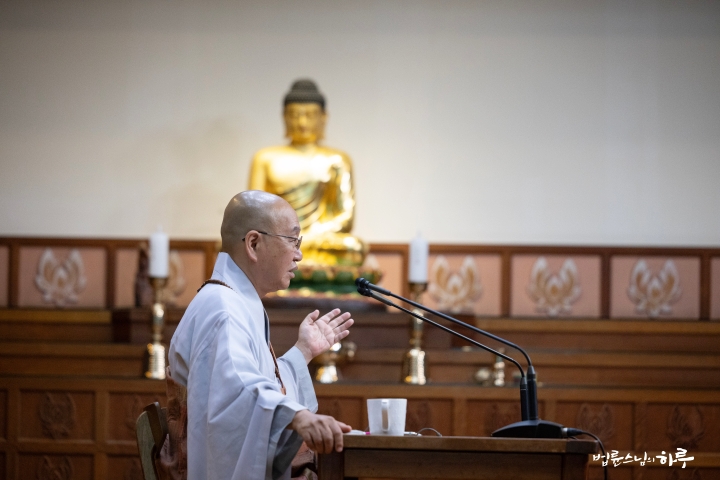
"Then is it acceptable for a practitioner to have attachments?"
"As a practitioner, what matters is that I do not have attachments. Whether someone else has attachments is not my concern. That is his issue. In other words, when a couple meets, likes each other, gets married, and finds joy in raising children, that is a kind of attachment, isn't it? When attachment is strong, suffering is great; when attachment is weak, suffering is small; when there is no attachment, suffering disappears. You are experiencing affliction because you hold the thought, 'A monk is a practitioner, so shouldn't he be free of attachment?' Though he has shaved his head and wears monastic robes, he is still just a person. Traditionally, keeping pet animals goes against the precepts of a practitioner. However, today, things are gradually changing in a direction where personal hobbies or preferences are not seen as a major issue. For instance, the clothes I am wearing are called a practitioner's robes. But to put it more accurately, they are closer to ceremonial religious attire. Originally, the basic spirit of a practitioner's clothing was to pick up and wear discarded garments. However, the color and shape of the clothes that practitioners wore in the Buddha's time have now become a kind of uniform. Nowadays, many people make these robes from silk or other luxurious fabrics. Though the form of the clothing may appear the same as in the past and present, the spirit behind it has changed. Today, it is more like an upscale uniform for religious figures than a practitioner's garment. The same is true for temples. Practitioners originally slept under trees or in caves. Over time, the people, recognizing practitioners as worthy of respect, began building structures for them. So, if you look at large temples, they are built to resemble royal palaces. The Vatican and the great cathedrals of Europe also resemble royal palaces, don't they? So while we call temples places of practice, in reality they have become large and luxurious buildings. If I apply the standard 'a practitioner must live this way to uphold the Dharma' to myself and live by it, my suffering decreases, and that becomes upholding the Dharma. But if I apply it to others, saying, 'You're a practitioner—why don't you live like one!' then I am engaged in judgment and discrimination, and I am missing the perspective of a practitioner.""Yes, I understand well."
After the conversation ended, the questioner's voice sounded noticeably lighter and more cheerful. Two more questioners followed.
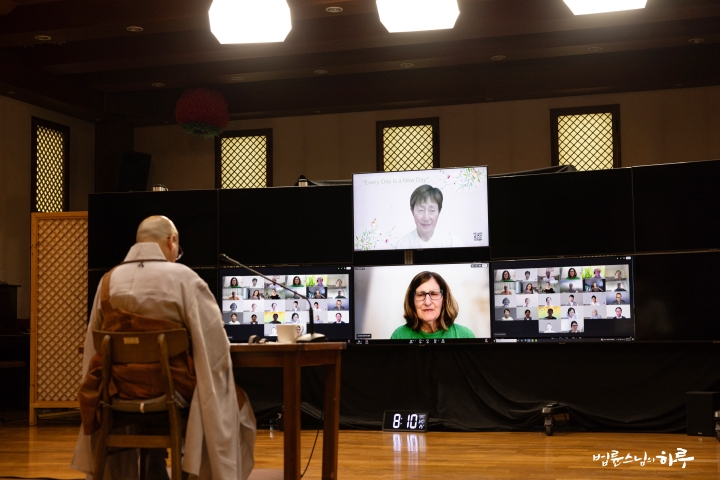
▪ My grandmother, who was like a mother to me, passed away five years ago. I regret the harsh words I said to her while she was alive and that I couldn't even say a proper goodbye, and it causes me great suffering.
▪ Is it possible to deeply connect with and love someone without attachment?
When the English Dharma Q&A ended, Sunim moved straight to the Peace Foundation. From 10:20 a.m., the Peace Foundation Tongil Euibyung National Assembly was held.
In the 9th-floor auditorium, several volunteers had arrived early to prepare for the event, and a rehearsal was in full swing. This time, there were 12 new Euibyung members, which seemed to greatly encourage the existing volunteers; a lively energy filled the room as preparations for the assembly continued.
First, there was a pre-performance by a young Euibyung, who appeared to be the youngest among the Tongil Euibyung.
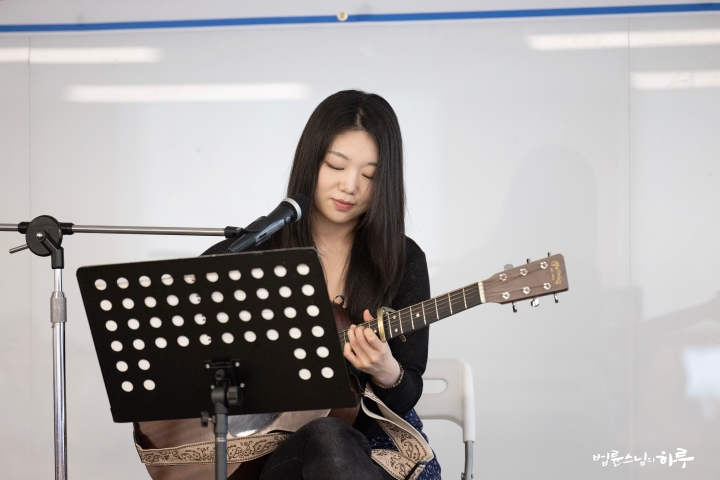
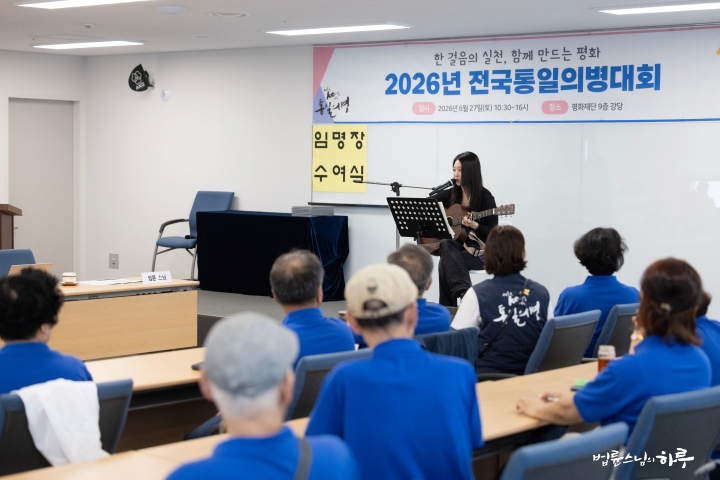
She sang Yang Hee-eun's song "Evergreen Tree" along with one other song, with beautiful vocals accompanied by acoustic guitar.
"Though what we have is little, hand in hand we shed tears together. Though our path is long and rough, we will break through and ultimately prevail."
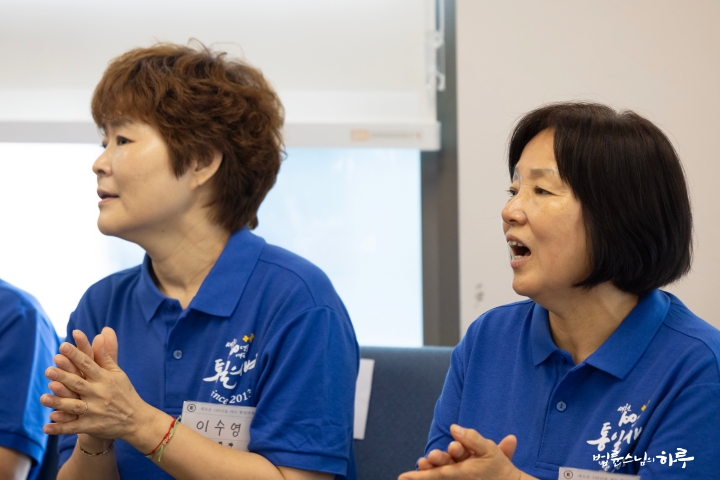
The Euibyung members, who had been quietly listening, began to sing along, and the atmosphere became one of unity as everyone poured their hearts into the lyrics.
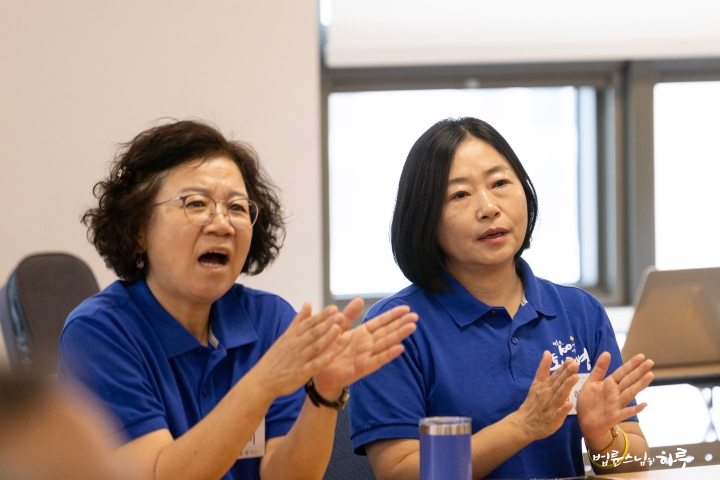
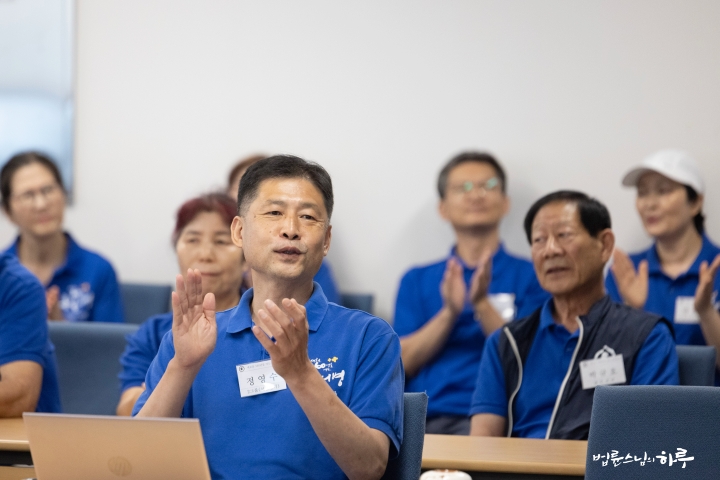
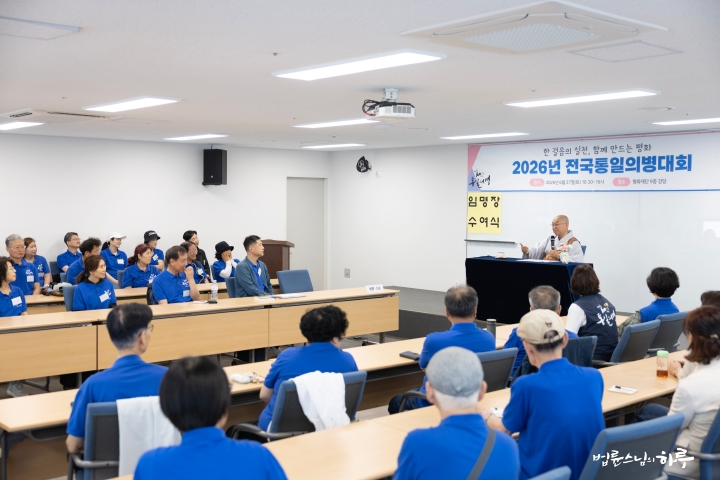
By the time the pre-performance ended, a large crowd had gathered. Finally, with about 60 Tongil Euibyung members from across the country in attendance, the Peace Foundation National Tongil Euibyung Assembly began, hosted by Lee Won-kyung (이원경).
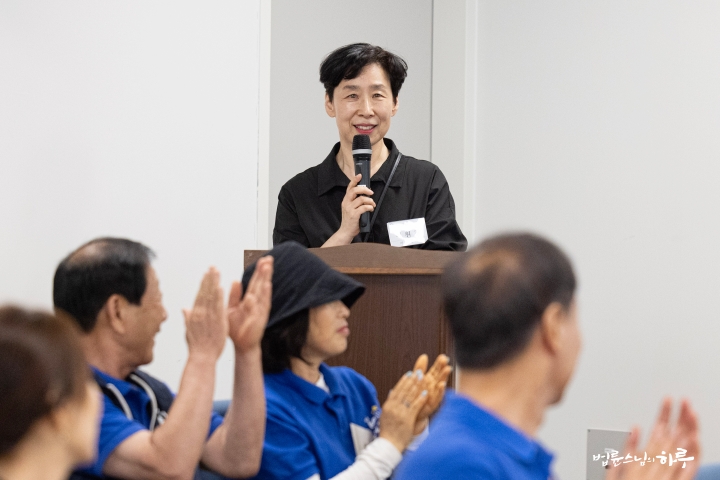
After everyone watched a video reviewing the first half of the year's activities and two new Euibyung members read their reflections, it was time for the appointment ceremony for the new Euibyung. Sunim was to personally present the certificates of appointment.
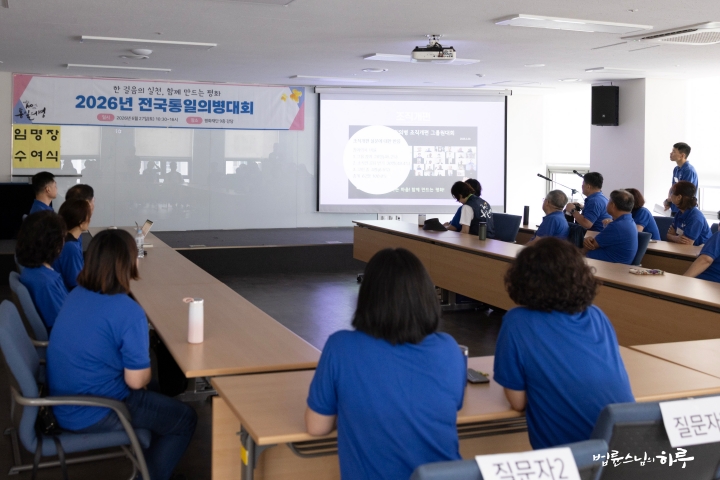
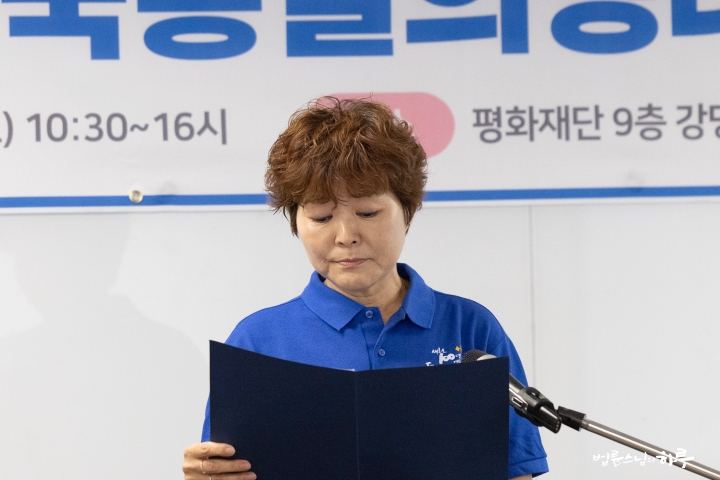
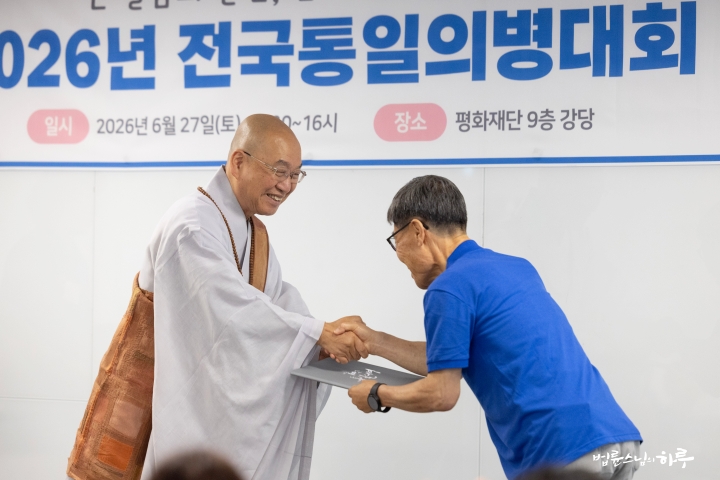
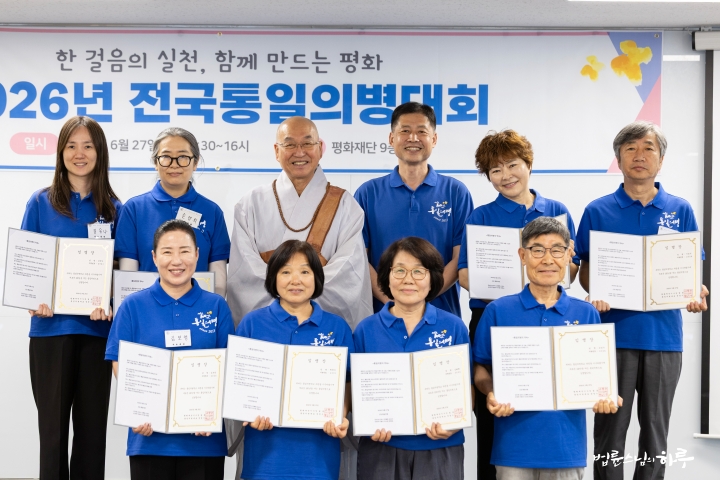
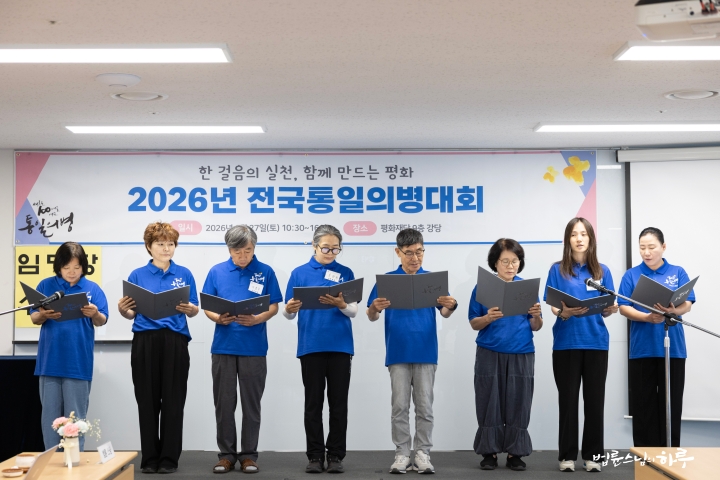
The Euibyung members who received their appointment certificates read aloud the Tongil Euibyung Pledge on stage with serious and earnest expressions.
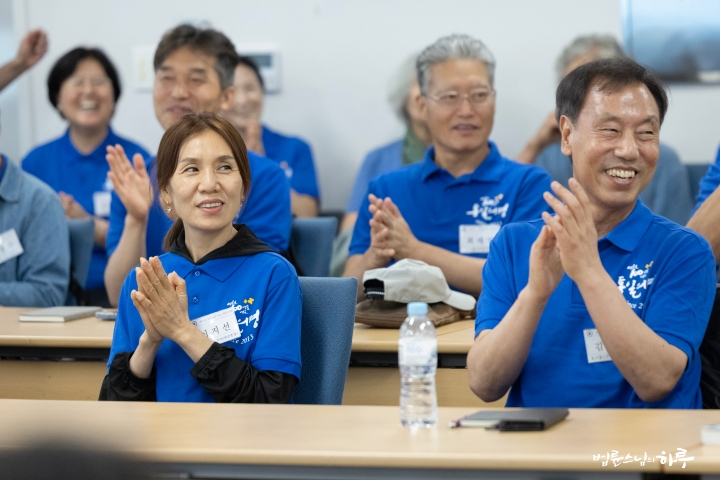
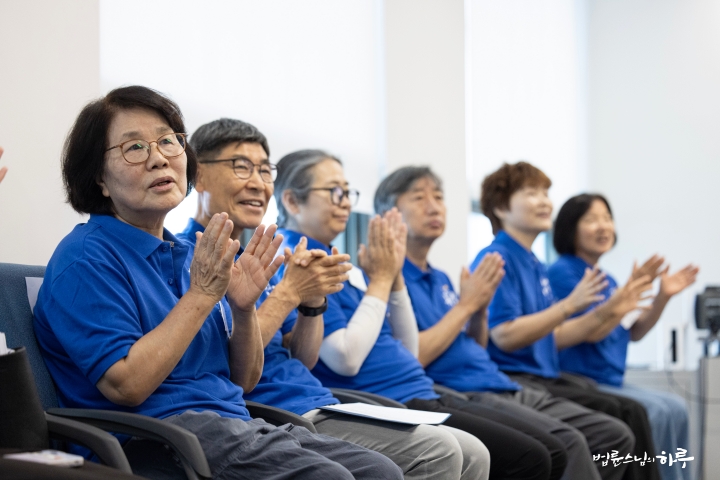
Then came Venerable Pomnyun Sunim's Dharma Q&A. With applause from the Euibyung members, Sunim stepped onto the stage.
An Increasingly Precarious International Situation
Four years ago, when Russia invaded Ukraine, the international community fiercely condemned it, asking, 'How can a great power invade a neighboring country?' Since then, Israel, a member of the so-called free world, carried out a massacre in Gaza, which shocked us deeply. And now, the United States has invaded Iran, delivering an even greater shock than the previous wars. It seems that the role of 'supervisor' or 'police officer' that once spoke of justice and morality in the international community has effectively disappeared, and we may be entering an era dominated solely by the logic of power. Now, even if China were to invade Taiwan, no one would readily condemn it, and we cannot help but anticipate that an era judged solely by power has arrived.The Path to Achieving the Happiness of the People and the Safety of the Nation
Currently, our dream on the Korean Peninsula is reunification. However, reunification in the future society cannot be thought of merely as unifying political systems as in the past. Now, more important than political unification is 'how we will share cooperative systems, including supply chains.' In that sense, bringing peace first is what matters. Then, the important question becomes whether to leave North Korea to be incorporated into the systems of China and Russia, or to guide it toward cooperation with us. However, contrary to our wishes, U.S. policy has not only pushed North Korea into Russia's arms but is now pushing it further into China's. If things continue this way, it could cause serious difficulties for our national security. Looking back, 2012 was our last chance to decide whether we would move toward reunification or continue maintaining the divided system. Unfortunately, we missed that opportunity. Now, rather than reunification, we must focus first on achieving peace; however, given the current developments in Northeast Asia, even that does not seem easy. Yet, the people are more focused on small immediate gains than on the stability of society. They cling to small claims and opinions, fueling division and conflict. Our society holds many possibilities and strengths, but it also carries great risks and difficulties. At times like these, rather than insisting on a single approach, we must actively respond to changing circumstances. In that context, our dream should now be the happiness of the people and the safety of the nation. We have pursued peace as a means to achieve the happiness of the people and the safety of the nation, and we have further aspired to reunification. Currently, North Korea defines inter-Korean relations as 'two states,' and even further as 'hostile states.' It has erased the terms 'reunification' and 'nation' and abolished the departments that connect inter-Korean relations. In such a situation, talk of 'improving inter-Korean relations' or 'reunification' from the South inevitably sounds very hollow. It may bring great despair and frustration to many who have worked for reunification. In this situation, continuing to advocate reunification could even sound like a call for the two Koreas to fight again. If that happens, the reunification movement could rapidly weaken and become a hollow shell.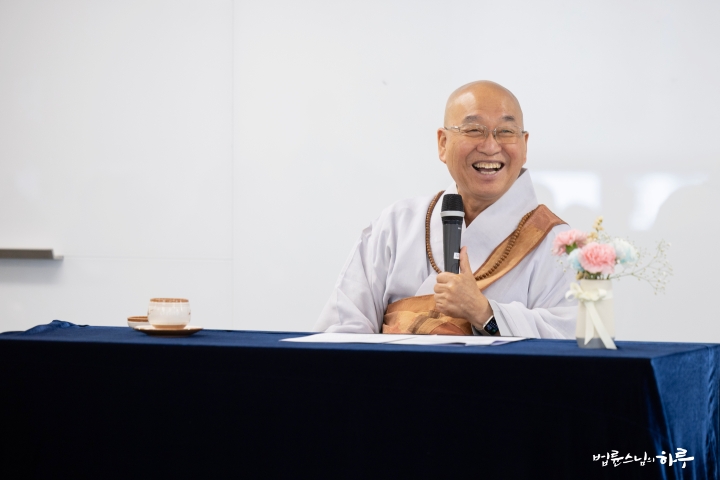
The Tongil Euibyung Continues Steadily, Adapting to Change
What we must remember is that 'changes in circumstances' cannot be assumed to remain the same next year or ten years from now. Just as we could not predict the current situation ten years ago, the situation ten years from now is also not easy to predict. Therefore, a person with a vow is not easily shaken by such changes in circumstances. Holding fast to the great vow we have set, we must steadily continue our activities, responding to changes like the seasons—reducing outdoor activities when winter comes and increasing them when spring arrives. If your goal and will are clear, even when the external environment changes, only the manner of response shifts slightly; the work we wish to do can continue steadily. However, if the goal and will are not clear, you will repeatedly swing between being easily elated and easily depressed, depending on the situation. So, do not be too constrained by circumstances; what is more important is to continue activities steadily and broaden the base. A farmer is not without work just because it is winter. Throughout the winter, the farmer prepares for next year's farming, so that when spring comes, the work can begin immediately. Likewise, the changing environment may bring difficulties to our activities, but it can also be an opportunity to strengthen our vow even more firmly. So, do not be discouraged. I urge you to steadily continue the vow you first set."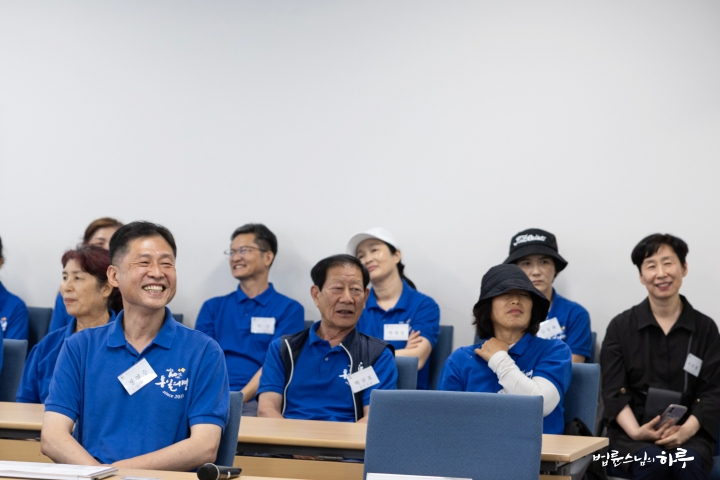
Then, questions from the audience followed.
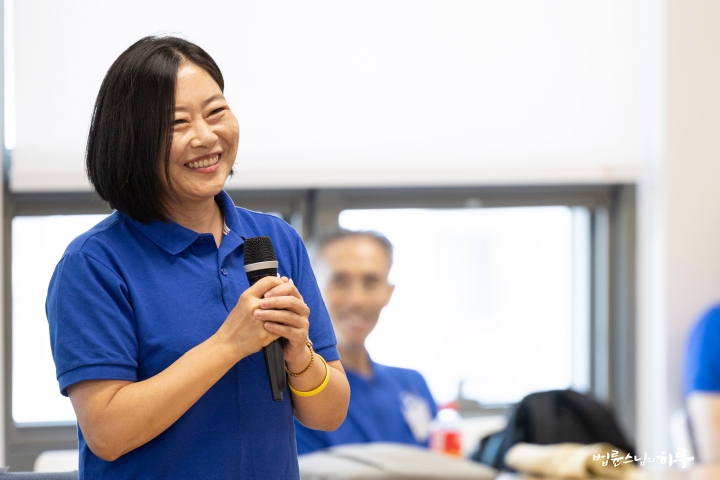
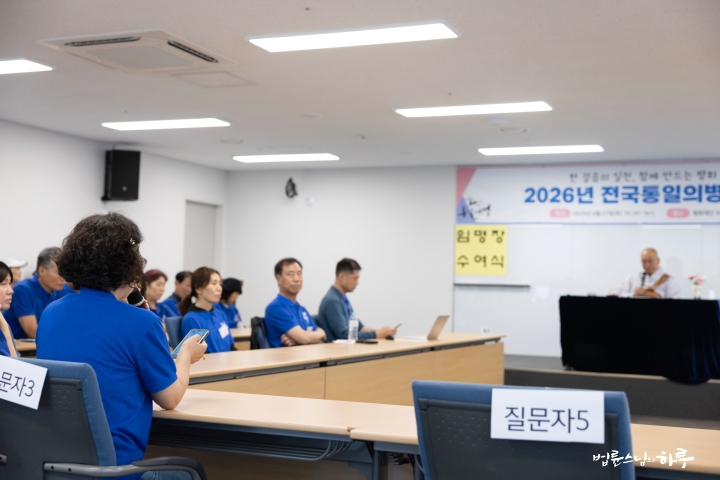
▪ Since last year, the number of former Jungto Society volunteers entering the Peace Foundation Tongil Euibyung School has been increasing. As the leader of the Peace Foundation Tongil Euibyung, how should we view this phenomenon?
▪ When middle-aged and older generations begin to learn and take on the challenges of the AI era, what do you think is the first mindset they should let go of?
▪ How should we understand events that defy democratic common sense occurring throughout our society, such as the ballot shortage on June 3?
▪ How has the Republic of Korea's standing and international relations changed from 2012, when the Tongil Euibyung was first launched, to now? What preparations should society make to seize the opportunities that lie ahead?
▪ Under the severed inter-Korean system, can the Korean government cooperate with Russia and China to create a process for preventing war?
Through the questions, which carried concerns about society and worries about national security, the hearts of awakened citizens could be felt.
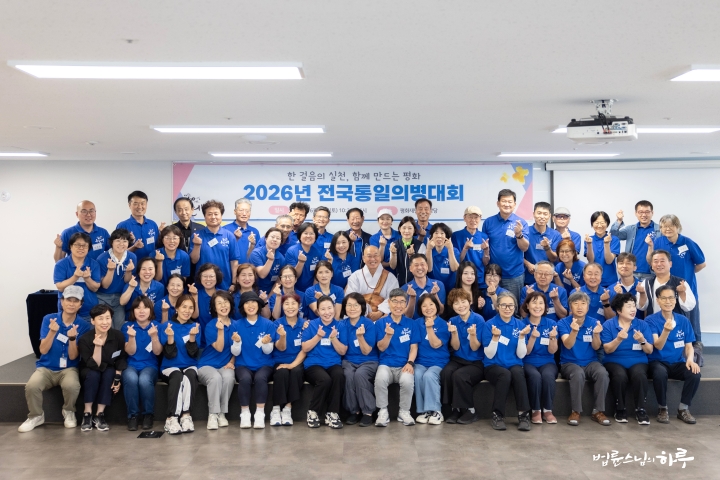
By the time the Dharma Q&A with the Peace Foundation Tongil Euibyung ended, it was nearly 1 p.m. Sunim had lunch and packed his bags for the trip to Sri Lanka.
From 6 p.m., a meeting on the Sankassa Dharma project was held on the second floor of the Jungto Dharma Center. The meeting was to arrange the placement of the lodging, auditorium, and stupa to be built on the Sankassa Dharma project site, and to revise the interior design of the lodging.
As the meeting was wrapping up, volunteers who had been working in Bhutan arrived in Korea and came to greet Sunim.
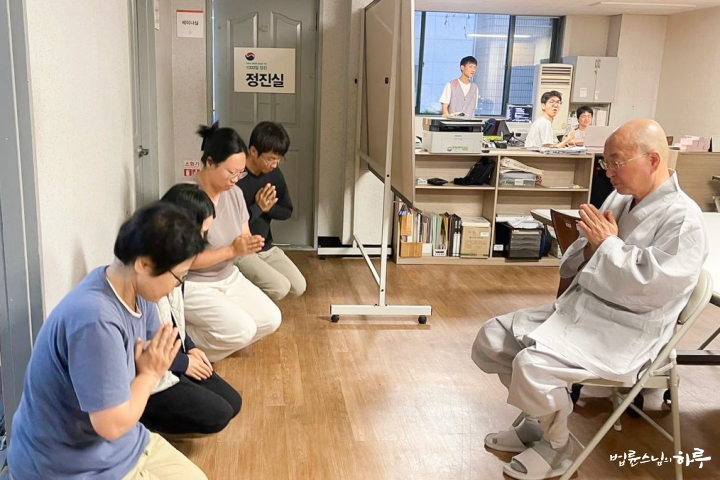
Sunim took the volunteers, who had returned after their hard work, out to a Chinese restaurant for dinner. After sharing the evening meal with the volunteers, Sunim returned to his lodging, reviewed the day's tasks, and concluded the day.
Tomorrow, the 2-2 Opening Ceremony will be held, along with the Members' Day of the Western Branch.