I Keep Nagging My Father Who Is Battling Cancer.
Jun 26, 2026. Meetings, Happy Dialogue Lecture in Ansan
Hello. Today, Sunim had meetings at The Peace Foundation and a Happy Dialogue lecture in Ansan.
Sunim began the day with early morning practice. At 9 a.m., he went to his office to attend to administrative work.

At 9:30 a.m., Sunim handled bank card issuance matters, and at 10:30 a.m., the head of the Nowon branch of the Seoul West District of Jungto Society and the newly elected Mayor of Gangbuk-gu came to greet Sunim.
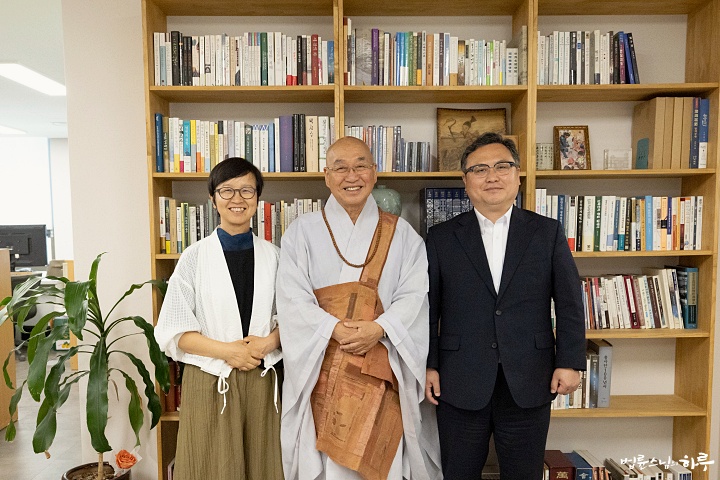
After lunch, Sunim held a meeting with staff members of JTS and the International Cooperation Team.
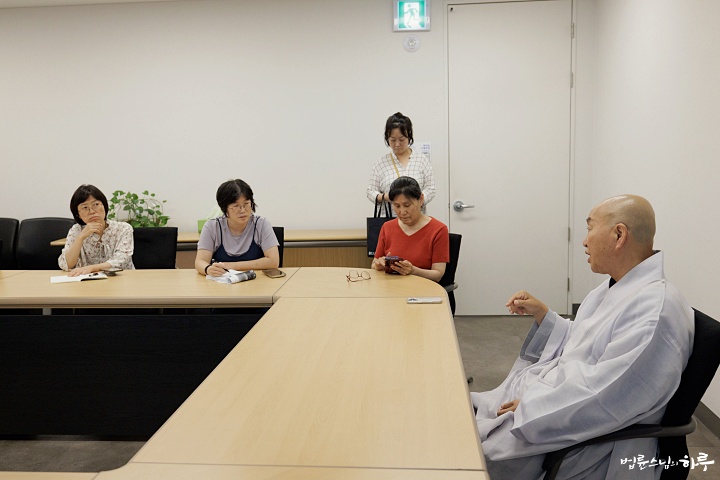
Sunim discussed with the staff how to utilize and distribute the video showcasing the first-year achievements of the Bhutan project, and talked about expanding the Bhutan sustainable development model to Southeast Asia. They also discussed informing previous INEB visitors to Jungto Society and activists from countries with existing connections about sustainable development projects, and considered a plan to accept project applications from those who agree with this sustainable development approach.
At 4 p.m., a prominent social figure visited Sunim for a meeting. As soon as the meeting ended, Sunim headed straight to the lecture venue in Ansan without a moment to catch his breath.

Around 7 p.m., Sunim arrived at the Happy Dialogue lecture venue at the Erica Campus of Hanyang University.
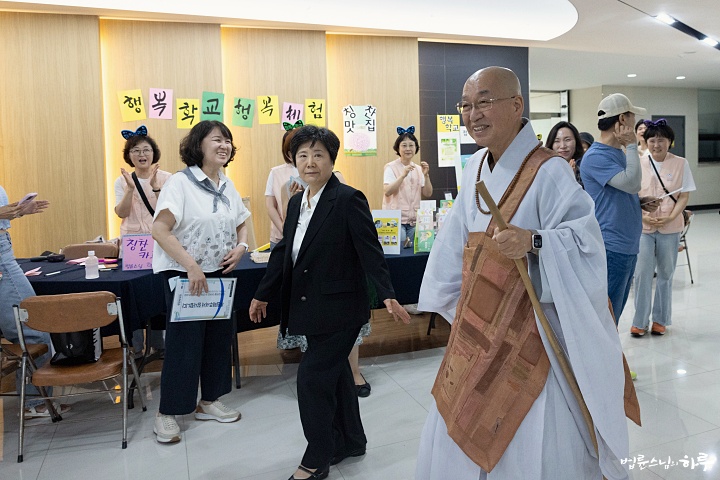
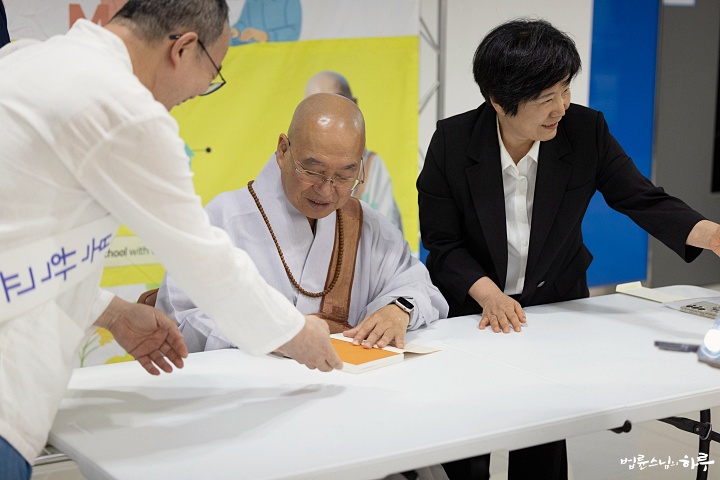
Sunim greeted the volunteers who had prepared the lecture and, in the waiting room, signed books to be given to guests.
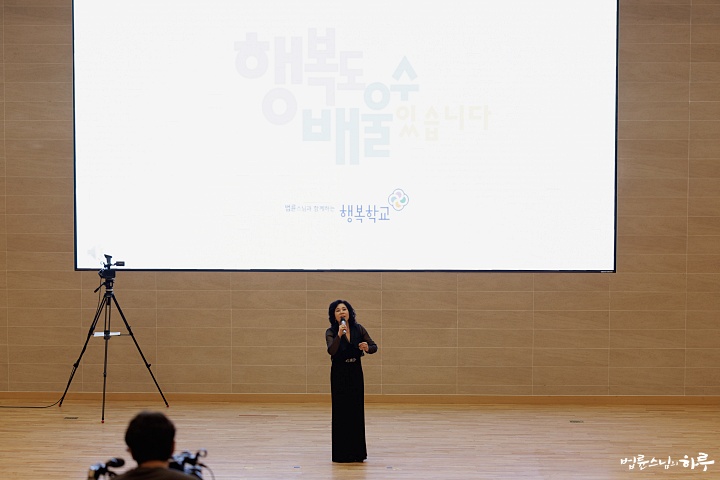
From 7:15 p.m., Kim Mi-ra, the lead vocalist of the Tikitaka Band, took the stage and passionately performed Patti Kim's "You, My Friend" and Han Young-ae's "Is Anybody There?" earning enthusiastic applause and warm responses from the audience. Kim Mi-ra expressed that it was an honor to be invited to Sunim's lecture and said that she and her husband would stay until the end of the lecture.
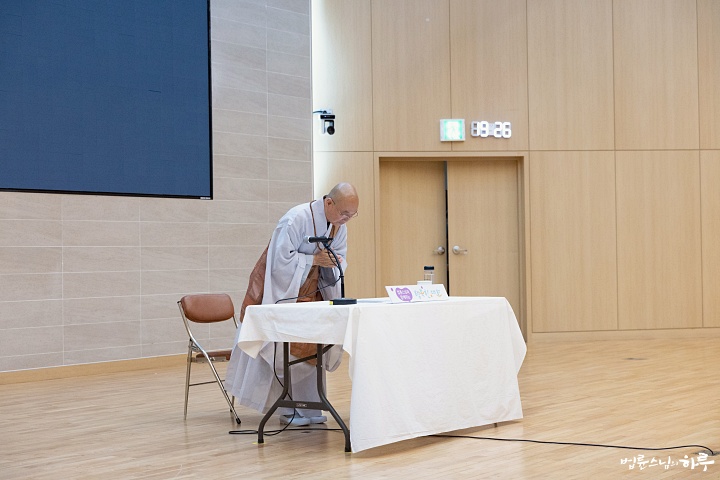
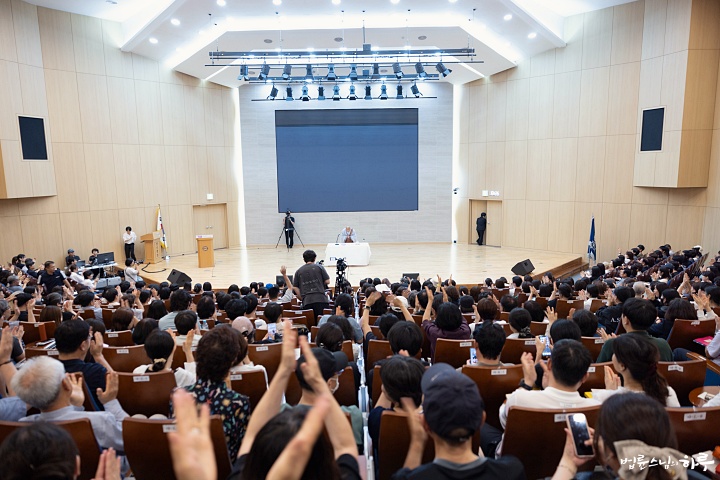
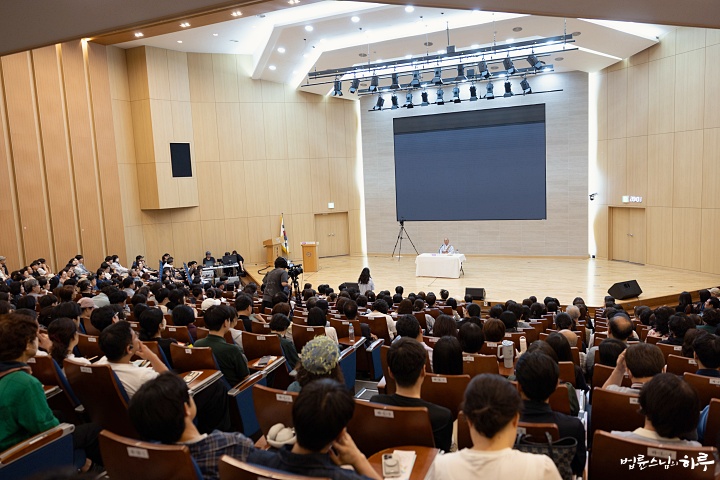
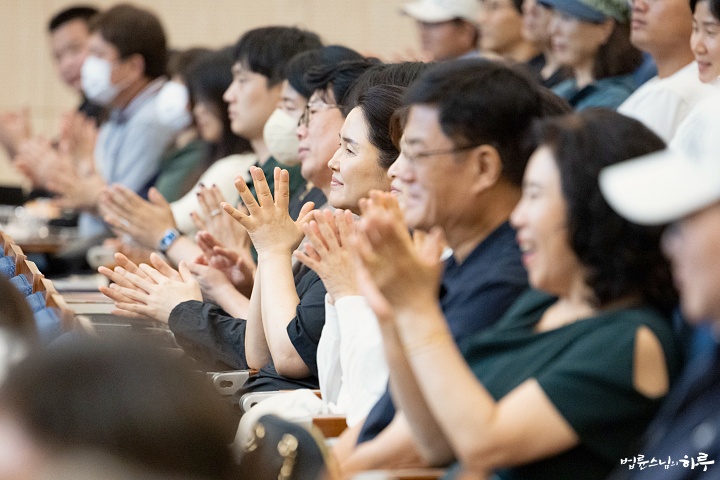
After everyone watched the introduction video about Sunim, the host invited Sunim to the stage. The audience welcomed him with loud applause. About 500 people attended in person, and around 5,600 viewers joined the lecture online today.
Dharma Q&A: A Process of Finding Your Own Answers
"Dharma Q&A is not a place where I provide answers to questions, but rather a format for having a conversation. Think of it like having a cup of tea with a friend. Whether your friend talks about their parents, their girlfriend or boyfriend, or their workplace, it's entirely up to them. We simply use that as a topic for conversation. While the format may look like the friend asking and me answering, the truth is that the person asking may not necessarily be looking for an answer. Even if they do want one, I don't have any obligation or responsibility to provide it. My job is to listen carefully. And if the questioner is only seeing one side, I might point out, 'There's another perspective too.' Through this kind of conversation, the person often finds their own answer, thinking, 'Oh, I can handle it this way. It's not a big deal after all.'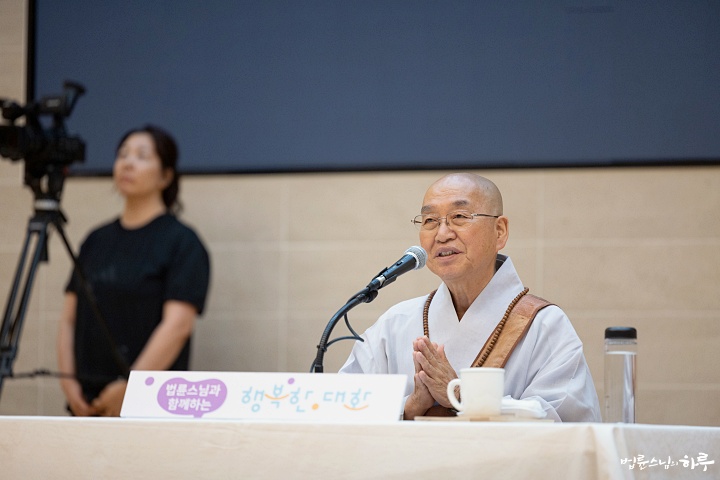
I Only Share the Facts; the Choice Is Yours
When something happens, there is no right answer that says 'you must do it this way.' You can do it this way or that way. How you handle it is entirely your own choice. When there is food containing poison and someone is about to eat it unknowingly, the Buddha simply informs them, 'There is poison in that.' He doesn't say, 'It contains poison, so don't eat it'—he only tells them the fact that it contains poison. When you don't know there's poison, you might eat it, but once you know, you probably won't. Yet sometimes there are people who eat it even knowing the truth. Does that make them wrong? No. Whether to eat or not is a matter of personal freedom and choice. All we can do is inform those who don't know that there is poison. Whether to eat it or not is their own choice. If you eat it unknowingly and die, you'll be filled with regret and suffering. But if you eat it knowingly, it becomes your own choice. If you want to live, you won't eat it; if you want to die, you will. There's no right or wrong in that choice. If anything, most people would choose not to eat because they want to live. But just because the majority chooses something doesn't necessarily make it right. It simply means that more people make that choice. However, since so many make the same choice, people mistake it for the correct answer. Saying 'don't do this, don't do that' falls into the realm of ethics or morality based on good and evil. Most religions also use good and evil as their standard. But Buddhist teachings originally have no concept of good and evil. They only tell you the truth; the choice is yours. However, because the choices of the majority have become standardized, it seems as though the Buddha said 'don't do this.' As a result, Buddhism ends up sounding like a 'preachy lecture by an old-fashioned elder' giving moral advice. But Buddhism doesn't act like a stubborn elder telling you 'do this, don't do that.' It respects each individual's choice. It only informs you of the truth so that you won't regret your choices later. Animals living in the mountains don't follow anyone's teachings—they live according to their own instincts. All living things in nature live without anyone's instructions. If humans are truly the lords of all creation, shouldn't we be even more capable of living wisely on our own?
Awakening from Ignorance Frees You from Suffering
We suffer when the outcome of our choices doesn't match our expectations. So when you make a choice, I want to remind you: 'What kind of result are you expecting from this choice?' When you get married, what do you look at first? You look at photos and faces, right? But have you ever heard of someone getting divorced because they couldn't stand looking at their spouse's face every morning? You've probably heard plenty of people say, 'We divorced because our personalities didn't match.' When choosing a spouse, people mostly consider appearance and ability, but rarely personality or lifestyle. Yet once you live together, what causes the most conflict is personality and lifestyle habits. When choosing a marriage partner, you may consider their abilities a bit, but you don't really need to focus on their face. Personality, preferences, and lifestyle attitudes are far more important in married life. It's not that you sinned in a past life and that's why your spouse doesn't match you, nor is it because God is punishing you. The standard of your choice simply didn't match the result you wanted.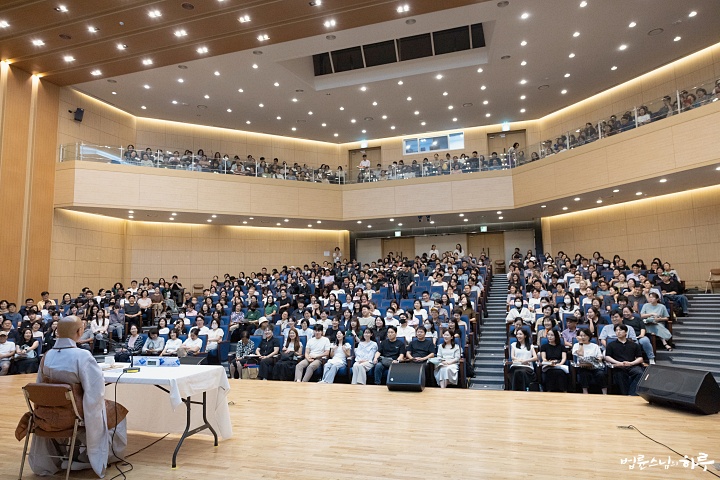
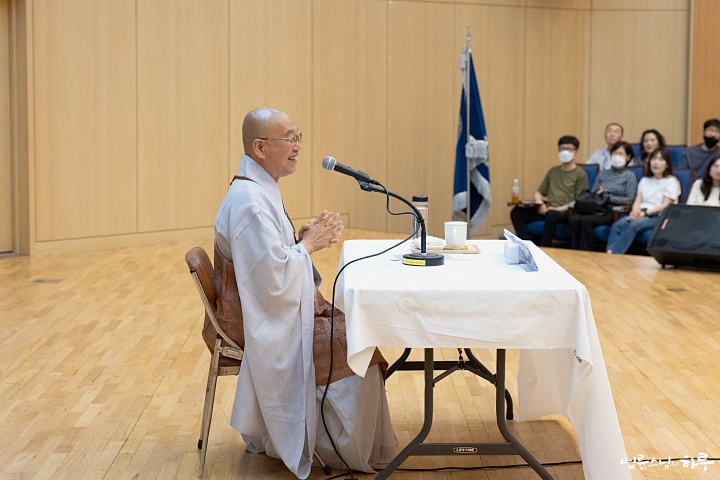
Four people who had registered in advance asked Sunim questions.
▪ I'm seeing my girlfriend with marriage in mind, but we have so many differences. Is this how everyone dates and gets married?
▪ My dog is getting old. The thought of life without my dog makes me sad. What should I do to live without regret?
▪ Since childhood, I was slow at memorizing multiplication tables and struggled academically. I'm okay now, but my anxiety is high. It's painful.
▪ When my father passed away, he should have been buried in the family cemetery, but we placed his ashes in a charnel house instead. I regret what's already done. Also, I find it burdensome to handle my father's memorial rites and look after my mother, who is divorced, during the holidays.
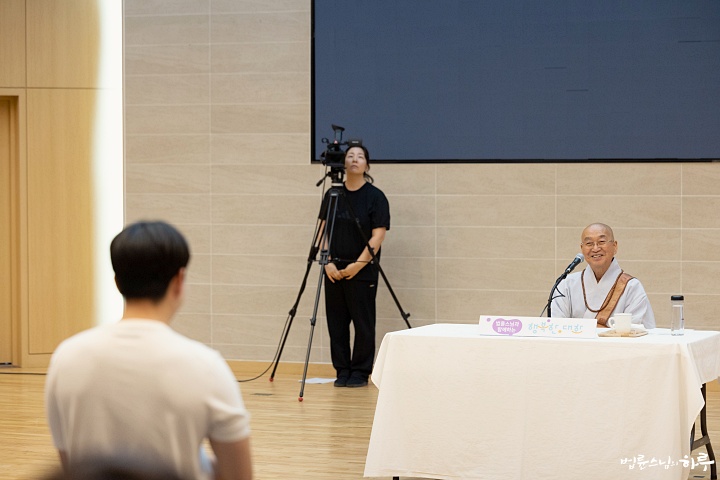
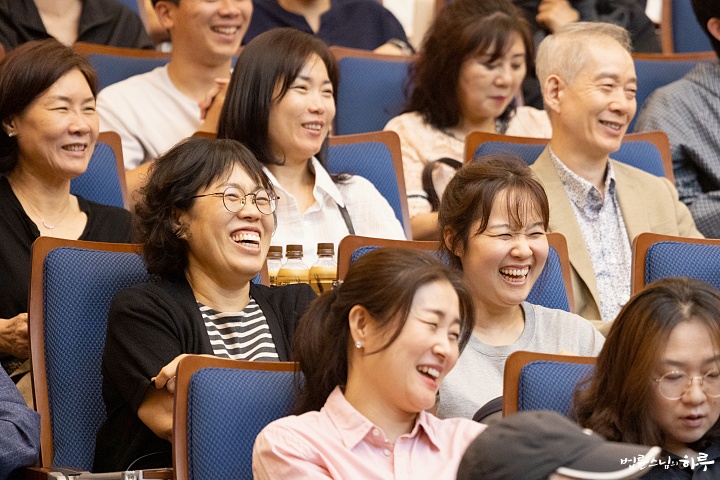
Sunim also took questions from the audience on-site. Five people asked questions.
▪ Sunim, when you give Dharma talks in response to people's questions, do you feel a sense of fulfillment and pride?
▪ I've changed jobs seven times. It's hard to find a new job.
▪ What's the best way to live as my truest self?
▪ When I feel wronged, I wonder whether it's better to respond or not respond.
▪ My father has lung cancer, but he doesn't exercise and keeps eating unhealthy foods. So I end up nagging him. What should I do for my father?
This post concludes with Sunim's Dharma talk in response to the question from the person troubled by constantly nagging her sick father.
I Keep Nagging My Father Who Is Battling Cancer
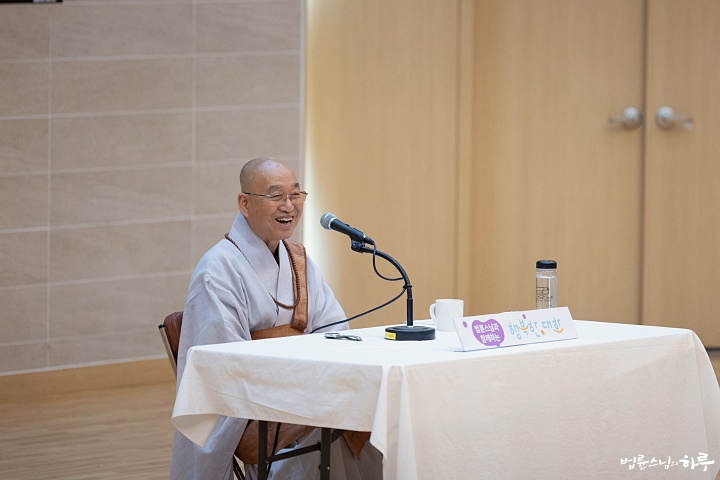
"You already know that it's better not to nag, right? So just don't do it." (Laughter)"My father was diagnosed with lung cancer three years ago, and recently it spread to his bones, leading to a stage 4 diagnosis. He's currently undergoing chemotherapy every three weeks. I wish he would exercise and eat healthy foods, but because he's so exhausted, he only eats what he likes. Whenever that happens, I end up nagging him without realizing it, and then I regret it. What should I do to stop nagging him?"
"I keep nagging because I want my father to be healthy."
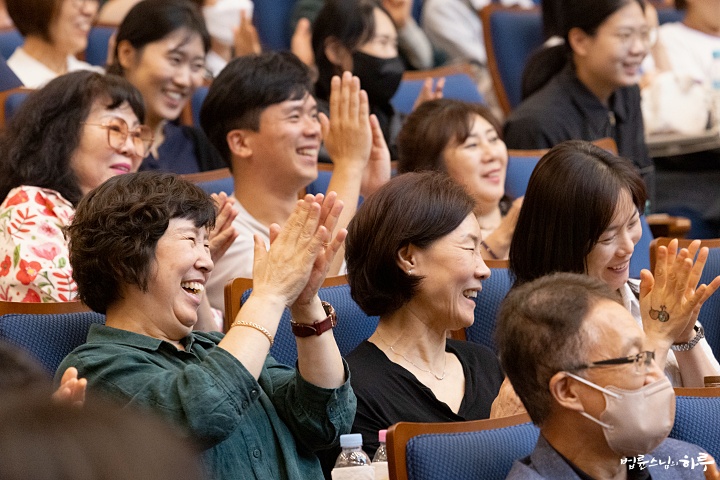
"I completely understand that feeling. But does creating conflict with your father really help his health? You nag your father with good intentions. But is it good or bad for a cancer patient to feel stressed? You started with good intentions, but as a result, you're doing something contradictory. Wishing your father to get well is your own desire. But you're insisting that this wish must come true. You can wish for it, but reality may not unfold as you want. Even if you want to marry someone, you can't force them if they don't want to, right? Similarly, your intention to care for your father is good, but in the end, it amounts to forcing him to follow your wishes. Having a wish is your own matter, but thinking the other person must listen to you is self-righteousness. You're insisting, 'I'm saying this for your sake, so how can you not listen?' Parents nag their children to raise them well, but the kids find it unbearable because of their parents, right? You say your father is making your life hard, but if your father were here, wouldn't he say his daughter is making his life hard? (Laughter) When someone is stressed, do they drink more alcohol or less?""They drink more."
"Thank you."
Today's lecture took place in a relatively small venue with a close distance between Sunim and the audience, allowing the conversation to flow naturally as if Sunim and the audience were sitting face-to-face. After the lecture, Sunim held a book signing in the lobby. Many people lined up to have their books signed by Sunim. The faces of those who received signatures were filled with smiles.
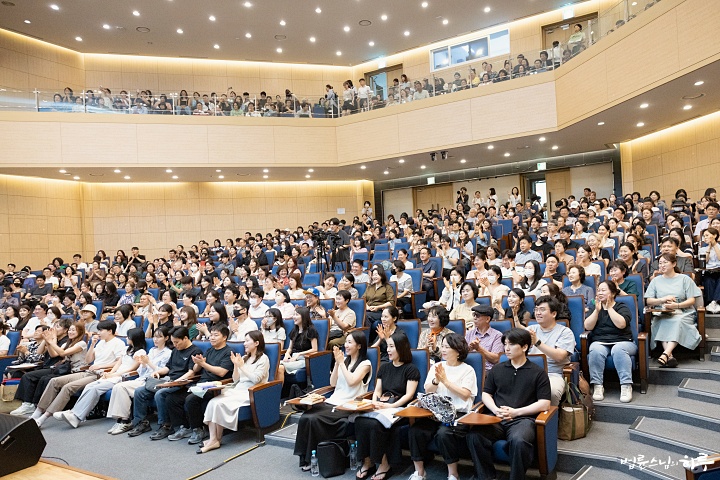
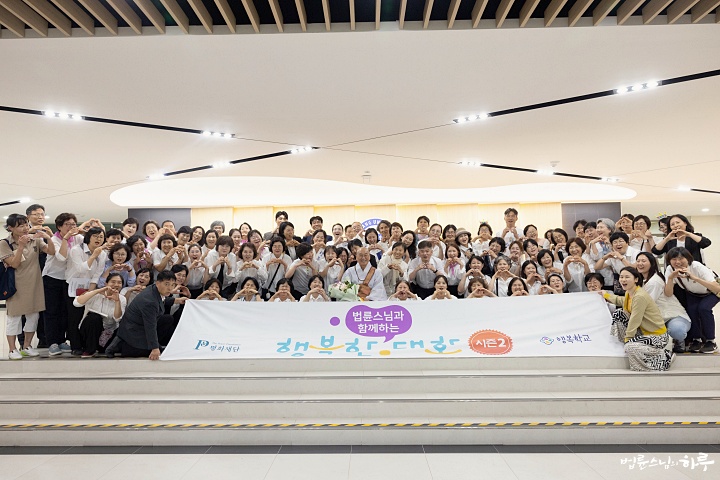
This was followed by a group photo with the Happy Citizen volunteers who had worked hard to prepare for the lecture. The volunteers made finger hearts and called out together, "Sunim, we love you."
After leaving the lecture venue, Sunim arrived at the Seocho Jungto Center at 10:15 p.m. Sunim wrapped up his work and rested.
Tomorrow, Sunim is scheduled to lead a Dharma Q&A for the English Buddhism Course and attend The Peace Foundation's Tongil Euibyung (통일 의병, Korean Minutemen for Peace and Unification) assembly.