Hello. Today marks Day 4 of Sunim’s meetings in Washington D.C. The day began with an early morning online Dharma Q&A, followed by four consecutive meetings throughout the day.
At 5 a.m., Sunim performed the morning ceremony at the Dharma hall of the Washington D.C. Jungto Center and began the day with early morning practice and meditation.
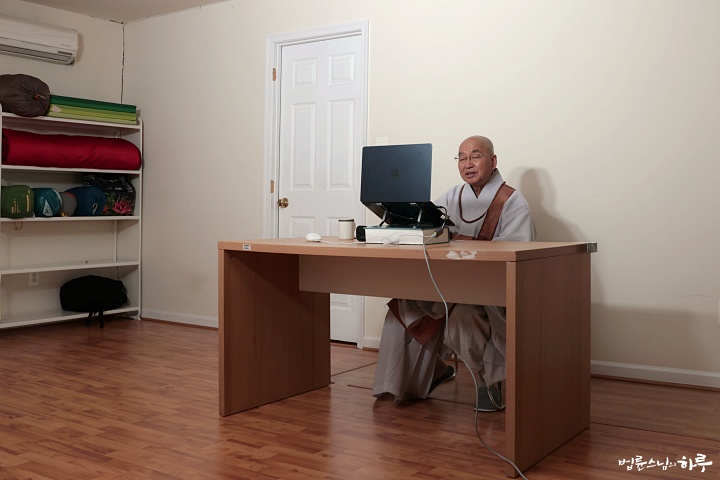
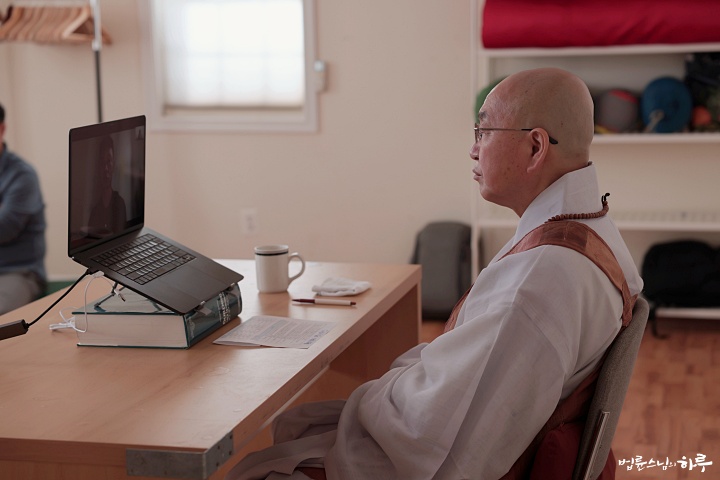
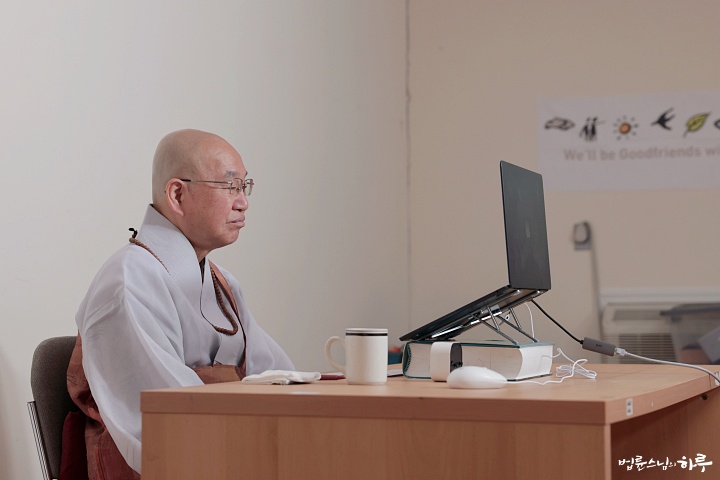
At 6:30 a.m. local time, Sunim put on his kasaya (Buddhist robe) and outer robe and sat in front of his computer to conduct the online Dharma Q&A.
“Hello. I am currently in Washington D.C., USA. Today’s Dharma Q&A isn’t being held in a properly equipped broadcasting studio, so the lighting and sound may be somewhat lacking. Since I’m broadcasting live from a laptop, there are quite a few shadows on my face. I appreciate your understanding.
I came to the United States because I hope to see improved relations between the U.S. and North Korea for the sake of peace on the Korean Peninsula, and I wanted to explore ways to address this. Of course, there are many issues between Korea and the U.S. as well, but above all, improving U.S.-North Korea relations seems to be the most critical task for peace on the Korean Peninsula. For the 25 million people living in North Korea to escape suffering, humanitarian aid to North Korea must be allowed, and sanctions related to daily necessities should be lifted.
Currently, economic sanctions are being imposed to prevent North Korea from developing weapons of mass destruction. However, since North Korea has formed a military alliance with Russia, the effectiveness of these sanctions has become largely nominal. In the end, the economic sanctions are only making life harder for ordinary North Korean citizens. These issues need to be reviewed comprehensively, and U.S.-North Korea relations need to be reset in line with the changed circumstances. I visited Washington D.C. to discuss these matters with members of the U.S. Congress, government officials, and think tank experts. This weekend, we will also hold an opening ceremony for the new meditation hall at the Washington D.C. Jungto Center, which has been built for the first time in seven years.
The weather here in May is wonderful, much like spring in Korea. However, the weather here changes drastically as well. Some days it rises to 30°C, while yesterday the high dropped below 15°C, and with cold winds blowing, it felt like winter. I was exposed to a lot of cold wind on the streets yesterday, so I feel like I’m coming down with a cold. With the weather changing so much, please everyone take care of your health. Now, let me hear your stories.”
After finishing his opening remarks, Sunim spoke with four questioners. Because Sunim had to leave immediately for his next appointment, he was unable to take questions from on-site participants.
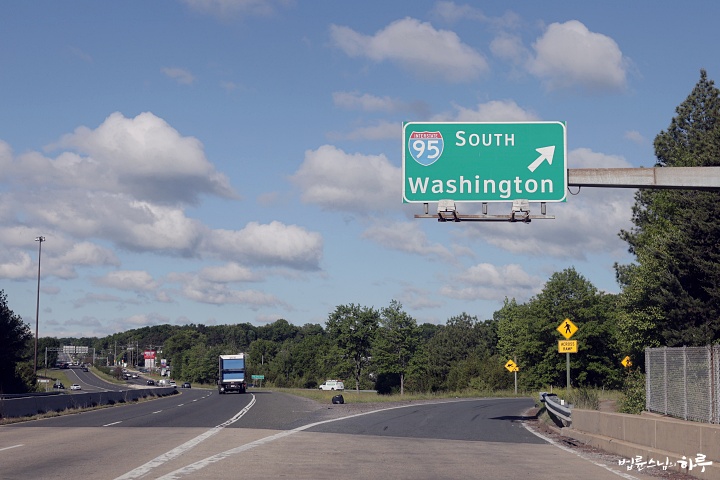
After getting ready to go out, Sunim departed from the Washington D.C. Jungto Center at 8:20 a.m. Even while traveling, Sunim reviewed a video that was scheduled to be aired soon.
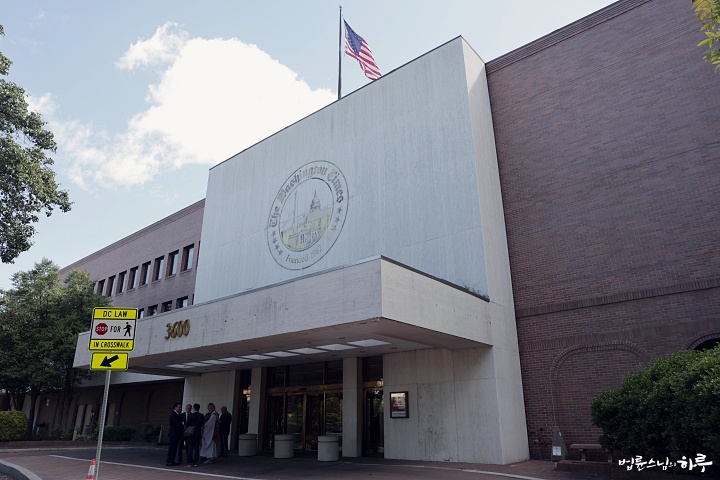
At 8:50 a.m., Sunim arrived at The Washington Times building. There, he met with Dr. Michael Jenkins, President of The Washington Times and Chairman of Washington Times Holdings, and his colleagues. Doug Bandow, Senior Fellow at the CATO Institute, whom Sunim had met last year, also joined the meeting. Mr. Bandow is one of the leading U.S. experts on foreign policy and security.
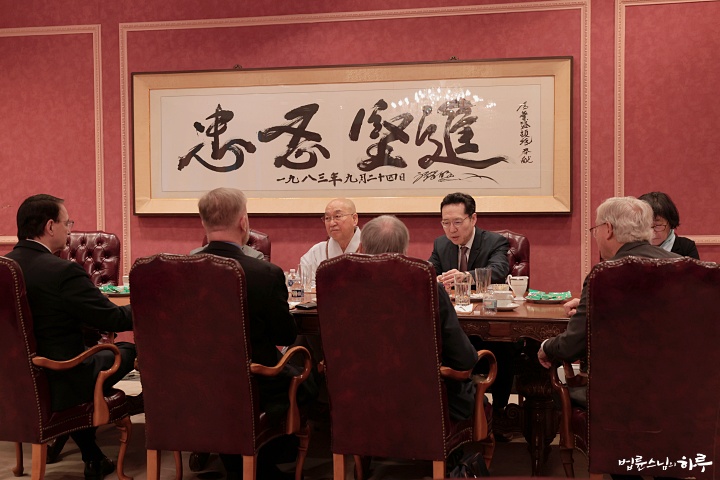
During this meeting, Sunim shared the atmosphere of the Washington D.C. meetings held over the past three days and exchanged various opinions on how to address the current U.S.-North Korea relations. After concluding the 1-hour-and-30-minute meeting, they took a commemorative photo together. Sunim then presented the meeting participants with copies of his English books, Happiness and Why Am I Anxious? , and promised to meet again before departing. Dr. Jenkins and his colleagues walked outside to see Sunim off, watching and waving farewell as Sunim’s car drove past the building from the parking lot.
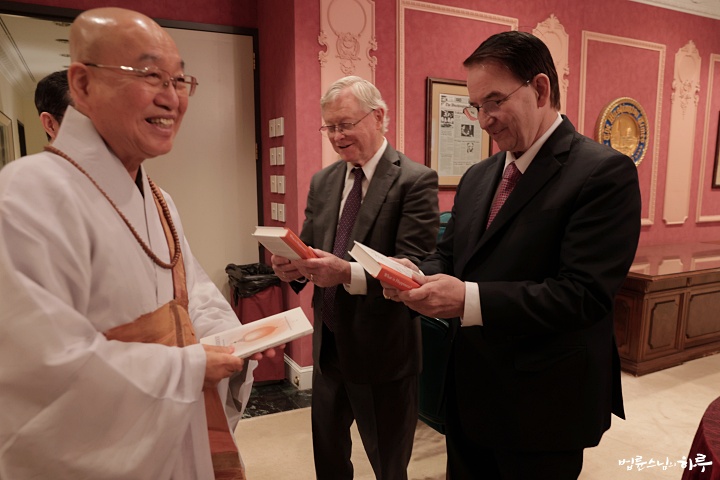
At 11:30 a.m., Sunim headed to George Mason University’s Arlington Campus to meet with Professor Ellen Laipson, Director of the Center for Security Policy Studies.
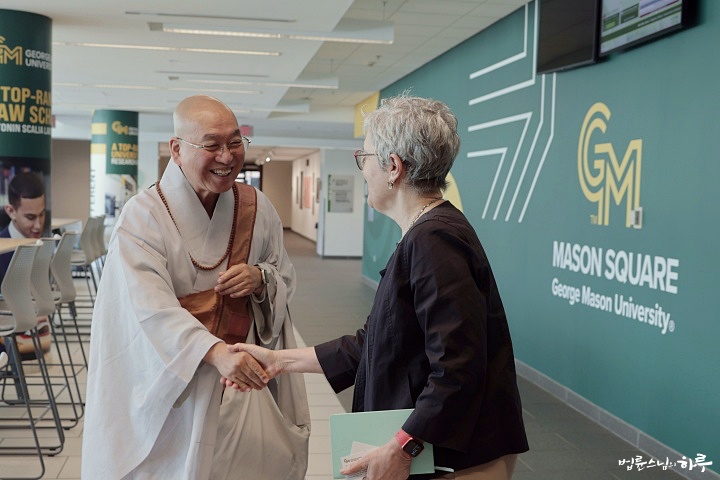
Drawing on her approximately 25 years of experience working in U.S. government intelligence and foreign policy departments, Professor Laipson has been actively engaged at private think tanks. She has deep interest in Korea’s geopolitical position and security situation regarding issues on the Korean Peninsula. She also collaborates with George Mason University’s Korea Campus (Incheon Global Campus) to host security seminars and maintains close communication with security experts in Korea.
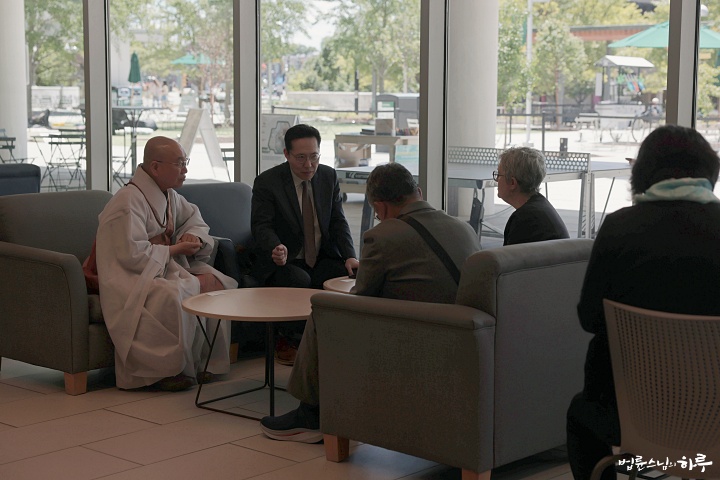
Sunim and Professor Laipson exchanged opinions on the current situation in North Korea and various approaches to facilitating U.S.-North Korea dialogue. They also discussed the possibility of holding a public lecture on North Korean issues at George Mason University’s Arlington Campus this coming September.
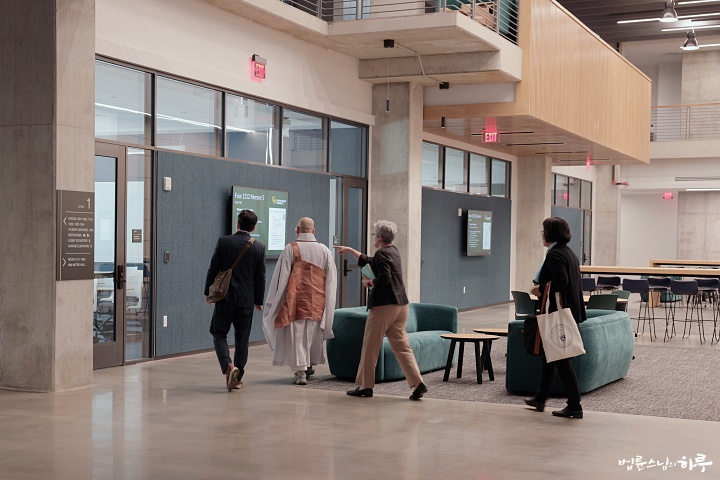
Professor Laipson guided Sunim through various locations on the first floor of the campus, including the auditorium and lecture halls. They agreed to positively consider co-hosting a public lecture in September of the second half of this year.
Afterward, Sunim had a quick lunch at a nearby Korean restaurant with Jason, who had served as the interpreter for the Washington D.C. schedule over the past five days. Sunim used even his mealtime to finish an urgent manuscript revision before picking up his chopsticks. After the meal, Sunim expressed his deep gratitude to Jason for his interpretation work over the past five days.
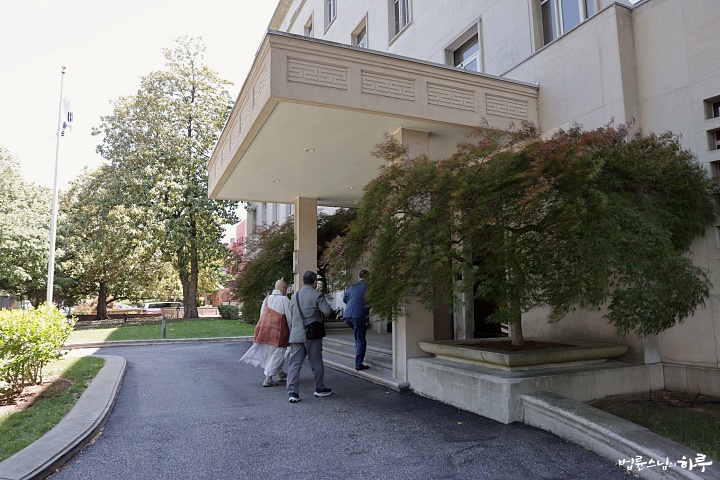
After lunch, Sunim headed to the Embassy of the Republic of Korea on Massachusetts Avenue to meet with Ambassador Kang Kyung-wha, who had assumed office last October. Having missed a highway exit along the way, Sunim arrived just in time for the appointment, where Consul General Moon In-sik, Vice Chairman Lee Jae-soo of the North American Region of the National Unification Advisory Council, and Chairman Park Jun-hyung of the Council were waiting at the entrance.
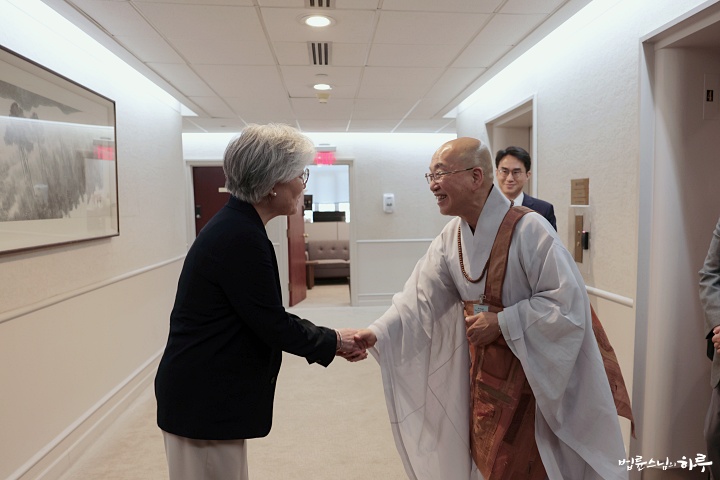
After exchanging warm greetings and stepping inside, Ambassador Kang Kyung-wha warmly welcomed Sunim as he stepped off the elevator.
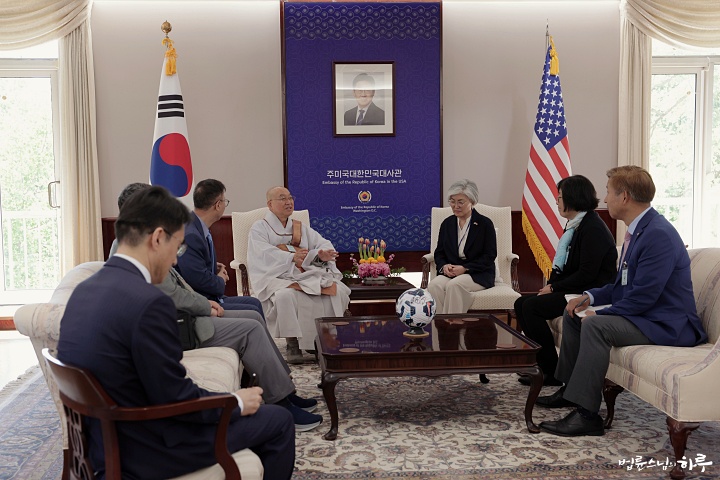
Sunim explained the purpose and schedule of his current visit to Washington D.C. to Ambassador Kang. He then had an in-depth conversation with her on the changes in international affairs since the start of the second Trump administration, as well as on what is needed to improve U.S.-North Korea relations and establish peace on the Korean Peninsula.
After the conversation, Sunim presented his newly published book, Tak! A Dialogue of Awakening , to Ambassador Kang and those who accompanied her. Ambassador Kang walked Sunim to the elevator to see him off and exchanged final greetings.
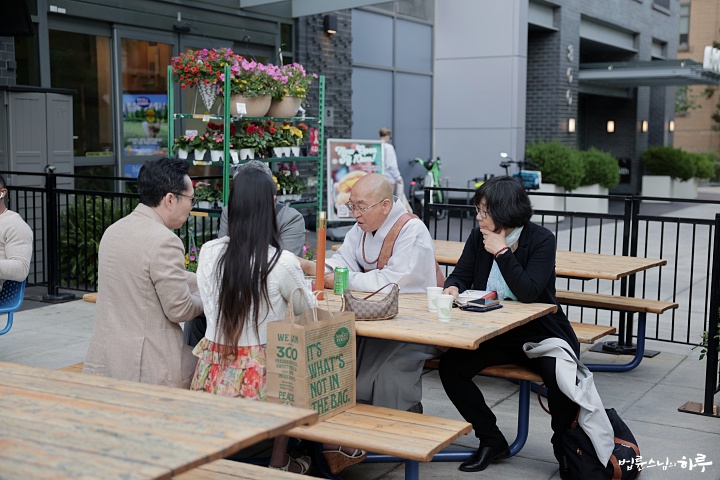
Lastly, Sunim headed to a café near the Capitol to meet with Hannah Kim. A former senior advisor to U.S. Congressman Charles Rangel and a former Deputy Assistant Secretary at the White House, Hannah Kim founded the organization “Remember 727” in 2008 and has been dedicated to honoring and commemorating Korean War veterans. Thanks to her efforts, the U.S. Congress passed federal legislation in 2009 designating July 27 as “Korean War Veterans Recognition Day.” Despite her busy schedule, Hannah came to meet Sunim upon hearing that he was visiting Washington D.C., as she very much wanted to see him. Even in their brief conversation, Sunim received fresh ideas from her. Sunim presented her with a copy of his English book, Why Am I Anxious?
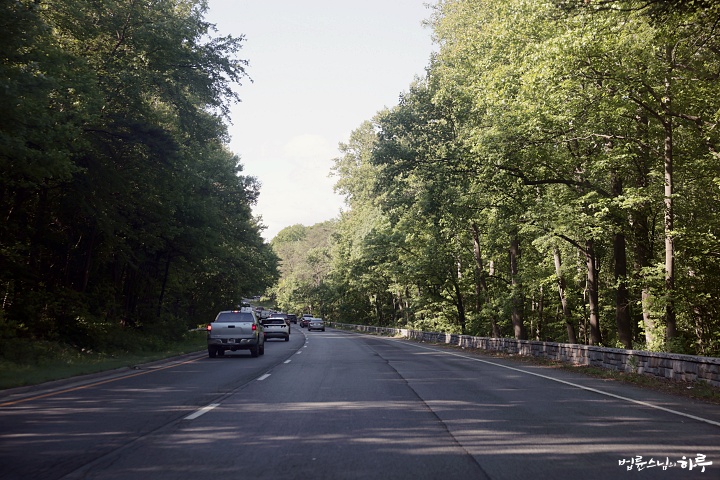
By the time Sunim returned to the Washington D.C. Jungto Center, it was already 7:20 p.m.
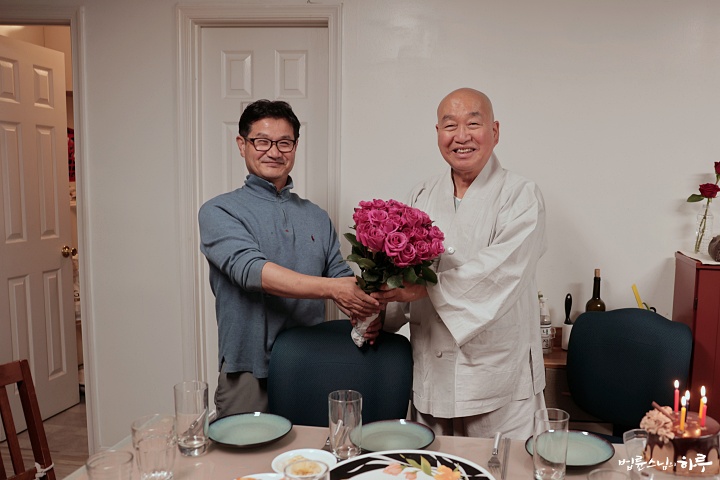
As it happened, today was Teachers’ Day in Korea, and the Jungto practitioners staying at the center had prepared a simple cake and bouquet of flowers, singing “Teacher’s Grace” to express their gratitude to Sunim. In return, Sunim untied the bouquet he received and gave one flower to each of the Jungto practitioners gathered there. After taking a commemorative photo together, Sunim blew out the candles on the cake, concluding the modest Teachers’ Day celebration before having dinner. Warm conversation continued throughout the meal. After dinner, Sunim wrapped up his day.
Tomorrow, Sunim will prepare for the opening ceremony of the meditation hall at the Washington D.C. Jungto Center, and in the afternoon, he will hold an online Dharma Q&A session with Jungto Society members from the International Division.
This post concludes with one of the conversations from the online Dharma Q&A held in the early morning U.S. time.
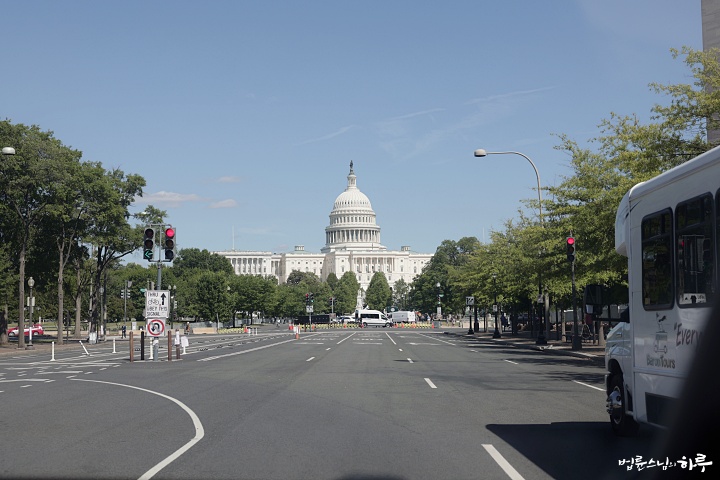
I’ve Worked at a Computer All My Life. Can I Find a New Kind of Work?
“My concern is how to find and start something new, apart from the work I’ve been doing. I’m a man in my late 40s, and I worked in the IT industry until I lost my job six months ago. Due to the nature of the industry, the rapid changes brought about by AI have reduced my place in the field, and I expect this trend will only worsen. So I feel I need to find new work, but since I’ve worked at a computer all my life, finding a different kind of job feels difficult. I don’t have any serious illnesses, but I do have joint problems, so if I do physical labor, I have to take anti-inflammatory medication for about a week. I currently have no income and am living off a negative balance line of credit. I’ve been freelancing for a long time, so I don’t have any retirement savings. I’ve been able to manage my mind and maintain a sense of peace through meditation. But lately, with no practical solutions in sight, anxiety has been rising. I’d like to hear your advice on how I should go about finding work in this situation.”
“For people, doing the work they’ve always done is the easiest. For farmers, farming is the easiest. For welders, welding is the easiest. For musicians, music is the easiest. As long as adequate compensation follows, the work that one has done for a long time is probably the easiest.
However, if the compensation is so low that it doesn’t cover living expenses, then the difficulty isn’t with the work itself but with the inadequate pay. Yet when society changes rapidly, there are times when there are no longer opportunities to make use of the specialized skills you’ve spent your life learning. The faster society changes, the more frequently this happens.
If I had been born 200 to 300 years ago, I would have lived as a farmer. Back then, there was a high probability that one would farm from childhood through adulthood. In such cases, whether we are poor or wealthy, we can call society stable. When a system stays the same across the grandfather’s generation, the father’s generation, and the grandson’s generation, we can say that society is stable.
Then what does it mean when society changes rapidly? It means that while the father farmed for a living, the son suddenly moves to the city in an industrial society to work as a welder or driver. In such cases, the young son has no problem because he learns driving or welding from the start, and the father has no problem if he continues farming until the end. However, if someone of the father’s generation has to move to the city because the agricultural sector has shrunk and take up welding or labor work, then the farming skills he has practiced his whole life become useless, and he has to learn something new to adapt. Furthermore, the knowledge and experience he has accumulated until now don’t necessarily give him an advantage in learning something new. If he were to farm, he would be vastly more skilled than his son’s generation, but in learning welding skills, he would actually be less proficient than his son in terms of age and various other factors. So he needs more money than his son to live, yet his actual income is less than his son’s. Since the son lives alone on that income, he can manage with low wages, but the parent has to support a spouse and children, making it difficult to live on that income. When this situation repeats, the parents’ generation ends up becoming the urban poor.
Since you are of the son’s or grandson’s generation, you may not have experienced such hardships. But as someone in my 70s, I grew up witnessing this process firsthand. I saw countless people lose their traditional jobs in agriculture and move to cities, becoming the urban poor and living difficult lives. In an industrial society, knowledge and skills are necessary for high labor efficiency. That’s why schools teach knowledge and skills.
In agriculture, you learn by following your parents, and once you reach an appropriate age, you can master the skills and start working right away. But in an industrial society, you have to go through elementary school, middle school, high school, college, and these days even graduate school or studying abroad to acquire the expertise needed to compete. The period of education has become very long. However, once you enter the workforce with knowledge and skills, life has been able to proceed stably.
But now, with the advent of the digital society and the development of artificial intelligence, even this has changed. The knowledge and skills learned through decades of school education, and the skills that have been useful in the workplace, have become useless. The jobs we’ve been doing are disappearing, and to find new jobs, we now have to learn yet different skills and knowledge—yet even those don’t have a clear future.
That’s why you’re feeling confused right now. If you had been able to continue using the skills you originally had, life would have been stable, but suddenly those skills have been replaced by AI, and you’ve effectively lost your job. That said, it doesn’t mean the world is coming to an end.
For example, I’m good at reading maps and have a strong sense of geography and terrain. This was a great talent for me. But with the advent of navigation systems, this talent has become useless. Being good at English was a talent compared to others, but now, with automatic interpretation and translation by AI, being good at English can hardly be considered a special talent. Also, with the emergence of self-driving cars, driving is becoming a profession that will be difficult to sustain in the future.
So does that mean I’m a useless person? Not at all. It just means that during this period of change, we have no choice but to let go of the skills and knowledge we’ve had until now and do something else that society needs. If you stay stuck thinking, ‘I would have been good at farming if I’d done it,’ or ‘I would have been good at welding,’ then it becomes very difficult to live in this society. Amid the changes of the times, instead of saying, ‘AI took my job,’ you should think, ‘What can I do using AI?’
When motor power emerged amid physical labor, it didn’t take away the work of livestock; rather, new work using motor power was created. When computers came along, they didn’t take away our work; rather, other work using them was created. In the same way, we have no choice but to keep changing our roles. Before navigation systems, knowing geography well was a great advantage, but now it isn’t. Instead, you have to find work that can be done using navigation systems, or find work you can do with self-driving cars. Don’t keep lamenting, ‘I was good at driving, but driving jobs have disappeared.’ You need to shift your perspective. Likewise, don’t keep comparing your income to past standards, saying, ‘It’s only half of what I used to earn,’ or ‘It’s only 70%.’ Instead, find work you can do in reality and live on that income.
With the advancement of technology, many existing job categories are disappearing, but at the same time, new demands are increasing tremendously. There are many essential tasks in society that can’t be done because there aren’t enough people. That’s why workers are brought in from abroad to do the work. If you go to the countryside, you’ll find such tasks piling up.
So I hope you won’t view your situation as too hopeless, nor cling stubbornly to your existing skills. In this changed society, please adopt the perspective of, ‘What can I do? What kind of work is needed?’ Don’t compare too much with your previous salary; it seems necessary to find work you can do now and work you can do well. Please try to shift your perspective in this way.”
“Yes, I understand. Thank you, Sunim.”