Deepfake Technology Makes It Hard to Tell What Is Real and What Is Fake
May 12, 2026. Day 1 of Washington D.C. Meetings, Live Weekly Dharma Assembly
Hello. Today marks the first day of meetings with various dignitaries in Washington, D.C., USA.
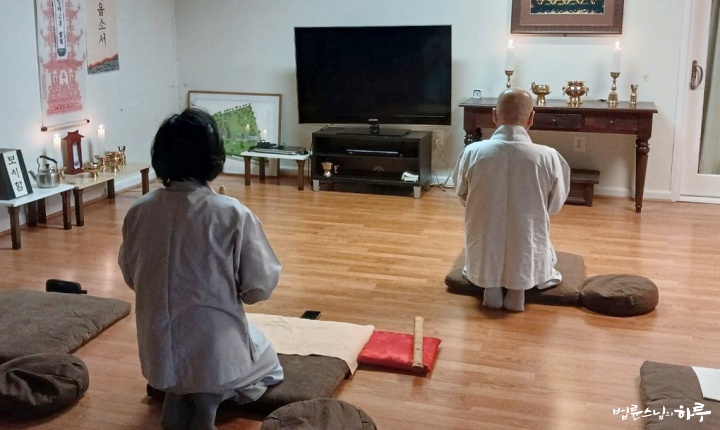
Sunim began his day at 5 a.m. with a morning service at the Dharma hall of the Washington DC Jungto Center, followed by early morning practice and meditation. After an early breakfast at 6:30 a.m., he prepared to head out for his meetings in Washington, D.C.
At 7:40 a.m., Sunim left the Washington DC Jungto Center and traveled into downtown Washington, D.C. Although he departed a bit early, expecting to arrive ahead of schedule, the morning rush hour traffic meant he arrived right on time.
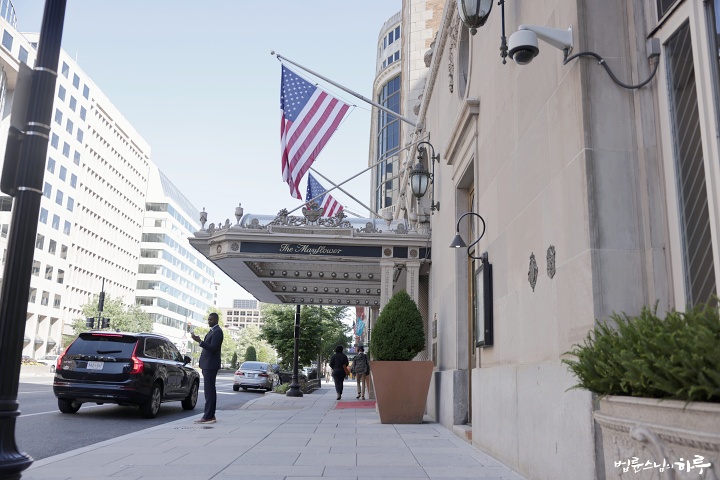
At 9 a.m., Sunim met Ambassador Joseph R. DeTrani at the café on the first floor of the Mayflower Hotel. Due to Ambassador DeTrani’s poor health last year, they had been unable to meet, so this reunion came after two years. They warmly greeted each other, exchanging news about their recent activities, health, and well-being.
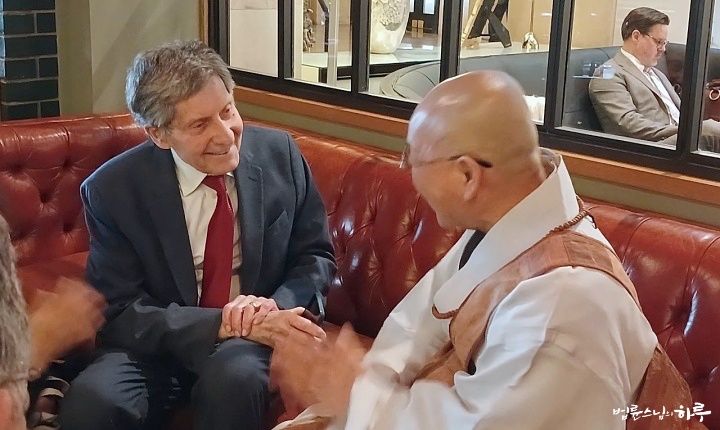
Ambassador DeTrani is one of the foremost experts on Korean Peninsula and North Korean nuclear issues, having served as the U.S. State Department’s Special Envoy for the Six-Party Talks and Special Envoy for North Korean Nuclear Issues. He has always remembered Venerable Pomnyun Sunim’s contribution to facilitating the September 19, 2005 Joint Statement and consistently expresses his respect and gratitude for Sunim’s insight and wisdom.
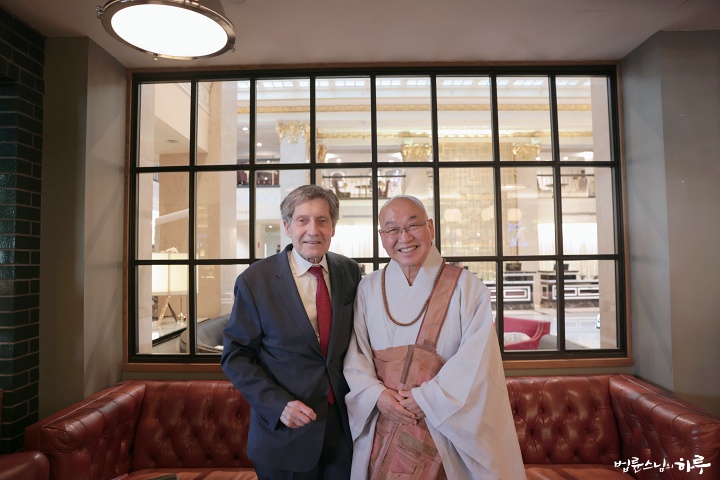
President Trump is scheduled to depart for China on the afternoon of the 12th for the U.S.-China summit. Ambassador DeTrani drew a hearty laugh when he asked whether Sunim had come to Washington, D.C. to greet President Trump before the U.S.-China summit. The Ambassador noted that while the upcoming U.S.-China summit involves many pressing issues, he hoped that the dialogue on North Korea would also lead to improved U.S.-North Korea relations, and he repeatedly remarked that Sunim had visited Washington, D.C. at a very opportune time. Sunim and the Ambassador had an extensive discussion about peace on the Korean Peninsula and ways to resume U.S.-North Korea dialogue.
“It’s been nearly 30 years since I first met Ambassador DeTrani. The most significant agreement regarding the Korean Peninsula was the September 19 Agreement in 2005, reached on the morning of Chuseok. After the Ambassador successfully facilitated the Six-Party Talks, the email he sent me on Chuseok morning deeply moved me.”As Sunim recalled this past moment of inspiration, the Ambassador continued the conversation, saying, ‘Although inter-Korean relations have declined since then, they will need to rise again.’ Sunim earnestly asked the Ambassador to help bring about a resolution to this issue that had remained unresolved despite their joint efforts over the past 30 years. After the approximately two-hour meeting, Sunim presented Ambassador DeTrani with a signed copy of the English translation, ‘What Is Happiness’, and they took a commemorative photo together. Ambassador DeTrani asked Sunim to be sure to send him the photo and they agreed to meet again in September. After seeing Ambassador DeTrani off, Sunim continued with his next meeting at the same location.
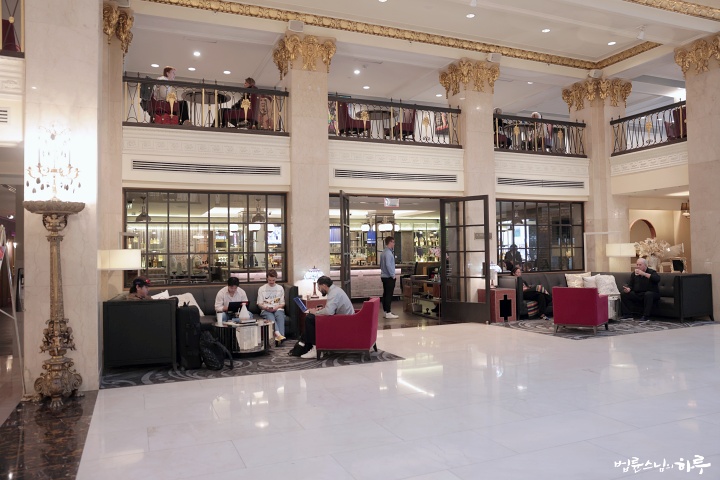
At 11 a.m., Mr. Olin Wethington and his group arrived at the meeting place. Mr. Wethington, formerly of the U.S. Treasury Department, is a director of the Atlantic Council, an American think tank specializing in international affairs. He has served as U.S. Special Envoy to China, Advisor to the Secretary of the Treasury, Assistant Secretary of the Treasury for International Affairs, and Special Assistant to the President at the White House National Economic Council. Sunim exchanged updates with Mr. Wethington and discussed peace on the Korean Peninsula and the resumption of U.S.-North Korea dialogue. At the end of the meeting, Sunim presented him with the English translation of his happiness book, and Mr. Wethington said it appeared to be an excellent book. He offered to arrange a gathering during Sunim’s next visit in September, inviting various leaders in D.C. for a conversation on the topic of happiness, and he asked many interested questions about the Happiness School. Although the meeting was originally scheduled for one hour, the conversation extended beyond that. After seeing Mr. Wethington and his group off, Sunim left the café to head to the next meeting location.
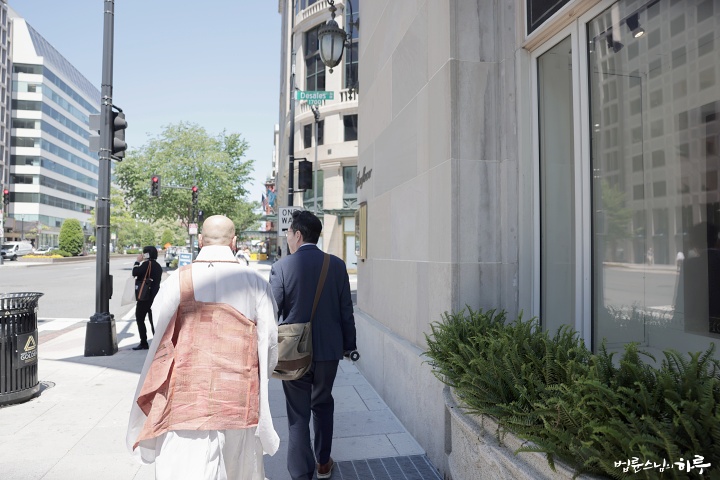
The next meeting location was the Mansfield Foundation office, which was not far from the Mayflower Hotel, the previous meeting venue.

With no time for lunch today, Sunim went near the Mansfield Foundation office and had a simple lunch of fruit he had prepared in advance, eaten in the car. At 1 p.m., he was scheduled to meet with President Frank Jannuzi and Executive Director Keith Luse of the National Committee on North Korea (NCNK).
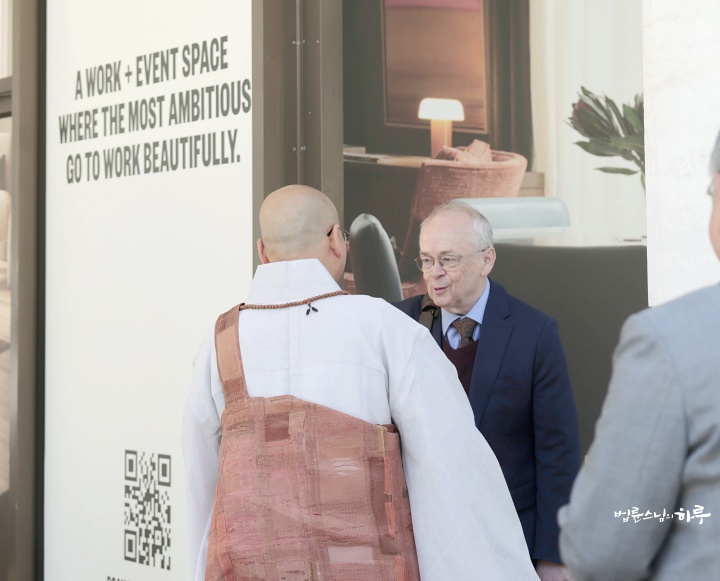
As Sunim got out of the vehicle and crossed the street to enter the Mansfield Foundation office, he ran into Executive Director Keith Luse, who greeted him very warmly.
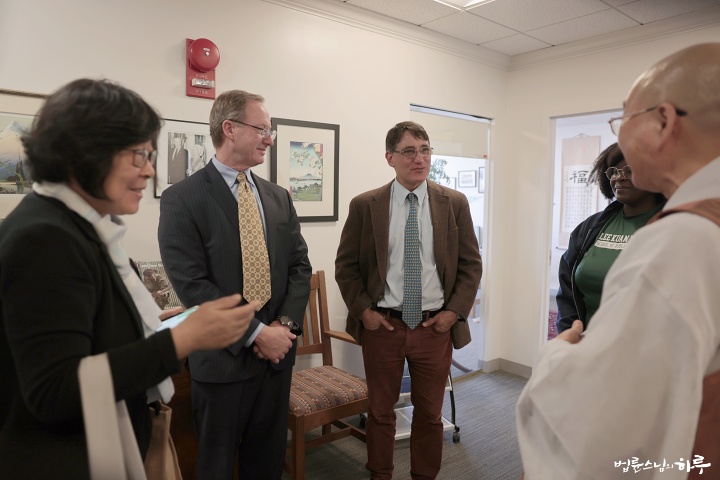
When Sunim arrived at the Mansfield Foundation office on the 11th floor, President Frank Jannuzi welcomed him warmly.
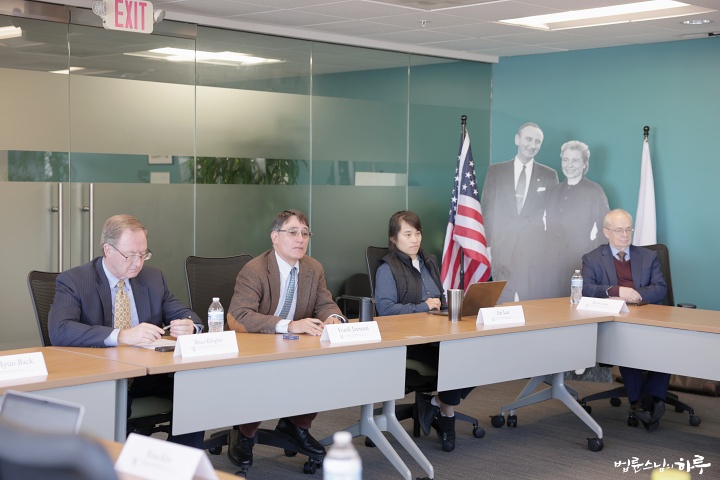
The roundtable began at 1 p.m. It was an open session for questions and discussion regarding peace on the Korean Peninsula and U.S.-North Korea relations. Researchers and interns were also present, sharing information through frank dialogue. President Frank Jannuzi nodded and listened intently each time Sunim spoke.
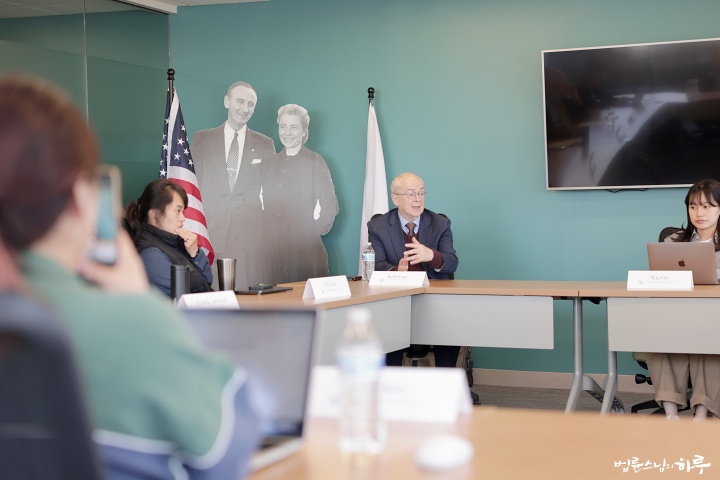
Sunim asked the other participants for their understanding and continued the conversation with Frank Jannuzi and Keith Luse separately in another room.
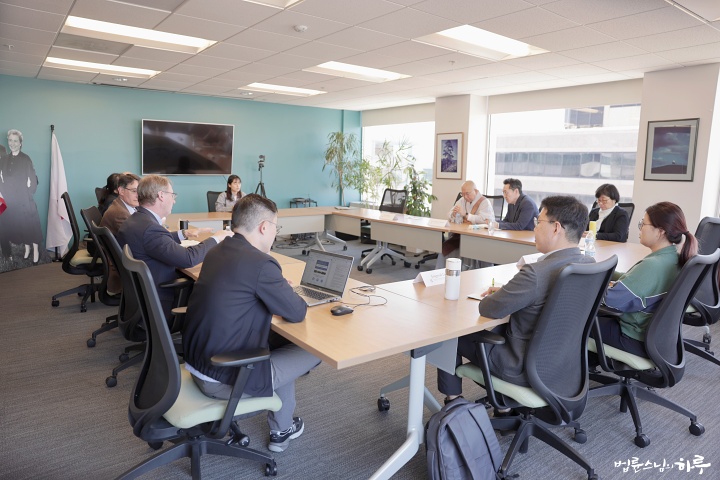
It was 3 p.m. before all the roundtable meetings at the Mansfield Foundation concluded. Particularly at the close of today’s meeting, Sunim shared that it had been 30 years since he began his work on North Korean issues in 1995, and that his relationship with Frank and Keith Luse had grown to span 25 years. Sunim emphasized once again the resolve to successfully bring closure to the U.S.-North Korea relations that had remained unresolved for 30 years, and conveyed parting words filled with determination.
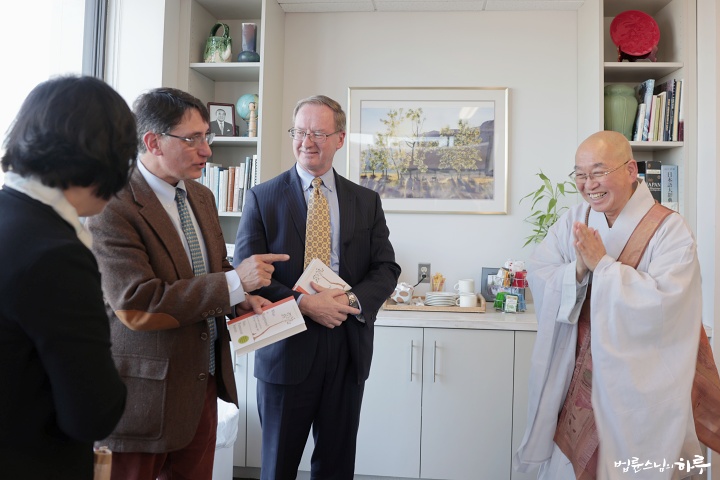
Sunim also presented English-language books to President Frank Jannuzi and Senior Research Fellow Bruce Klingner. President Jannuzi expressed his gratitude, saying he had been trying to put Sunim’s teachings into practice and that the book he received today would be the next one he would read after the book he was currently reading.
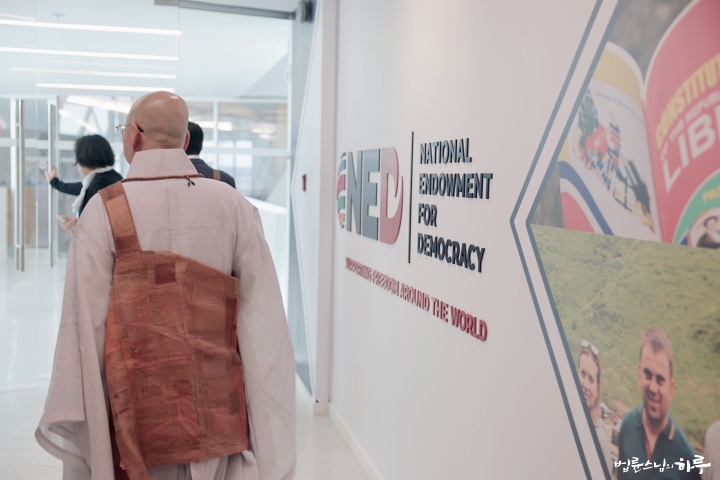
The next meeting location was the conference room of the National Endowment for Democracy (NED).
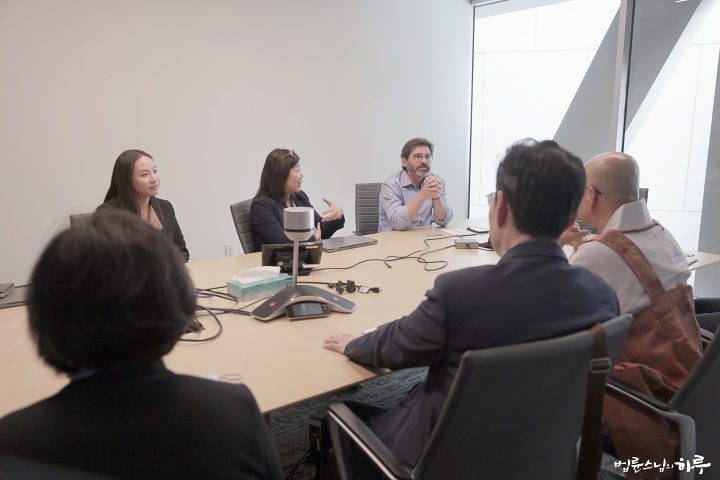
Director Lynn Lee and East Asia Program Officer Jiyoon Kim warmly greeted Sunim. The NED Vice President soon greeted Sunim as well, sharing that he had long been involved in refugee issues, including in Myanmar. Director Lynn Lee introduced Sunim, mentioning his support for Rohingya refugees in Bangladesh and refugees in Mae Sot, Thailand. Sunim also shared about his recent visit to Myanmar to provide assistance following the earthquake damage. Sunim and Director Lynn Lee discussed various topics including recent U.S. trends, the situation at NED, and Congressional matters. Looking forward to meeting again in September, Sunim presented an English-language book as a gift, exchanged greetings, and moved on to his next appointment.
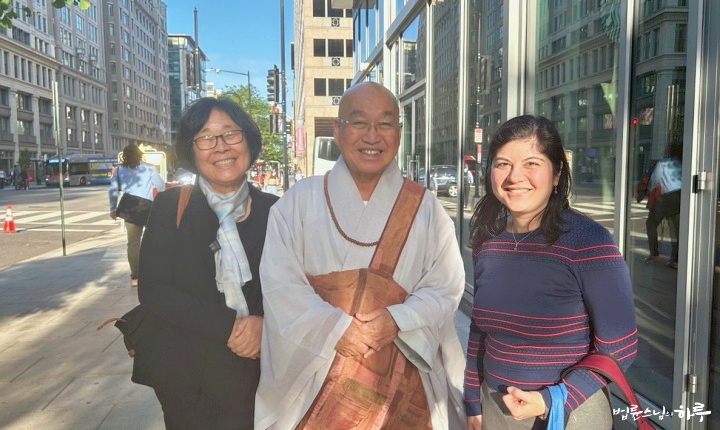
Immediately following, Sunim met Ms. Nina Soyer at a café near the NED office. Ms. Nina currently works at the Department of Defense. As this week was a leave period for her departmental transfer, she had been waiting near the final meeting location to meet with Sunim. She shared that she would be moving to another department starting next week, and they discussed peace on the Korean Peninsula. Sunim presented the English book ‘What is Happiness’ to Ms. Nina, and the meeting concluded around 6:30 p.m.
After completing all five scheduled meetings for the day, Sunim got into the vehicle and returned to the Washington DC Jungto Center. At 7:30 p.m., he arrived at the center and had a late dinner. After the meal, he took a brief rest, organized his things, and prepared for the Weekly Dharma Assembly.
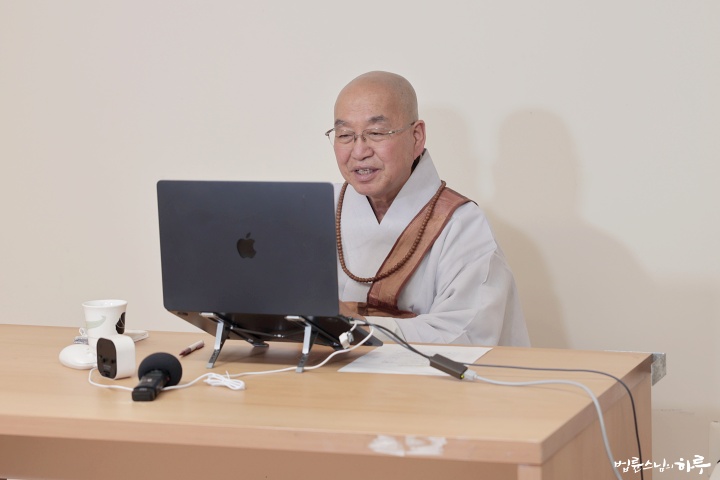
At 9 p.m. local time, which was 10 a.m. on Wednesday the 13th in Korean time, the Wednesday Weekly Dharma Assembly was broadcast live. After reciting the Three Refuges and the Heart Sutra, everyone watched the “Weekly News of Jungto Practitioners” video together. The participants requested the Dharma teaching from Sunim with the Dharma Request Song and three bows. Sunim began his Dharma talk by sharing news about his Washington, D.C. schedule.
“I am currently in Washington, D.C., in the United States. I departed from Korea, arrived in New York on Sunday evening, and reached here by car at 3 a.m. After meeting with a few people on Monday, today I began meeting with individuals connected to Korean Peninsula peace here in Washington, D.C. The goal is to normalize relations between North Korea and the United States through dialogue, followed by normalization between North Korea and Japan, and then between South and North Korea, thereby establishing peace on the Korean Peninsula. I came here to work toward maintaining a peace where there will be no more war, amidst the complex global situation. I’m not sure how much help my visit and meetings will be, but I have come hoping to be of even some small help, meeting with those involved. I will be staying here until this weekend. Also, a meditation hall has been built at the Washington DC Jungto Center. Due to various reasons, the construction did not proceed smoothly and took nearly 7 years. Those who undertook the construction worked through many hardships and built a wonderful meditation hall. The opening ceremony will be held this Sunday. Going forward, Jungto members in the eastern U.S. region will be able to do retreats and meditation here. The weather is nice here. It’s beautifully spring-like May weather, just as enjoyable as in Korea. I hope our Korean Peninsula can also be as peaceful as this weather. I wish that Korean people could live a little more happily. Today during my meetings with external figures, while discussing the issue of peace on the Korean Peninsula, someone asked, ‘What do you mainly do, Sunim?’ I answered, ‘I work on a happiness movement to bring peace of mind to people.’ They asked, ‘How do you carry out a happiness movement?’ I said, ‘We’re running a national happiness promotion movement through a program called the Happiness School,’ and then they asked, ‘What does the Happiness School involve?’ That person said, ‘Next time you come, I’d like to gather leaders of American society for a conversation about happiness. I’d like to arrange a dialogue with you, Sunim, inviting the chairman of the world’s most famous polling organization to bring survey data on happiness.’ The reason I’m sharing this is because humans have believed that increasing conveniences of life, such as food, clothing, and shelter, would bring happiness, and we have developed civilization accordingly. However, rather than becoming happier, the world has become more conflicted and complicated, and we experience more stress. So it seems we are arriving at the realization that material development alone cannot truly make humans happy, and since happiness is ultimately felt in the mind, we must manage our minds well. After I spoke about this a few times, these people quickly agreed. Also, whenever I gave the book “What Is Happiness” to people I met, everyone was pleased. For Jungto members, the Jungto Dharma School or Happiness School programs may seem ordinary, but they are actually essential for our society today. So we also discussed the hope that the Happiness School conducted in English will begin soon. Though I am far away, I will begin my conversation with all of you by sharing this news.”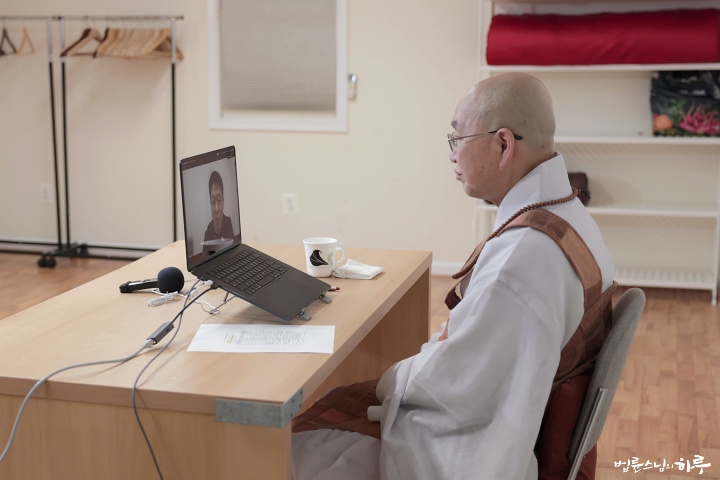
Sunim had a conversation with three pre-selected questioners. Among them, this post introduces a question about what kind of attitude and standards one should have when viewing content in a media environment where deepfake technology has advanced to the point where fake content is created to look real.
Deepfake Technology Makes It Hard to Tell What Is Real and What Is Fake.
“With the recent development of deepfake technology that can even synthesize voices, fake videos have become very common. There are even YouTube channels that misappropriate your image, Sunim, by creating thumbnails that look like Venerable Pomnyun Sunim with captions like, ‘I listened to Sunim’s lecture and good things happened to me.’ When I watch some of the channels that pop up through Sunim’s algorithm for a little while, I can tell, ‘This isn’t our Sunim’s teaching.’ On one hand, I feel proud thinking that such channels exist because our Sunim has become well-known. But on the other hand, I’m worried that it will become increasingly difficult to distinguish what is real. In the past, we had to be careful of deceptions using real faces, but now with the advancement of technology, fake faces and voices are being made to look real, and I feel afraid that I won’t be able to trust anything I see. In this era that is convenient yet anxiety-inducing, I’m curious about what mindset we should have to live without being deceived by media. I’m also curious about what criteria we should use when watching videos related to Sunim other than the official Jungto Society channels.”
“The advancement of technology means that as convenience increases, so do the risks. Just as using letters is convenient, but creating writing can lead to problems of plagiarism. Also, when we use a seal, we can confirm that a person verified something personally, but doesn’t it also come with the side effect of being subject to forgery? A knife is conveniently used for various purposes, but it can also become a weapon. Gunpowder is very useful for things like mine development, but in war, it becomes shells used to kill many people. Like this, the technologies we develop for convenience can cause that much harm when misused. This is not just a problem of deepfakes but applies to all technologies. So we must use technology beneficially while always being vigilant about the side effects it brings. Until now, when you saw Sunim’s face, you thought, ‘Ah, that’s Sunim.’ But from now on, you shouldn’t judge that it’s Venerable Pomnyun Sunim based on the face or voice alone. You need to listen to the content and verify it yourself. There was a similar situation in the time of the Buddha. The Buddha spoke of four scenarios where, in the future when he would no longer be present, someone might appear claiming, ‘I heard this directly from the Buddha,’ or claiming to have heard it from an elder monk or great teacher who had heard it directly from the Buddha. He said that just because such conditions are attached, you should neither unconditionally accept nor unconditionally reject what is said. Listen to the story carefully and compare it with what the Buddha has said up to now. He established the criterion: if the content aligns, accept it; if it does not align, do not accept it. Among the many writings we call Buddhist scriptures today, there are actually many apocryphal scriptures, that is, fake scriptures that are not the Buddha’s words. As countless scriptures were created throughout history, many stories of seeking blessings, tales of hell, and stories of miracles resulting from prayer became mixed in. Such content is far from the Buddha’s original teaching. However, in later periods, faith has often been formed centered around such things. When we speak of the Buddha’s teaching, we need to see whether the content aligns with the law of dependent origination, the Middle Way, and the concept of emptiness (空) in Mahayana Buddhism. If it aligns with that flow, you may accept it, but if it does not align, no matter how much someone claims, ‘The Buddha said this,’ or ‘Someone who heard it directly from the Buddha passed this on,’ you should not accept it. I will tell you the same thing. Even if it appears with Sunim’s face and voice, look at the content and examine whether it aligns with the practice perspective you have heard from Venerable Pomnyun Sunim up to now. If it aligns, accept it; if it does not align, do not accept it. For example, a story like ‘I placed seven red beans outside my front door on the spring equinox, and good fortune came in’—isn’t that different from what Venerable Pomnyun Sunim would say? Stories of the type, ‘I did this and that, and received blessings,’ don’t fit. If you ask whether it’s too difficult to distinguish these things, I would say no. In the past, we judged authenticity by face and voice, but now since anyone can imitate those, if you adopt the perspective that you must judge by content going forward, it’s not too difficult. However, some elderly female practitioners, when they see my face and hear my voice, think, ‘Hmm, that’s strange. Has our Sunim changed recently?’ and then follow it anyway. There was a case where someone called her daughter and said, ‘Venerable Pomnyun Sunim said good things will happen if you do this,’ and the daughter responded, ‘Mom, Sunim doesn’t usually say things like that, does he?’ That’s how it was reported to us. So we found out that way. The mother sensed something was off but believed it anyway because of the face and voice. Going forward, if anything seems even slightly strange, please contact Jungto Society to inquire. Even if there’s a Jungto Society logo, that too can be faked. Don’t think too complicatedly; if you listen to the content, you can quickly tell. Don’t be too attached to appearances (相) like voice or face; look at the content. These days, since it’s becoming harder to make fakes of Venerable Pomnyun Sunim, they use Venerable Beopjeong Sunim’s face, and when that’s blocked too, they deceive by attributing things to Venerable Seongcheol Sunim. But if you think about whether those teachers would normally say such things, you can quickly tell it’s a fake someone created. In conclusion, don’t worry too much, don’t be confused, and just examine the content carefully.”After the Dharma Q&A ended, Sunim listened to the questioners’ reflections. This post introduces the reflection of the questioner who asked about deepfake technology and Sunim’s closing remarks.
“I was truly amazed that the Buddha foresaw the future 2,600 years ago. Honestly, I have felt annoyed when I clicked on a video thinking it was Sunim’s teaching but found out it wasn’t. I felt like I had wasted my time. I think rather than being anxious and afraid, I will feel at ease if I only watch verified channels. I also realized that in daily life, I should become someone who can see the essence rather than being swayed by people’s appearances. Thank you.”
“Watching only verified channels is one good method, but if you take on the role of verifying whether there’s anything incorrect on Sunim’s channel, you can watch anything, right? You can watch anything while examining the content and thinking, ‘This isn’t Sunim’s content, this needs to be reported,’ becoming someone who verifies things yourself. Watching only verified content means living while pursuing only safety. If you’re not careful, you can still be deceived. You can be deceived by the very notion of ‘verified channels.’ Watching verified channels is good as a first step. However, you don’t need to confine yourself too much to verified channels. How did the person who created the fake Sunim make the content? How did they create the voice, and what content did they use? ‘This is how people would be deceived… I should report this to reduce the harm.’ If you watch media content with this perspective, there’s no need to be afraid. Watching slightly more verified channels is a passive attitude. If you take a more active perspective of ‘I will verify,’ I think you will become more free.”
Tomorrow is Day 2 of Washington D.C. meetings. Sunim will spend the day visiting Congress and holding various meetings with think tanks and other groups.