Going Forth (출가 : 出家) is the Starting Point of Enlightenment
March 26, 2026 - North Korea Reality Meeting, Commemorative Dharma Assembly for the Day of Leaving Home
Hello. After the North Korea Reality Meeting breakfast, Sunim held a commemorative Dharma assembly for the Day of Leaving Home.
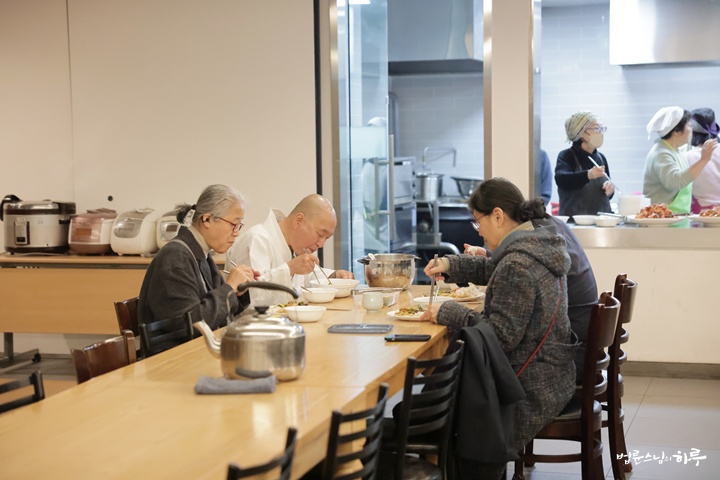
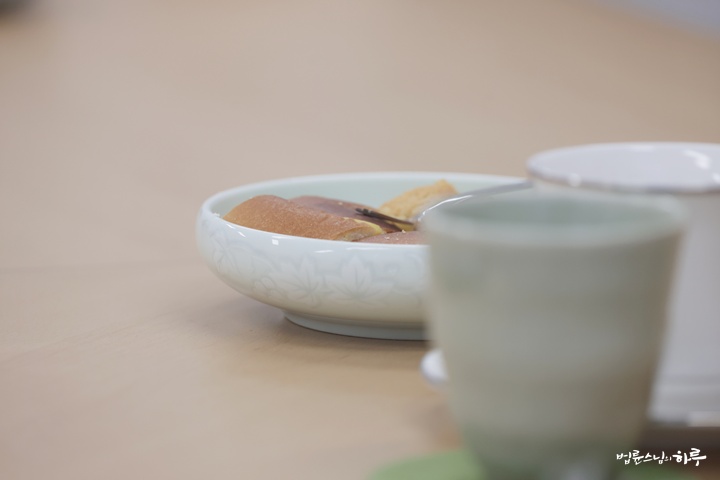
At 7 AM, Sunim had breakfast with North Korea experts in the basement cafeteria of the Jungto Social and Cultural Center, then moved to the conference room to discuss the reality of North Korea. The breakfast table featured spring vegetable dishes and pancakes made with day lilies and wild garlic that Sunim had personally harvested at Dubuk Jungto Retreat Center.
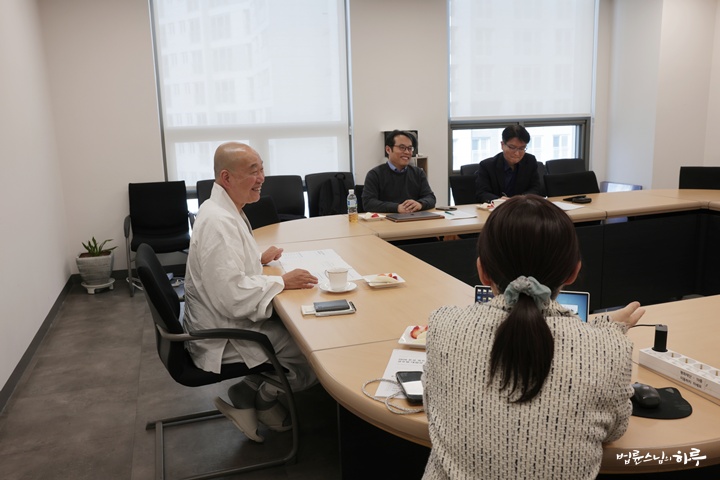
The North Korea experts first examined North Korea’s prices and exchange rates, as well as the living conditions of its citizens from various angles. The experts freely exchanged opinions about concerns over the recent surge in exchange rates and the resulting increase in daily necessities prices, prospects for worsening food conditions during the spring shortage period, and the possibility of improving North Korea-US relations.
After briefing on North Korea ended, Sunim had a brief meeting before the commemorative Dharma assembly for the Day of Leaving Home. A lay Sangha practitioner who had completed their practice with three bows yesterday was waiting to request a word from Sunim. Sunim encouraged them to maintain a practitioner’s perspective and continue their diligent practice.
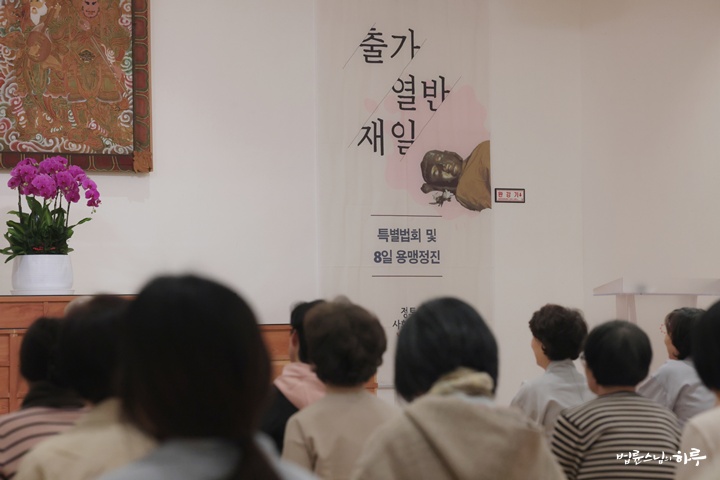
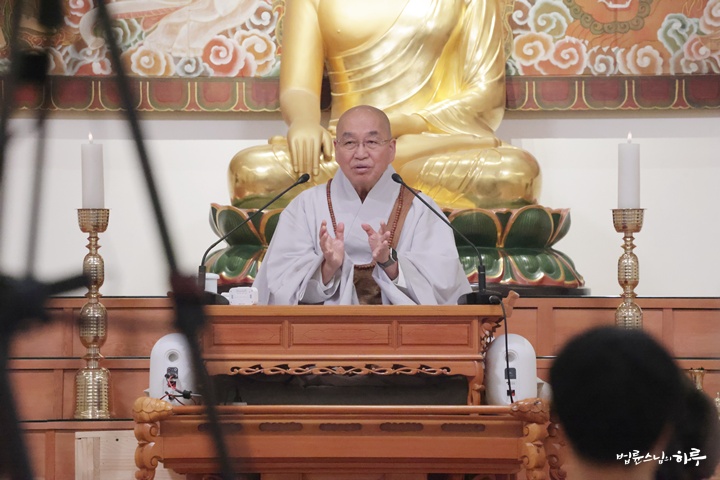
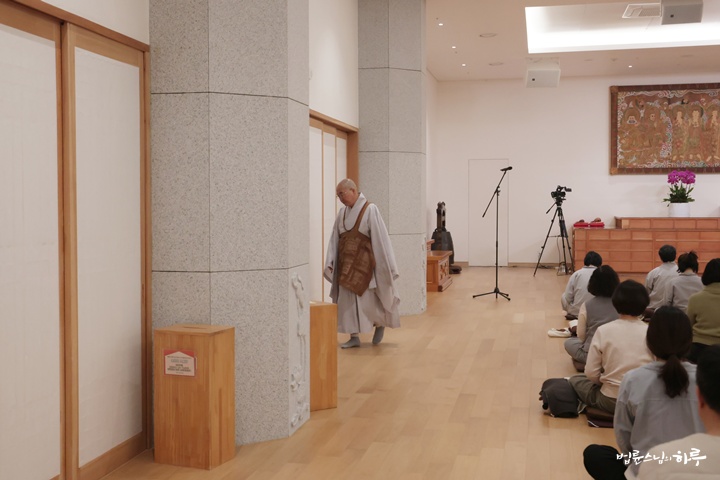
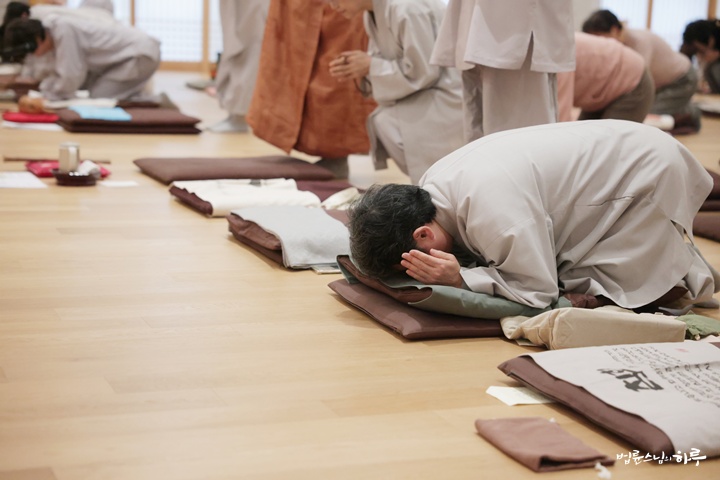
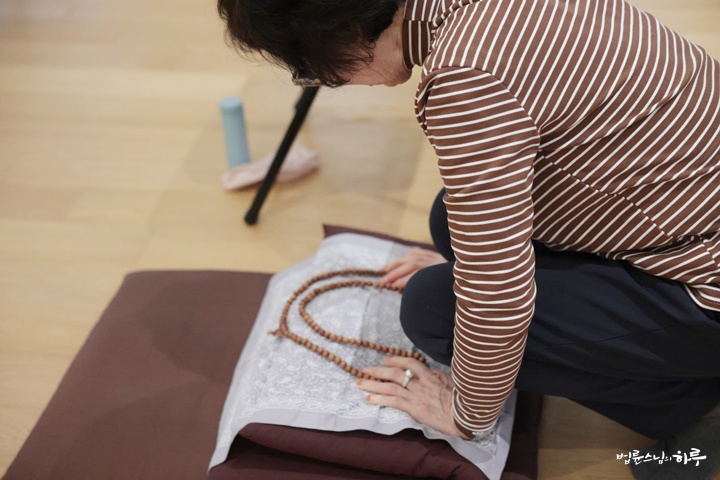
From 10 AM, the opening Dharma talk for Renunciation Day and Nirvana Day was held at the Dharma Hall of the Jungto Social and Cultural Center. The 8th day of the second lunar month is the day Buddha left home. Seven days later, the 15th day of the second lunar month, is the day Buddha entered nirvana. At Jungto Society, members attend daily Dharma assemblies and practice 300 prostrations for eight days to commemorate the Day of Leaving Home and the Day of Entering Nirvana. Today is the first day of this practice.
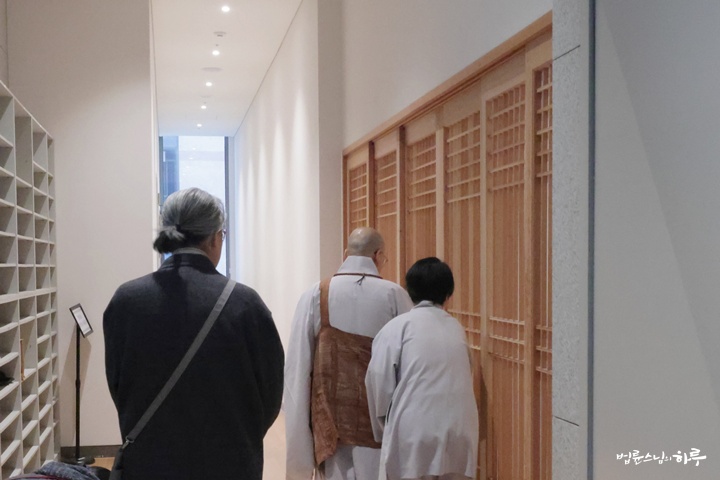
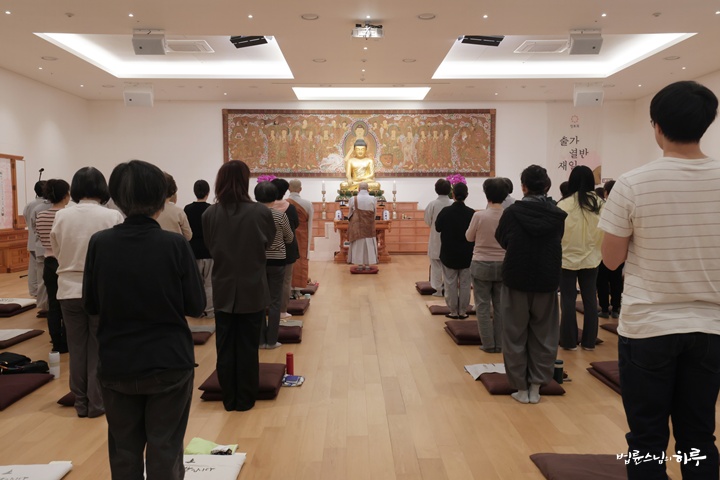
About 120 members had arrived early at the Dharma Hall to attend Sunim’s commemorative Dharma assembly for the Day of Leaving Home, while others listened to the Dharma talk online. The assembly sang the verse requesting the Dharma and to request a Dharma talkfrom Sunim.
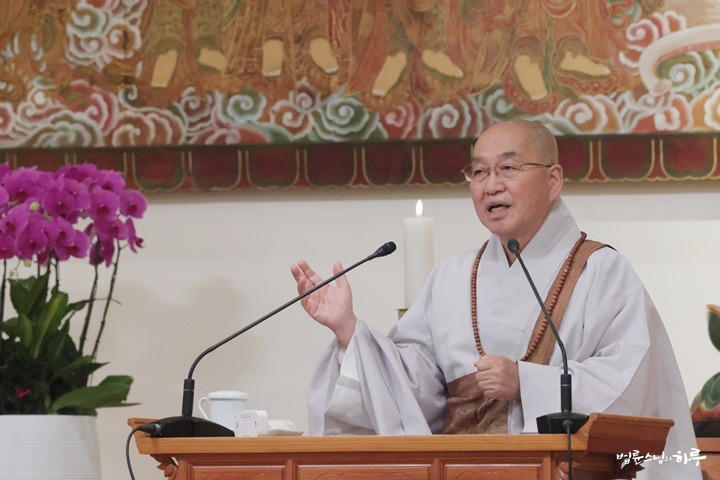
Wandering Between Comfort and Bondage is ‘Running Away’
A home is a place that protects us. As a building, a home has a floor to prevent moisture, walls and a ceiling to block wind and rain. Inside, it protects us from wind, rain, heat, and cold. That’s why we consider home a place of comfort. However, on the other hand, a home is also a place where the ceiling, walls, and floor are all closed off. When we’re inside, we become confined. In other words, a home is also a place that binds and restricts us. It is both a place that protects us and a place that confines us. When the protective function of home is strong, we long for it; when its confining function is strong, we want to leave. Those who leave home are called wanderers. Wanderers are characterized by loneliness, as they have no place of protection. These concepts of home and wanderer can be expanded further. When we broaden the concept of home, it becomes our hometown. Living away from one’s hometown is called living in a foreign place, and those who live this way can also be called wanderers. Expanding the concept further, home becomes one’s homeland. Immigrants who leave their homeland to live in unfamiliar countries can also be called wanderers. The reason wanderers leave their homes or hometowns is because they feel suffocated by the constraints. They leave the bondage of their familiar place for the freedom of living elsewhere, but when that life feels too lonely, they may return to their hometown or find a new home. Thus, when we leave home, we become lonely ‘wanderers’ without protection, and when we return home, we feel suffocated by the constraints and plan to leave again. This state of constantly moving back and forth between comfort and bondage, this endless wandering—this is the essence of the ‘running away’ that we repeat that.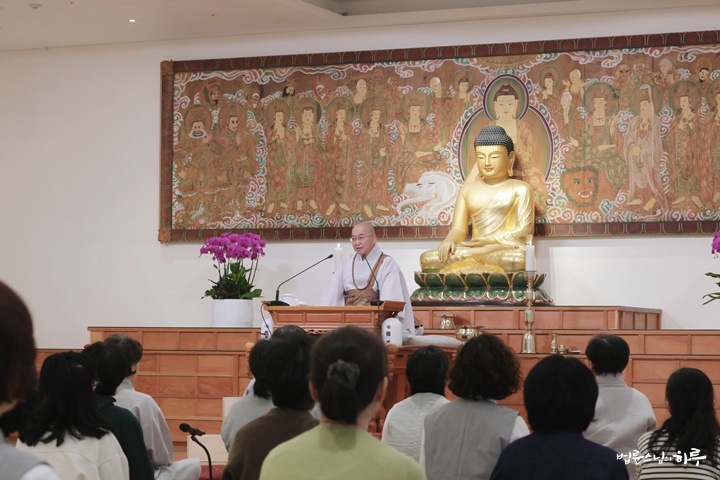
‘Leaving Home’ Is Burning Down the House
On the other hand, ‘leaving home’ means seeing through the duality of the house. It means realizing that while a house protects us, it is actually the source of bondage that constrains us. Therefore, leaving home is not about finding another house, but rather like burning down the house, declaring ‘I will never return home again.’ Here, ‘house’ doesn’t simply mean a building, but includes all family relationships, positions, honors, and even one’s hometown that protect us while simultaneously binding us. When we go to a foreign place, no one knows us, but in our hometown, there are many people who know all our childhood mistakes, our status, and our age, and who define us by them – this is the bondage that hometown brings. ‘Leaving home’ means departing from all these bonds in search of new hope and true freedom. Our life is samsara, where suffering and pleasure repeat endlessly. The fact that suffering and pleasure repeat means that pleasure is ‘not sustainable.’ In other words, it means suffering arises. The sustainable state where suffering does not arise, free from the cycle of samsara – this is called nirvana. Therefore, to abandon suffering, we must automatically abandon pleasure as well. Similarly, to escape from bondage, we must simultaneously give up comfort. But we are drawn to the sweetness that comfort provides, thereby inviting the pain of bondage upon ourselves. Thus, we constantly wander between this bondage and comfort, between suffering and pleasure. If we realize that comfort is bondage itself, we will not cling to any comfort. No matter how large the house, it becomes meaningless; no matter how fine the clothes, how delicious the food, how beautiful the spouse, children, or parents, or how prestigious the position of a king – knowing these are all causes of bondage, we let them go without any attachment.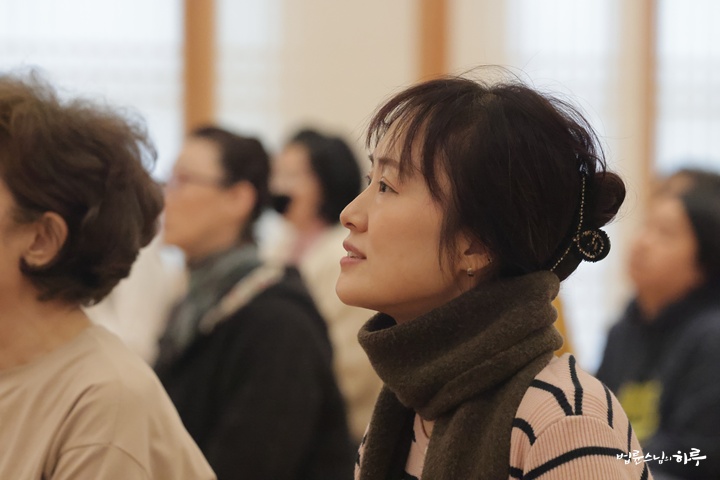
Why We Should Value Feces Like Gold
There’s a Korean saying that goes, “They defecate and don’t even look back.” This saying implies that feces are useless. However, the process of turning food into feces requires many steps and efforts. Food ingredients must be cooked and eaten. Once eaten, they must be chewed with teeth, mixed with saliva in the mouth, digested in the stomach, and further digested in the intestines before finally being expelled as feces. If we view this as a factory production line, feces are products that emerge after going through an enormous process. Shouldn’t we then value them like gold? But why do people defecate and not look back? If we become attached to results, then feces are precious. However, we have already enjoyed all the joy throughout the process of making feces. We found joy in farming, joy in cooking, joy in eating, and absorbed all the energy during digestion. Therefore, feces are ultimately just the remaining “waste.” That’s why we discard them without regret. Similarly, when you complete your own artistic work, that artwork is exactly like feces. What you wanted to enjoy during the process has already been enjoyed, and what remains is just “feces.” Yet most people’s lives are spent clinging to that feces.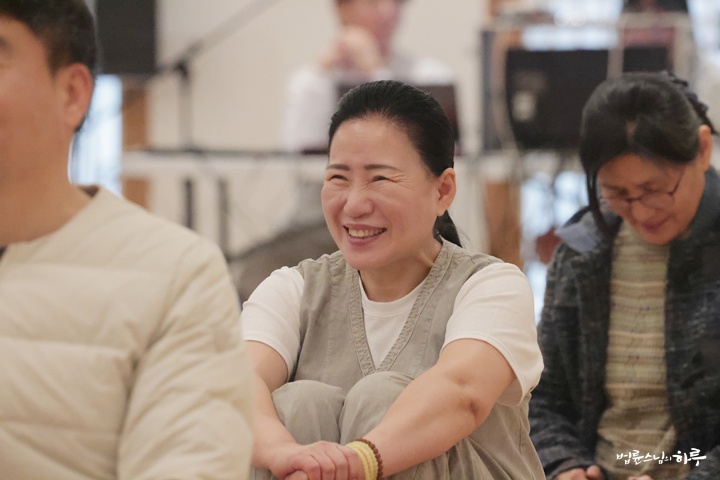
Renunciation as the Starting Point of Enlightenment
The Buddha’s renunciation is called ‘the Great Renunciation.’ Renunciation is the starting point of enlightenment. The perspective on renunciation must be clearly established. Only then does the practice on the path to enlightenment become centered on oneself, with oneself as the subject. Whatever situation one experiences, it becomes something one willingly chooses to do. However, without this perspective, the practice life becomes a continuous series of suffering and asceticism. Eating becomes difficult, sleeping becomes difficult, one must wake up early in the morning, and one cannot go anywhere for leisure. One constantly complains, ‘I’m dying because of this, I’m dying because of that,’ and eventually runs away. That’s not renunciation—that’s running away from home.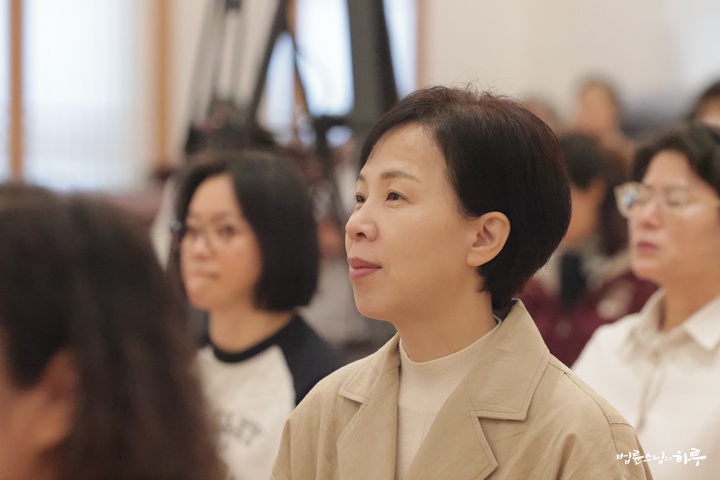
After concluding the Dharma talk, Sunim went down to the basement dining hall and had lunch with external guests.
At 1 PM, there was another meeting with security experts. During the Peace and Security Meeting, participants discussed international affairs including the Iran conflict and prospects for peace on the Korean Peninsula with experts.
At 3 PM, an external guest visited Sunim for a meeting.
After the meeting, at 4 PM, Sunim conducted an administrative review meeting with community staff members. From late June to early July, Sunim is scheduled to visit Sri Lanka with Korean religious leaders. Last July, religious leaders from ‘Dharmashakthi,’ a Sri Lankan interfaith organization, visited Korea for a 4-night, 5-day program and had exchanges with religious leaders from The Peace Foundation’s interfaith group. Dharmashakthi is an interfaith organization where Buddhist, Hindu, Islamic, and Christian leaders work together to promote solidarity and harmony in Sri Lanka, which has experienced over 30 years of civil war and religious conflicts.
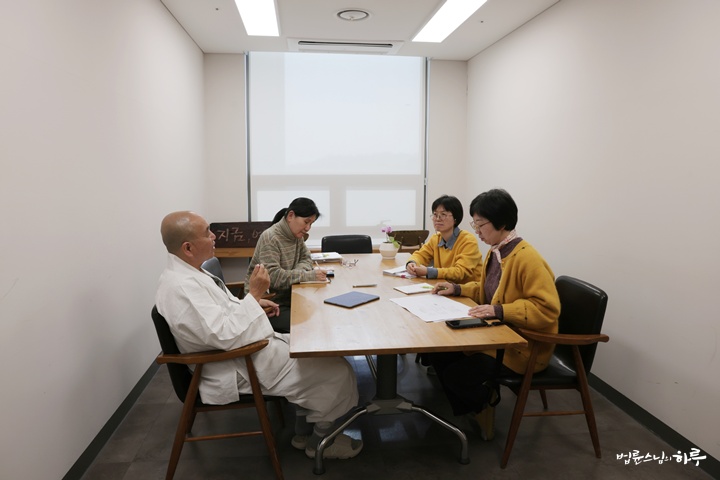
During last year’s visit to Korea, The Peace Foundation held a seminar on the theme of “Asian Interfaith Dialogue for Reconciliation and Peace,” where religious leaders discussed what they could do for peace in various situations in Sri Lanka and Korea. This coming June, Korean religious leaders are scheduled to visit Sri Lanka for exchanges. Sunim discussed practical preparations for this visit with staff members. From 5 PM, there was a discussion about the pilgrimage course for the sacred sites of Namsan Mountain in Gyeongju (경주). Based on the results of last weekend’s field survey, incomplete aspects were supplemented.
Today, Sunim had continuous meetings between breakfast and the morning Chulga anniversary Dharma assembly, and after lunch at various time slots. After the review meeting and finishing administrative work, Sunim packed for tomorrow’s overseas trip. Tomorrow, Sunim is scheduled to depart for relief activities in the Aceh region of Indonesia. He plans to leave for Incheon Airport early in the morning.