Why Do I Feel Anxious Every Day About the Child I Desperately Wanted?
Feb 6, 2026. National Museum of Delhi, Friday Dharma Q&A, Lecture for Korean Expatriates in India
Hello. Today, Sunim traveled to Delhi with the pilgrimage group, visited the National Museum of Delhi, and conducted a Friday Dharma Q&A (금요즉문즉설) broadcast and a lecture for Korean expatriates at the Korean Cultural Center.
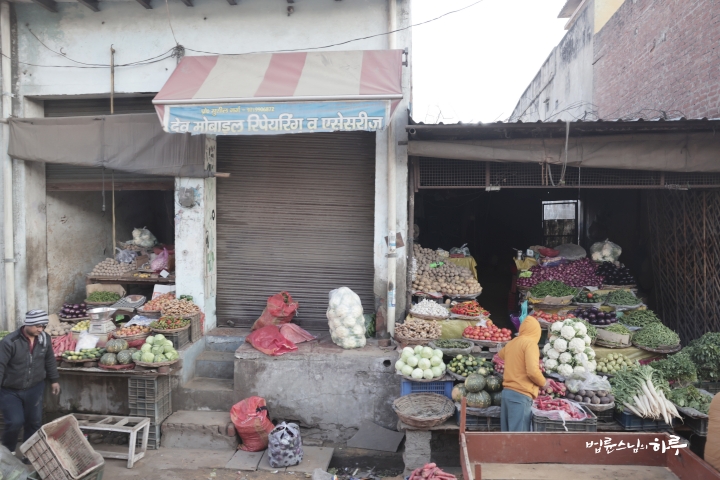
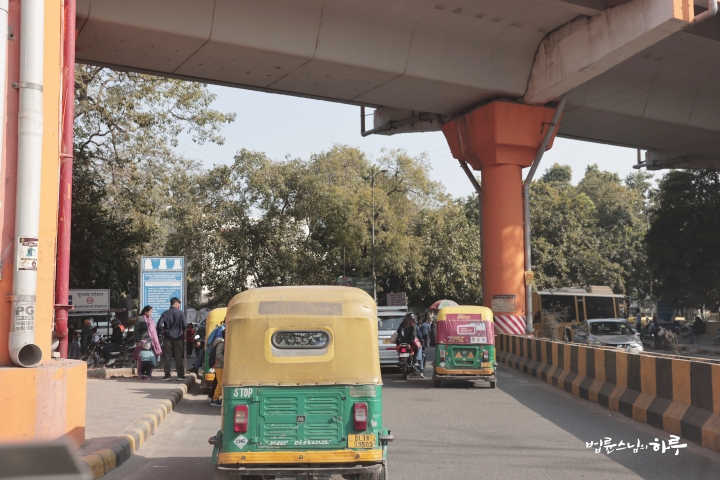
At 3:50 AM, Sunim and the pilgrimage group departed from Sankasia for Delhi. After boarding the bus, they performed morning practice and meditation before falling into a deep sleep. After driving for about 5 hours, they arrived at a rest stop near Delhi at 9 AM.
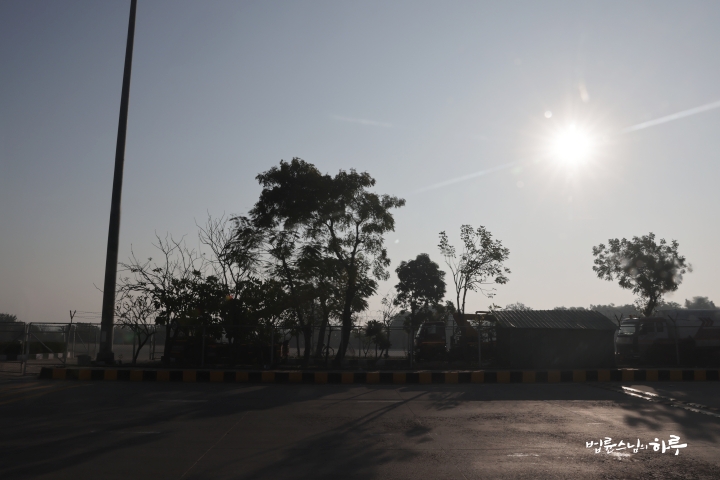
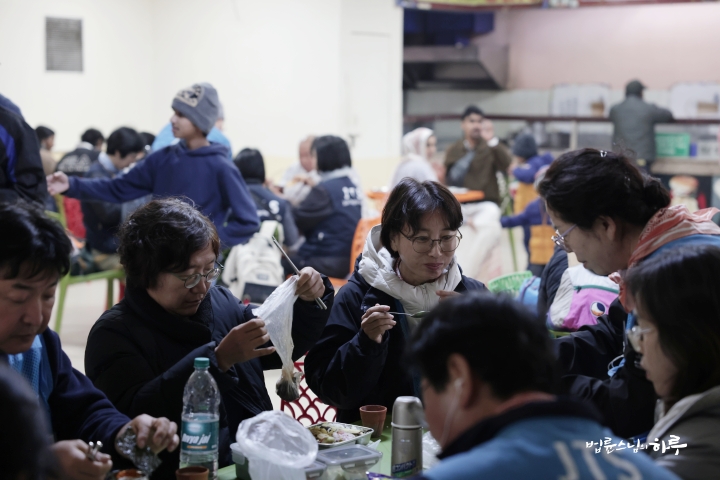
Sunim found a spot at the rest stop and ate a packed lunch with the staff members. The pilgrimage group also spread out across the rest stop to eat their packed breakfasts.
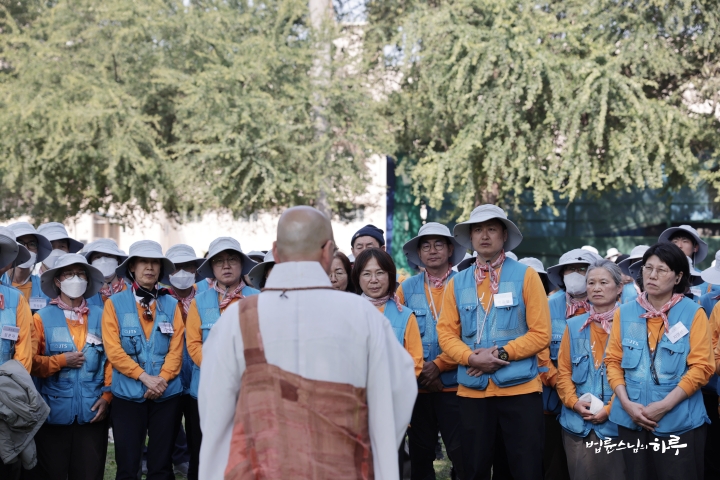
After finishing breakfast, they continued by bus and arrived at the National Museum of Delhi at 11:20 AM. The pilgrimage group decided to tour the museum in three teams. Sunim began guiding the first team that had arrived at the museum entrance.
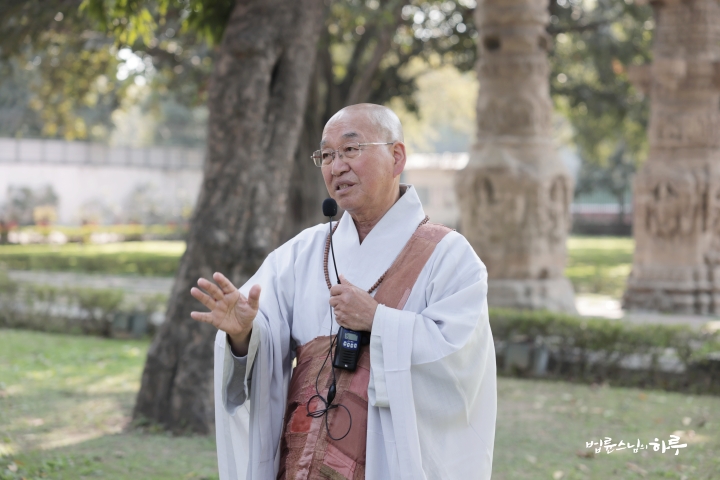
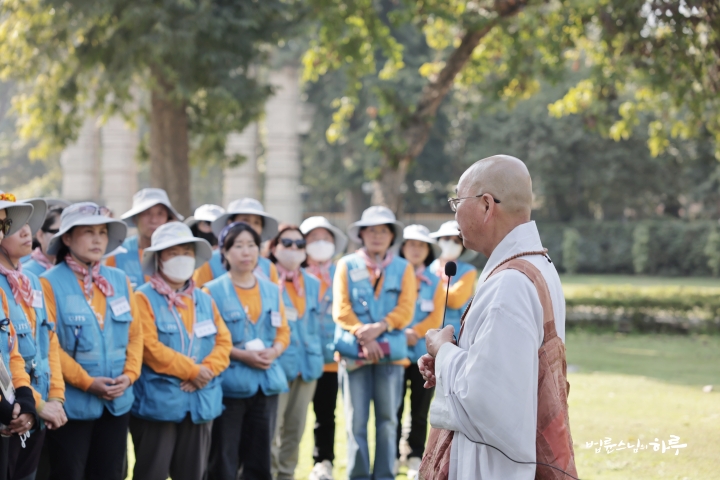
He began by explaining the geography and history of the Indian subcontinent. He explained that the Indian subcontinent is shaped like a triangular peninsula. Surrounded by the Arabian Sea, Bay of Bengal, Indian Ocean, and Himalayan Mountains, it was once like an isolated world. The Indus civilization of the indigenous Dravidian people began around 3300 BCE. He introduced that hundreds of urban civilizations including Harappa and Mohenjo-daro had been confirmed, making it one of the world’s four great civilizations (세계 4대 문명). He informed them that upon entering the museum, they would first encounter the Mohenjo-daro and Harappa civilization halls.
He then explained about the Aryans who migrated from the Afghanistan region over the Hindu Kush mountains around 1500 BCE. He said that as these people with iron civilization cultivated the Ganges River basin, production greatly increased, leading through the Vedic period (베다 시대) to the religious period when the caste system took root, and then to the Upanishadic philosophical period of deep contemplation. He added that during the decline of this civilization, when about 300 countries were fighting each other, various new philosophies emerged including Buddhism and Jainism.
Sunim also explained the relationship between India’s major dynasties and the museum artifacts. He introduced the flow from the Mauryan dynasty of King Ashoka who unified India in the 3rd century BCE, to the Kushan dynasty that came down from the north, and then to the Gupta dynasty that arose from the mainland, noting that most of the remaining stupas and artifacts are from these three dynasties. He also briefly touched on the history through the Mughal Empire’s rule (무갈 제국) and British colonial period to independence.
Finally, he guided them to remove their shoes and offer three bows before viewing the Buddha’s authentic relics (부처님의 진신사리) discovered at Piprahwa, which are enshrined in the museum’s Buddhist gallery. He also recommended visiting the Sanskrit script exhibition room, mentioning that there are many forms similar to Hangeul (한글)and that Buddhist monks were actually deeply involved in the creation of Hangeul.
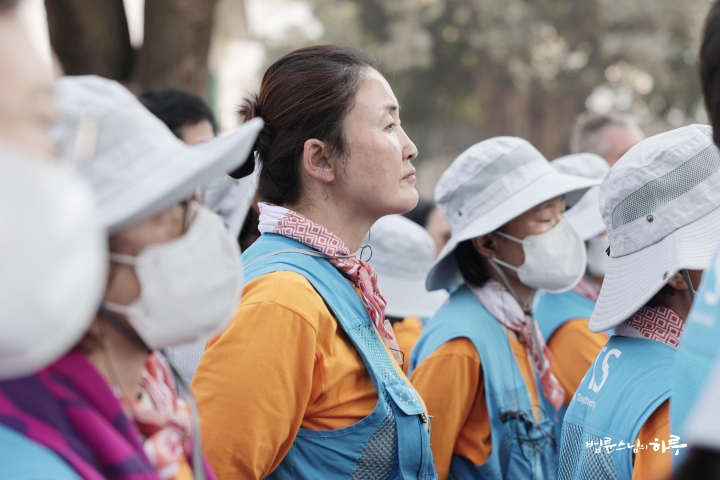
After finishing the explanation, they entered the museum and slowly toured the artifacts. During the tour, he added brief explanations in front of some exhibits.
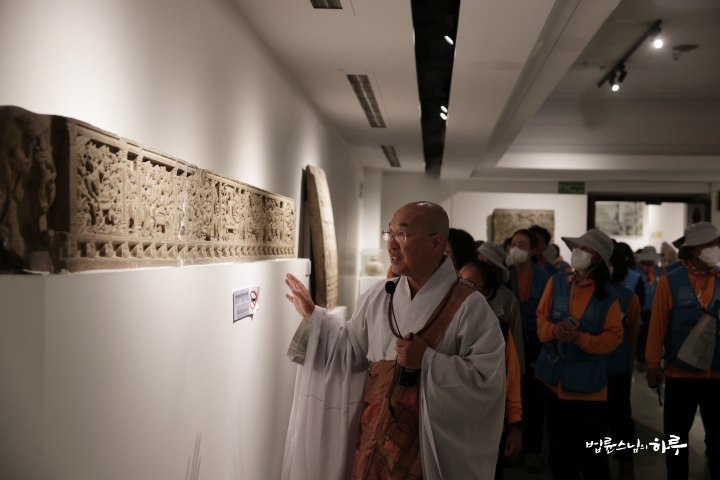
The Buddha’s authentic relics discovered at Piprahwa were displayed in the Buddhist gallery. Sunim led the pilgrimage group to the authentic relics.
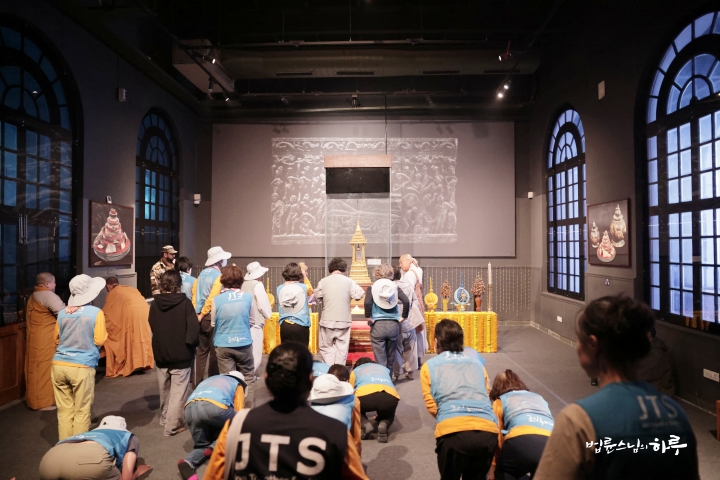
“These are the Buddha’s authentic relics. Let us all offer three bows.”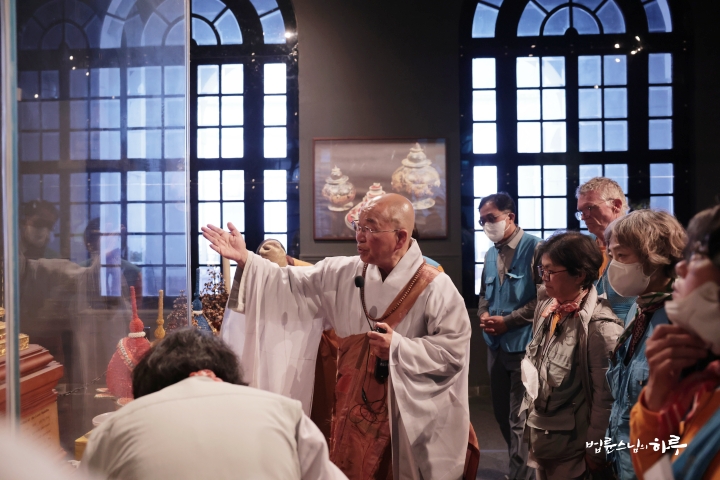
The pilgrimage group offered three bows before the authentic relics.
After finishing the museum tour for the first team, Sunim gave the pilgrimage group free time to explore. The second team arrived at 1:15 PM and the museum tour began.
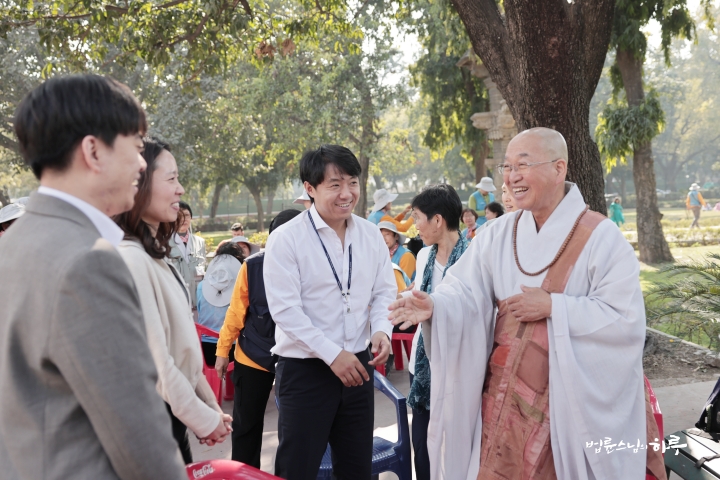
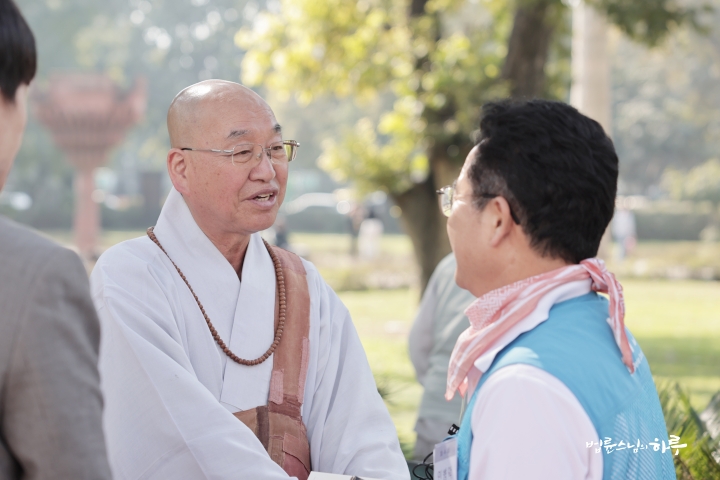
While guiding, consular officials from the Korean Embassy in India came to the museum to meet Sunim. After finishing the second team’s tour, Sunim warmly greeted the consular officials.
“Not at all, Sunim. I’m glad to hear everything went well.”
Sunim presented books to the consular officials. He also extended greetings to Assemblyman Min Byung-deok (민병덕 의원), who had quietly accompanied them during the pilgrimage.
The last team arrived at 1:40 PM.
After finishing the tour for the last team, Sunim moved to the Korean Cultural Center at 2:30 PM for the Friday Dharma Q&A broadcast. Staff members greeted Sunim with flowers at the entrance of the cultural center.
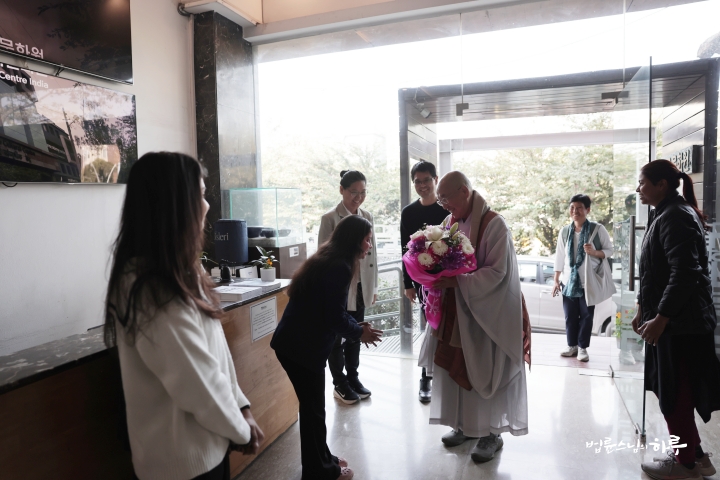
“Welcome, Sunim. Today the director had business at the Korea-India collaborative art exhibition hall and is temporarily away. He asked us to escort you to the director’s office when you arrive.”
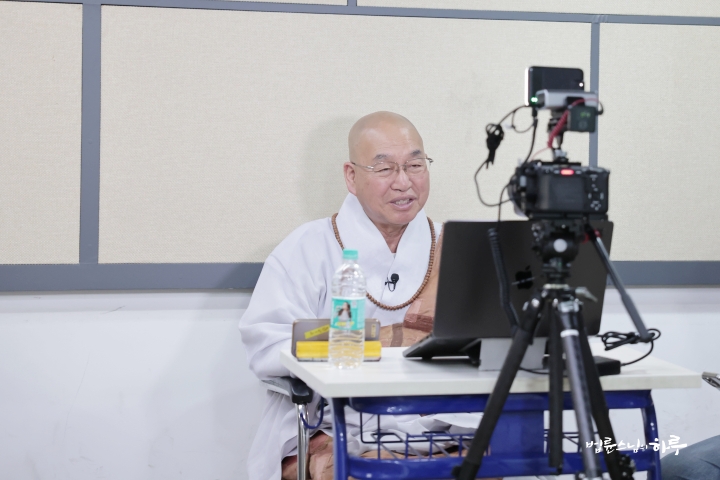
“Thank you.”After editing manuscripts in the director’s office, Sunim began the Dharma Q&A broadcast at 4 PM local time, 7:30 PM Korean time. With about 3,200 people connected to the YouTube live stream, Sunim gave his greeting.
I Can’t Stop Even When I’m Aware of My Anger
“I have trouble controlling my anger, which interferes with my social life. In the military, I finished my service a month later than others, and in society, I’ve received criminal punishment several times. When situations arise that make me angry, I react emotionally immediately, and even when I’m aware of my anger, I can’t control my actions well. I’ve been receiving consistent medication treatment at a hospital for about 10 months. I’m worried about my future and want to change my karma of getting angry easily. Sunim, please help me.” 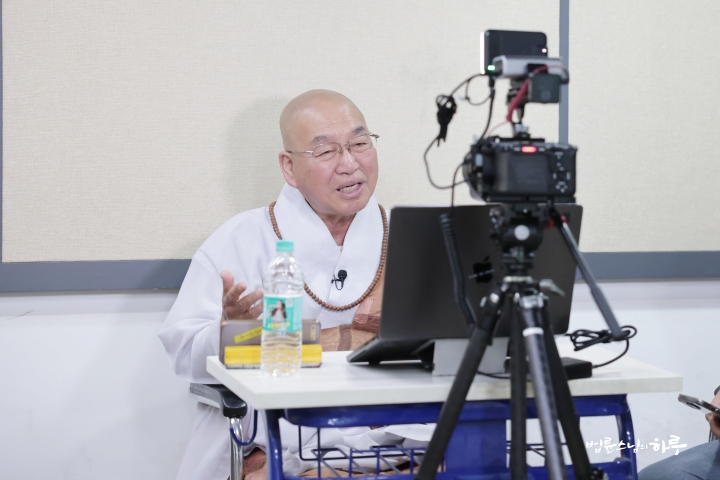
“Yes, right now we’re in the process of adjusting to see if there are side effects when taking a certain amount of medication and whether I sleep well. I’ll consistently take medication as the doctor instructs, and as Sunim says, I’ll do many prostrations and live peacefully from now on. Thank you.”
“Psychiatric medication works to relieve sensitive nerves. So when you take medication, you might feel a bit drowsy and dazed. Because of these symptoms, patients sometimes stop taking medication without consulting their doctor. But while feeling a bit dazed and drowsy gets better after sleeping, if you burst out in anger and curse or hit others, the consequences can be severe. So it’s better to be a little dull than to not take medication and cause accidents. If you can’t control your emotions even with medication, the medication isn’t sufficient. Conversely, if you’re out of it and extremely drowsy, the medication might be a bit too much. So you need some period of meeting with the doctor once a week to adjust the type or amount of medication. But rather than relying too much on medication alone, doing many prostrations while saying ‘I am still learning,’ ‘There is nothing I can claim to be right about’ and doing repentance prostrations is also very helpful. Please try that.”“Thank you. I understand well.”
Questions continued to follow.
I started Buddhism through the Heart Sutra (반야심경), but I’ve become attached to praying for blessings and formalities, and I get angry at my parents. How can I escape from this suffering of knowing Buddhism but not being able to practice it?
After discovering that my husband secretly met another woman, we reconciled, but I still have anxious thoughts wondering if they might be meeting again. How should I manage this mind?
Although the local internet connection was unstable throughout the live broadcast, fortunately the conversations were completed safely. They agreed to meet viewers at Sujata Academy next Friday and ended the broadcast.
After the broadcast, Sunim returned to the director’s office. Soon the Korean Cultural Center director arrived. Sunim and the director warmly inquired about each other’s well-being and exchanged greetings.
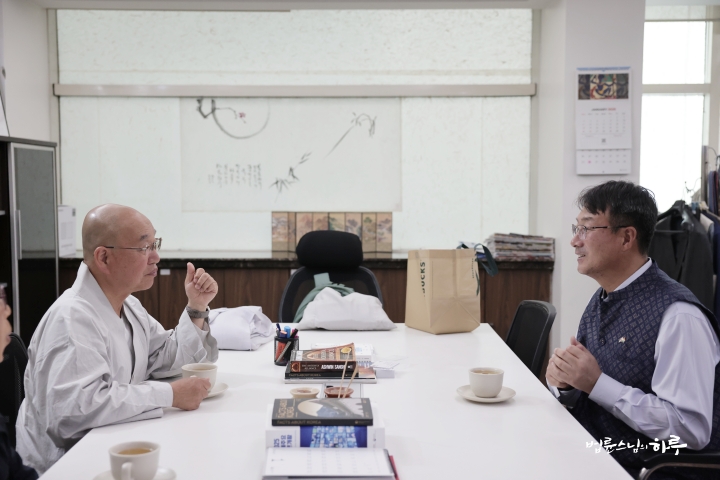
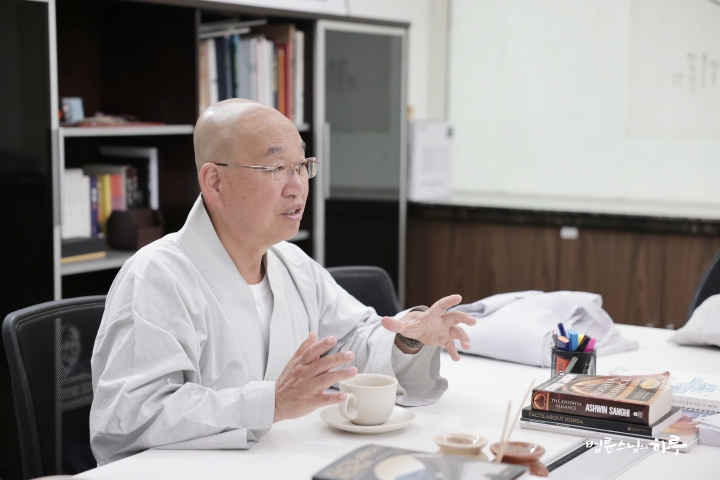
The director shared that the status of the cultural center has changed significantly since the rapid spread of Korean Wave culture following the COVID-19 pandemic. He brought up a recent concern to Sunim.
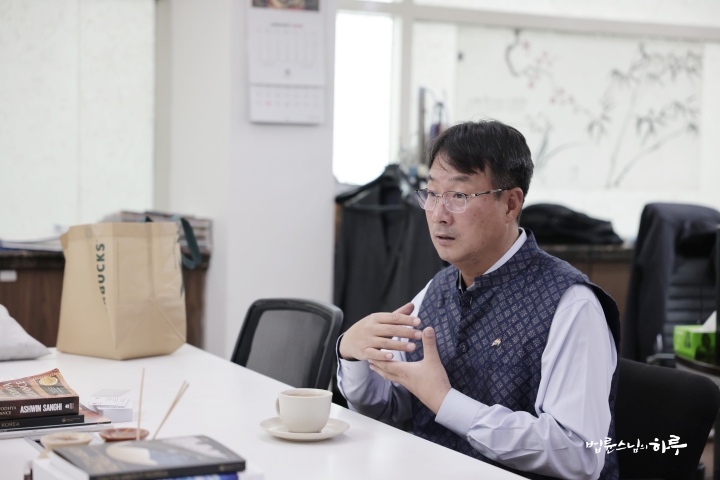
“Sunim, while the status of K-culture has been rising considerably these days, there was an incident near the cultural center. Yesterday, three sisters ranging from early teens to 6 years old jumped from their home in a group suicide. The father stated that ‘the children weren’t going to school and were only absorbed in Korean games,’ and their friends said ‘those children watched so many Korean dramas that they even had Korean names.’ All day yesterday, major local media outlets reported that ‘Indian girls committed suicide because of K-dramas.’
According to the local police, there seem to be family environment issues as well, but with continuous reports blaming Korean culture, I’m at a loss as to how to respond. Fortunately, among the local youth, the prevailing sentiment is ‘how could this be because of Korean culture?'”
While they were talking, the president of the Korean Association came to greet Sunim.
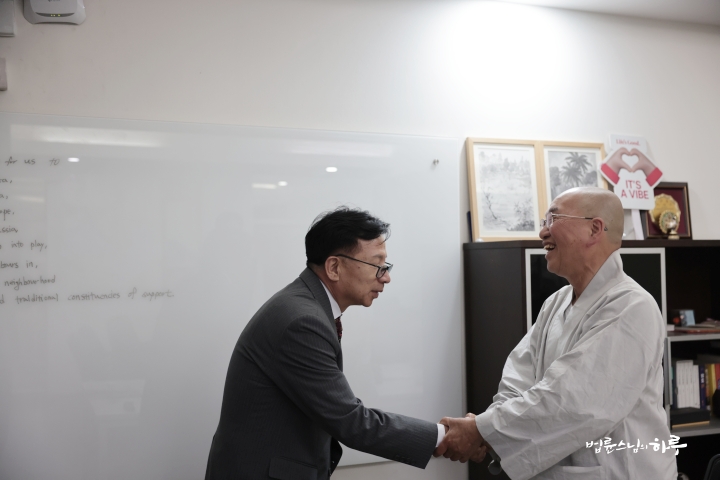
Sunim discussed the current state of the Korean community in rapidly changing India with the association president. Soon it was time to begin the lecture.
At 6 PM, the Dharma assembly for Korean residents began in the cultural center’s basement auditorium. Before the lecture, the association president presented a gift to Sunim as a token of gratitude for never forgetting to hold annual lectures for the Korean community.
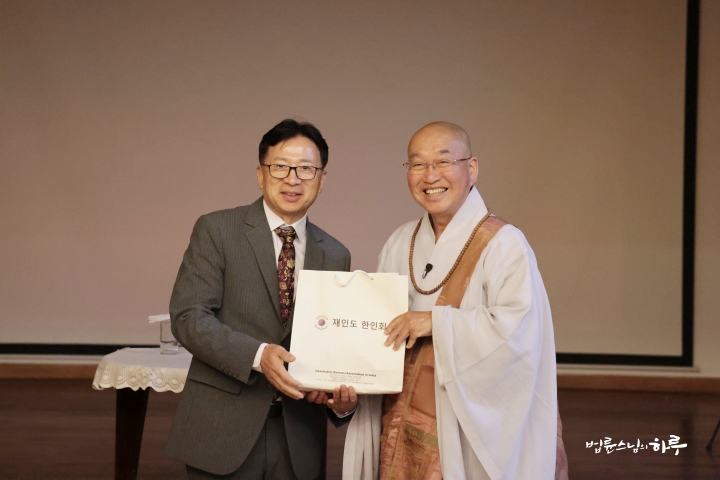
Sunim then took the stage and began the lecture.
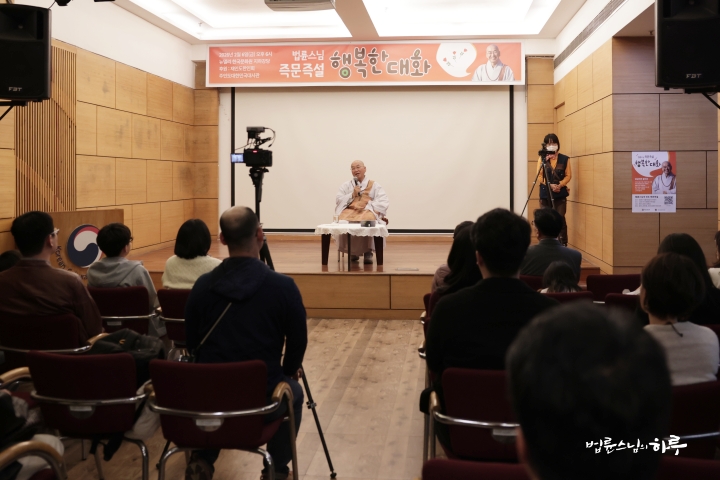
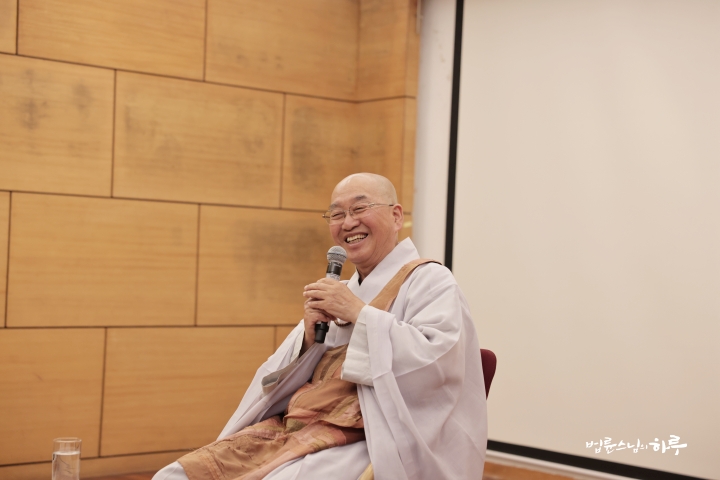
There Are No Difficult Things, We Just Cling to Our Habits
Living like this in India for more than two weeks might seem like a special way of life to modern people today. However, for Indians, this is ordinary life, and it was also common when we were young. I believe that people become awakened by directly experiencing this pilgrim’s life. They come to realize how abundantly and comfortably they live, and how good their daily life in Korea really is. Yet when living in Korea, people complain that this is a problem and that is a problem – they’re full of all kinds of complaints. About 50 young people came this time, and most of them haven’t been able to get married. In India, even when it’s hard to get enough to eat, everyone born as a human being gets married. There’s a place called Tansen in Nepal at about 2,000 meters above sea level, and when you drive up there, you can see mountains like Annapurna and Dhaulagiri clearly. Even people born in these mountains are all living well. Since I also live without getting married, I don’t concern myself with young people not getting married. Choosing not to marry is a good thing. However, objectively speaking, it’s not that they can’t get married. Young people are choosing not to marry. Saying you can’t marry because you don’t have a house is, to put it bluntly, having standards that are too high. Saying you can’t marry because you lack something doesn’t make sense. People say marriage can only last if you like each other, and while it’s good if you do like each other, you can maintain a marriage even if you don’t, and everyone manages to live. When we say something is ‘difficult,’ it’s the mind that finds it difficult, not really the body. We can say the body suffers when we’re enslaved, tortured, or abused. However, what we usually call difficult in daily life is mostly mental difficulty. Mental difficulty means it’s hard to change habits. For someone who doesn’t smoke, is not smoking difficult or easy?”“It’s easy.”
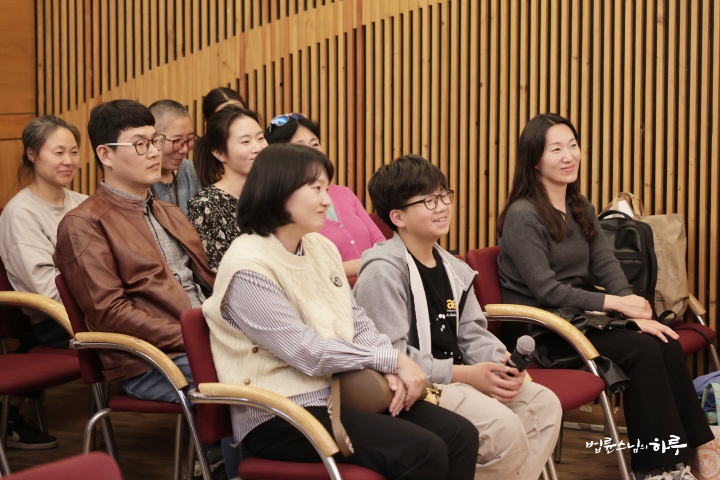
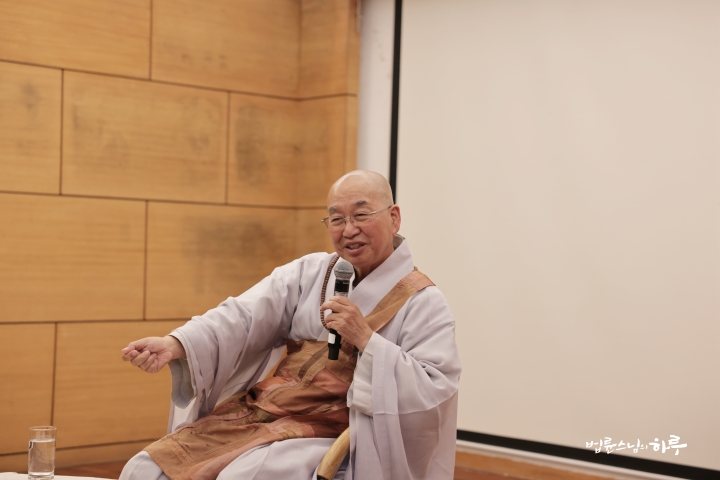
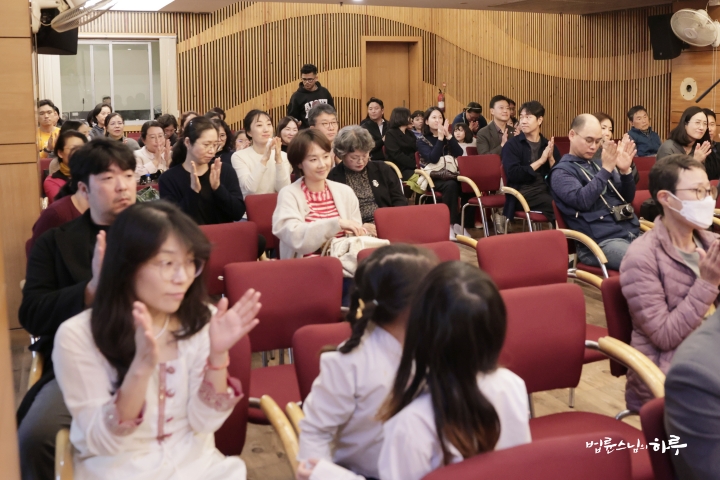
Anyone could then raise their hand and ask questions about their concerns or curiosities. For one hour and forty minutes, eight people had the opportunity to ask Sunim questions. There were particularly many questions from children. Sunim answered the children’s questions with great care and attention.
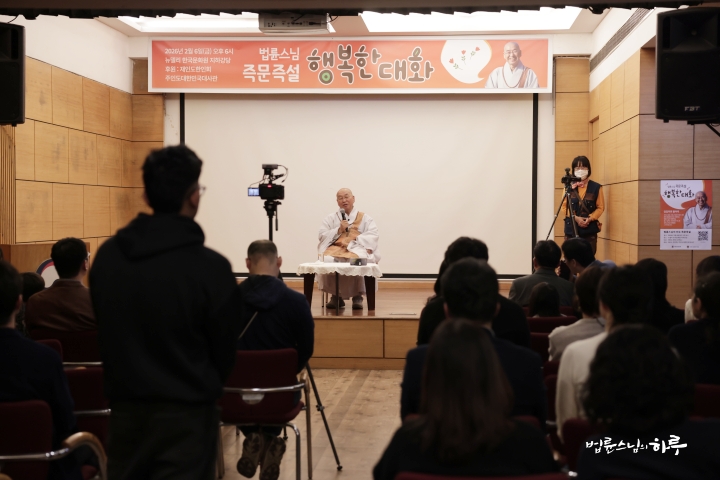
As the conversation was coming to an end, a woman shared her concerns with Sunim. She explained that she had desperately wanted a child and now had a 7-year-old, but she was constantly anxious about something bad happening to the child. She asked Sunim for advice on what to do.
I Desperately Wanted This Child, So Why Am I Anxious Every Day?
“It took me a very long time to have a child, and that child is now 7 years old. I got what I wanted most, but I don’t understand why my heart is still struggling, and I don’t know how long this struggle will last.” 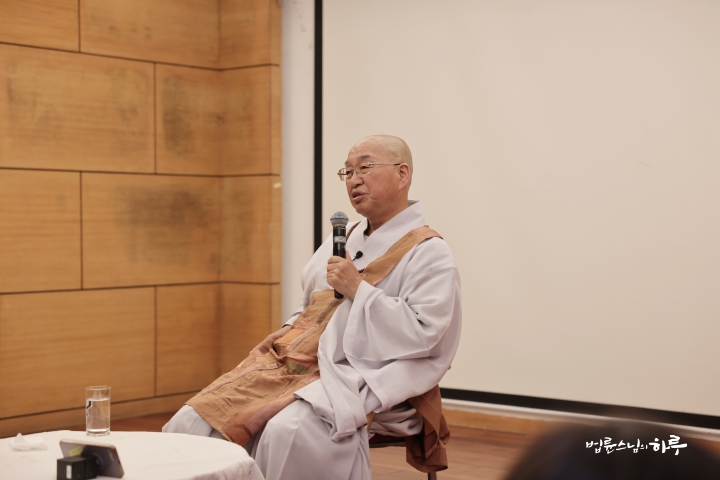
“I’m always anxious that something bad will happen to my child, and I’m most worried that it might be because of me.”
“In the old days, people typically had seven children and raised them without much fuss. This was because it was realistically impossible to care for all of them individually. In poor households, they had to cook with firewood, make clothes from cotton or hemp fabric, do all the laundry at the stream, and tend to the fields. While doing all this and raising seven children, it was realistically impossible to pay attention to each child individually. So mothers only took care of infants, and most children were looked after by their older sisters. As children grew up together, they would fight and develop social skills among themselves. Because mothers didn’t have high expectations for their children, the children could grow up relatively freely. Nowadays, people only have one child, and especially in cases like yours where you waited so long to have a child, expectations for that child are inevitably high. The greater the joy of having a child, the greater the fear of something bad happening to them. This is the cycle of joy and suffering. The more attached you are to money, the greater the pain when you lose it. If you pick up a pebble with little expectation, there’s little suffering when you lose it. The greater the joy of having gold, the greater the suffering when losing it. This is the cycle of samsara (윤회)
. Because you had such high expectations for your child, your fears about the child are inevitably greater than others’. So it would be good for you to lower your expectations for your child a bit.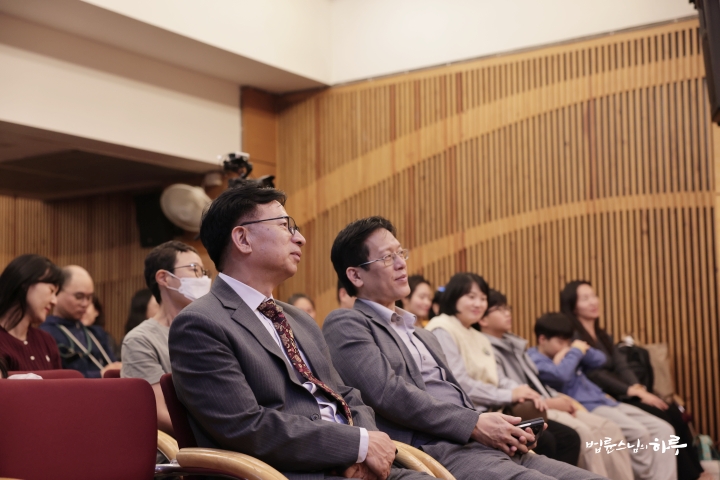
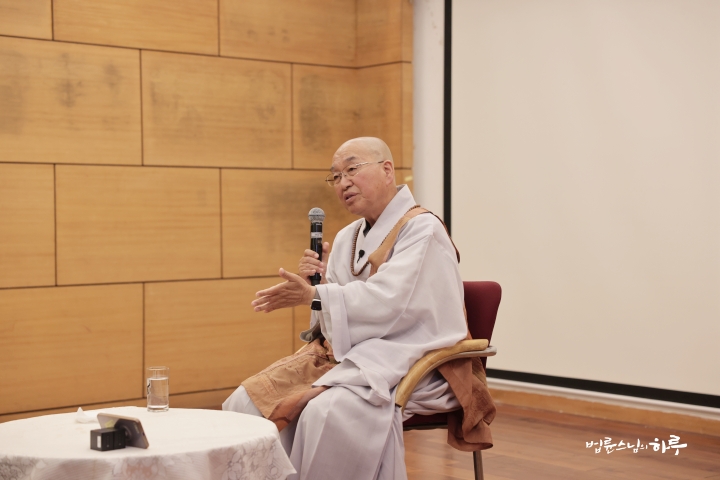
“Thank you.”
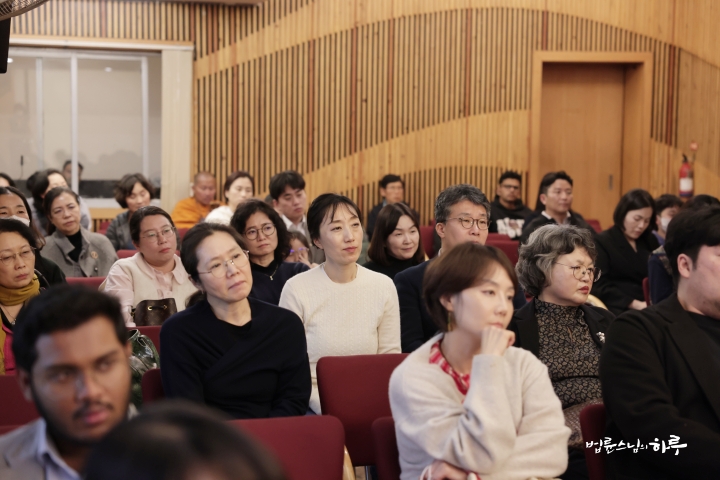
Questions continued one after another.
I’ve been living happily with my children in India, but as our return to Korea approaches, I’m worried about my future without a job and my children’s education direction. How should I guide my children as a parent?
While I’m satisfied with life in India, I’m not clear on whether a satisfying life and a happy life are the same thing. What exactly is happiness as Buddhism defines it?
I have to return to Korea in six months, but I’m anxious because I hear that children my age in Korea are already studying middle school curriculum. Studying is difficult and I don’t want to do it. What should I do?
I’m curious about the existence of aliens. Where do aliens come from?
After seeing death-related scenes on YouTube, Netflix, and other videos, thoughts about death come to me every night. What happens when we die?
When my younger sibling hits or teases me, I get angry and end up hitting them back, but I don’t want to hit them. How can I not hit them when my sibling makes me angry?
I’m living doing what I want within the scope of what I can take responsibility for, but the judgmental looks from people around me asking if a mother should act this way are burdensome. Can’t I live the way I want?
After finishing the lecture, everyone took a commemorative photo together.
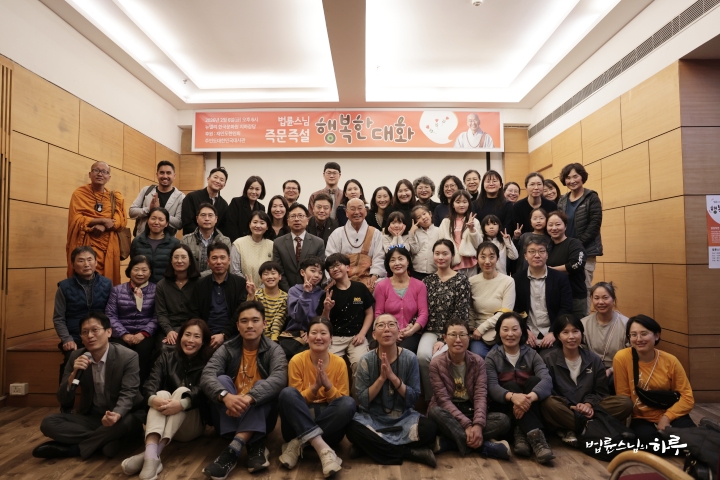
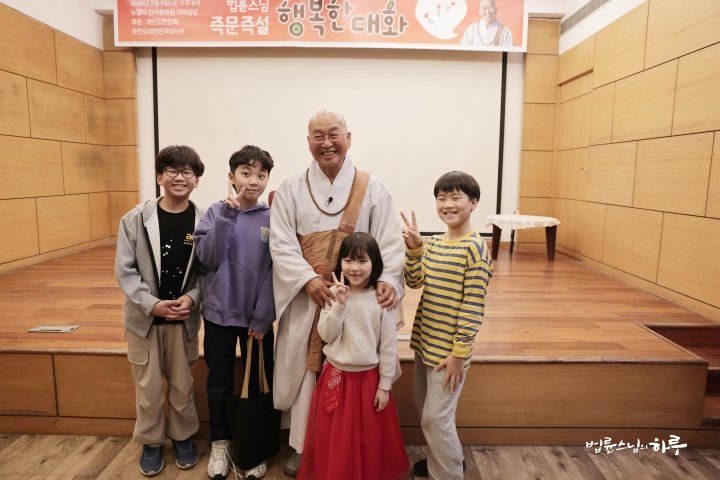
Today there were especially many questions from children. After finishing the Dharma Q&A, Sunim took a separate commemorative photo with the children.
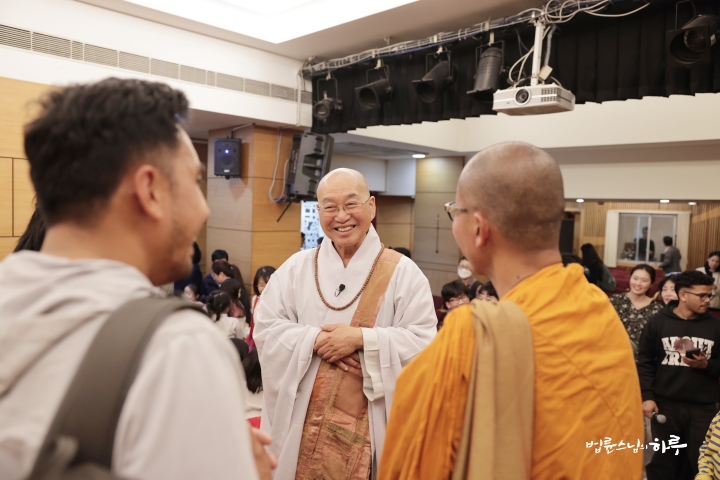
International Division members who had joined the pilgrimage and the consul who visited the museum during the day also attended the Korean community Dharma assembly. A Thai monk who had joined the pilgrimage also participated in the Korean community Dharma assembly and exchanged greetings with Sunim.
After finishing the Korean community Dharma assembly, Sunim had dinner with the Korean community members on the second floor of the Korean Cultural Center, then departed for accommodations near the airport after 9 PM.

It was well past 10 PM when they arrived at the accommodation. Sunim concluded another long day and took some rest.

Tomorrow, Sunim will give a lecture at Delhi University in the morning and then travel to Sankasia.