What Should I Do When I Don’t Feel Like Doing Something?
Jun 8, 2025 - Day 1 of Washington D.C. Visit
Hello. Starting today, Sunim will be staying in Washington D.C. for four days, meeting with many people to work for peace on the Korean Peninsula.
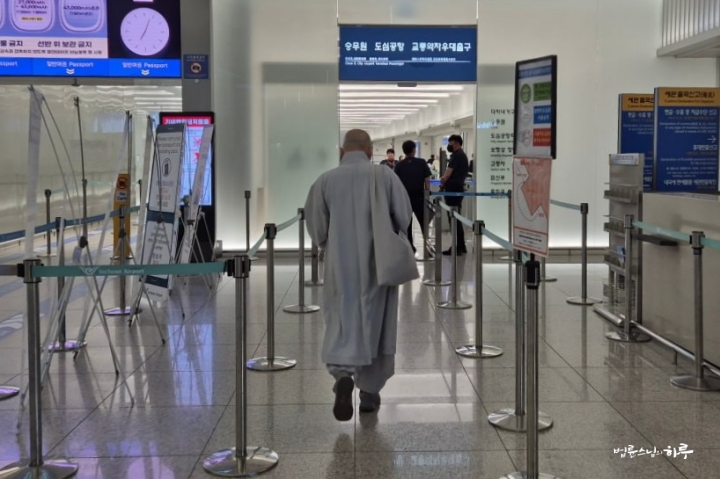
The flight that departed from Incheon at 9 PM on the 8th arrived in San Francisco at 4 PM local time on the 8th after approximately 11 hours of flight. After completing immigration procedures and collecting luggage, Sunim rechecked the luggage for the flight to Washington D.C. After waiting for about 5 hours, he boarded the flight to Washington D.C. at 9 PM.
After a 5-hour overnight flight, Sunim arrived at Washington Dulles Airport at 5 AM on the 9th. Once again, to save costs, Sunim chose a flight with a layover in San Francisco instead of a direct flight. As a result, he arrived in Washington D.C. 21 hours after leaving Incheon. JTS Secretary General Min Deokhong and International Division Director Kim Jihyun were waiting at the airport.
“Sunim, thank you for making the long journey to the United States.”
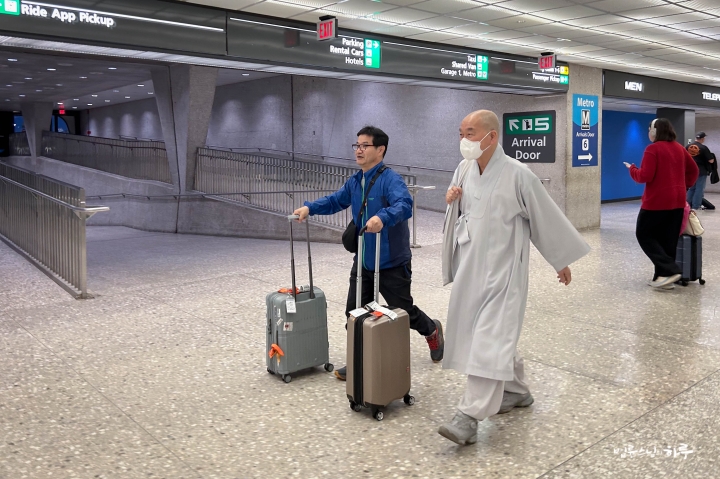
After exchanging greetings, they immediately headed to the US Jungto Society.
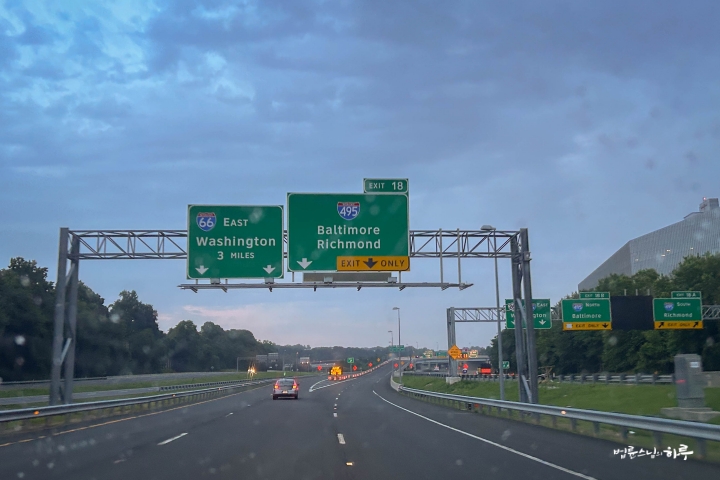
Upon arriving at the center, Sunim first visited the Dharma hall to offer three prostrations and greeted the resident volunteers at the center. The volunteers first offered three prostrations to Sunim, who was visiting Washington after a year, and reported on the construction status of the new building.
“Sunim, the first phase of the new building construction has been completed.”
“Thank you for all your hard work in constructing the new building.”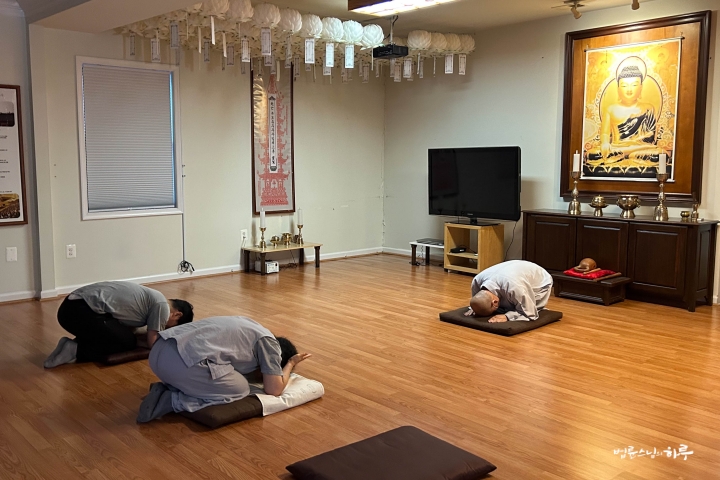
After a simple breakfast, Sunim organized his luggage. He had brought both the Korean and English editions of his recently published book “Buddha the Revolutionary” on the flight. This was a way to save on international shipping costs. After organizing his belongings, he toured the newly constructed building and its surroundings.
“No matter how tired I am, I need to see what needs to be seen.”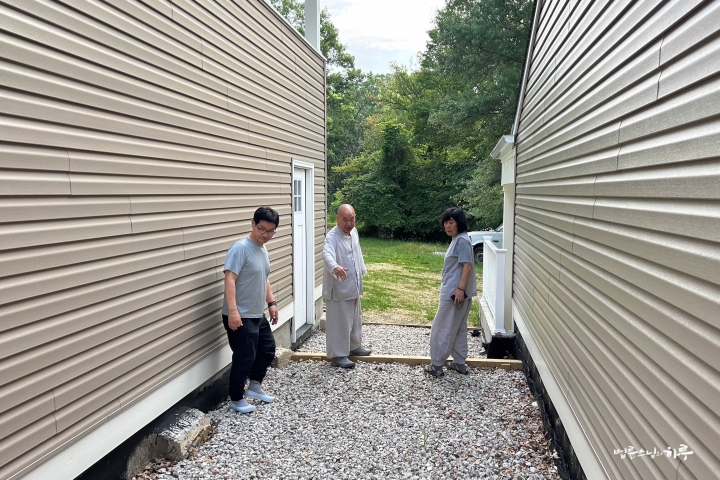
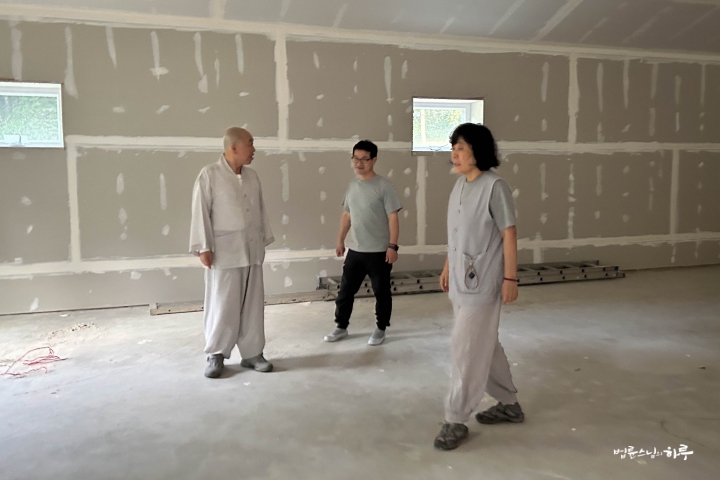
Sunim slowly walked around the center grounds, offering detailed advice. Since the site has a sloped terrain, they discussed how to create pathways for people and water drainage.
“It might be good to use the new building as an auditorium with chairs. Since the ground is low, we need to excavate more soil in front of the building to prevent water from entering. Considering the sloped terrain, we also need to create proper drainage channels. If we’re going to make a garden on the lower side, we’ll need to level the ground.”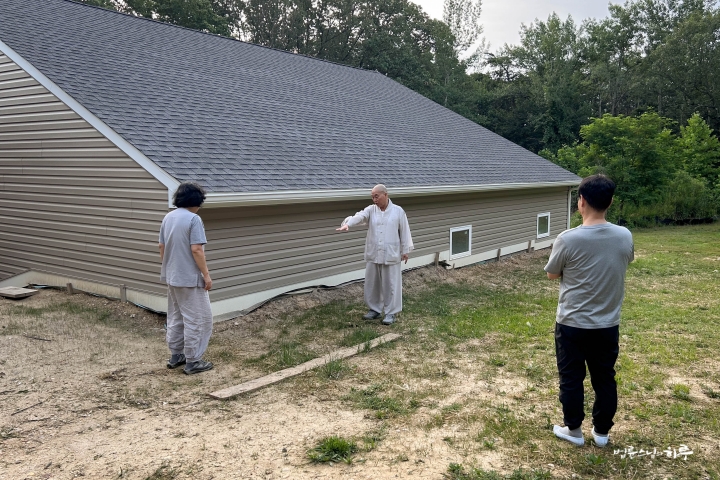
After thoroughly inspecting the site, Sunim took a brief rest before his next appointment.
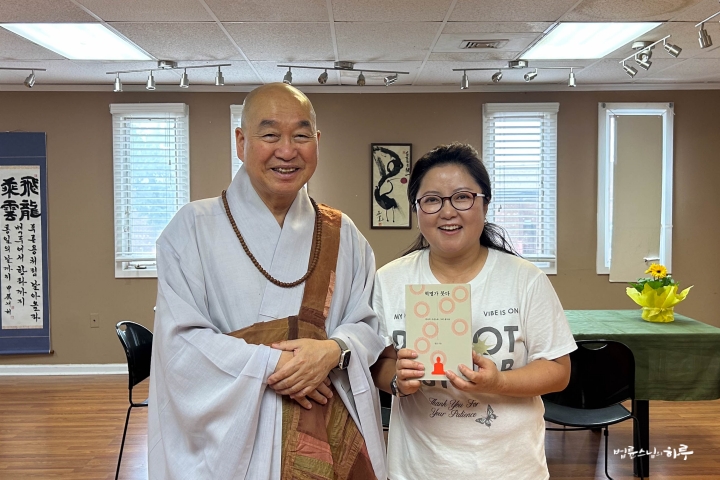
In the afternoon, he had an appointment in Fairfax, Virginia, so after finishing lunch, he left the center. The meeting took place at the William Cho Peace Center, which had previously been rented and used as the Virginia Dharma Center. Upon arriving at the center, Jason, who was in charge of interpretation, greeted him warmly. Kwak Sujin, a member of the International Division, had been cleaning and preparing refreshments since the day before. Sunim helped organize the tables, thanked her for her hard work, and presented her with a copy of “Buddha the Revolutionary.”
At 2 PM, Olin Wethington, former Assistant Secretary of the U.S. Treasury, arrived. This was their first meeting in a year since they last met in Washington.
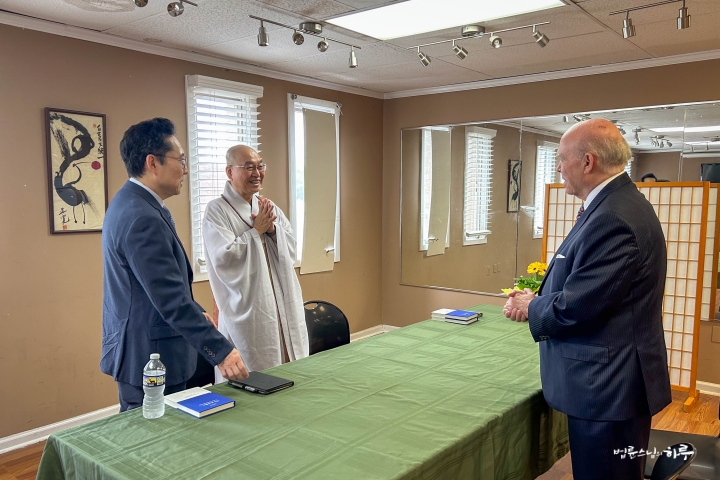
Sunim presented the English edition of “Buddha the Revolutionary” as a gift before beginning their conversation. The two discussed a wide range of topics including peace on the Korean Peninsula, resumption of U.S.-North Korea relations, and sanctions and human rights issues regarding North Korea.
“Recently, North Korea has severed all official communication channels with South Korea and has shifted from its previous stance of pursuing reunification to drawing a line as ‘two hostile states.’ In this situation, there is less room for the South Korean government to act independently. It would be more realistic to first improve U.S.-North Korea relations, and then improve inter-Korean relations.”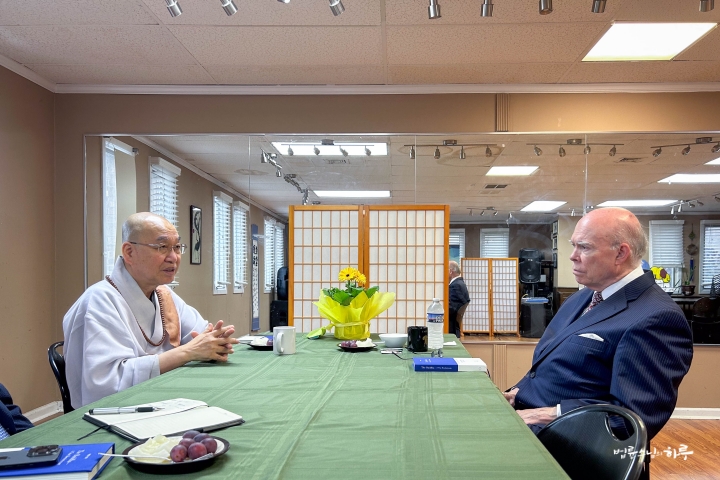
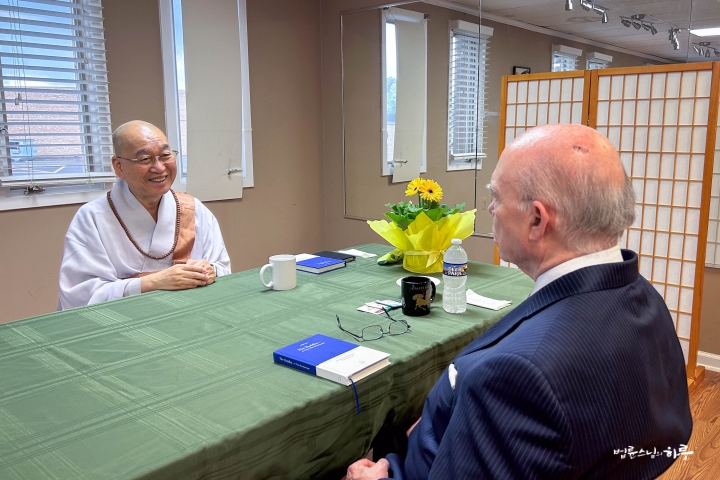
After conversing for over an hour, Sunim made another earnest request to Olin.
“Please provide plenty of advice to the Trump administration so that dialogue between the U.S. and North Korea can resume.”“Yes, Sunim. I hope to see you again.”
Soon after, Michael Jenkins, President of the Washington Times Foundation, Larry Moffitt from the Washington Times, Doug Bandow from the Cato Institute, and Greg Scarlatoiu, Executive Director of the Committee for Human Rights in North Korea, arrived.
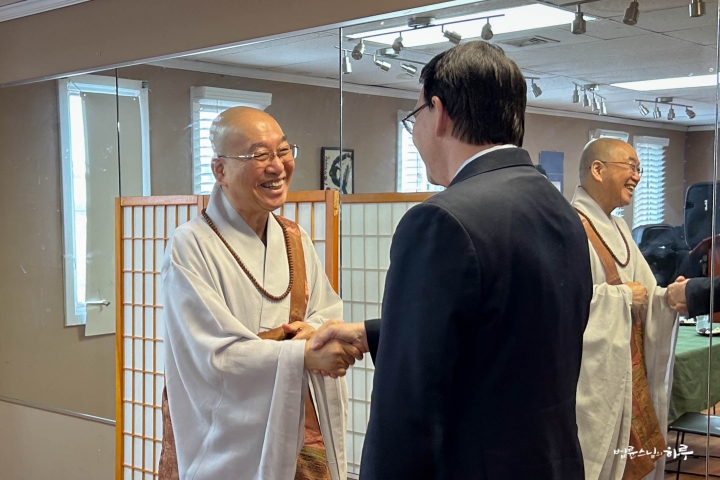
“Sunim, it’s an honor to see you again.”
“Thank you for making time. I should have visited the Washington Times Foundation, but I’m sorry for making you come all the way here.”“Not at all. I live nearby, so it’s fine.”
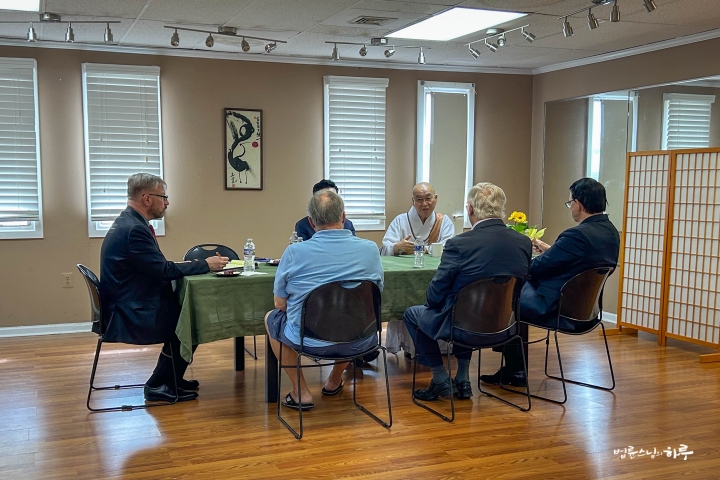
Jenkins informed Sunim that Ambassador Joseph DeTrani, Sunim’s longtime friend and former U.S. Special Envoy for North Korea, could not attend due to health issues. Sunim said he had heard about it and wished him a speedy recovery. Sunim presented each person with an English edition of “Buddha the Revolutionary” and began the conversation. For about two hours, they had an in-depth discussion about solutions for improving U.S.-North Korea relations and peace on the Korean Peninsula.
After the conversation, at 5 PM, they moved to a nearby restaurant. Joining them for dinner were Lee Jae-soo, former president of the Washington Council for Democratic and Peaceful Unification of Korea, Reverend Choi Sang-seok from the Washington Episcopal Church, Jeon Dae-sung, and Christine Ahn from Women Cross DMZ. Reverend Choi Sang-seok is a supporter of Sunim’s activities who provides church venues for lectures on unification.
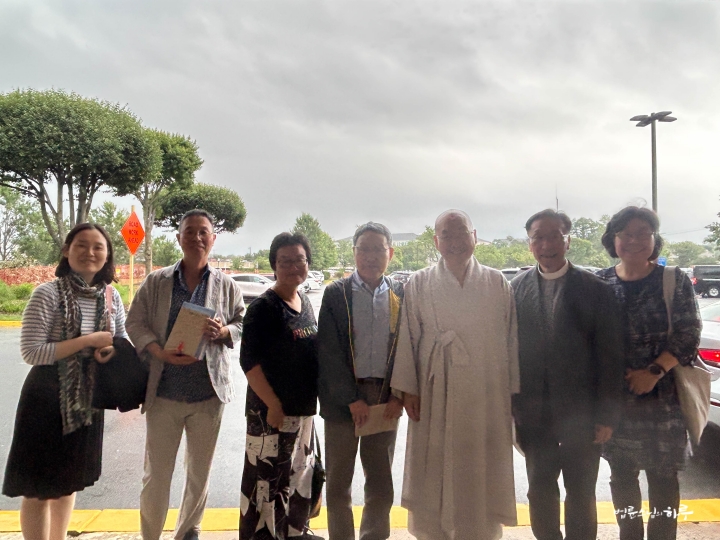
After warm greetings, they exchanged views extensively on recent developments in Korea and the United States, as well as inter-Korean and U.S.-North Korea relations. Sunim thanked President Lee Jae-soo for preparing the dinner and presented him with “Buddha the Revolutionary” and a Korean language dictionary.
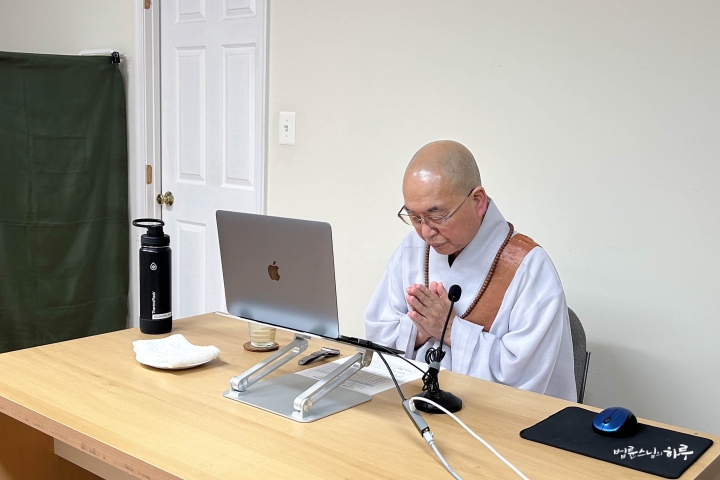
On a rainy night, after returning to the Jungto Center, a live broadcast of the Dharma propagation assembly began at 9 PM. Today was a special day when lead volunteers gathered for a Dharma propagation assembly after a long time. Since daily Dharma talks had been ongoing for the past hundred days, they hadn’t been able to hold separate propagation assemblies. Today was particularly significant as it marked the beginning of the Jeongil-sa (Builders of Jungto) retreat, so the Dharma talk also served as the opening ceremony.
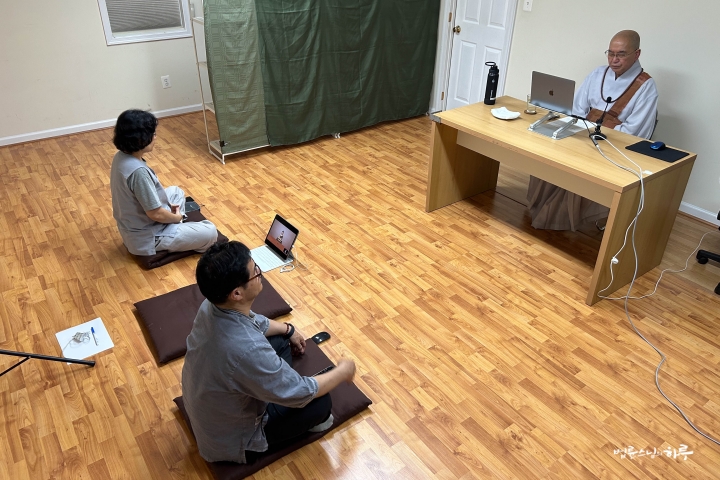
Due to consecutive schedules and overseas travel, Sunim’s cold hadn’t healed easily, resulting in severe coughing and poor throat condition. Once all the lead volunteers entered the video conference room, despite his hoarse voice, Sunim gathered his strength and began the Dharma talk.
“Jungto Society is a community of practitioners who come together to engage in social practices such as peace, unification, environment, and human rights. Its nature differs from social movements led by ordinary citizens. However, if one participates in activities without the awareness that ‘I am a practitioner,’ they have missed their qualification as a lead volunteer. Of course, one can participate as an ordinary citizen or as a general member of Jungto Society. But if you are a lead volunteer, you must clearly maintain the perspective that ‘I am a practitioner.’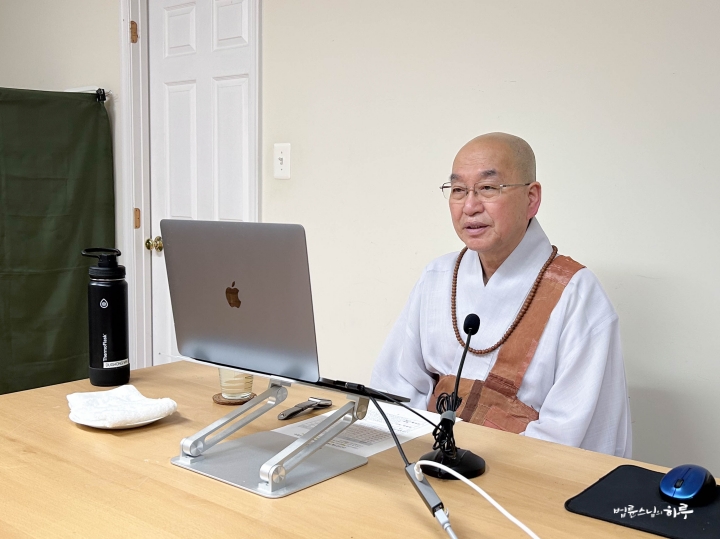
What Kind of Person Can Be Called a Practitioner?
A practitioner is someone who never blames conditions or resents others in any situation. Even when feeling angry, irritated, sad, or stressed, they don’t blame external factors but maintain the perspective that ‘this is my problem.’ This doesn’t mean you shouldn’t get angry. Anyone can get angry, feel irritated, or cry from sadness. You might unconsciously blame others. However, what’s important is that even in such states, you should be able to quickly return to center by remembering, ‘Ah, I am a practitioner.’ A practitioner is someone who is free from suffering and liberated in any situation. Although we may not have reached that level yet, we are people walking toward that path. Therefore, when we fall short of that standard, we should be able to reflect and say, ‘I missed it.’ If we lose the perspective of self-reflection, we can no longer call ourselves practitioners. Getting angry, irritated, or stressed in reality doesn’t mean you’re unqualified as a practitioner. These are problems arising from my shortcomings, so you just need to be aware: ‘Ah, I missed it.’ However, if you rationalize your stress while blaming others and creating disputes, you’ve lost the practitioner’s perspective. Then you cannot be called a practitioner.To Remain Aware That I Am a Practitioner Even at Work and Home
Jungto Society is a gathering of people who aspire to practice. While general members also aspire to practice, their awareness of ‘I am a practitioner’ tends to be less pronounced compared to leading members. However, leading members must have a clear awareness that ‘I am a practitioner.’ Since this awareness can be lost while engaged in daily activities, Jungto Society conducts Jeongil-sa (People Building Jungto) retreats twice a year – once in the first half and once in the second half.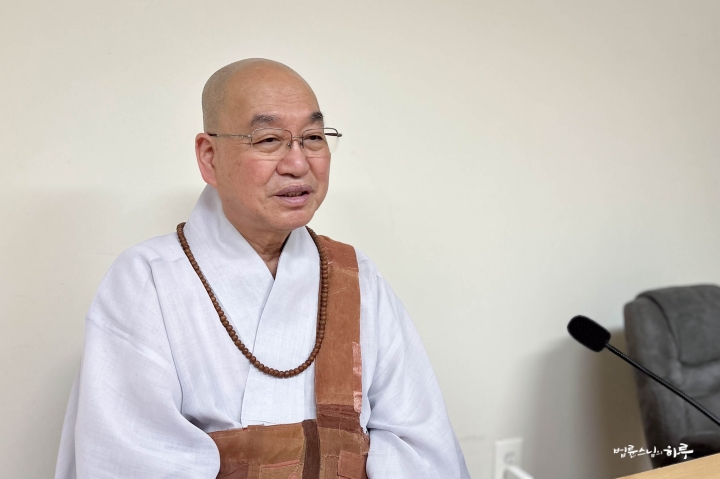
Starting today, leading members have begun recruiting participants for the 100-day consumption pause campaign, while Sunim is currently in Washington D.C. meeting various people for peace on the Korean Peninsula. Sunim then emphasized the significance of the consumption pause and peace movement that leading members are practicing in our current era.
“In today’s climate crisis era, environmental practice like ‘consumption pause’ can be an uncomfortable proposition in a society that aims solely for growth. It may face resistance as an action against the existing order. However, we choose to walk this path in a peaceful manner for the sustainable development of all life. Some people or groups blinded only by economic profit may find environmental practice uncomfortable. That’s why you too may face opposition from your spouse, parents, or children, or be ridiculed by friends. Such things might actually be expected. Only when we overcome such resistance can our new way of life spread throughout the world.Consumption Pause: An Experiment Opening a New Civilization
However, if we endure that process forcefully, suffering and struggling through it, we may appear pitiful to others. They might help temporarily, but this way of life would be difficult to spread. That’s why we must live more joyfully, meaningfully, and willingly in voluntary simplicity. Only then will people look at us with new eyes and think, ‘Ah, one can live that way too.’ That’s when our new way of life can become competitive with existing lifestyles. In this sense, ‘consumption pause’ – reducing consumption and sharing surplus with neighbors – is also a grand experiment by Jungto Society to establish a new future civilization. Please understand this movement from this perspective. Jungto Society was founded to realize the Buddha’s correct teachings in this land. At the same time, we’ve taken on another mission: protecting peace on the Korean Peninsula and achieving unification. We founded Jungto Society with these two goals as our ‘two wheels.’ As citizens of the Republic of Korea, we must work to overcome the threat of war, the so-called ‘Korea risk,’ and transcend division. Only then can we realize peace. And as Buddhists, we must establish practice-centered Buddhism in this land and spread it throughout the world. These two aspects are Jungto Society’s founding motivation and fundamental goals. If we only thought about establishing and spreading the Buddha’s correct Dharma, there would be no need to become Tongil Euibyung (Korean Minutemen for Peace and Unification). However, if we want to turn these two wheels together, we must have a clear perspective on peace and unification. That’s why leading members and above, who take on important decision-making roles in Jungto Society, must have clear perspectives on peace and unification. Therefore, we must study our nation’s history, especially modern history, and understand the causes of division and the formation of inter-Korean relations. Although institutionally separated, we must not forget the perspective that we are one people. We shouldn’t regard North Korean people’s suffering as someone else’s problem. We need an attitude that accepts their suffering as our responsibility.What We Must Do Now for Peace on the Korean Peninsula
To move toward peace and unification, we must resolve not only inter-Korean relations but also North Korea-US and North Korea-Japan relations. That’s precisely why I’m here in Washington D.C. I arrived early this morning and have been meeting various people all day to exchange opinions. That’s why my voice is quite hoarse. You might wonder, ‘Why is Sunim pushing himself so hard?’ While the risk of war on the Korean Peninsula has decreased, the system for stable peace hasn’t been established yet. This moment, with President Trump’s election and a new government in Korea, is a good opportunity to take the first step toward the peace we’ve long desired. However, if support for President Trump weakens in next year’s US midterm elections, or if the current government loses in next year’s Korean local elections and its political foundation is shaken, we might miss this good opportunity. Perhaps we only have one year left. This is a very important time for achieving peace on the Korean Peninsula. That’s why, even if my body is a bit unwell, I’m meeting and persuading various people with the hope of seizing this opportunity. To walk the path of peace, Korean society must first be internally unified. If our society is too divided, we’ll keep receiving external interference. To be less influenced by external forces, our society must first be internally unified. In this sense, national unity is very important. While inter-Korean dialogue is necessary, domestically we need communication between progressives and conservatives, between ruling and opposition parties. South Korea has already established diplomatic relations with China and Russia, but North Korea hasn’t yet established relations with the US and Japan. This is another challenge we must resolve. International relations and inter-Korean relations must stabilize, and domestic politics must also stabilize simultaneously. Only then can we design a stable future on the foundation of peace. If you haven’t been thinking about this, I hope from today you can reflect on yourself, realizing ‘I’ve been forgetting that I’m a Tongil Euibyung.'”Today’s leading members’ Dharma assembly was held jointly with the opening ceremony of Jeongil-sa, a retreat program for Lay Member Group volunteers. After the Dharma Teacher group provided guidance about the Jeongil-sa retreat program, Sunim gave an opening Dharma talk about the mindset for approaching Jeongil-sa retreat.
Although this is becoming an increasingly busy time with various events, everyone resolved to prioritize practice above all else, and questions were taken about difficulties in activities. Two people pressed the hand-raising button and asked Sunim questions. One of them said their passion for Dharma spreading activities had weakened considerably after recently suffering a leg injury, and asked Sunim for advice on what mindset to maintain while practicing.
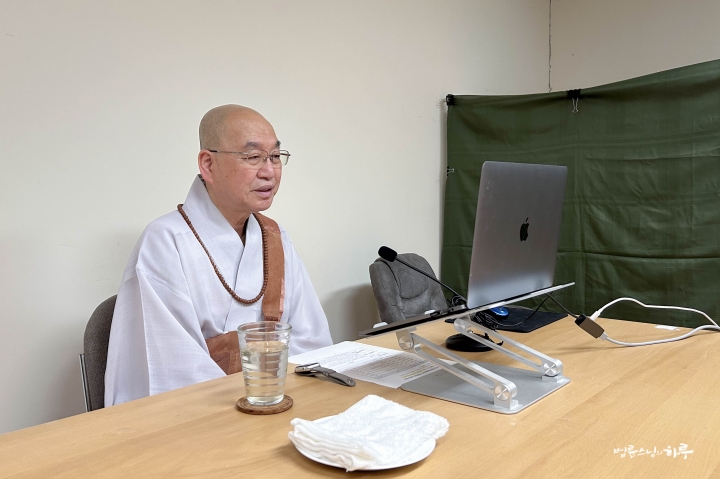
What Should I Do When I Don’t Feel Like Doing Something?
“I’ve been active as a lead volunteer for about a year and have felt proud of it. However, since this year I’m no longer serving as a co-facilitator or moderator, my motivation has been dropping, and the thought ‘I don’t want to do this’ keeps arising. Recently, I even injured my Achilles tendon and can’t do prostrations for a while. In this situation, what mindset should I have and what should I prioritize as I continue my practice?”
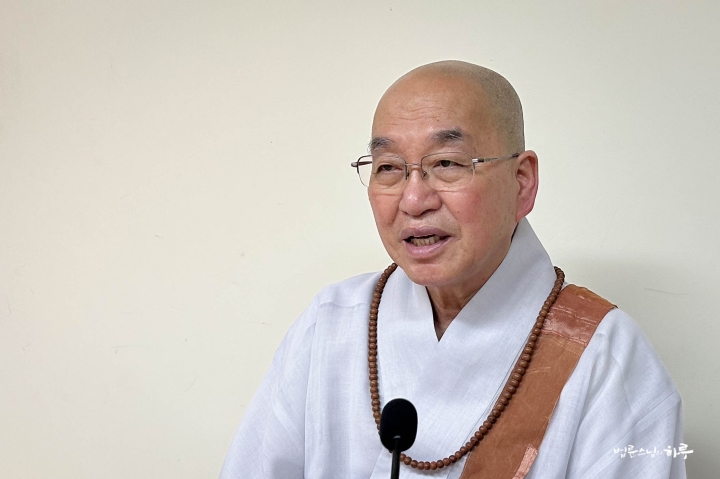
“I’ve come to reflect that I was generating negative thoughts and putting worry first. If I don’t succeed once, I’ll generate determination and put it into action twice or three times. I will become a leading member who overcomes feelings of difficulty and not wanting to do things. Seeing Venerable Pomnyun Sunim practicing with both body and mind today, I too will become a practitioner who takes one more step forward. Thank you.”
One more person asked a question.
After the presidential election, many believe that firm action is needed against insurrectionist forces. In this situation, what direction do you think the government should take?
After finishing the conversation, it was already past 11 PM. The leading members’ assembly concluded with the Four Great Vows. Thus ended another long day.
Tomorrow, Sunim will meet with U.S. government, congressional, and think tank officials in Washington D.C. for peace on the Korean Peninsula.