How can I practice Jesus’ teachings in my daily life?
Apr 20, 2025 - 63th Day of Dharma Talk, Meditation, 80th Anniversary Lecture at Kyungdong Church
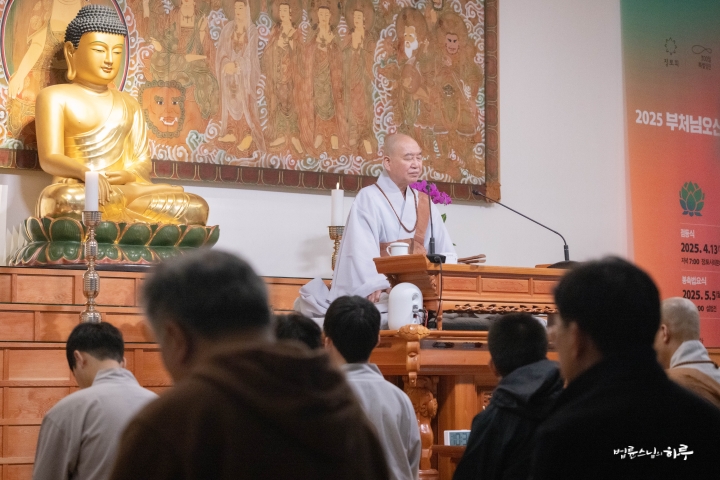
After completing his morning practice and meditation, Sunim headed to the Jungto Social and Cultural Center. By 10:15 AM, about 240 people had gathered in the third-floor Dharma hall. The Sunday meditation began with the recitation of the Three Refuges and the Heart Sutra.
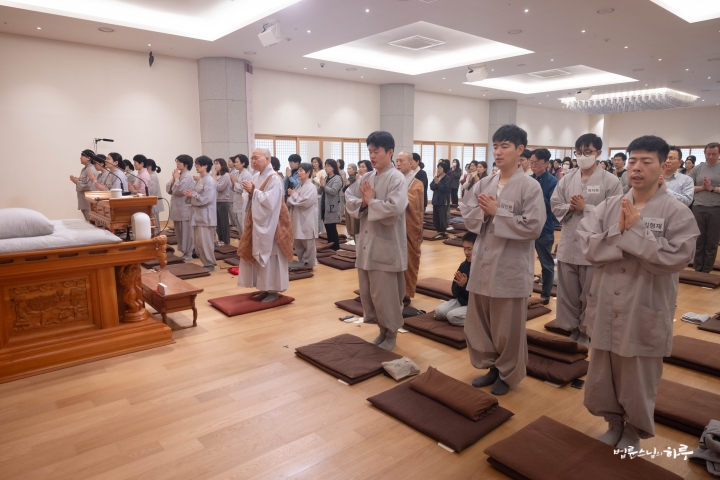
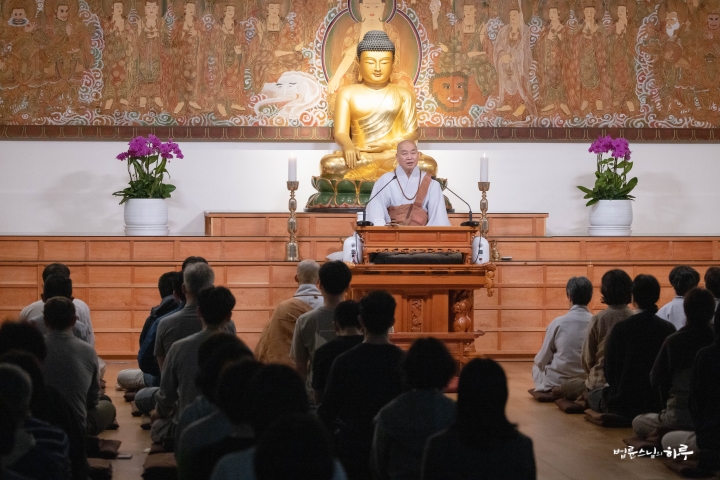
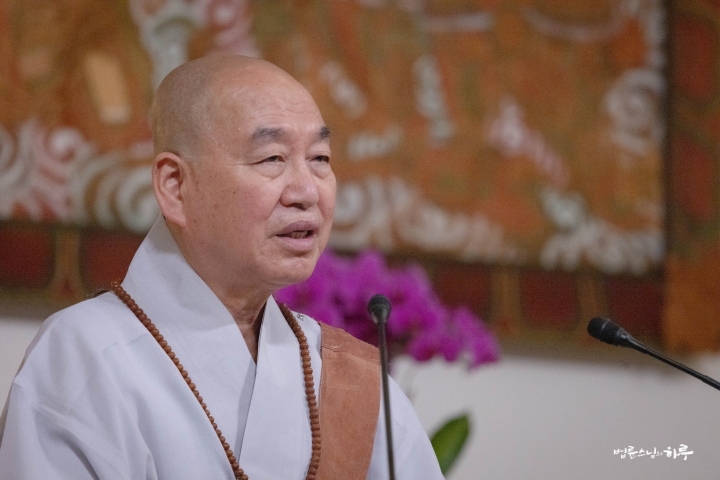
After the assembly paid respect to Sunim with three bows and requested his teaching, Sunim provided guidance on how to meditate.
**Why Do Conflicts Never End?
**
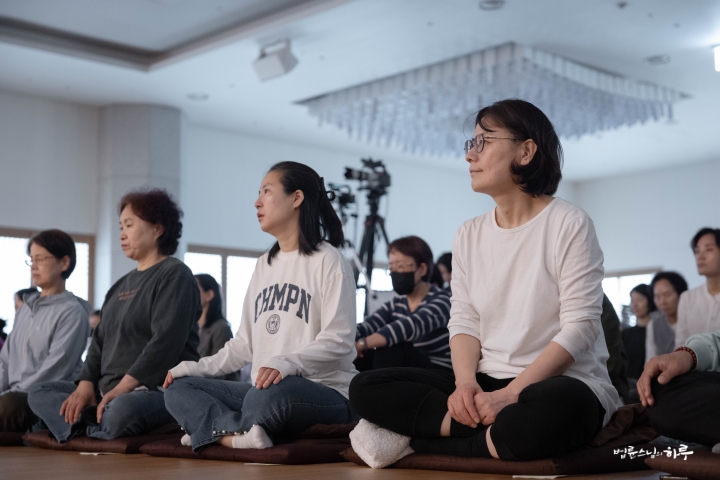
Simply Notice Your Inhalation and Exhalation
Focus your mind on the tip of your nostrils. Simply notice your inhalation and exhalation without attaching meaning to anything. Do not see with your eyes, do not assign meaning to sounds you hear, and do not attach significance to smells or tastes. Do not give meaning to sensations arising in your body, such as itching or pain, and do not attach importance to the various thoughts that spontaneously arise in your mind. Simply notice the breath entering and leaving the tip of your nostrils.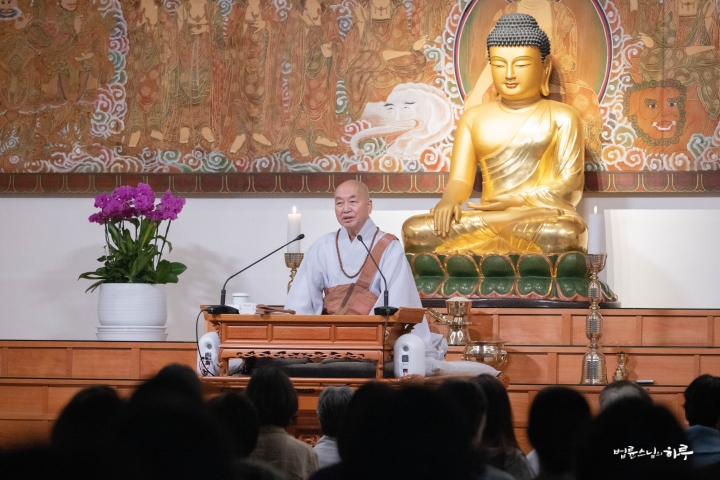
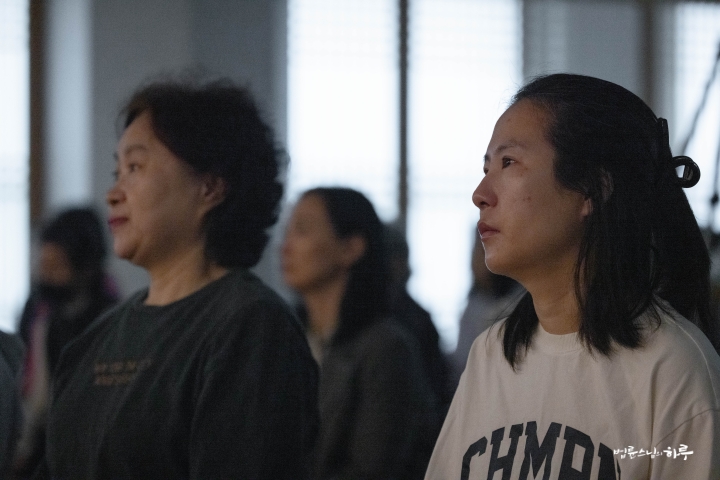
‘
When you feel an itch, simply notice, ‘There is itching.’ When stimuli arise, do not connect them to thoughts like, ‘Why am I in pain?’ or ‘How can I make this pain go away?’ When you practice this way, your mind gradually becomes calm. When a room is filled with dust, turning on a fan or sweeping with a broom only stirs up more dust. Thoughts work the same way. The moment you think, ‘I shouldn’t be thinking!’ another thought arises. If you leave them alone, thoughts and emotions naturally settle down. Stop all movements and simply notice your inhalation and exhalation. Whatever arises, do not attach any meaning to it. Just know, ‘That’s how it is.’ Not attaching meaning means not turning the stimulus into a story that leads to the next thought. When you assign meaning, a story is immediately created.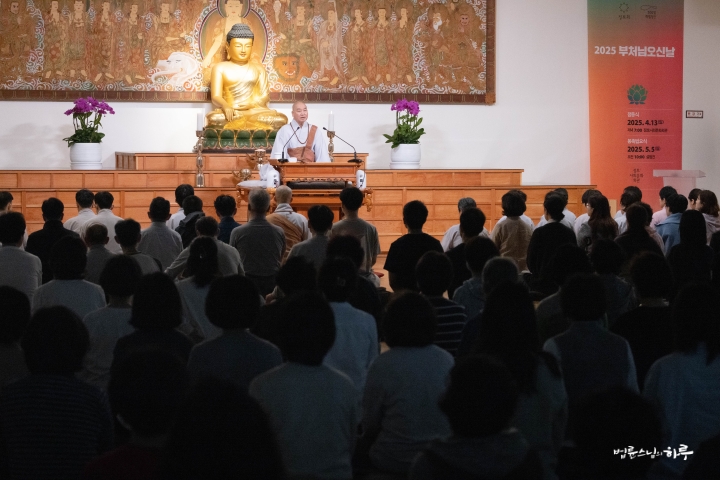
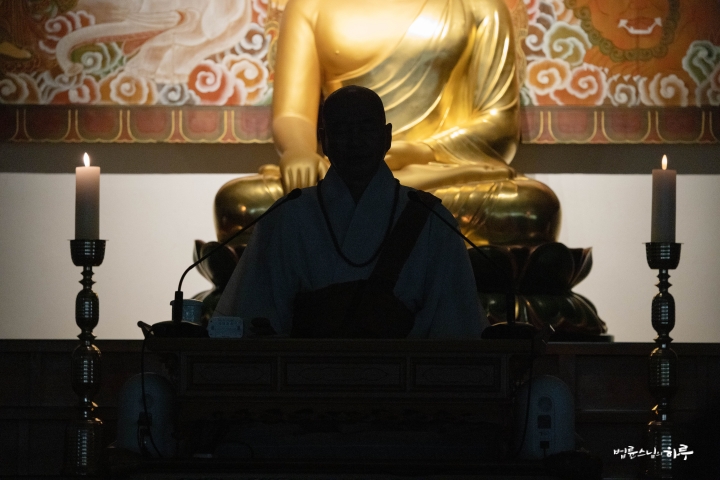
After Sunim finished his guidance, meditation began with the sound of the wooden clapper.
“Tak, tak, tak!”
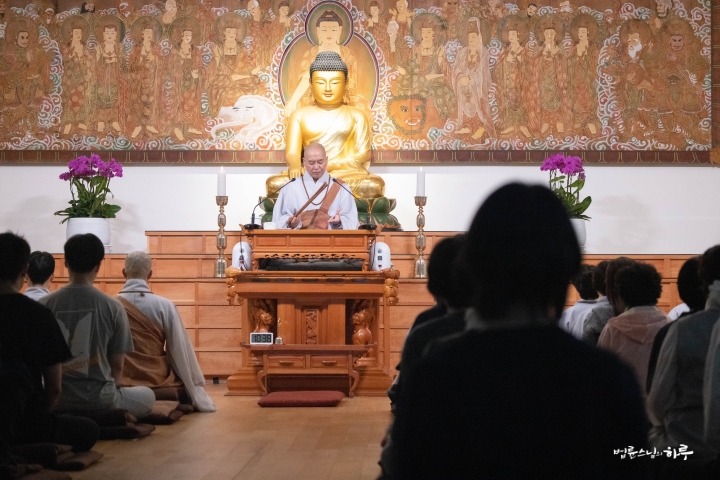
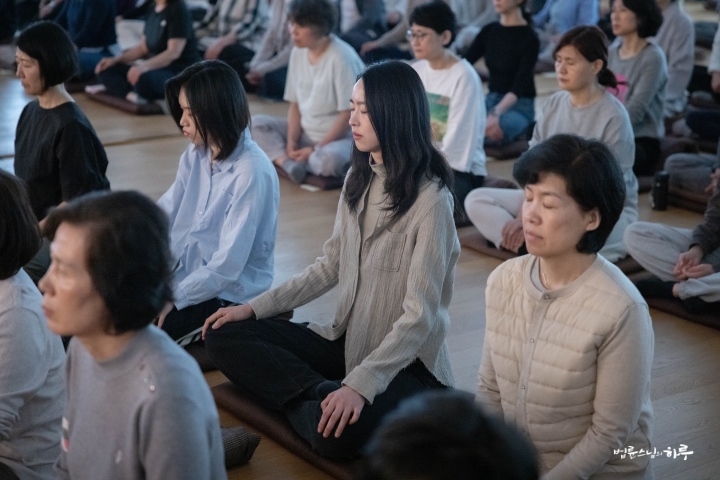
After 30 minutes of meditation, the wooden clapper sounded again. Then everyone practiced walking meditation for 10 minutes.
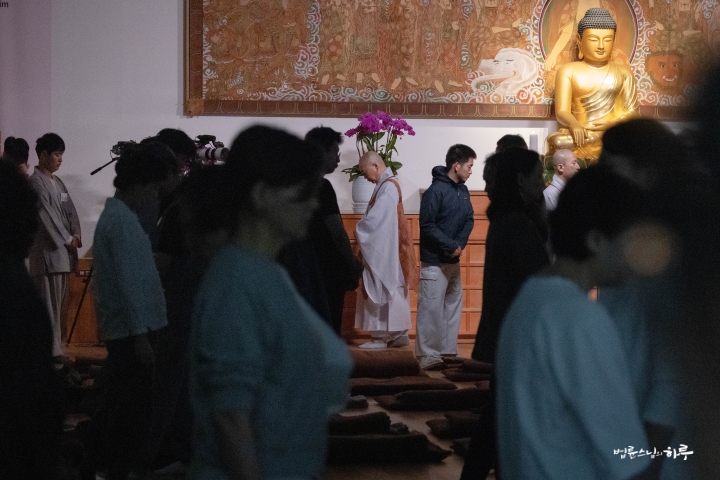
During walking meditation, everyone focused on being aware of their posture and movements.
Following Sunim’s guidance, everyone sat down again to meditate. This second meditation session also lasted 30 minutes.
“Tak, tak, tak!”
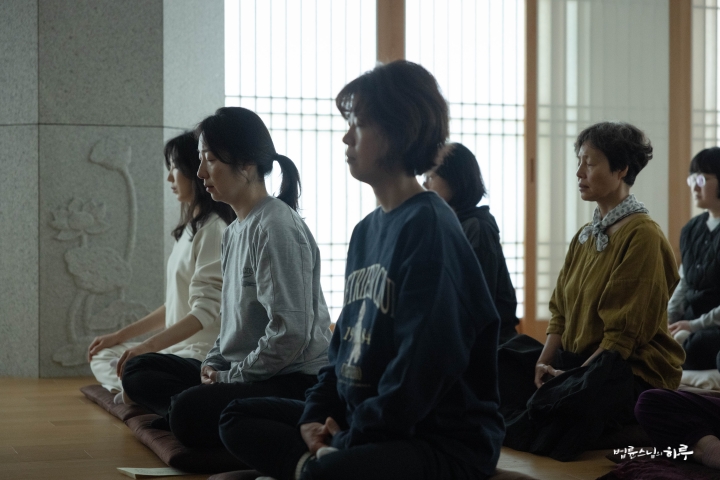
After three 30-minute meditation sessions, the practice concluded. The participants broke into small groups for mindful sharing, while Sunim had lunch and then headed to Kyungdong Church located in Jung-gu, Seoul.
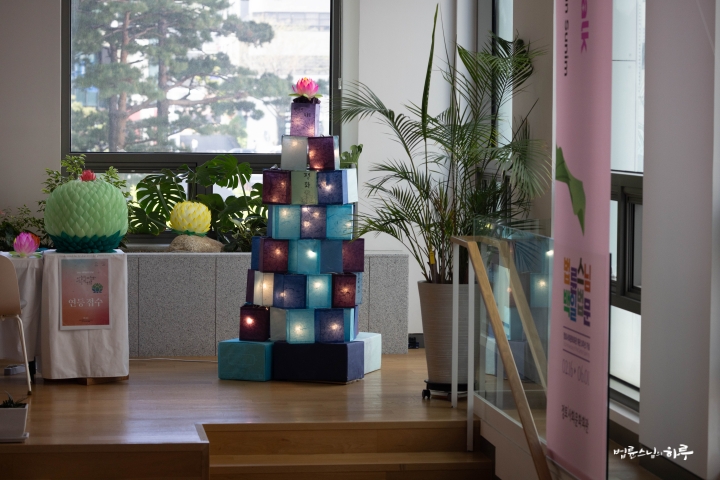
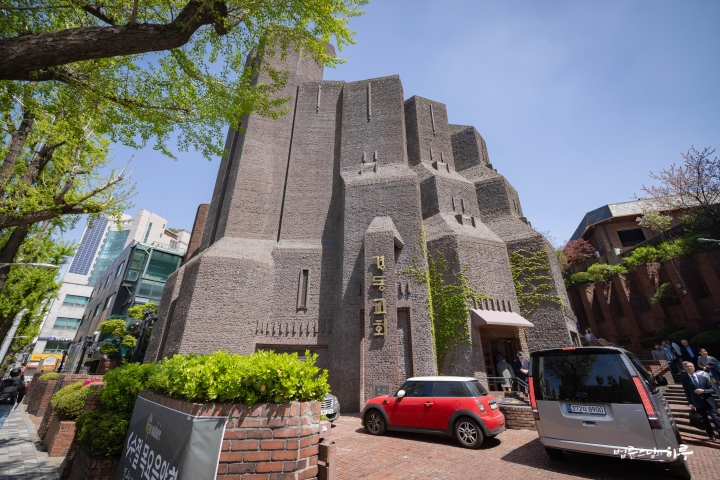
Sunim arrived at Kyungdong Church at 1:20 PM.
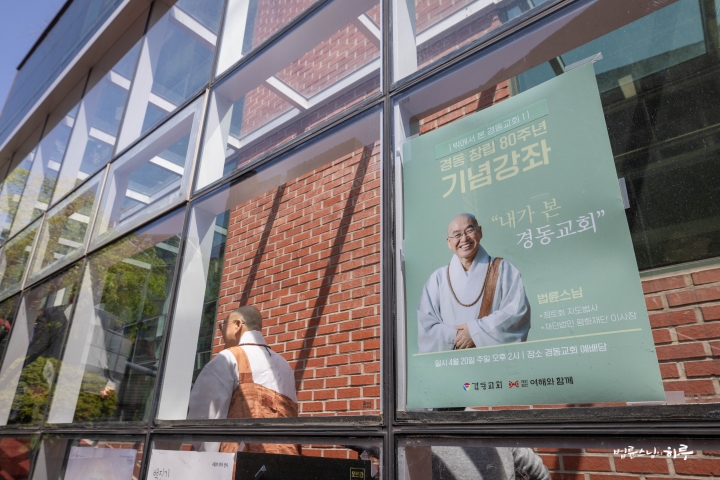
First, Sunim met with Honorary Director Kang Dae-in of the Dialogue Culture Academy, operated by the Yeohae and Together Foundation, for tea and conversation. Jung Sung-heon, Chairman of the Korea DMZ Peace and Life Garden, also joined them.
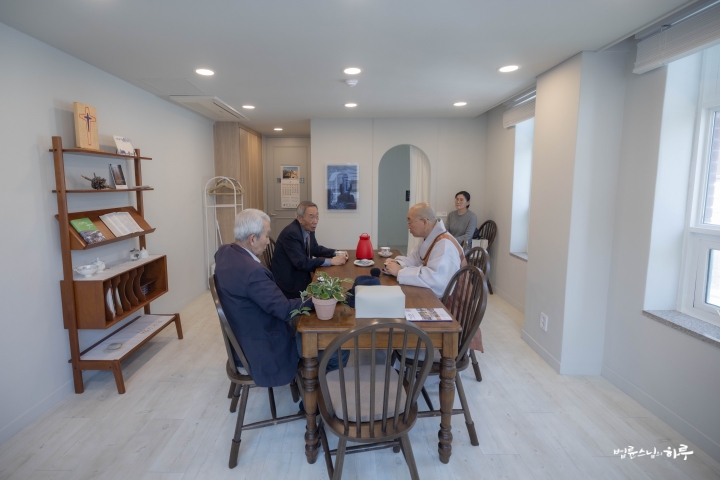
After warmly greeting both of them, Sunim presented them with elm tree shoots harvested from Dubuk Retreat Center. Director Kang informed Sunim that today was Easter, the most significant holiday in Christianity.
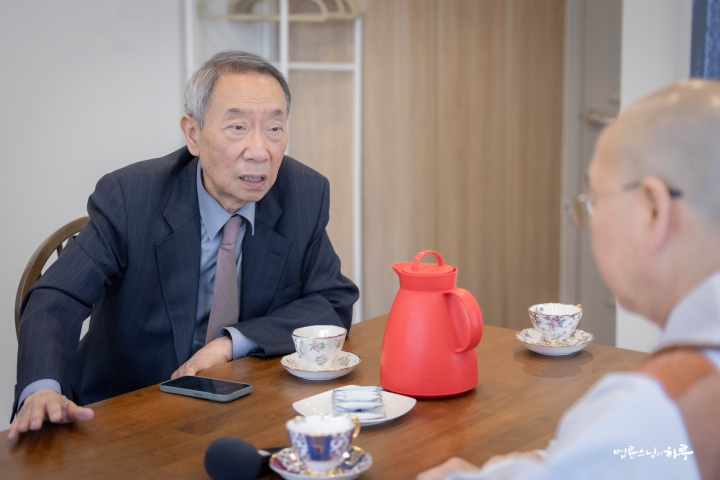
“Today is Easter. In Buddhism, Buddha’s Birthday is the biggest holiday, right? In Christianity, Easter is our most important holiday. We don’t place as much significance on Jesus’s birth.”
Sunim replied.
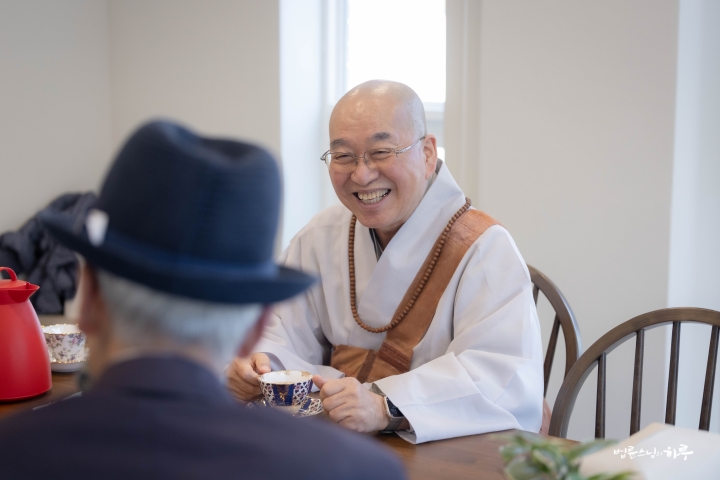
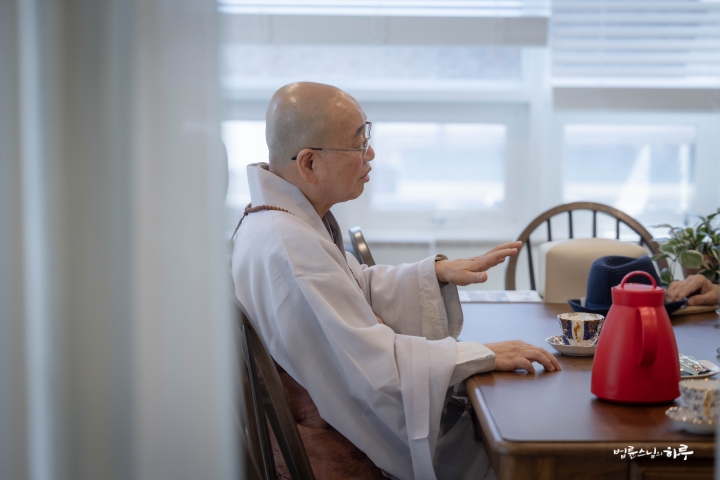
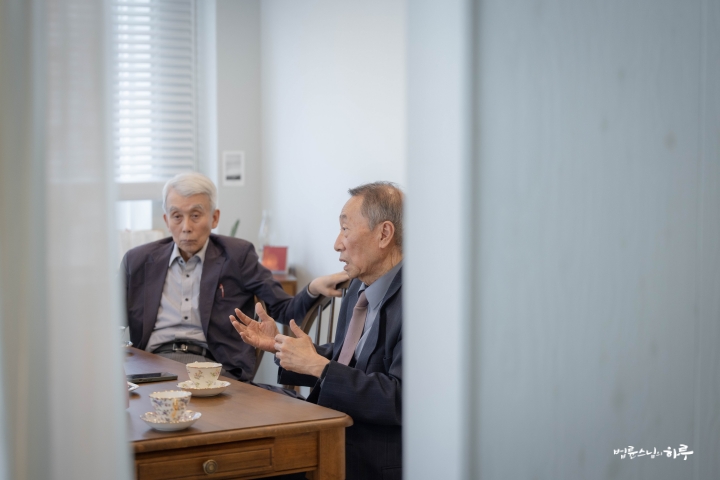
After exchanging pleasantries, they discussed current national issues. The three expressed concern about the deepening division in public opinion and deliberated on how to achieve national unity. They had an extensive conversation about what role social elders could play in bringing politicians to the dialogue table instead of treating each other as enemies.
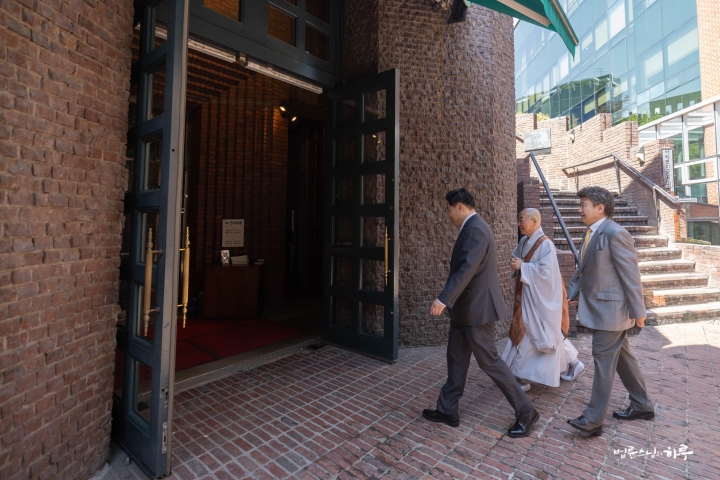
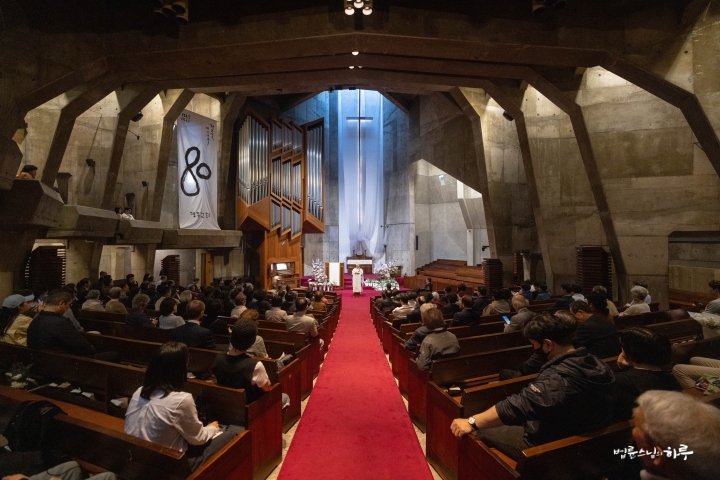
At 2 PM, they all headed to the chapel where Kyungdong Church’s 80th anniversary celebration was being held.
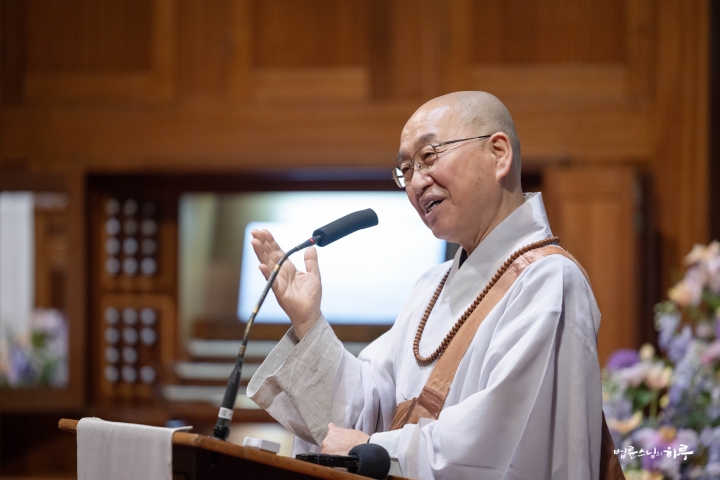
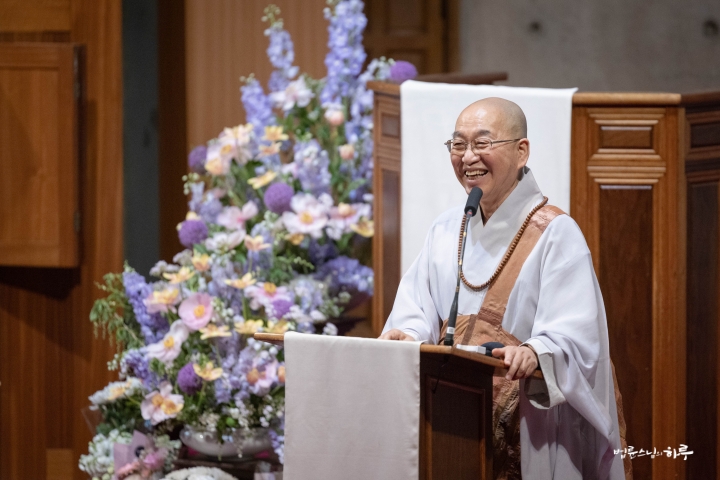
When the host introduced Sunim, he stood beneath the cross to great applause.
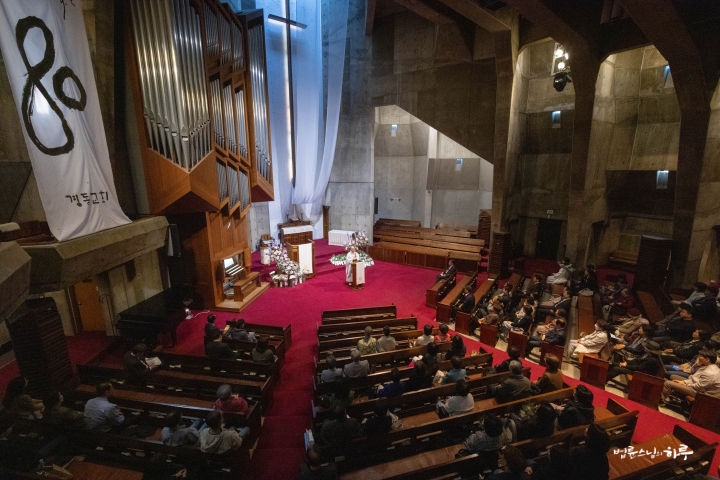
Sunim began his speech by congratulating Kyungdong Church on its 80th anniversary and sharing his connection with the late Reverend Kang Won-yong, the church’s founder.
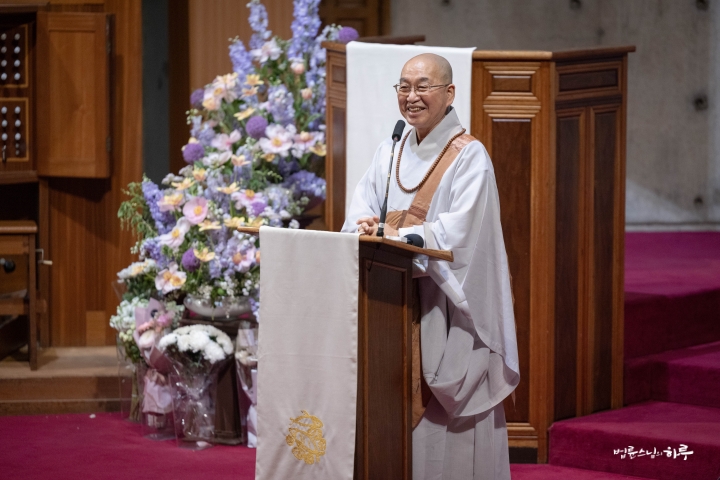
50 Years of Connection with Kyungdong Church
My relationship with Kyungdong Church and the Christian Academy began when I met Reverend Kang Won-yong in my mid-twenties, and it has continued for over 50 years. When I was young, I attended a small rural church. At Christmas, I received cards and even played the role of one of the Wise Men in plays. Looking back, my life resembles the journey of the Wise Men searching for truth. This connection with the church has continued until now, and in Buddhism, we call this a ‘wonderful affinity.’ In Christianity, I believe you would call it ‘God’s providence.’ I believe that God works not only through Christians and pastors but also through people of other religions and various backgrounds. I learned a great deal from Reverend Kang Won-yong in my youth. Just as Reverend Kang established Kyungdong Church and the Christian Academy to contribute to our society, I too have established Jungto Society and various social organizations to contribute to our society. You could say I benchmarked Kyungdong Church. (Laughs)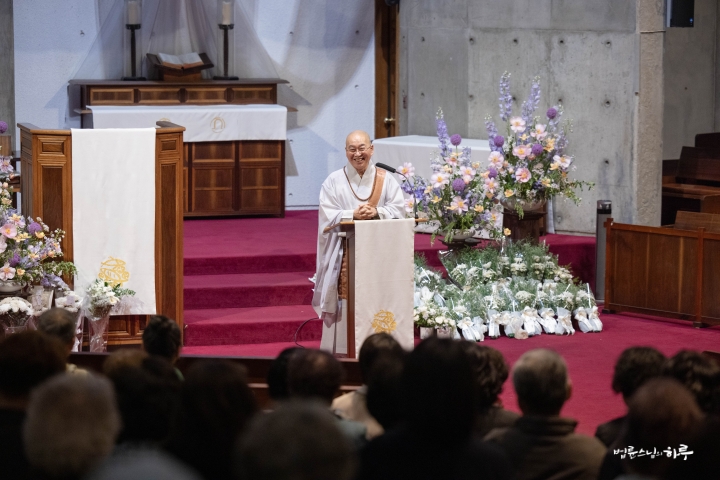
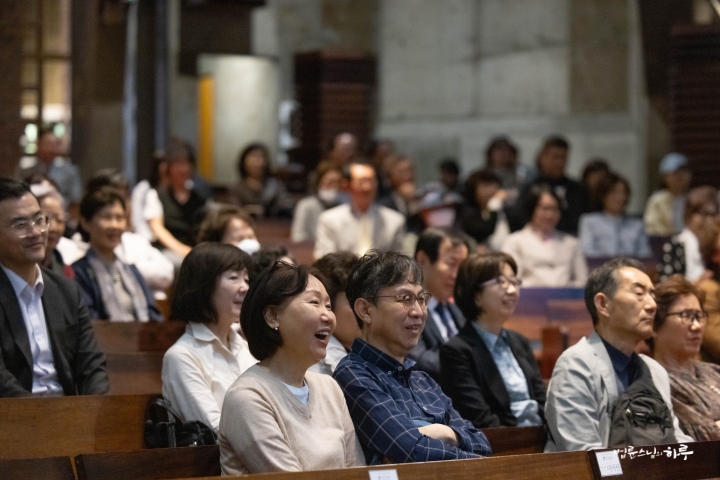
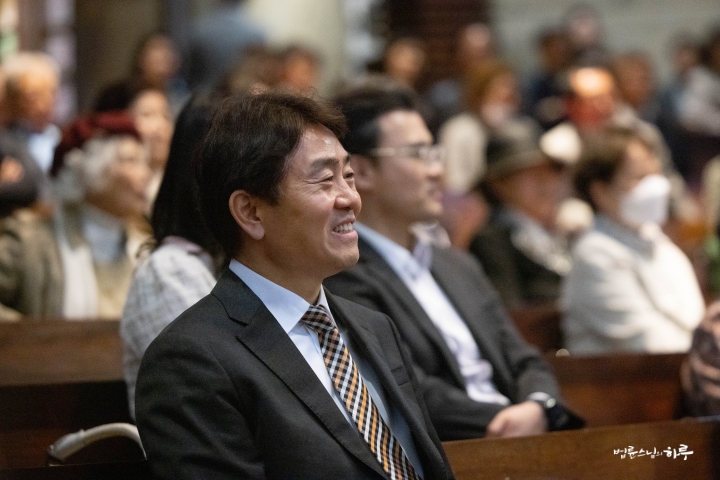
Reverend Kang Won-yong, the Social Mentor of Jungto Society
In my younger years, I had opportunities to hear Reverend Kang Won-yong’s teachings during difficult times, but I never had a direct relationship with him. Later, I was invited to participate in an interfaith dialogue organized by the Christian Academy. Through this connection, I joined the ‘Peace Forum’ and began working alongside Reverend Kang for peace on the Korean Peninsula. At Jungto Society’s 10th anniversary event, we invited him as the main speaker to seek his advice on the future direction of Jungto Society. Therefore, while I have had several Buddhist masters who taught me spiritual practice, I can say that Reverend Kang Won-yong has been my social mentor. As a religious person, I have often been disappointed by religion. Neither the Bible nor Buddhist scriptures say that praying for blessings will bring them. Jesus himself said, ‘Enter your room and pray in secret,’ not ‘Pray for blessings in the streets.’ When I first established Jungto Society, people around me insisted that a religion cannot exist without praying for blessings. However, Jungto Society emphasizes the path of practice to awaken from one’s ignorance rather than praying for blessings. As recorded in both the Bible and Buddhist scriptures, if you live righteously and do good for your neighbors, blessings will naturally follow. That’s why we engage in various social practices based on the teaching from Matthew 25:31 onwards, which describes six practices and states that ‘whatever you did for one of the least of these brothers and sisters of mine, you did for me.’ I believe this teaching is the path to heaven.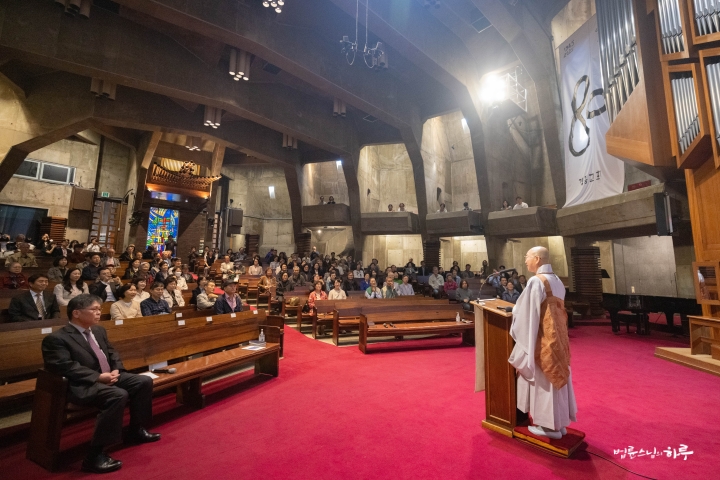
Kyungdong Church, Which Has Deeply Influenced Various Social Movements in Korean Society
Just as Reverend Kang Won-yong led efforts to resolve social conflicts through various social activities at that time, I too have established the Peace Foundation for peace on the Korean Peninsula and Eco Buddha to address the climate crisis. For international relief efforts, I founded ‘JTS (Join Together Society).’ JTS adheres to the principle of helping anyone in need of humanitarian aid without discrimination, regardless of religious background or ideology. Additionally, I organized ‘Good Friends’ to support human rights improvement and refugees, continuing activities for socially vulnerable groups. The ideas underlying these activities all came from what I learned at the Christian Academy. Rather than simple imitation, I have been implementing these ideas by adapting them to contemporary challenges in practical ways until today.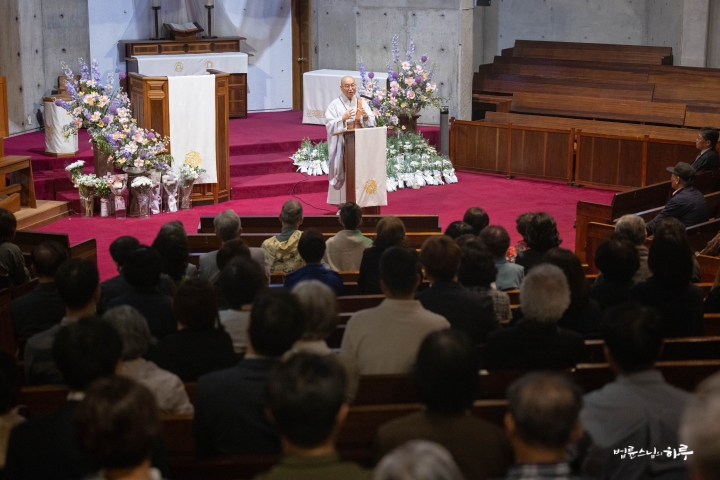
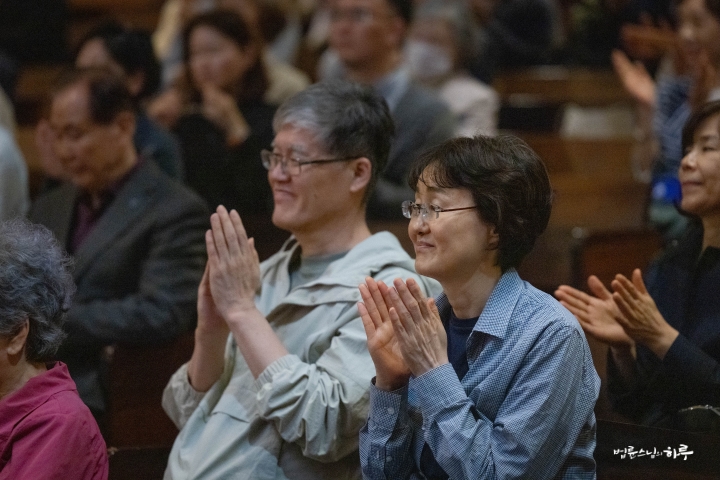
Following this, Sunim received questions from the church members who were curious about various topics. Among them, one person asked for advice on what might be lacking as they reflect on the 80th anniversary of Kyungdong Church.
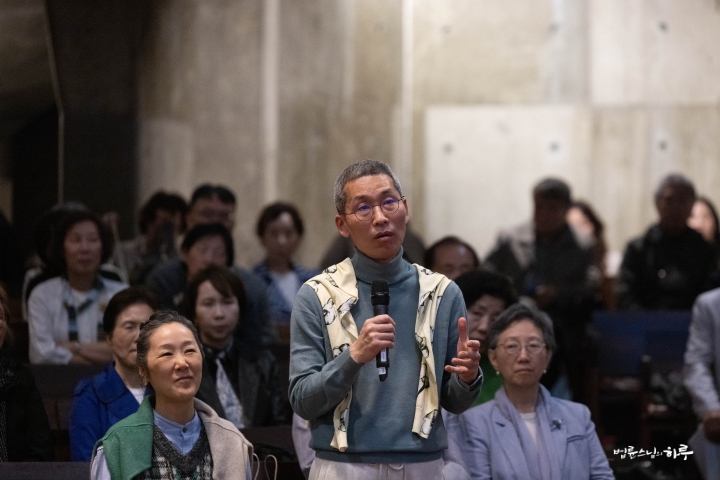
What do you think Kyungdong Church might be lacking?
“I believe you have clearly achieved Buddhist enlightenment. Listening to your teachings, I feel confident that we are heading toward the same destination. From this perspective, I would be grateful if you could offer some advice to us as church members.”
“The life and enlightenment of the historical Buddha, as well as his early teachings, are quite different from Buddhism as it exists as a religion in Korea today. It wouldn’t be an exaggeration to say they have little connection. Today’s Buddhism as a religion is Buddhist in name only and not much different from traditional Indian beliefs. The only difference is that the name of the deity is ‘Buddha,’ while the methods of praying for blessings are almost identical. Nevertheless, I don’t judge these practices as ‘right’ or ‘wrong’ because what exists in reality is a fact in itself. However, at Jungto Society, we emphasize a practice-oriented perspective that seeks to emulate the life and philosophy of the historical Buddha. I distinguish this from Buddhism as a religion by calling it Buddhism as practice.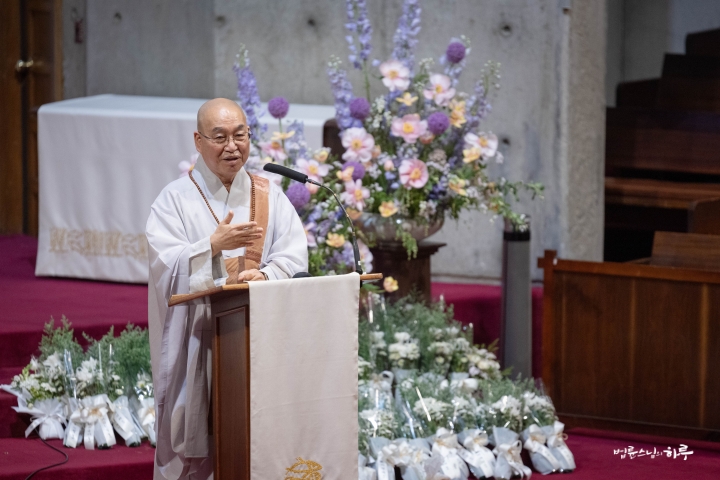
How can I practice Jesus’s teachings in my daily life?
Actually, I’ve long wanted to give a Dharma talk based on the Bible. I’d even like to write a book on this subject someday. This is because the Bible also contains abundant teachings about practice when viewed from a Buddhist perspective. A prime example is Jesus’s Sermon on the Mount: ‘If someone asks you to go one mile, go with him two miles,’ ‘If someone wants your shirt, give your coat as well,’ ‘If someone slaps you on the right cheek, turn to them the other cheek also.’ These teachings are practices in themselves. Going beyond ‘Do not hate anyone’ to teach ‘Love your enemies’ also aligns with Buddha’s teachings. When you cultivate love instead of suppressing hatred, hatred naturally disappears. Similarly, teaching ‘Give to others’ instead of just ‘Do not steal’ follows the same principle. The teaching that prayer should be done in private without conditions also perfectly aligns with the practice-oriented perspective. This is because God is omniscient and already knows our hearts. Praying loudly or listing conditions one by one shows a lack of faith in God. It’s an action taken out of concern that God might not hear or might miss our prayers.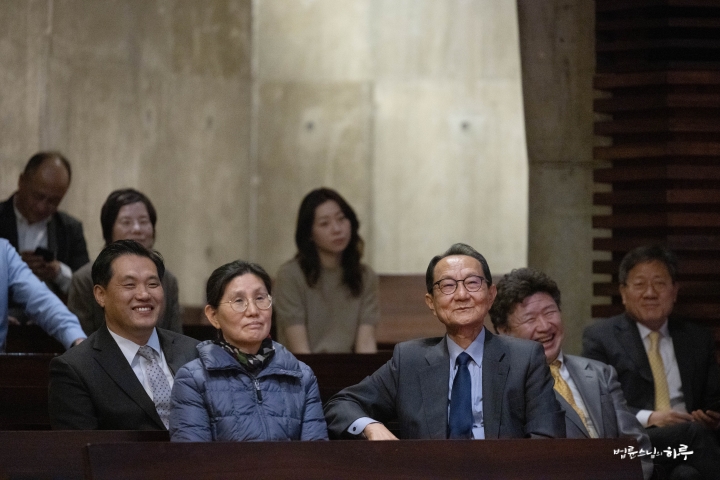
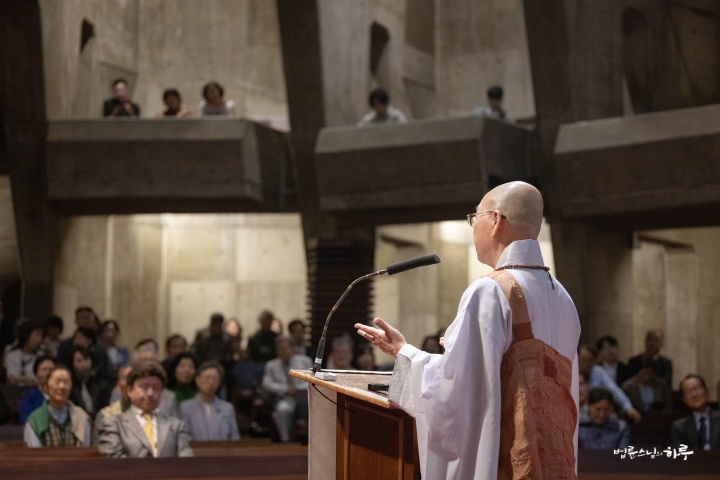
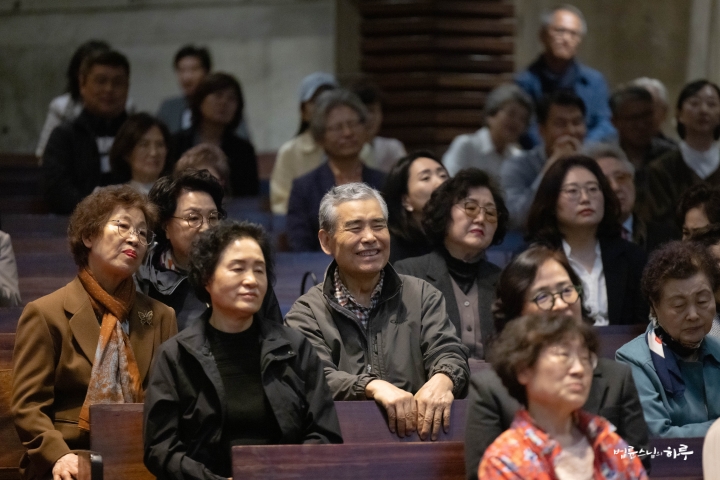
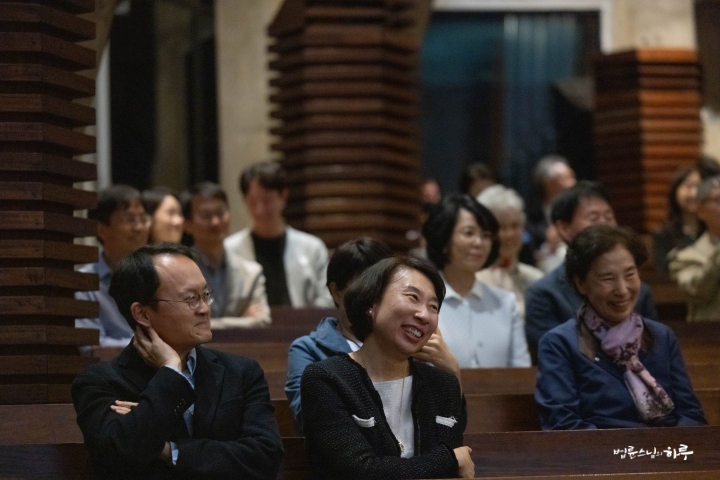
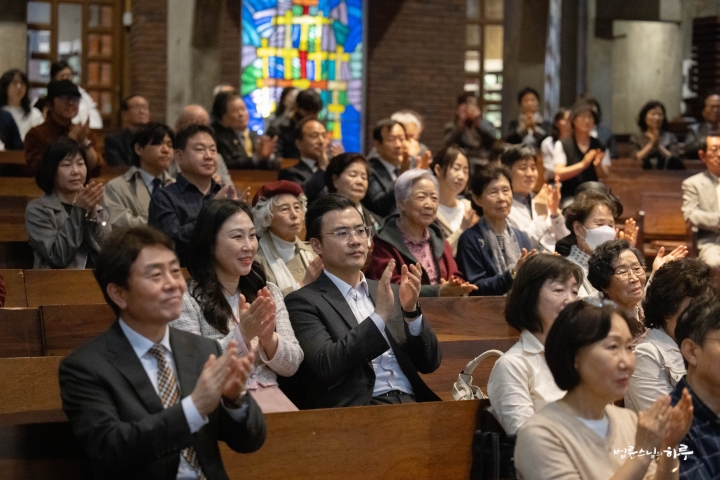
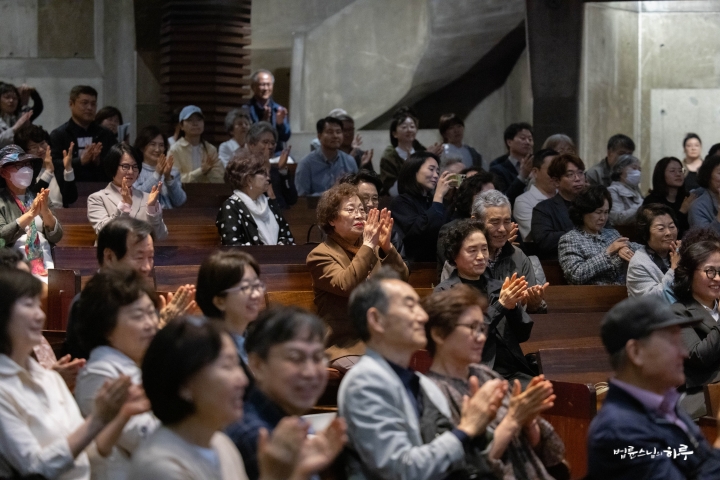
As the lecture ended, expressions of admiration flowed from all around, and even after Sunim descended from the podium, the applause continued unabated. A profound resonance lingered on everyone’s faces. Following this, Reverend Park Jong-hwa, the senior pastor of Kyungdong Church, came forward to deliver congratulatory remarks.
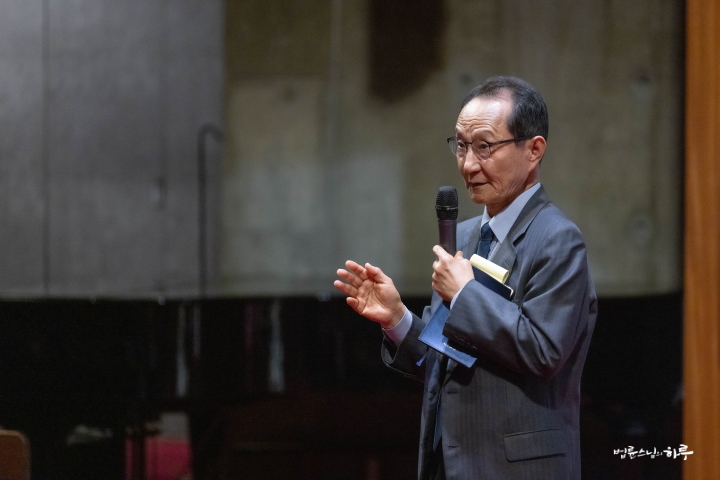
“Once a month, I visit Jungto Society to participate in a gathering of religious leaders for national reconciliation and peace. We collaborate on various activities including humanitarian aid to North Korea, national integration, and peace on the Korean Peninsula. Such beneficial social activities can be carried out beyond religious boundaries.
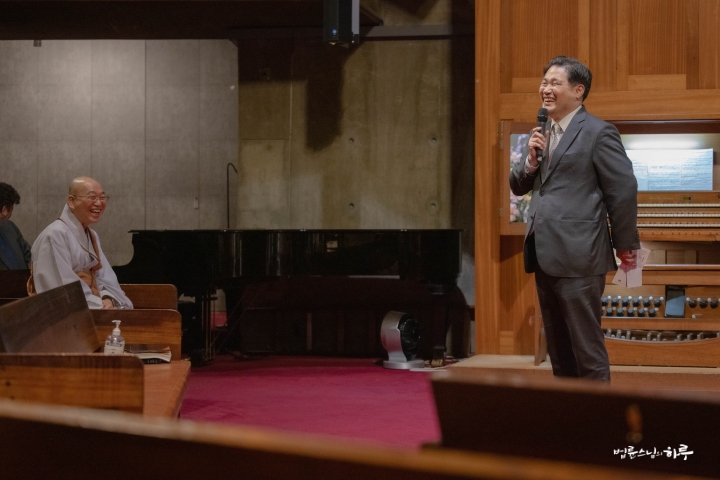
Every Buddha’s Birthday, I am invited by Jungto Society to give a sermon. Once, when I told Buddhists to ‘attain enlightenment,’ it was posted online, and I was criticized by Christians asking, ‘How could a pastor say such a thing?’ But think about it—even as a pastor, when visiting a temple, I should say ‘attain enlightenment,’ not ‘hallelujah,’ shouldn’t I?” (Laughter)
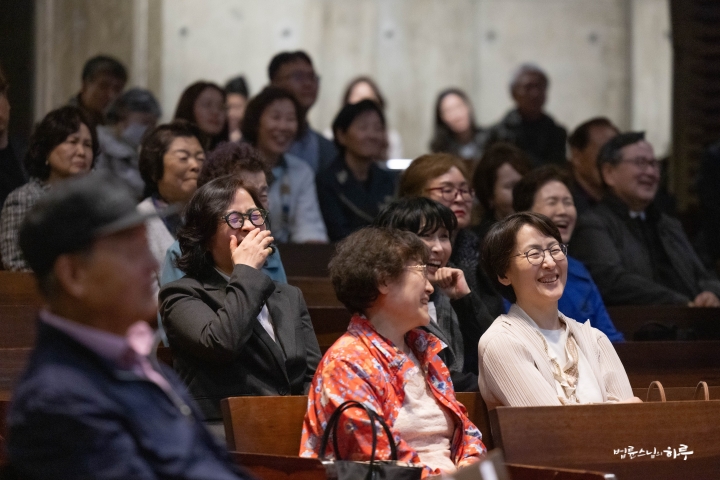
Religions may differ, but the practical implementation of life that religious people should pursue is the same. I had this thought while listening to Sunim’s talk today. I pray that Kyungdong Church continues to walk the path of practicing Jesus’s life even after its 80th anniversary.”
Finally, Reverend Im Young-sup, the lead pastor of Kyungdong Church, gave closing remarks to conclude the lecture.
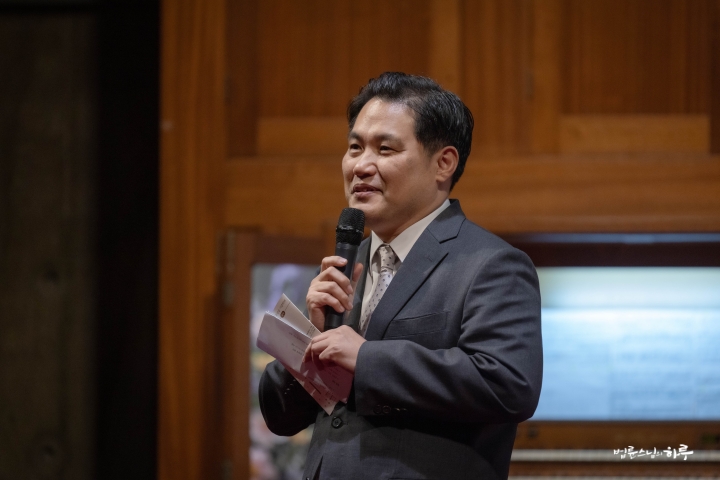
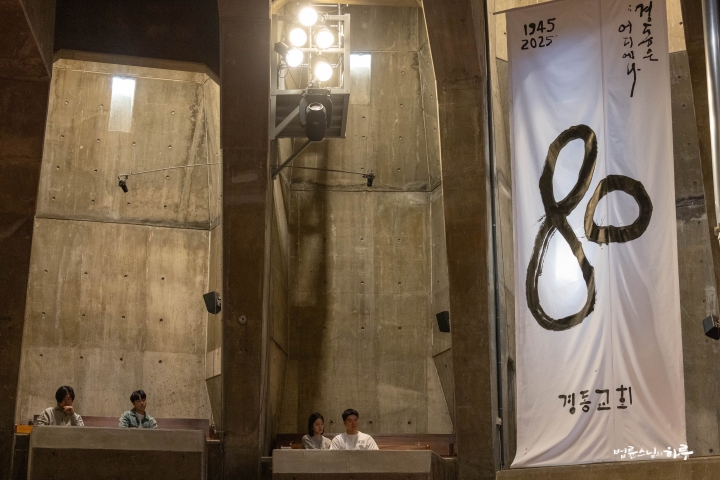
“If you look at the banner over there, you’ll see three circles within the number 80. These three circles seem to symbolize the three stepping stones that represent the history of Kyungdong Church. Reverend Kang Won-yong and Reverend Park Jong-hwa laid solid stones, and we must continue their legacy well.
The Christian community is facing many challenges these days, and hearing that Venerable Pomnyun Sunim is studying the Bible makes me feel even more of a sense of crisis. (Laughter) I also began visiting Jungto Society last year. I will strive to find more ways we can cooperate to create a better world.”
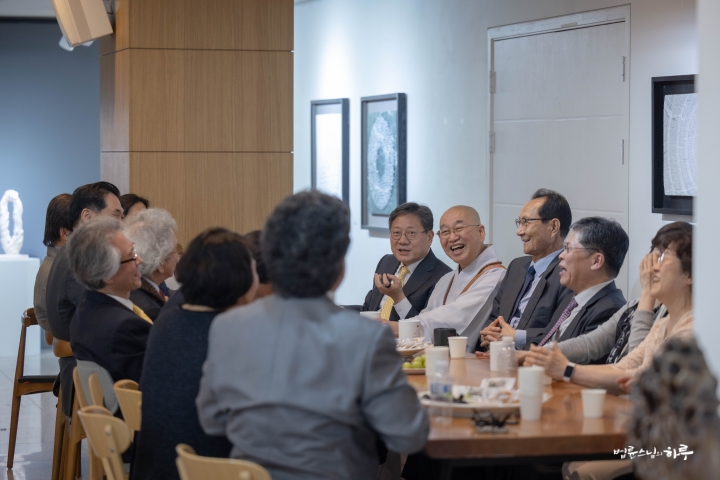
After the commemorative lecture, Sunim moved to a tea reception area. All the Kyungdong Church officials gathered there, introduced themselves, and engaged in conversation before leaving the church.
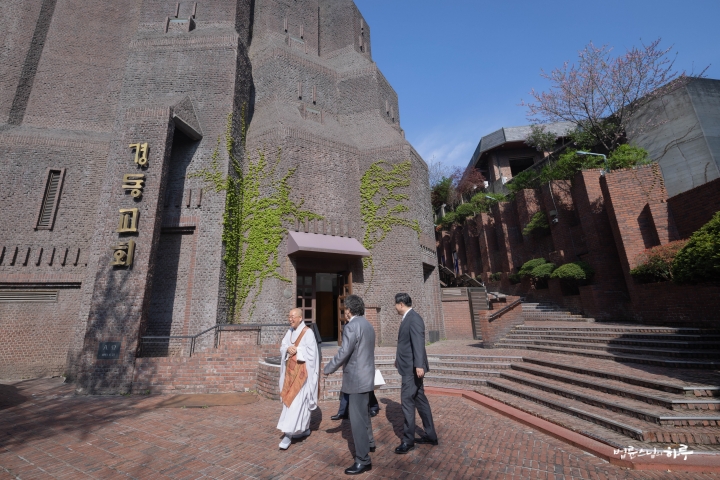
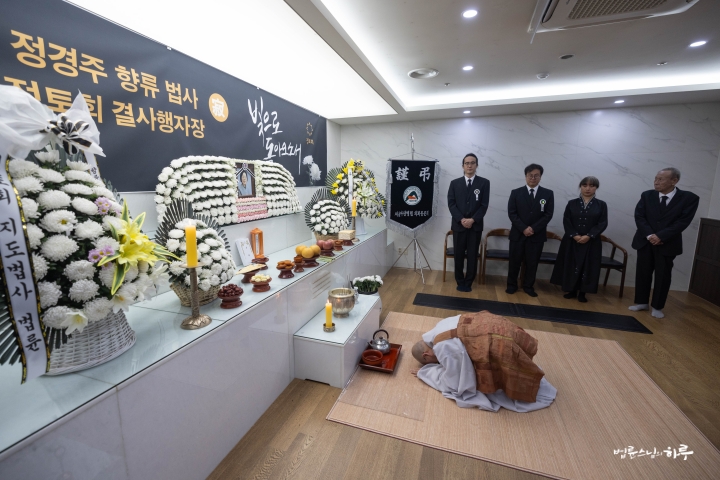
Departing from Kyungdong Church at 4 PM, Sunim headed to Daejeon. Last night, Dharma Teacher Hyangryu, a Gyeolsa Practitioner of Jungto Society, passed away after battling cancer for over a year. The Jungto Dharma Teachers’ group prepared a funeral altar in Daejeon, where Dharma Teacher Hyangryu had been active for a long time.

After a three-hour drive, Sunim arrived at the funeral home at 7 PM.
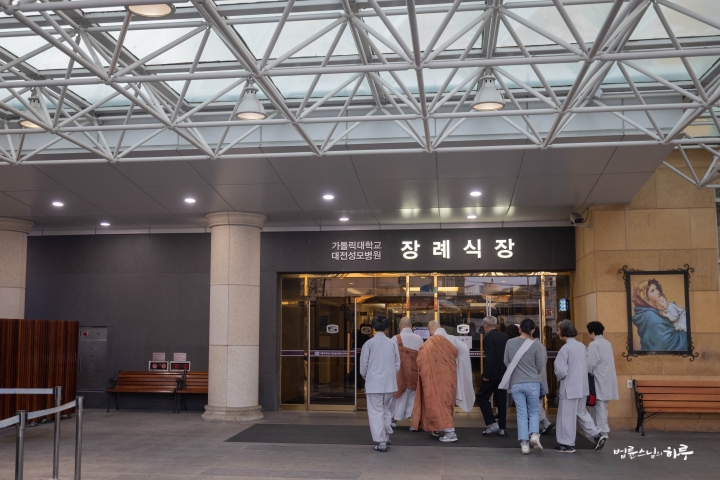
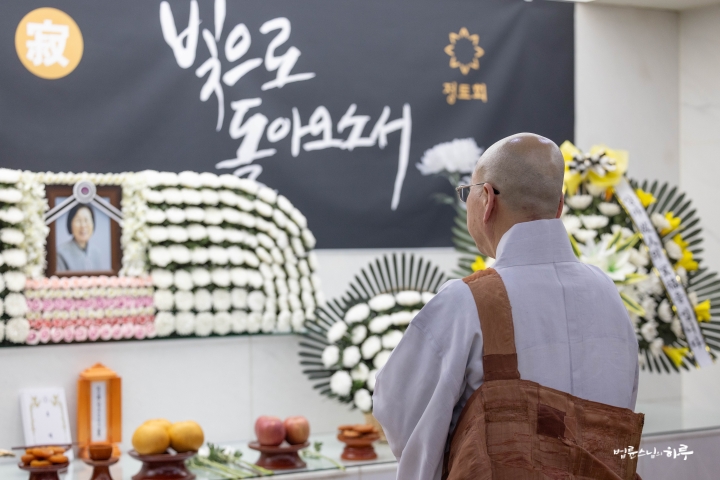
After lighting incense and performing three bows before the portrait, Sunim consoled the family members.
Mr. Kwak Young-sul, the husband, has been serving in many roles on the Construction Committee of Jungto Society. Sunim embraced him tightly to offer comfort.
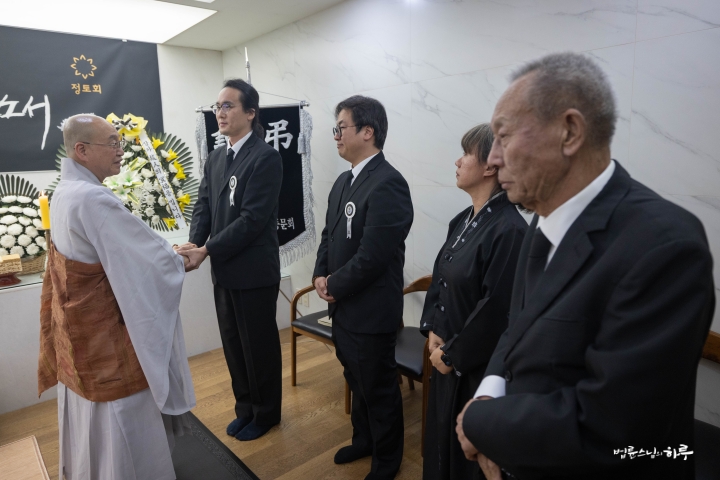
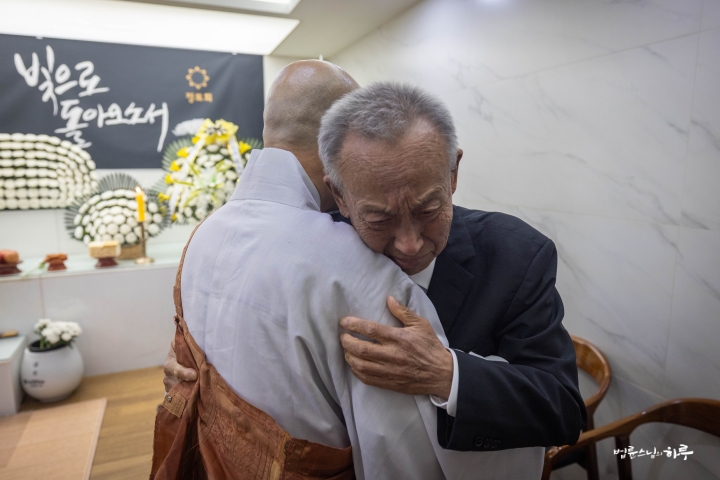
The husband could not hold back his tears. Dharma Teacher Hyangryu, after graduating from Jungto Dharma School, served as the general manager of Daejeon Dharma Center, director of the Central Region, and representative of Daejeon Jungto Society, becoming a role model for Jungto practitioners. Many people who had worked with her in the Daejeon area visited the funeral home and could not contain their grief.
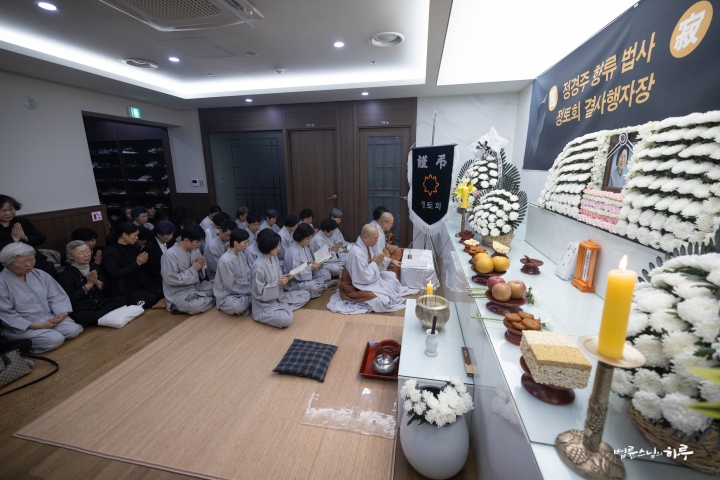
A memorial service was held with all attendees gathered before the portrait. Before the chanting began, Sunim gave a Dharma talk for the deceased.
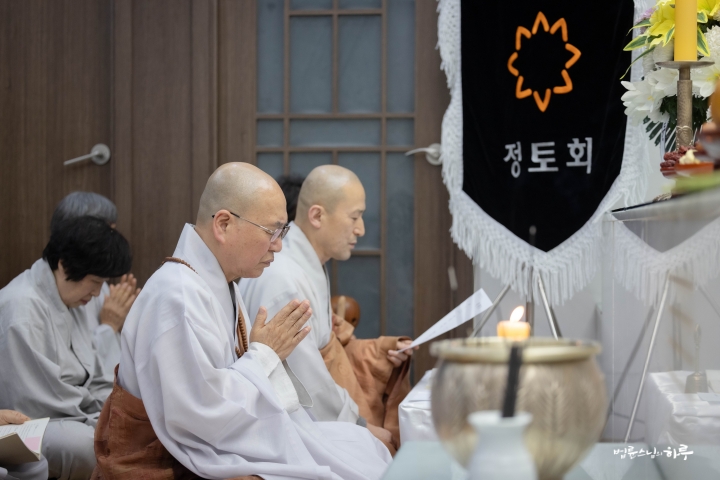
What is your original face?
The goal of learning the Buddha’s teachings is to understand that life and death are not separate, so that we may be unhindered by birth and death. Even if you depart suddenly like this today, there is nothing to call ‘going,’ and even if you come, there is nothing to call ‘coming’—when we understand this principle, we say we have entered nirvana. So we too, seeing your departure, should not only hold onto sadness but share the Buddha’s teachings again. When the great Buddha entered nirvana, it is said that practitioners wept in grief at their teacher’s departure. However, the Venerable Aniruddha reminded them of the Buddha’s teaching that ‘there is nothing sacred in this body, nothing pleasant in these feelings, nothing permanent in this mind, and nothing that can be called self in these phenomena,’ helping the assembly regain equanimity and meet the Buddha’s passing with serenity. Today, though we cannot contain our sadness when thoughts arise, we try to set aside those thoughts and return to the Buddha’s teachings to maintain equanimity. Therefore, soul of the departed, please gather your consciousness and respond vigorously to this Dharma teacher’s question.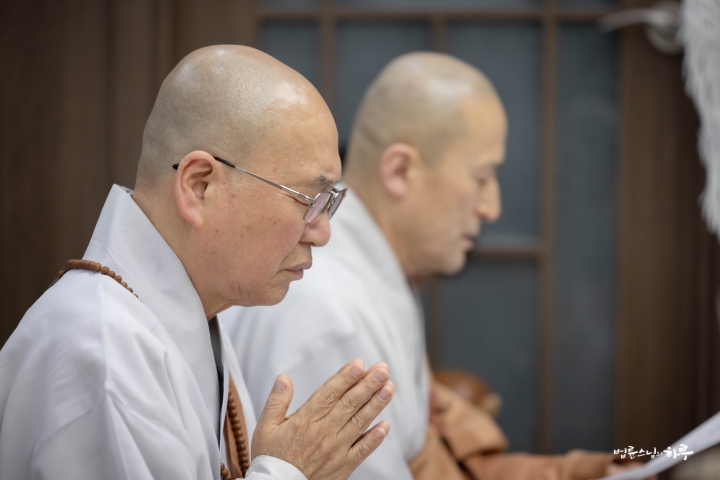
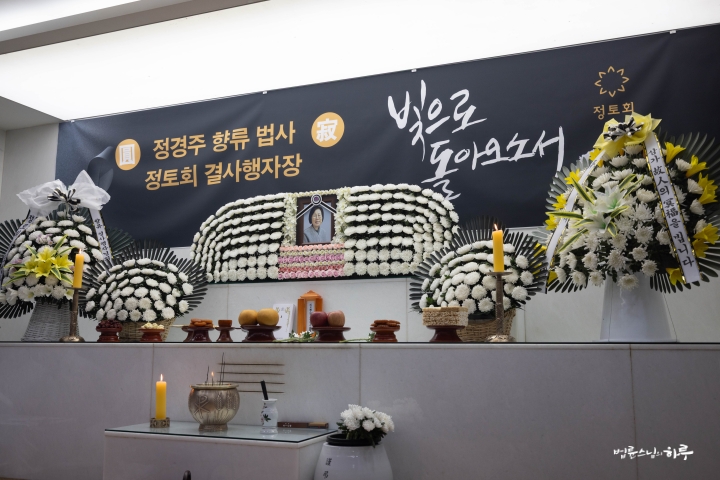
Everyone then chanted together with sincere hearts.
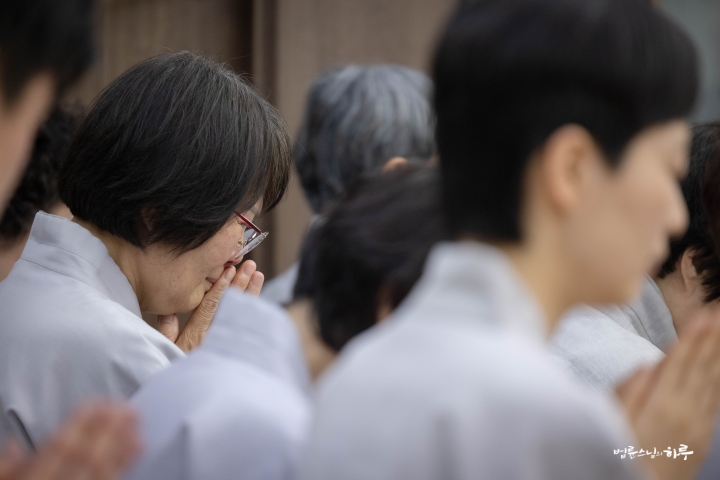
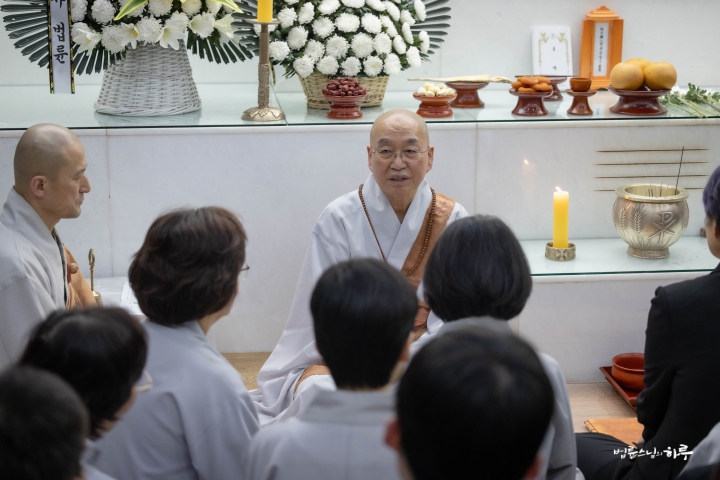
After conducting the memorial service with solemn chanting and sincere devotion, Sunim sat facing the assembly. He then shared a few words about Dharma Teacher Hyangryu.
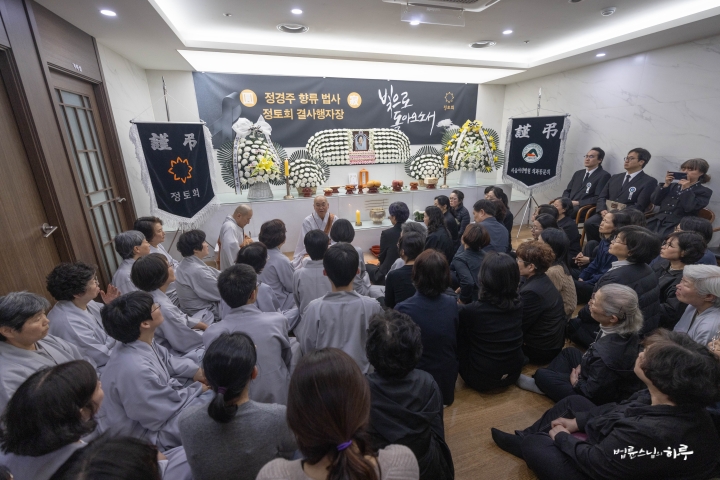
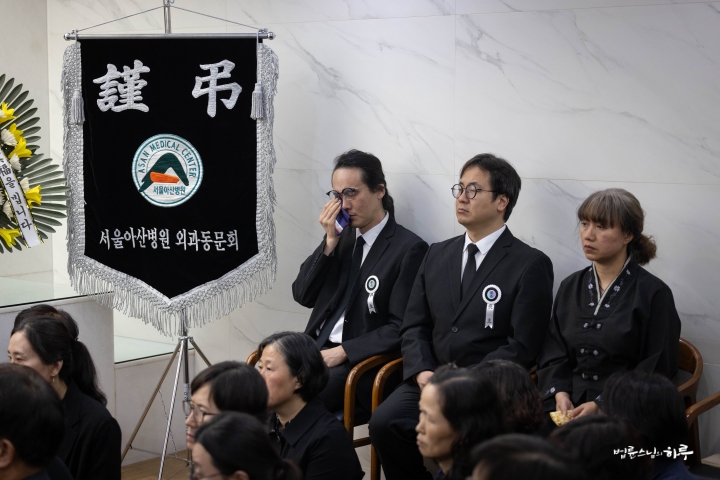
Many Jungto Society volunteers visited the funeral home and conducted memorial prayers at different times throughout the day.
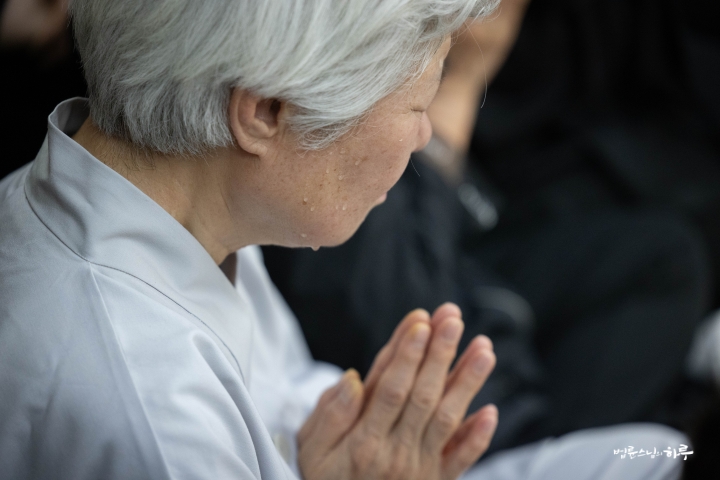
After further conversation with the grief-stricken Mr. Kwak Young-sul, Sunim said goodbye to the family members and departed from Daejeon.
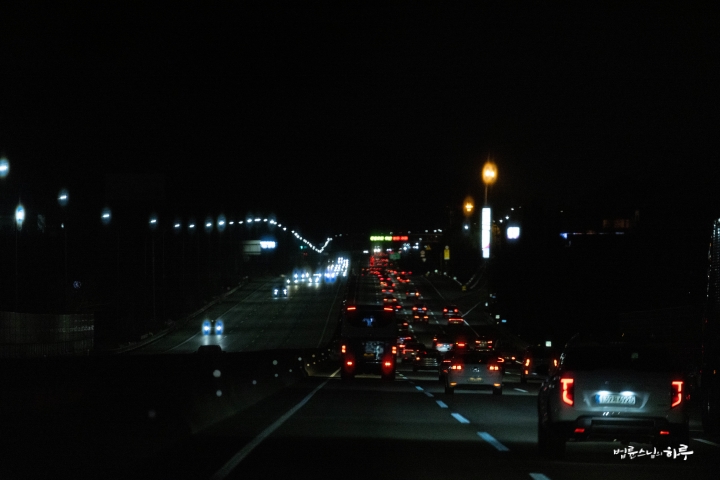
After a two-hour drive, Sunim arrived at the Seoul Jungto Center just after 10 PM, concluding his day.
Tomorrow will be the 64th day of the 100-Day Dharma Talk. In the morning, Sunim will hold a Dharma Q&A session to conclude his Diamond Sutra lectures at the Dharma Hall on the third floor of the Jungto Social and Cultural Center. In the afternoon, he will be interviewed by the Ramon Magsaysay Foundation from the Philippines, and in the evening, he will give the 13th lecture of the Buddhist Social Studies Course in the main auditorium on the basement level.