I’m Worried About My Child Showing Symptoms of Schizophrenia
Apr 2, 2025 - 45th Day of the 100-Day Dharma Talk, Weekly Dharma Assembly, Standing Committee Meeting
Hello everyone. Today is the 45th day of Venerable Pomnyun Sunim’s 100-Day Dharma Talk. We have now reached the midpoint of the 100-Day Dharma Talk.

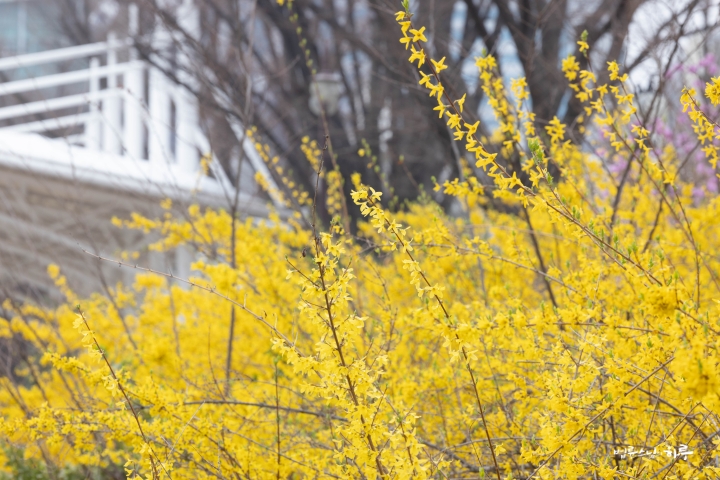
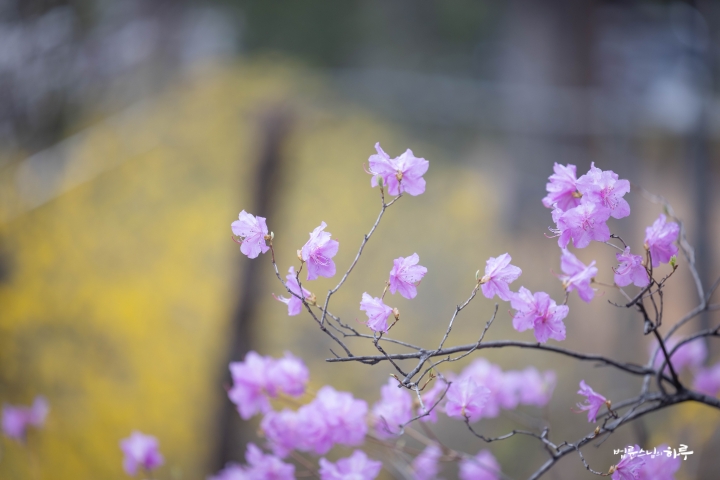
After completing his morning practice and meditation, Sunim headed to the Jungto Social and Cultural Center for the Weekly Dharma Assembly. Spring is in full bloom. Cherry blossoms, forsythias, azaleas, and magnolias are blooming throughout downtown Seoul.
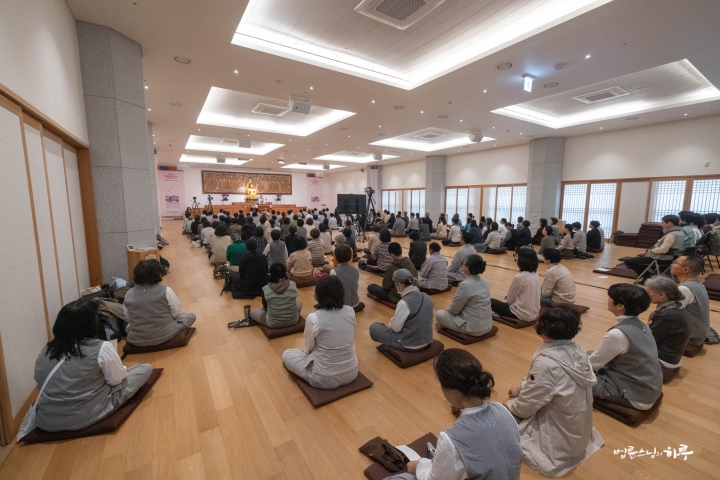
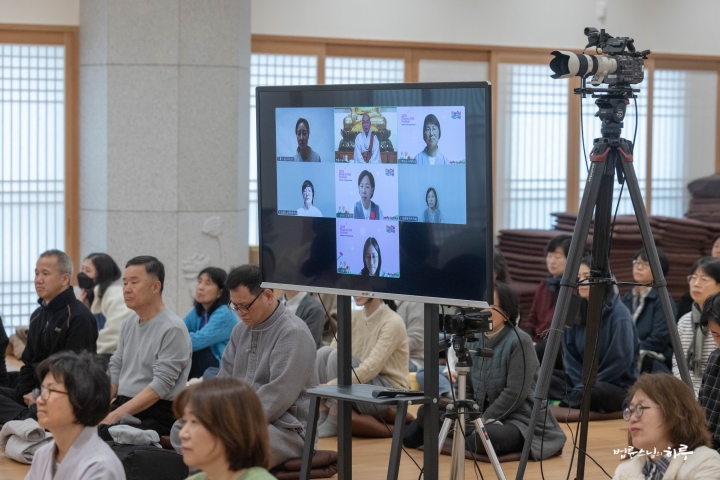
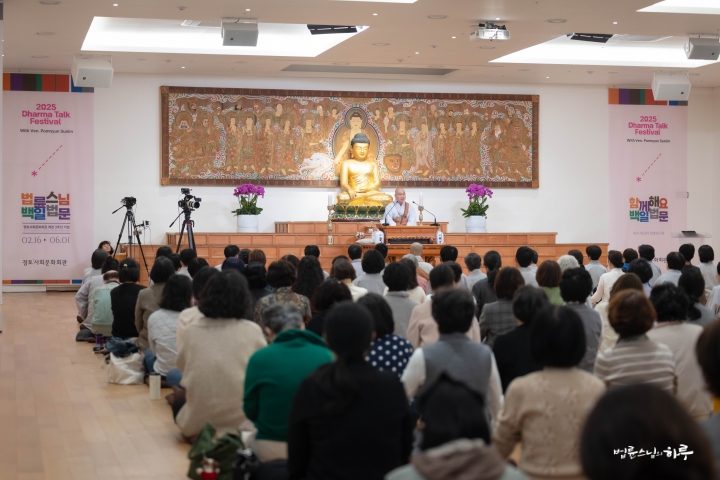
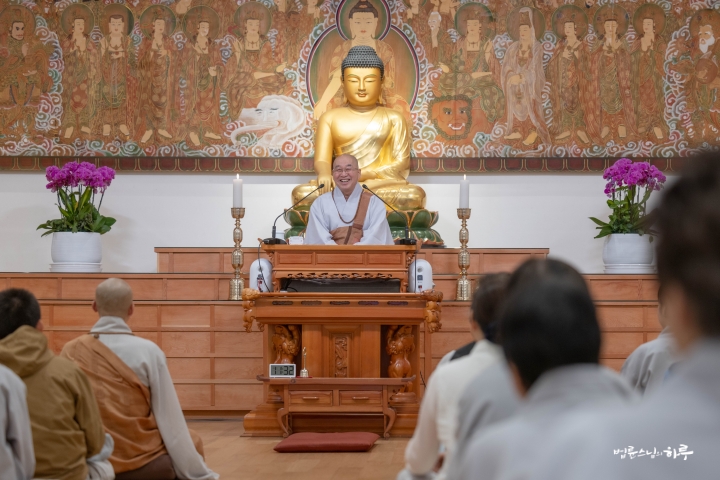
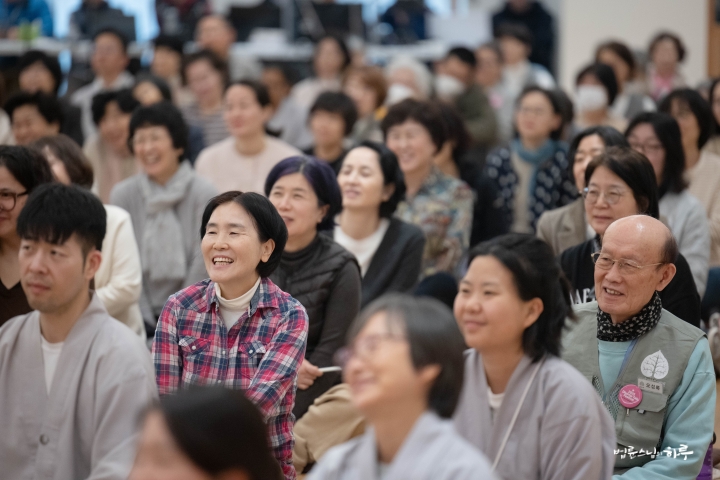
At 10:15 AM, with about 170 people gathered in the third-floor Dharma hall, the Weekly Dharma Assembly began with the recitation of the Three Refuges and the Heart Sutra. Jungto Society members also joined online through a video conference. The audience requested Sunim’s teaching with three full bows.

Sunim began his Dharma talk by sharing news about the massive forest fire in the Yeongnam region that caused extensive damage last week and the recent devastating earthquake in Myanmar.
Extending Condolences to the Families of Forest Fire Victims
Natural disasters are exceeding our expectations. Until now, we’ve mainly experienced floods and strong winds due to climate change, but we didn’t anticipate forest fires could be this severe. Looking at why this forest fire spread so rapidly, first, climate change due to global warming created unusually high temperatures and dry conditions combined with strong winds, which intensified the damage. Second, the excessive density of the forests contributed to the problem. Through this forest fire, we’ve learned that leaving trees and vegetation untouched isn’t necessarily the best way to protect forests. It might be better to cut down some trees for timber rather than losing everything to fire at once. Building forest roads, thinning trees, and selective logging aren’t necessarily harmful to forests but can be methods of protection. This is why we need a middle path. In the past, cutting too many trees created barren mountains that led to natural disasters, but now, excessive protection is causing different natural disasters. Through this catastrophe, we’ve deeply realized that while dense forests can prevent flood damage, appropriate thinning can prevent forest fire damage. I extend my condolences to the families of those who lost their lives in this forest fire.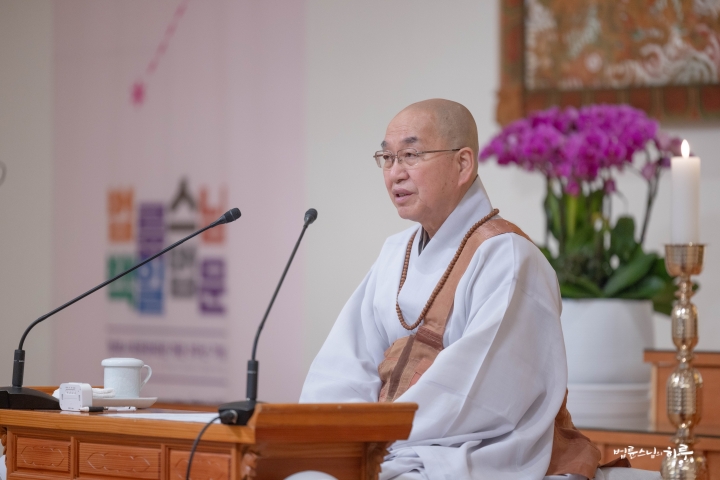
Hoping for Swift Emergency Relief for Myanmar Earthquake Victims
In central Myanmar near Mandalay, a magnitude 7.7 earthquake struck, causing many casualties. Many buildings collapsed, resulting in enormous economic losses. The scale of the damage is still impossible to quantify. Myanmar’s communication networks are disrupted in many areas due to civil war under military rule. Currently, government forces control about 30 percent of Myanmar’s territory, while resistance forces control the remaining 70 percent. In just the 30 percent area controlled by the government, the death toll has reached 3,000, and there are still places where bodies haven’t been recovered. The damage in the remaining 70 percent of the territory is currently impossible to assess. I estimate that at least 10,000 people have lost their lives. When accurate statistics become available, this might be recorded as a catastrophe with tens of thousands of casualties. Jungto Society sent an emergency relief team to the forest fire-affected areas. By the time we recognized the severity of the damage and deployed support, the firefighting was already in its final stages. We helped some displaced people and provided masks and equipment needed for firefighting activities to the firefighters. A major task of reconstruction remains, and once the basic direction for recovery is established, the entire nation will need to participate.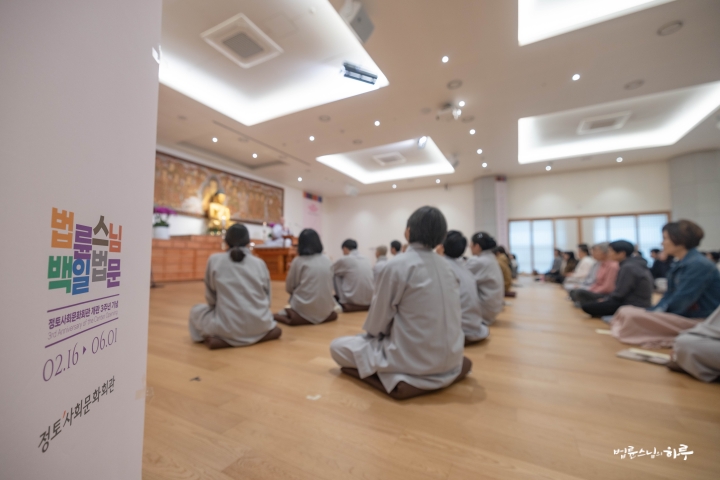
Everyone then recited the Haetaljoo three times to the rhythm of the moktak wooden instrument, praying for the victims’ peaceful rebirth.
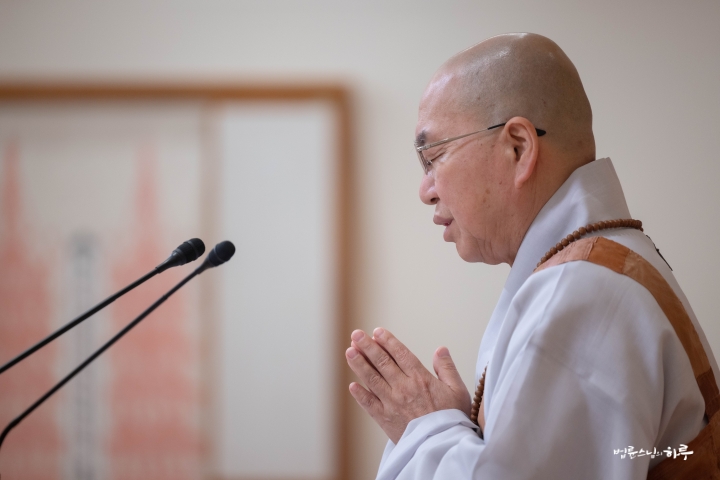
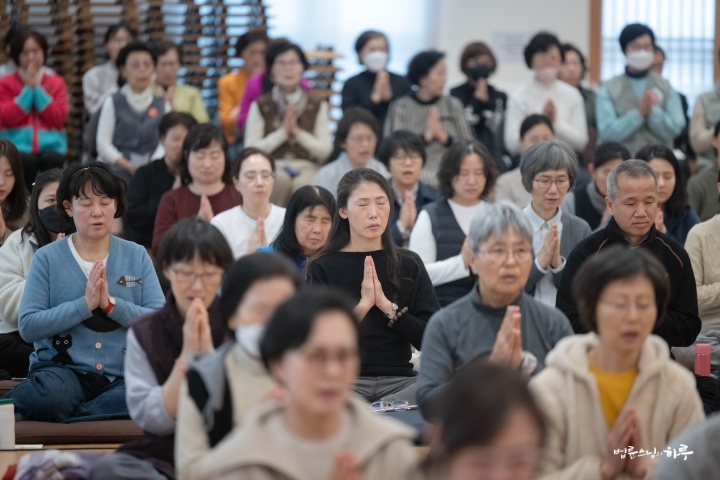
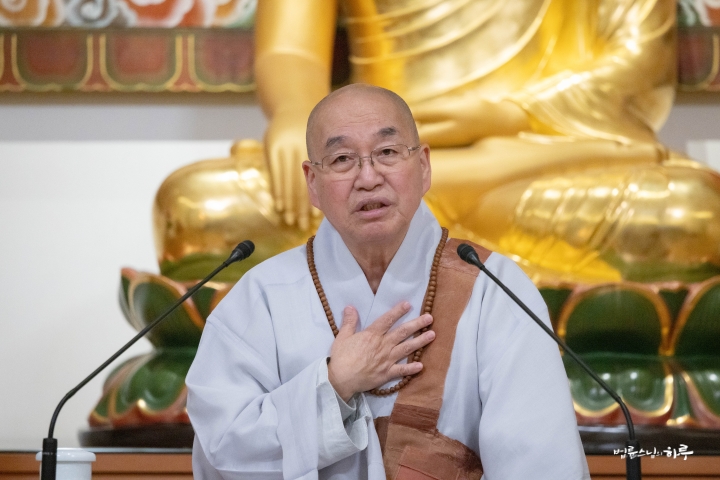
Afterward, Sunim took questions from those who had registered in advance. One person asked a question online, followed by someone from the audience who raised their hand. One questioner expressed concern about her child after discovering that her husband’s family had a hereditary disease, worrying that her child might not live long and seeking Sunim’s advice.
I’m Worried About My Child Showing Symptoms of Schizophrenia
“I recently discovered that my husband’s family has a hereditary disease. My husband’s nephew has suffered from schizophrenia for over ten years, and I had thought it came from his sister-in-law’s family. But recently, when another child of my husband’s other brother also developed schizophrenia, I realized it was from my husband’s family. I have a 16-year-old daughter who has many unusual traits, so she’s been receiving psychiatric counseling consistently. My child cannot control her emotions and uses severe profanity and violence when angry. Sometimes she threatens us with knives, causing injuries to both my husband and me. Since schizophrenia typically appears after age 18, I live each day with anxiety. If I had known about this hereditary disease in my husband’s family, I probably wouldn’t have had children. It’s too late for regrets now, but I’m afraid my child might attempt suicide like her cousins if she learns about this. And I worry she won’t be able to marry in the future. How should I approach caring for my child?” 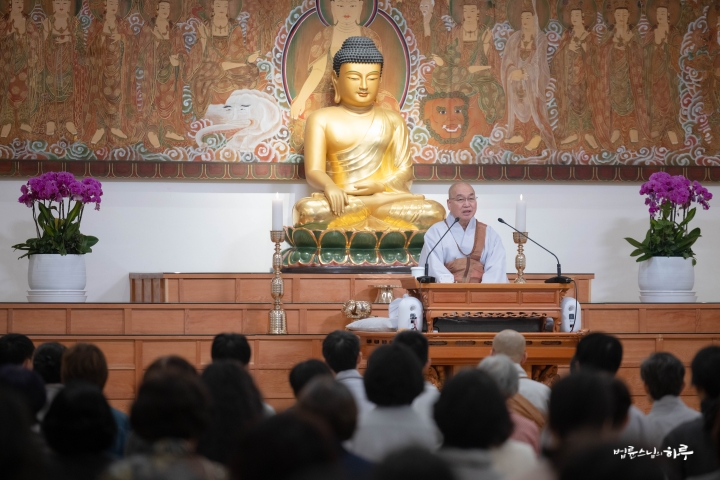
“Thank you. I understand now.”
After taking one more question from the audience and concluding the conversation, it was almost noon. The live broadcast ended with a promise to meet again at next week’s Weekly Dharma Assembly.
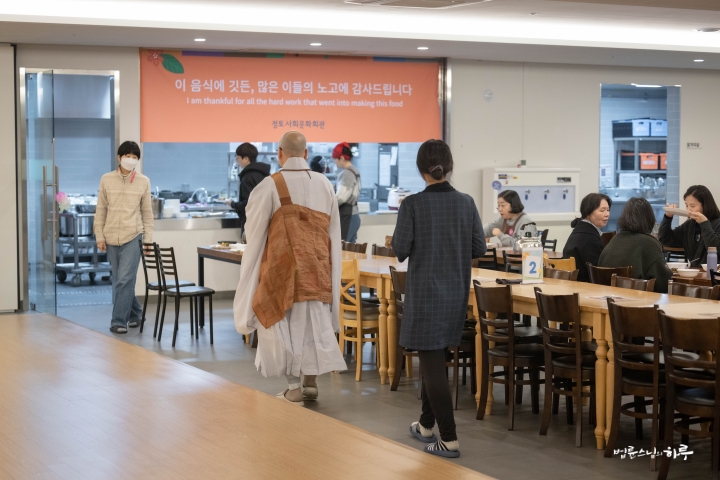
After leaving the third-floor Dharma hall, Sunim went to the basement dining hall to have lunch with the members.
From 2:00 PM, Sunim held a second meeting with the Standing Committee members of the Jungto Society’s 1000-Day Preparation Committee in the Peace Foundation conference room. Jungto Society forms this committee every three years to prepare for the next 1000 days (three years). This committee drafts the overall business plan for Jungto Society, including organizational restructuring and personnel changes.
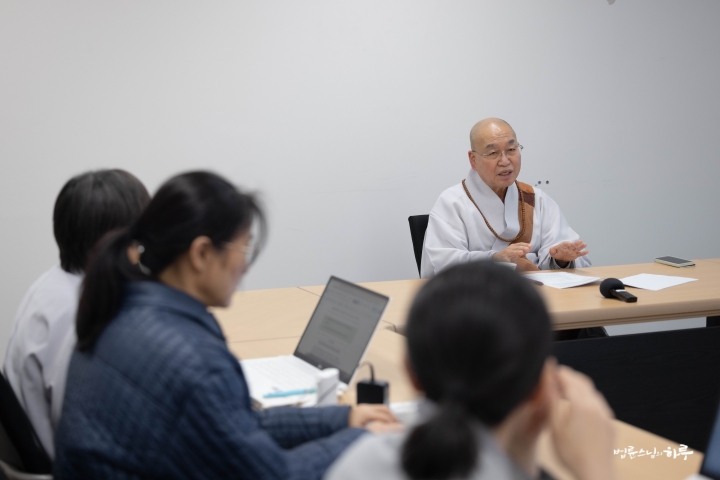
The committee members sought Sunim’s advice on various agenda items they were researching, including evaluating operations since transitioning to an online Jungto Society, promotional strategies for the Jungto Dharma School, and training engaged volunteers. After two hours of discussion with Sunim, they concluded the meeting, agreeing to develop more practical implementation plans at their third meeting.
Afterward, Sunim discussed how to dispatch an emergency rescue team for Myanmar earthquake victims with JTS President Park Gina, then continued with office work.

As the sun set, at 7:30 PM, Sunim conducted the evening Weekly Dharma Assembly live broadcast. About 100 people gathered in the third-floor Dharma hall, while Jungto Society members connected through an online meeting room. They requested Dharma teachings from Sunim with three bows.
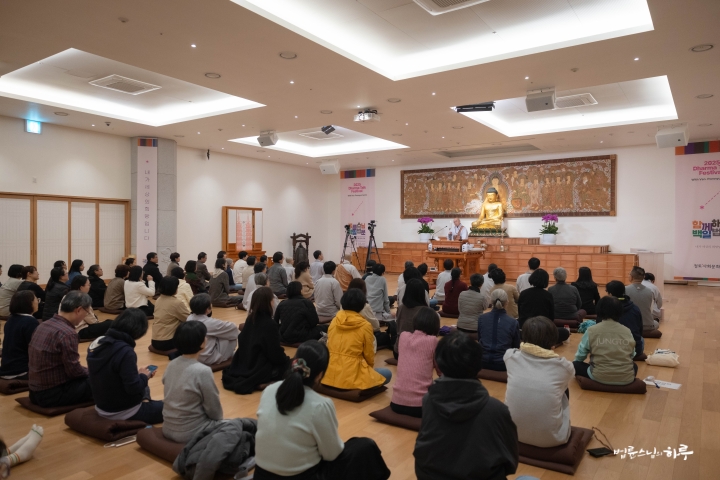
As in the morning assembly, Sunim shared news about JTS preparing to dispatch emergency rescue teams for the forest fire damage in the Yeongnam region and the earthquake in Myanmar. After reciting the Liberation Mantra together, the dialogue began.
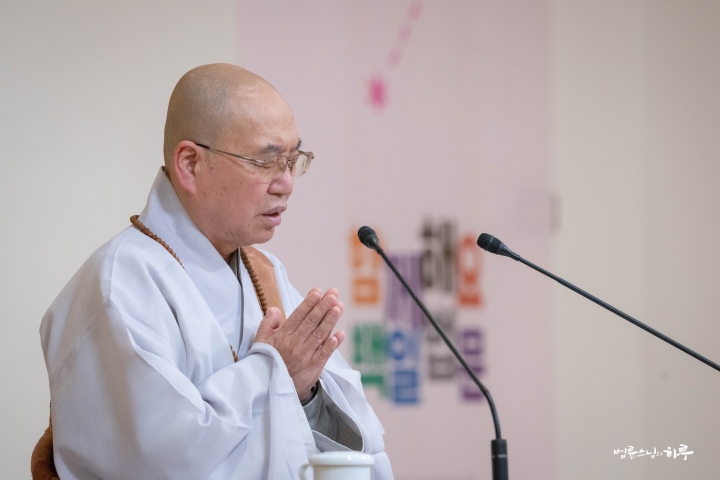
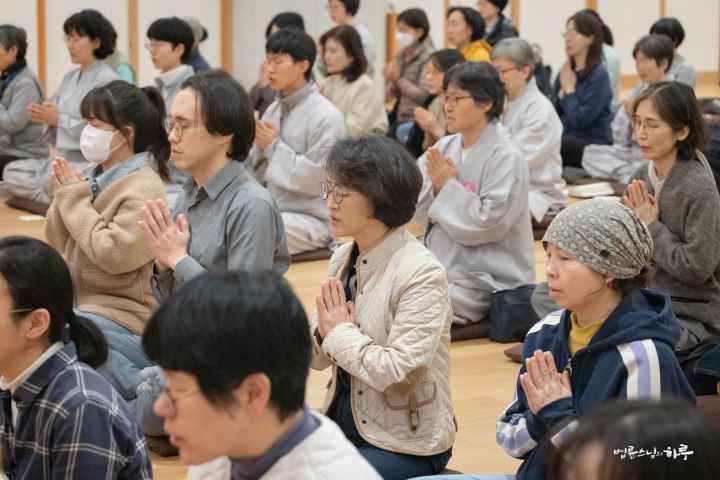
Two people asked questions. One of them sought Sunim’s advice on how to manage feelings of loneliness after quitting her job and moving to a new city following her husband.
I’m Struggling with Life in a New City After Following My Husband
“I’ve been living in Changwon for seven years after moving from Seoul when I got married. I’ve been working as a freelancer, but I experienced burnout. My marriage has been difficult due to my husband’s bipolar disorder, and I feel very lonely living in a new city. Currently, I’ve quit my job and am receiving treatment while taking education courses to find different work. However, my mind wavers several times a day, making me question if I’m on the right path. I think I’ve been using my work as an emotional crutch. How can I stabilize my mind?”
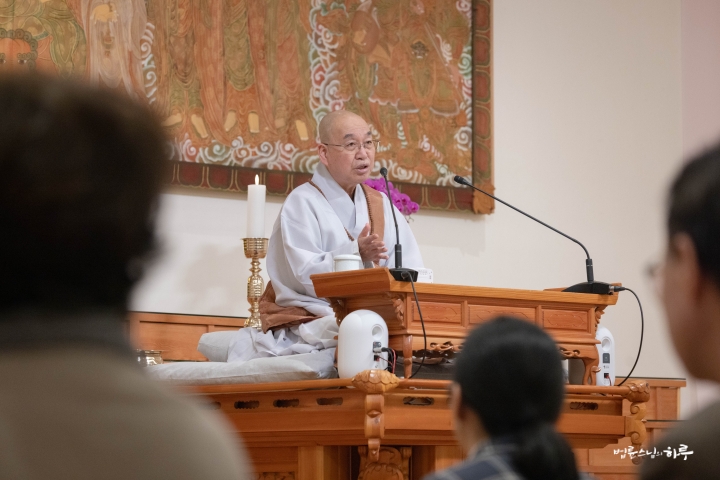
“Yes, I do.”
“Do you have food to eat?”“Yes, I do.”
“Do you have clothes to wear?”“Yes, I do.”
“Then what is there to worry about? If you have a place to live, food to eat, and clothes to wear, shouldn’t you be free from worries? With all these basic necessities met, you can live anywhere. Whether it’s Seoul, Changwon, America, or India, you don’t need to worry about where to live.”
“I think I’ve been using my work as an emotional anchor since moving to a new city. Now that I don’t have that work, I feel like I’ve lost my personal weapon.”
“Not having work is a good thing. You can still eat, have clothes to wear, and a place to sleep even without work—isn’t that wonderful? Most people complain about how difficult work is. The majority wish they didn’t have to work. But they work because without it, they would run out of food, couldn’t buy clothes, and couldn’t pay rent. That’s why I first asked if you had a place to live, food to eat, and clothes to wear. It’s actually great that you have all your basic living conditions met even without working! You can relax and do nothing. If you have nothing to do, you can practice meditation or chanting, or go outside and volunteer. You could help clean up houses in nearby areas affected by forest fires. You can do all kinds of work wherever help is needed.”“My husband is also in poor condition and might have to quit his job, so I think I need to go out and earn money.”
“Then go out and work. Once you start working, your depression will disappear because you’ll be too busy to be depressed. If you don’t have work, it’s good to have free time, and if you need to work, it’s good to have work. So there’s nothing to worry about. If you couldn’t eat because you had no work, I might consider supporting you, but since you have food, shelter, and clothing, there’s no problem. In short, you’re worrying unnecessarily. You’re doing something that doesn’t help at all. Not having work is a good thing. But if you become so impoverished that you can’t eat, then you need to work. When you work, you won’t have time to be bored, so there’s no problem. Thinking there’s a problem when there isn’t one is an illness. In that case, you should go to the hospital, take medication, and receive treatment. You’re not trapped under building debris from an earthquake, you don’t have a broken leg needing treatment, you’re not starving, and you’re not sick. There’s no problem at all, so why do you keep thinking there is one? Having leisure time is a good thing. If you play too much and can’t eat, then go back to work. When you work, you’ll be too busy to be depressed.”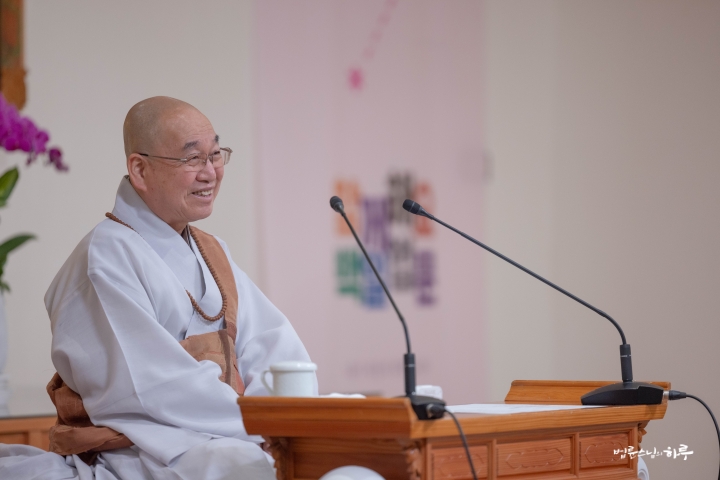
“I used to write books for children, but I had to quit that job. Now I need to work in a factory.”
“Then work in a factory. We need people working in factories so we can live. People need to work in clothing factories so we can wear clothes. People need to work in food factories so we can eat. Farmers need to farm so we can eat, and construction workers need to build so we can have homes. But even without people making books, there’s no problem with people’s survival. You’re now going to do work that’s truly necessary for the world, so that’s a good thing. There’s no problem at all. What you’re saying is like a farmer saying, ‘I only want to grow lettuce, not cabbage.’ Or like saying you only want to do dry-field farming, not rice farming. You need to do work that people need. No matter how much you want to write children’s stories, if no one reads them, there’s no work for you. If you cook food but no one eats it because it doesn’t taste good, you’re doing unnecessary work. You should do work that people need. Why do you keep trying to do unnecessary work? You should hug someone who says, ‘Please hug me,’ but if you go to someone who doesn’t need a hug and say, ‘I’ll hug you,’ that becomes sexual harassment. You need to do work that the world needs. It doesn’t matter what kind of work it is. Why do you think you must continue doing today what you did yesterday? You can do one job yesterday and a different job tomorrow. So your question itself is misguided.”
“I’m hesitant because it happens to be a defense industry job making weapons.”
“Then look for work other than making weapons. As far as I know, there are thousands of factories in the Changwon industrial complex, and there should be jobs at other factories too. Besides defense industries, there are many automotive parts companies. Look for places other than weapons manufacturers. If no one else offers you a job, then you might need to work at a weapons factory just to survive. But you don’t possess core weapons technology, do you? Painting the exterior of weapons doesn’t contribute significantly to killing, so it’s acceptable to work in the defense industry. If you don’t want to contribute even that much to weapons manufacturing, work at an automotive parts company. So, is there a problem or not?”“There’s no problem at all.”
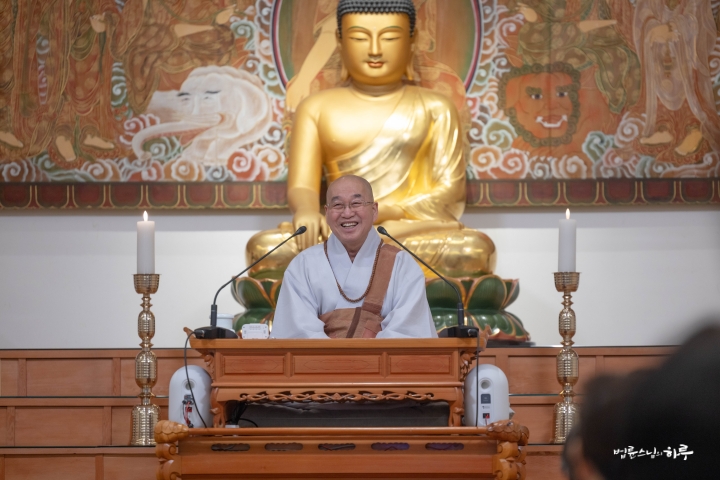
“Thank you.”
Everyone applauded the person who courageously asked such an honest question.
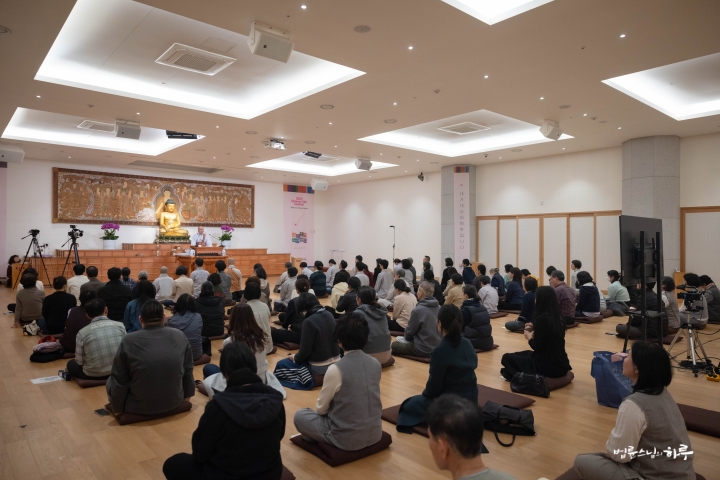
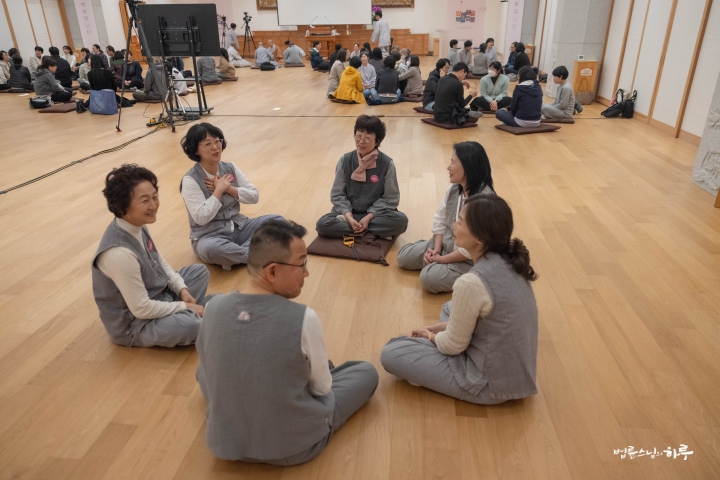
By the time the dialogue ended, it was well past 9 PM. The participants sat in circles by group for mindful sharing, while Sunim left the Dharma hall and headed to the Jungto Center.
Tomorrow will be the 46th day of the 100-Day Dharma Talk. In the morning, Sunim will give the 8th lecture on Buddhist scriptures in the third-floor Dharma hall of the Jungto Social and Cultural Center, and in the evening, he will conduct the 8th lecture of the Buddhist Social Studies Course in the basement auditorium.